
On this page
Start here
Quick answer
A seasonal door shift usually shows up as a latch or bolt that works smoothly with the door open but rubs the strike or jamb when the door is closed. Test the lock with the door open first, then close the door without lifting or pulling it and look for the contact point. A loose hinge, weatherstrip pressure, a shifted strike, or a warped or sagging door can change the alignment. Make only a small adjustment that uses the existing hardware holes; stop forcing the lock and call a locksmith if the lock binds with the door open, the jamb is damaged, or the alignment cannot be restored safely.
Work through in order
Diagnostic checks
Use only checks that match the exact appliance or system and its official guide.
-
Check 1
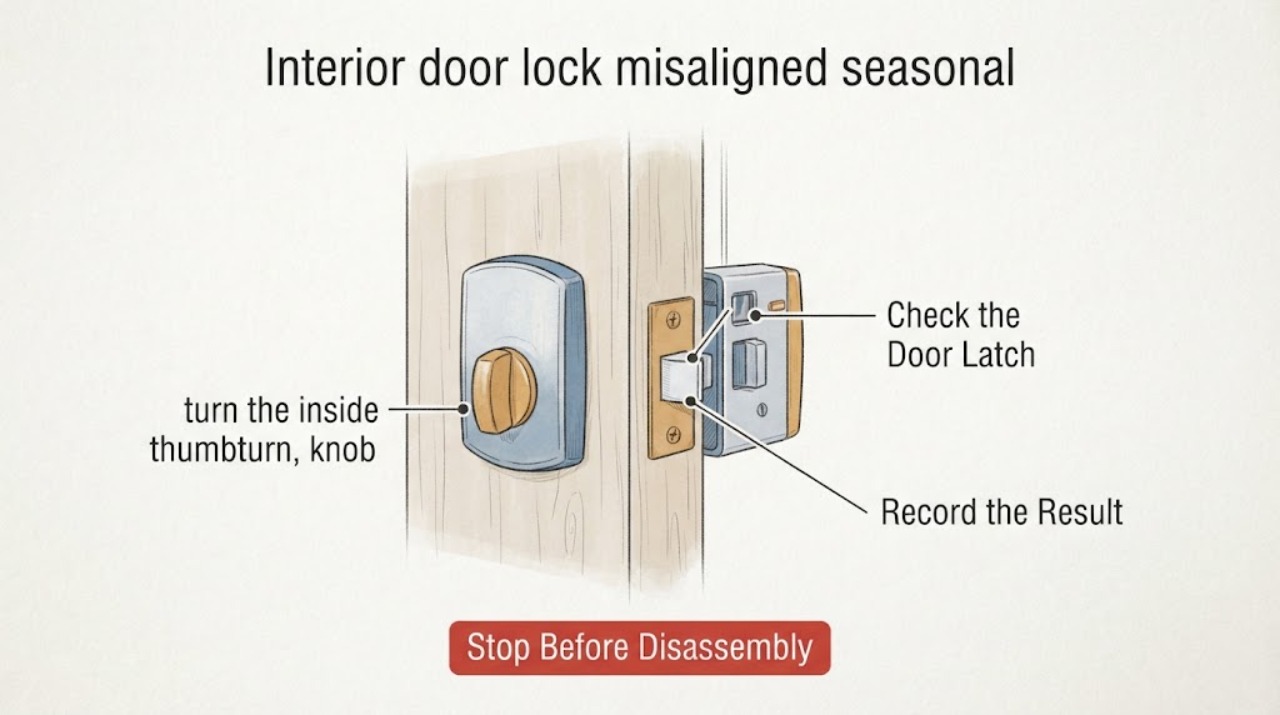
With the door fully open, turn the inside thumbturn, knob, or lever through a complete lock and unlock cycle; if the lock has a key cylinder, turn the key gently without forcing it.
Expected result: The latch or bolt moves smoothly with the door open, or it binds, grinds, or fails to travel even with the door open.
Next step: If it is smooth, continue with the closed-door alignment checks. If it binds open, stop forcing the control and arrange a locksmith inspection rather than enlarging the jamb.
Why this matters
Why: Smooth open-door movement makes a closed-door alignment problem more likely. Binding while the door is open points instead to the lock, latch, trim tension, or an obstruction in the hardware.
-
Check 2
Close the door normally without lifting, pulling, or pushing it, then operate the lock from the inside while watching and listening as the latch or bolt approaches the strike opening.
Expected result: The lock works smoothly, or the bolt drags, hits the strike edge, or needs pressure on the door before it will turn.
Next step: Leave the door open between tests and continue by locating the exact contact point. Do not keep cycling a lock that needs force.
Why this matters
Why: A problem that appears only when closed indicates that the door, latch, and strike are not meeting in the same position. Needing to lift or pull the door is a clue to movement or sag, not a reason to keep applying force.
-
Check 3
Use a flashlight to compare the center of the extended latch or bolt with the strike opening, and look for fresh rub marks on the strike edge, jamb, or latch face.
Expected result: The bolt is high, low, or sideways relative to the opening, or a bright worn mark shows one edge is taking the load.
Next step: Mark the contact area with the door open. Use that mark to guide only a small, reversible strike adjustment if the existing screw holes can accommodate it; stop before filing, chiseling, or cutting the jamb.
Why this matters
Why: A consistent edge mark identifies the direction of the misalignment. A high or low pattern makes door sag or hinge movement more likely; a sideways pattern makes a shifted strike, stop, or side pressure more likely.
-
Check 4
Inspect the hinge leaves and accessible hinge screws, paying particular attention to the top hinge, and check whether the latch-side corner of the door sits lower than the strike.
Expected result: A screw or hinge is visibly loose, or the door corner drops and rises when the door is supported by hand.
Next step: If a screw is visibly loose and its threads still hold, snug it with a manual screwdriver and retest with the door closed without pressure. Stop if a screw spins, the hinge is pulling out, or the frame is splitting.
Why this matters
Why: Loose hinge hardware or a sagging door can move the latch away from the strike. If the hinges are tight and the door remains square, the strike or door stop becomes more likely.
-
Check 5
Inspect the latch-side weatherstripping and door stop for a section that is folded, displaced, or pressing the door away from the frame.
Expected result: The seal is compressed unevenly or the door springs away from the stop near the latch, while the lock works when that pressure is relieved.
Next step: Correct only a visibly displaced, accessible seal or stop condition without cutting the door. If the seal is fixed in place or the door remains under load, have a door professional assess the fit.
Why this matters
Why: Pressure at the stop can keep the bolt from lining up with the strike even though the lock mechanism is working. If there is no pressure pattern, the weatherstrip is less likely to be the main cause.
-
Check 6
After identifying the contact direction, check whether the strike plate can be shifted a small amount using its existing screws and holes; keep the door open while loosening or retightening hardware.
Expected result: A small shift brings the latch or bolt into the opening and the lock then operates smoothly with the door closed without pushing or pulling, or the opening still misses the bolt.
Next step: Retest several times with the door closed normally. If the plate needs new holes, filing, chiseling, or a large move, stop and call a locksmith or qualified door professional.
Why this matters
Why: A successful small shift supports a strike-alignment problem. If the opening still misses, the door may be warped or sagging, the jamb may need skilled correction, or the lock hardware may be worn.
Use your observations
Decision map
Find the observation that best matches what you see, then follow the next safe action.
-
PATH 01Next step
What you see
Do this next
Use the rub mark and hinge/stop checks to identify the direction of movement, then try only a small existing-hole strike adjustment. Do not force the lock to overcome the misalignment.
-
PATH 02Next step
What you see
Do this next
Stop applying force and arrange a locksmith inspection. Keep the lock in a usable position and do not dismantle the lock body or drill the door as a first response.
-
PATH 03Next step
What you see
Do this next
Correct a clearly loose accessible hinge screw or displaced seal only if it can be done without damaging the frame, then retest. If the issue returns, the door needs a locksmith or door professional to assess its fit through the frame and lock.
Helpful context
Understand the symptom
Why a seasonal shift can misalign an interior lock
A door and its frame can move relative to one another as weather changes. The result is often not a failed lock: the latch may be centered when the door is open, then scrape the strike edge or jamb when the door is closed. A door that has started to sag, loose hinge hardware, pressure from weatherstripping, or a strike that no longer lines up can all produce that pattern. Treat the contact pattern as the useful clue rather than forcing the key or turnpiece.
Keep testing reversible
Keep the door open while checking whether the latch or bolt itself moves freely. When you test it closed, use the inside control first and do not push, pull, or lift the door to make the lock work. That keeps a binding condition from being mistaken for a successful repair and reduces the chance of being locked out during testing.
Only after diagnosis
Potential parts
- replacement strike plate
Consider this only if the existing strike is bent, damaged, or cannot provide a smooth alignment after the cause and contact direction are confirmed.
Match the lockset type, strike dimensions, screw-hole pattern, and door preparation; confirm fit with the lock manufacturer or a locksmith before ordering. - replacement latch assembly
Consider this only if the latch binds with the door open after visible obstructions and excessive trim pressure have been ruled out.
Confirm the latch face shape, backset, door thickness, and handing for the existing lockset before ordering; do not assume a generic latch will fit.
When checks do not resolve it
Need a professional?
Stop turning the key or thumbturn if the lock jams, the door must be lifted or pulled to operate, the jamb is splitting, or the door cannot remain secure. Call a locksmith or qualified door professional if the lock binds with the door open, a hinge or screw is pulling out, the strike needs new holes or cutting, or a small existing-hole adjustment does not restore smooth operation. Keep the door open while testing so you cannot lock yourself out.
Common questions
FAQ
Why does the interior lock work with the door open but not when the door is closed?
That pattern usually means the latch or bolt is being forced against the strike or jamb only in the closed position. Check the contact mark, hinge position, stop pressure, and strike alignment before considering a lock replacement.
Should I keep pushing or lifting the door while turning the lock?
No. Use that behavior as a diagnostic clue, then stop forcing the lock. Retest with the door open and call a locksmith if smooth operation cannot be restored without pressure.
Can I move the strike plate myself?
A small shift using the existing screw holes can be a reasonable reversible test when the contact point is clear. Stop before making new holes, filing, chiseling, or cutting the jamb; those changes should be handled by a locksmith or qualified door professional.
When does a seasonal alignment problem need professional help?
Call when the latch binds with the door open, a hinge or jamb is damaged, the door has to be lifted or pulled to lock, or the issue returns after a small alignment correction. Those signs point beyond a simple strike adjustment.
Read the exact guide
Official sources
- How to install a deadbolt lockSchlage · The lock testing and strike-alignment guidance supports the general closed-door latch or bolt contact check for an interior door lock.
- How do I check door alignment for my smart lock?Kwikset · The open-door versus closed-door alignment checks are applicable to diagnosing an interior latch or bolt that binds only when the door is closed.
- ASSA ABLOY ACCENTRA 8800 series parts manualASSA ABLOY Access and Egress Hardware Group · The manual's troubleshooting description of warped or sagging doors, loose hardware, and latch binding in the strike supports seasonal-shift diagnosis without assuming a particular interior lock model.
Community feedback
Share a repair observation
Share a plain-text repair observation. Accepted observations are published automatically; this page may take a moment to update.