
On this page
Start here
Quick answer
Do not force a stuck interior latch or use a bypass method. If the door is open and access is authorized, keep it open while you gently observe whether the handle retracts and returns the latch, whether the latch works only when the door is away from the strike, and whether the door or strike looks shifted or loose. If the latch works open but binds closed, alignment, hinge sag, or seasonal door movement may be involved; if it fails while open, the latch or lockset is a stronger service suspect. If anyone is trapped, the door is needed for egress, or normal operation cannot open it, stop and call a qualified locksmith, building manager, or appropriate emergency service.
Before you begin
Safety first
- Do not bypass, pick, force, pry, drill, chisel, probe, destructively disassemble, or repeatedly cycle the stuck latch. Keep an accessible door open when safe and authorized.
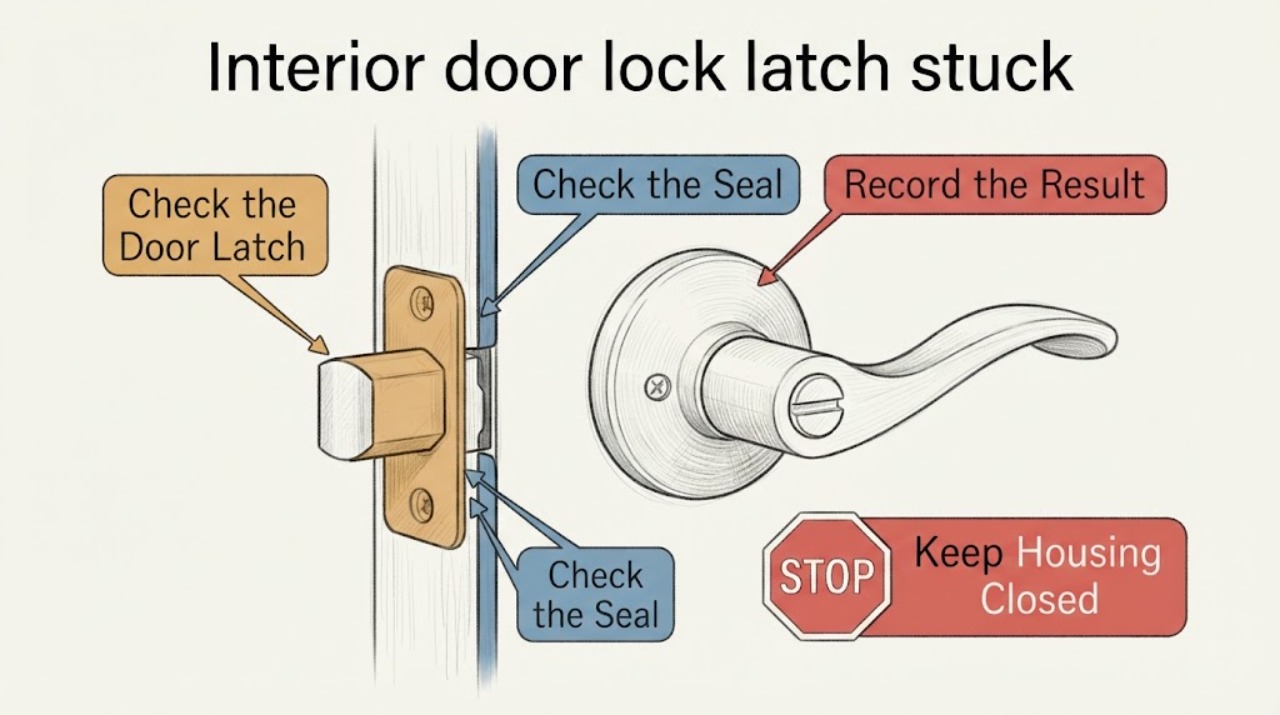
Work through in order
Diagnostic checks
Use only checks that match the exact appliance or system and its official guide.
-
Check 1
Confirm the access state: if the door is open, keep it open; if it is closed, determine only whether it opens normally from the authorized side without force. Do not test a privacy release, bypass, or improvised latch method.
Expected result: An open and usable door allows low-risk observation; a person locked in or out, a door needed for egress, or a door that will not open normally is an access incident.
Next step: If access is normal, keep the door open and continue. If access is blocked or someone may be at risk, contact a qualified locksmith, building manager, or appropriate emergency service and give the door location.
Stop if: Stop all testing if someone is trapped, the door is part of a required exit, the lock is access-controlled, or normal operation will not open it.
Why this matters
Why: The access state decides whether the next step is simple observation or immediate professional/emergency response, not which bypass technique to try.
-
Check 2
With the door open and hands clear of the edge, turn the handle or privacy turn once through its normal travel and watch the latch face at the door edge; stop at the first sign of grinding, binding, or separation.
Expected result: The latch should retract when the handle moves and return when released. If the handle moves without the latch, the latch stays extended, or the mechanism grinds while open, the lockset or latch is likely involved.
Next step: Photograph the handle and latch face, note the handle direction and any visible marking, and ask a locksmith to assess the mechanism and compatible replacement options.
Stop if: Stop if the handle becomes loose, parts separate, the latch does not return, or the mechanism becomes more unstable after one gentle test.
Why this matters
Why: A latch that fails while the door is open is not being held by the strike, so alignment is less likely to be the primary fault and professional lockset/latch service is appropriate.
-
Check 3
Only if the door opens freely and can be reopened normally, close it gently once and observe whether the latch meets the strike without pushing, pulling, lifting, or slamming; reopen it normally immediately after the observation.
Expected result: A latch that works open but rubs, misses, or needs the door lifted or pulled when closed is consistent with strike misalignment, hinge-side sag, or door movement; a latch that fails open points back to the mechanism.
Next step: Record the contact side and whether the door sags or rubs, then request a locksmith or qualified door-hardware professional to inspect alignment; do not enlarge or move the strike yourself.
Stop if: Stop if the latch jams, the door does not reopen normally, the frame flexes, or any force is needed to move the door.
Why this matters
Why: Schlage and Kwikset manufacturer guidance use the open-versus-closed comparison to separate latch/strike alignment from a lock mechanism problem.
-
Check 4
Compare the stuck behavior with recent conditions from a safe position: note whether the problem is worse in humid, cold, or hot weather, after painting or weatherstrip changes, or after the door has begun rubbing at the top or latch side.
Expected result: A latch that works during some seasons or changes with door rubbing supports temporary door or frame movement; a constant failure regardless of weather or fit points more toward the latch, handle, or strike hardware.
Next step: Add the timing and rubbing location to the service request and have a professional assess the door, hinges, strike, and latch together.
Stop if: Stop if the door is rubbing severely, the frame is cracked, the latch or strike is sharp or unstable, or a weatherstrip is loose enough to fall.
Why this matters
Why: Schlage identifies temperature or moisture-related warping and weatherstrip interference as possible fit changes, so the pattern is useful context without proving a specific repair.
-
Check 5
From the room side with the door open, inspect only visible hardware for a wobbling handle, shifted faceplate or strike, missing visible fastener, split frame wood, or a latch face that is not flush; use a flashlight and do not remove covers.
Expected result: A loose handle or shifted strike can explain intermittent latch engagement, while stable visible hardware with an inoperable latch points toward an internal fault or a deeper alignment issue.
Next step: Take close photos and note which component moves; stop using the door if hardware may fall or pinch and arrange locksmith or door-hardware service.
Stop if: Stop if the handle is separating, the faceplate is sharp, the frame is splitting, or touching the hardware makes it less stable.
Why this matters
Why: The visible condition helps the professional decide whether to assess mounting, the frame and hinges, or the latch/lockset first.
Use your observations
Decision map
Find the observation that best matches what you see, then follow the next safe action.
-
PATH 01Next step
What you see
The door cannot be opened normally, someone is trapped or locked out, or the opening is needed for immediate safety or egress.
Do this next
Stop diagnosis and contact a qualified locksmith, building manager, or appropriate emergency service. Do not force or defeat the lock.
-
PATH 02Next step
What you see
The latch fails to retract or return while the door is open.
Do this next
Keep the door open and arrange professional latch or lockset assessment; provide photos and any model/finish marking.
-
PATH 03Next step
What you see
The latch works open but binds or misses only when the door is closed.
Do this next
Request inspection of the strike, hinges, door sag, frame, and seasonal fit; do not cut or move the strike based on guesswork.
-
PATH 04Next step
What you see
The problem changes with weather, recent paint, weatherstrip, or visible door rubbing.
Do this next
Report the pattern and rubbing location for a professional alignment assessment; do not alter the door or frame yourself.
-
PATH 05Next step
What you see
The handle, strike, faceplate, or frame is visibly loose, shifted, split, or unstable.
Do this next
Stop using the door if safe, keep people clear of falling or pinching hardware, photograph the condition, and request locksmith or door-hardware service.
Helpful context
Understand the symptom
First separate latch failure from alignment
A stuck latch can be a failed mechanism, but it can also be a healthy latch pressing against a strike because the door has shifted, sagged, or changed with temperature or moisture. Schlage's opened guidance specifically compares operation with the door open and closed and notes that seasonal fit changes, loose hinges, and strike contact can affect latching. Keep the door open when possible and use the comparison only as an observation, not as a reason to force the handle or alter the frame.
Protect access while waiting for service
A privacy latch is not a safe place to experiment with improvised tools. Do not pick, probe, drill, pry, remove concealed trim, or keep cycling a mechanism that is binding. If the door can be left open safely, leave it open and keep the room available. If it cannot be opened normally or a person is at risk, escalate immediately rather than attempting a defeat technique.
Only after diagnosis
Potential parts
- interior door latch
Consider a latch replacement only if the latch fails with the door open and a professional confirms the existing lockset and door preparation are compatible with that latch.
Confirm faceplate or drive-in style, backset, door thickness, handing if applicable, lockset family, and manufacturer fit information before ordering. - interior door lockset
Consider a complete lockset only when the handle or internal mechanism is faulty and the professional determines that replacement is more suitable than alignment or repair.
Match privacy or passage function, door preparation, thickness, latch configuration, finish, and any rental, fire, or access-control requirement; do not assume universal fit. - interior door strike plate
Consider a strike only if inspection confirms that the latch works open and the existing strike is damaged, shifted, or incompatible after alignment is evaluated.
Confirm latch type, strike shape, frame preparation, screw locations, and door alignment; a replacement strike does not justify enlarging or chiseling the frame without professional assessment.
When checks do not resolve it
Need a professional?
Call a qualified locksmith or door-hardware professional when the latch fails open, binds closed, the door needs force, the fit changes with weather, or any handle, strike, frame, or faceplate is unstable. Escalate immediately if access is blocked or someone may be at risk.
Safety scope: Do not bypass, pick, force, pry, drill, chisel, probe, destructively disassemble, or repeatedly cycle the stuck latch. Keep an accessible door open when safe and authorized.
Have this ready
- Provide the access state, privacy or passage function, open-versus-closed result, weather or rubbing pattern, visible handle/strike/frame condition, photos, door location, and model or finish marking if safely visible.
Common questions
FAQ
How can I tell if a stuck latch is an alignment problem?
If the handle retracts and returns the latch with the door open but the latch rubs or misses only when closed, alignment, hinge sag, frame movement, or the strike is involved. If it fails while open, the latch or lockset is a stronger suspect.
Can I push the latch back with a card or tool?
No. Do not use a bypass or improvised tool. If the door will not open normally, stop and call a qualified locksmith, building manager, or appropriate emergency service.
Why does the latch stick only in certain weather?
Temperature or moisture can change a door, frame, or weatherstrip fit enough to affect the strike relationship. Record when it happens and where the door rubs, then have the alignment assessed rather than altering the frame yourself.
Should I replace the strike plate first?
Not automatically. A new strike will not fix a latch that fails with the door open, a sagging door, a split frame, or a deeper lockset problem. Have the professional confirm the cause and compatibility first.
Read the exact guide
Official sources
- How to fix a door that won’t latchSchlage · Supports comparing open and closed operation and considering seasonal movement, weatherstrip interference, strike contact, and hinge sag without treating those clues as a DIY disassembly instruction.
- Support for Latch IssuesKwikset · Supports using open-versus-closed behavior to identify possible alignment or binding and escalating persistent latch problems to professional support.
- 4 Install knobsKwikset · Supports observing whether the latch is centered and enters or sits loosely in the strike; the article does not reproduce removal, drilling, or adjustment instructions.
Community feedback
Share a repair observation
Share a plain-text repair observation. Accepted observations are published automatically; this page may take a moment to update.