
On this page
Start here
Quick answer
First determine whether the Admiral refrigerator has an ice-and-water dispenser and whether water, ice, or both have stopped. On models with a dispenser, select the requested function, turn off Control Lock or Dispenser Lock if shown, close the doors, and press the paddle or pad fully with a sturdy glass. If water alone fails, inspect only the visible supply line for a kink and consider a recently changed or clogged filter according to the exact model manual. If ice alone fails, check whether the ice maker is making ice and whether the bin, chute, or cubes are visibly obstructed; use no sharp tool. If neither works after these external checks, or there is a leak, damaged line, unusual noise, or no safe way to identify the configuration, leave the refrigerator operating normally only if there is no safety symptom and arrange qualified appliance service rather than opening panels.
Before you begin
Safety first
- This article permits only normal control use and safe external observation of the accessible dispenser, ice bin, filter area, and visible water line. It does not authorize cabinet or panel removal, live electrical testing, bypassing door or lock interlocks, disconnecting pressurized tubing, or disassembling the ice or water mechanism.
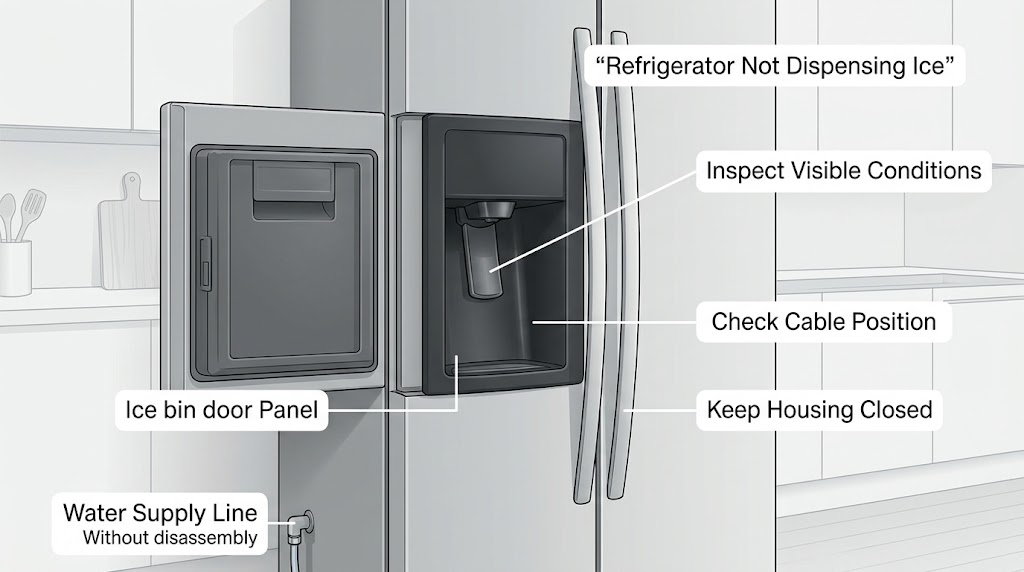
Work through in order
Diagnostic checks
Use only checks that match the exact appliance or system and its official guide.
-
Check 1
Use the Admiral model number and its manual to confirm which dispenser features are fitted. With the doors closed, select water or ice as applicable, turn off Control Lock or Dispenser Lock if the display shows it, and press the dispenser paddle or pad fully with a sturdy glass.
Expected result: Water dispenses, ice dispenses, neither dispenses, the controls show a lock, or the refrigerator has no water-and-ice dispenser feature.
Next step: If the model has no dispenser, stop using this fault path and follow its manual for the installed ice maker or water feature. If water works but ice does not, use the ice-only checks; if ice works but water does not, use the water-only checks. If neither works, continue with the external supply and ice-production split.
Stop if: Do not force the paddle, bypass a door or lock feature, or remove a control panel to make the dispenser respond.
Why this matters
Why: A lock, an incompletely engaged paddle, an open-door interlock, or an assumed-but-absent dispenser can explain a no-response report before a water or ice fault is considered. A working output narrows the problem to the other delivery path.
-
Check 2
For a water-only failure, inspect the visible water supply tubing and shutoff area without pulling the refrigerator out or loosening a fitting. Look for a kink, crack, wet connection, or a shutoff that is visibly closed; if the filter was recently changed, verify from the Admiral manual that it is seated and sealed in the correct position.
Expected result: The line is kinked or damaged, a connection is leaking, the shutoff is closed, the filter was recently disturbed, or the external water path looks normal but no water flows.
Next step: If the manual identifies a safe user adjustment, straighten only an accessible kink or correct the filter seating without forcing it, then recheck once. Do not open the water system or continue if there is a leak; arrange service for persistent no-flow or a damaged line.
Stop if: Do not pull the refrigerator to reach hidden tubing, disconnect pressurized fittings, cut tubing, or substitute an unverified filter or bypass part.
Why this matters
Why: A kinked or damaged supply line can restrict or stop water dispensing, while a recently changed or incorrectly installed filter can reduce or stop flow. A normal-looking exterior does not rule out an inlet valve, internal tube, or control fault.
-
Check 3
For an ice-only failure, check from the normal user-accessible area whether the ice maker is producing ice, whether the ice bin is fully seated for the model, and whether cubes are clumped in the bin or blocking the chute. If the manual permits cleaning, use a warm damp cloth for accessible residue and a plastic utensil for loose clumps; never use a sharp object.
Expected result: The ice maker is not making ice, the bin is not seated, cubes are clumped, the chute is visibly blocked, or ice production and the delivery path look normal.
Next step: Correct only a plainly mis-seated bin or loose, accessible ice obstruction according to the manual and recheck once. If the maker produces no ice, the chute remains blocked, or delivery still fails, leave internal diagnosis to qualified service.
Stop if: Do not chip ice with a knife or other sharp tool, reach into an auger or motor path, remove the ice-maker cover, or disassemble the dispenser.
Why this matters
Why: No ice production points to an ice-making branch rather than only a dispenser chute. A mis-seated bin, clumped cubes, or a blocked chute can prevent delivery even when ice exists. A normal bin and chute with no delivery may indicate an internal actuator, motor, door, or control issue.
-
Check 4
If both water and ice fail, observe whether the display, lights, and other refrigerator functions operate normally while the dispenser remains unresponsive. Recheck the lock state, closed doors, and model-specific dispenser selection once, without opening the rear or electrical compartments.
Expected result: The refrigerator has normal power but neither output works; the lock or door condition was incorrect; or the dispenser and refrigerator show a broader power or control symptom.
Next step: If correcting the lock or door state restores dispensing, monitor it. If both outputs remain unavailable after the external checks, record the model and arrange qualified appliance service rather than guessing at a common part.
Stop if: Do not remove panels, test live wiring, bypass a door switch, repeatedly reset the refrigerator, or alter household electrical protection.
Why this matters
Why: A shared lock, door-status, control, or supply condition is more likely when both outputs fail together, but normal lights do not prove that the dispenser circuit or water system is healthy. A broader power symptom needs a separate appliance diagnosis.
Use your observations
Decision map
Find the observation that best matches what you see, then follow the next safe action.
-
PATH 01Next step
What you see
The model has no dispenser feature, or the reported failure is only that the assumed water or ice option is absent.
Do this next
Use the exact Admiral model manual to confirm its fitted features and follow the applicable ice-maker or water-supply guidance instead.
Why this path and its safety boundary
Why it matters: Admiral refrigerator configurations differ; a refrigerator without the relevant dispenser cannot be repaired through a dispenser fault tree.
-
PATH 02Next step
What you see
Ice dispenses but water does not, and the control is unlocked with the doors closed.
Do this next
Check the visible line for a kink or leak and verify a recently changed filter only as the model manual allows. Service the refrigerator for persistent no-flow or any leak.
Why this path and its safety boundary
Why it matters: The dispenser controls are responding, making the water filter, external supply line, shutoff, inlet path, or water-side component more likely than a general dispenser lock.
-
PATH 03Next step
What you see
Water dispenses but ice does not, and the control is unlocked with the doors closed.
Do this next
Confirm whether the ice maker is producing ice and inspect only the user-accessible bin and chute. Do not open the ice-maker or dispenser mechanism; arrange service if the external path is clear but delivery fails.
Why this path and its safety boundary
Why it matters: The water side is working, so ice production, an incorrectly seated bin, clumped cubes, a blocked chute, or the ice-delivery mechanism is more likely.
-
PATH 04Next step
What you see
Neither water nor ice dispenses after the lock, door, selection, and external checks, or the refrigerator has a leak, damaged tubing, unusual noise, or a wider power/control symptom.
Do this next
Keep the appliance in its normal safe state without bypassing anything, document the model and observations, and arrange qualified appliance service. Use a licensed plumber or electrician when the home water or electrical supply is implicated.
Why this path and its safety boundary
Why it matters: A shared control or supply issue, an internal water component, or an ice/dispenser mechanism fault is possible; the public evidence does not justify identifying a particular part for an unspecified Admiral model.
Helpful context
Understand the symptom
Start with the dispenser type and the failed output
Admiral sells more than one refrigerator configuration. Its official product information shows a side-by-side model with an external water dispenser, while other listed refrigerators use different layouts and features. Confirm from the model label and manual that the refrigerator is equipped for water, ice, or both. Then record whether the failure is water only, ice only, or no response from either selection; those patterns lead to different checks.
Use only model-appropriate external checks
The official guidance used here covers common dispenser controls, water supply, filter, and ice-bin conditions across applicable refrigerator families. It is not proof that every Admiral model has the same lock button, filter location, door interlock, ice bin, or water connection. Use the Admiral model manual for the control names and layout, and do not remove covers or open a sealed electrical or refrigeration area.
Stop when the symptom points beyond a simple blockage or setting
A dispenser that stays silent after the correct control and door checks, a water line that is damaged or leaking, or an ice maker that is not producing ice needs model-specific diagnosis. Do not bypass a safety interlock, repeatedly power-cycle the refrigerator, or order a valve, motor, control, or dispenser assembly without confirming the model and the failed branch.
When checks do not resolve it
Need a professional?
Arrange qualified appliance service when neither output dispenses after the model-appropriate external checks, when an ice maker is not producing ice, when the chute or bin remains clear but ice still will not deliver, or when the filter or supply line does not explain water failure. Stop and obtain plumbing help for a leaking or damaged household water connection, and electrical help for a power or outlet symptom. Do not open panels, bypass interlocks, or replace an internal valve, motor, actuator, or control without model-specific diagnosis.
Safety scope: This article permits only normal control use and safe external observation of the accessible dispenser, ice bin, filter area, and visible water line. It does not authorize cabinet or panel removal, live electrical testing, bypassing door or lock interlocks, disconnecting pressurized tubing, or disassembling the ice or water mechanism.
Common questions
FAQ
Why does my Admiral refrigerator dispense neither ice nor water?
Confirm that the model actually has both features, then check the display lock, closed doors, selected output, and fully engaged paddle. If both remain unavailable, a shared control or supply issue is possible, but the exact model is needed before identifying a part; arrange service after the safe external checks.
What should I check when an Admiral refrigerator dispenses water but not ice?
Check whether the ice maker is producing ice, whether the ice bin is seated, and whether cubes are clumped or blocking the chute. Use only a plastic utensil for loose clumps and no sharp tool. If the delivery path is clear but ice still will not dispense, arrange qualified service.
What should I check when the Admiral refrigerator makes ice but will not dispense water?
Verify the control is unlocked, then inspect the visible water line for a kink or leak and review the exact model manual for a recently changed or incorrectly seated filter. Do not disconnect fittings or pull the refrigerator out; persistent no-flow or any leak needs service.
Read the exact guide
Official sources
- Not Dispensing Ice or Water - RefrigeratorWhirlpool · Official Whirlpool Product Help guidance for applicable side-by-side refrigerator families; used for common decision branches and not as proof of an exact Admiral layout.
- Does the Water Filter Need to be Replaced?Whirlpool · Official Whirlpool Product Help article; its filter locations and bypass behavior are model-dependent and are not assumed for every Admiral refrigerator.
- Not Dispensing Ice - Side by Side RefrigeratorWhirlpool · Official Whirlpool Product Help guidance for applicable side-by-side refrigerator families; exact Admiral model instructions control.
- How to Check the Water Supply LineWhirlpool · Official Whirlpool installation guidance used for safe visible water-line triage; the exact Admiral installation and accessible connections must be confirmed in its manual.
- Admiral Refrigerators, Freezers, and Chillers - Keep Your Food FreshAdmiral Appliances · Official Admiral Appliances product page; it confirms the brand's listed configurations and features but does not supply a universal repair procedure or establish the user's exact model.
Community feedback
Share a repair observation
Share a plain-text repair observation. Accepted observations are published automatically; this page may take a moment to update.