
On this page
Start here
Quick answer
First separate no water from no ice, because they do not share every cause. For either dispenser, select the intended option, close the doors, make sure the Control or Dispenser Lock is off, and press a sturdy glass firmly against the paddle or pad. For water, check from outside that the cold-water shutoff is open, the supply line is not kinked, and a recently changed filter is seated and the system was flushed according to the model manual. For ice, confirm the ice maker is making ice, the bin is seated, and the chute is not blocked by clumped ice; clean only with a warm damp cloth or a plastic utensil as Amana directs. If both outputs fail, a filter or supply issue is more likely than an ice-chute jam. If a line, filter housing, paddle, bin, or chute leaks or requires internal access, stop and arrange model-specific service.
Before you begin
Safety first
- This article covers external selection, lock, door, paddle, filter, visible-line, bin, chute, and model-directed flush or reset checks. It does not authorize water-valve or door-panel disassembly, motor or wiring tests, sharp-tool clearing, safety bypass, or generic part replacement.
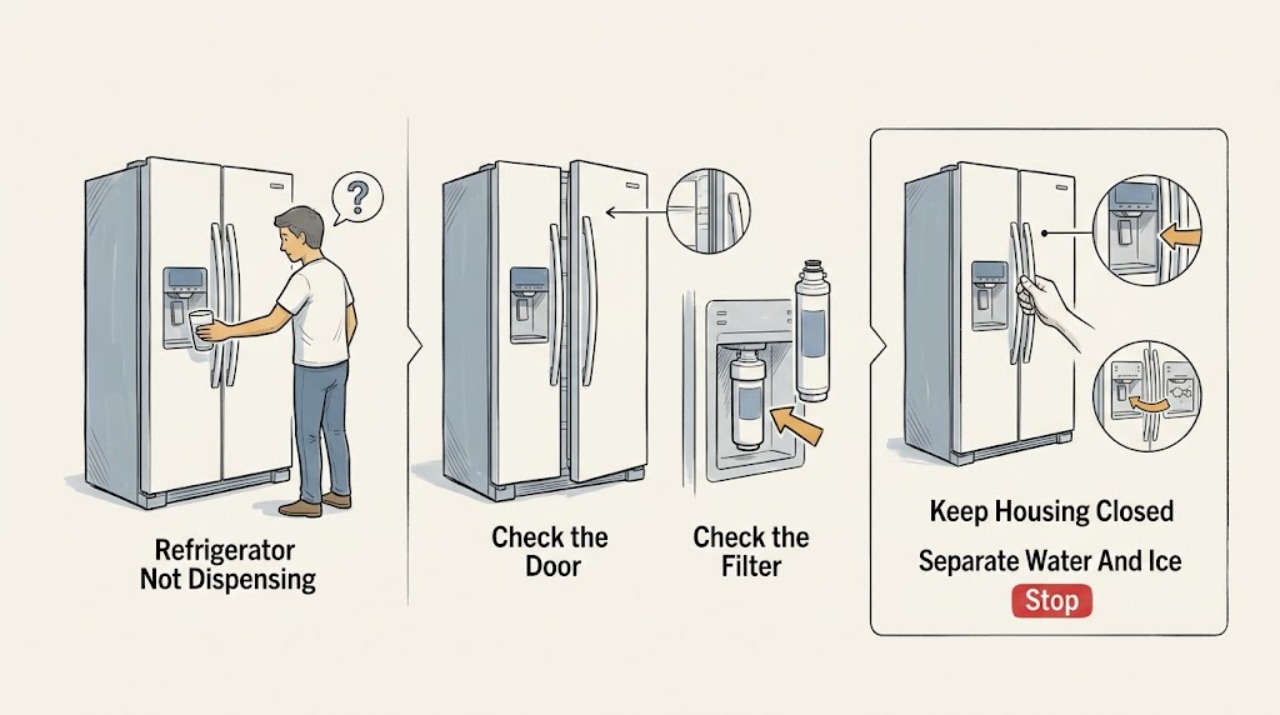
Work through in order
Diagnostic checks
Use only checks that match the exact appliance or system and its official guide.
-
Check 1
At the dispenser, select water and test it once with a sturdy glass, then select ice and test it once with the door closed if the model requires that. Record whether water works, ice works, both fail, the dispenser light or display responds, and whether the paddle or pad is engaged fully.
Expected result: Only water fails, only ice fails, both fail, the controls do not respond, or the paddle does not engage normally.
Next step: Use the shared-control checks first, then follow the water path or ice path that matches the result. If the paddle or pad is damaged or requires force, stop and arrange service.
Stop if: Stop for a cracked paddle, loose dispenser trim, water leaking into the door, arcing, burning odor, or any need to open the dispenser housing.
Why this matters
Why: A shared lock, door, or paddle condition is more likely when both outputs and controls fail. A water-only failure points toward the filter or supply path, while an ice-only failure points toward ice production, the bin, clumping, or chute.
-
Check 2
With the refrigerator idle, confirm the intended water or ice selection, check for a Control or Dispenser Lock indicator, close the doors fully, and press the sturdy glass or pad firmly enough to engage the paddle without striking or forcing it.
Expected result: A lock indicator is on, a door is open or not seated, the paddle is not fully engaged, or all controls appear normal.
Next step: Use the exact manual's control-lock procedure, close the door, and retest once. If controls are normal but output remains absent, continue to the water-filter or ice-bin branch.
Stop if: Stop if the door cannot close, the paddle is loose or cracked, the lock cannot be changed without service access, or the dispenser leaks.
Why this matters
Why: Amana says the lock deactivates dispenser controls and some models require closed doors; incomplete paddle engagement also prevents ice or water release. The lock does not necessarily turn off refrigerator power or the dispenser light.
-
Check 3
For a water failure or low flow, check from outside whether the cold-water shutoff is open and the visible supply line is kinked or pinched. If the filter was recently changed, follow the model manual to confirm it is locked and sealed and flush the system as instructed; do not remove a filter over a wet floor or force its housing.
Expected result: The valve is closed, the line is kinked, the filter is not seated, the system was not flushed after a filter change, or the visible water path appears normal.
Next step: Open only an accessible shutoff valve, straighten a visible kink without moving the refrigerator hard against the wall, or reseat and flush the filter exactly as the manual directs. Retest once; if flow remains absent or a leak appears, arrange service.
Stop if: Stop for a leaking filter housing, damaged line, wet electrical area, a valve that will not close, or any need to move a hardwired or tightly installed refrigerator.
Why this matters
Why: Amana links low or absent water dispensing and reduced ice production to a closed or kinked line, an improperly installed or clogged filter, and air or incomplete flushing after installation. A normal external path does not identify an inlet valve or dispenser fault.
-
Check 4
For an ice-only failure, check whether fresh ice is being made, whether the ice bin is fully seated, and whether ice is clumped in the bin or chute. With the ice maker and dispenser idle, clean accessible chute surfaces with a warm damp cloth and dry them; break clumps only with a plastic utensil and discard them.
Expected result: The ice maker is not producing, the bin is not seated, ice is clumped, the chute is blocked, or the bin and chute are clear.
Next step: Use the manual to turn on or reset the ice maker only if appropriate, seat the bin, or clear accessible clumping once. If the bin and chute are clear but the auger or dispenser still does not move, arrange service.
Stop if: Stop for a jam that will not release without force, a broken auger or bin, sharp ice fragments, water leaking into the door, or any need to disassemble the ice mechanism.
Why this matters
Why: Amana separates production from delivery: no ice in the bin requires the ice-maker, temperature, water, or filter path, while ice in a seated bin with a blocked chute makes clumping or obstruction more likely. Sharp tools can damage the mechanism.
-
Check 5
For an unresolved complaint, record the exact model, whether water, ice, or both fail, lock and door state, paddle response, filter history and seating, visible line condition, ice production, bin seating, chute condition, and any leak or unusual noise. Do not repeatedly run the dispenser to reproduce the fault.
Expected result: A documented correction restores output, the same symptom returns, or both water and ice remain unavailable with normal external conditions.
Next step: Use the dispenser only if it operates normally without leaks or abnormal sounds. Otherwise leave it unused and provide the record to an Amana service provider.
Stop if: Stop for a leak, electrical smell, exposed wiring, damaged bin or paddle, repeated jamming, or any need to remove panels or test a motor or valve.
Why this matters
Why: A successful filter, line, lock, load, bin, or clump correction narrows the symptom but does not certify hidden valves, switches, auger motors, wiring, or controls. Persistent failure needs model-specific diagnosis.
Use your observations
Decision map
Find the observation that best matches what you see, then follow the next safe action.
-
PATH 01Safety boundary
What you see
Neither water nor ice dispenses, or the dispenser controls do not respond, while the refrigerator otherwise has power.
Do this next
Check the selected option, lock state, closed doors, and paddle engagement. Then inspect the filter and visible supply path without opening the refrigerator.
Why this path and its safety boundary
Why it matters: A Control or Dispenser Lock, open-door requirement, paddle or pad engagement, filter or shared supply issue is more likely than an ice-chute-only jam.
Safety stop: Do not remove the dispenser housing, bypass a switch, or repeatedly press a damaged paddle.
-
PATH 02Safety boundary
What you see
Ice dispenses or ice production is normal, but no water or only a slow stream comes from the water dispenser.
Do this next
Check the lock, filter seating and recent filter change, visible supply valve and kink, and model-directed flushing. If normal external conditions do not restore flow, arrange service.
Why this path and its safety boundary
Why it matters: The water filter, supply valve or line, incomplete filter flush, or a water-side dispenser fault is more likely than an ice-bin problem.
Safety stop: Do not force the filter housing, move the refrigerator into a kinked line, or open the water valve or door panel.
-
PATH 03Safety boundary
What you see
Water dispenses, but ice does not, and the control lock and paddle respond normally.
Do this next
Check the ice maker, seated bin, clumping, and chute using the model manual and safe accessible cleaning. Arrange service if the bin and chute are clear but ice still will not deliver.
Why this path and its safety boundary
Why it matters: The next decision is whether the ice maker is producing ice. If ice is present, bin seating, clumping, or chute blockage is more likely; an empty bin requires an ice-production path.
Safety stop: Do not use sharp tools, force the auger, or disassemble the ice maker or dispenser mechanism.
-
PATH 04Safety boundary
What you see
Water and ice remain unavailable after the documented external checks, or the line, filter housing, bin, chute, paddle, or door leaks or is damaged.
Do this next
Stop using the dispenser, preserve the model and observations, and contact an Amana service provider for model-specific diagnosis.
Why this path and its safety boundary
Why it matters: A valve, switch, auger, control, wiring, or sealed dispenser issue remains possible, but the generic symptom does not select a safe replacement part.
Safety stop: For water near electrical parts, exposed wiring, burning smell, arcing, or a line that cannot be safely isolated, disconnect power only when safe and obtain qualified help.
Helpful context
Understand the symptom
No water and no ice are different dispenser failures
An Amana refrigerator can stop dispensing water, ice, or both. A shared control lock, door, or paddle problem can affect either output, while a water filter or kinked supply line can restrict water and ice production and an ice chute jam can affect ice alone. Test the two outputs separately and note whether the ice maker is producing ice.
Use only external, model-appropriate checks
The dispenser paddle, display lock, doors, filter seating, visible water line, ice bin, and chute are the useful first observations. Amana's instructions vary by refrigerator design, so follow the exact Owner's Manual for filter removal, ice-bin seating, flushing, and any reset. Do not pull the refrigerator farther out than its service loop allows or open a water valve, wiring compartment, or dispenser housing.
A jam or filter issue does not prove a failed dispenser motor
A full ice bin with a jammed chute, an empty bin because the ice maker is not producing, and no water after a filter change point to different next steps. If the shared controls respond but the output remains absent after the documented checks, stop before ordering an inlet valve, auger motor, dispenser module, or control board; the exact model is needed for diagnosis.
Safety boundary
Stop conditions
- Do not bypass the Control or Dispenser Lock, door requirement, paddle, or any dispenser safety interlock.
- Do not use sharp tools to break ice, force the auger, pry a bin, or disassemble the dispenser mechanism.
- Do not force a water filter, open a valve or filter housing, or move the refrigerator against a kinked line.
- Do not operate with a leaking filter housing, supply line, bin, chute, door, or water near electrical parts.
- Do not order a filter, valve, auger motor, paddle, control, or dispenser assembly until the exact model and failed component are confirmed.
When checks do not resolve it
Need a professional?
Contact Amana service when the lock, door, paddle, filter, visible line, ice bin, and chute checks do not restore dispensing; the water filter housing or supply line leaks; the ice bin or auger is damaged; both outputs fail with normal controls; or diagnosis would require opening the door, testing a valve, pump, motor, wiring, or control. Stop immediately for water near electrical parts, exposed wiring, smoke, burning odor, arcing, or a line that cannot be safely isolated.
Safety scope: This article covers external selection, lock, door, paddle, filter, visible-line, bin, chute, and model-directed flush or reset checks. It does not authorize water-valve or door-panel disassembly, motor or wiring tests, sharp-tool clearing, safety bypass, or generic part replacement.
Common questions
FAQ
Why does my Amana refrigerator dispense neither ice nor water?
Check the selected dispenser option, Control or Dispenser Lock, closed doors, and full paddle engagement. Then inspect the water filter and visible supply path. If both outputs still fail with normal controls, arrange service rather than assuming the ice motor failed.
Why does my Amana refrigerator dispense water but not ice?
Check whether the ice maker is producing ice, whether the bin is seated, and whether clumped ice blocks the chute. Use a plastic utensil for loose clumps and a warm damp cloth for accessible chute cleaning; do not use sharp tools or force the auger.
Can a water filter stop an Amana refrigerator dispenser?
Yes. Amana says an incorrectly installed or clogged filter can reduce or stop water flow and lower ice production. Follow the model manual to reseat or replace the filter and flush the system after installation; stop if the housing leaks or the filter will not release normally.
When should an Amana refrigerator dispenser be serviced?
Arrange service when a filter, line, bin, chute, paddle, or housing is damaged or leaking, when both outputs fail after external checks, or when diagnosis would require opening the door, testing a valve or motor, or accessing wiring. Stop immediately for water near electrical parts, smoke, burning, or arcing.
Read the exact guide
Official sources
- Not Dispensing Ice or Water - RefrigeratorProduct Help | Amana · Official Amana Product Help article for French-door bottom-freezer refrigerators; water-line and filter access vary by model.
- Not Dispensing Ice - Side by Side RefrigeratorProduct Help | Amana · Official Amana Product Help article for side-by-side ice dispensers; ice-bin and chute designs vary by model.
- Ice Maker Not Working - TroubleshootingProduct Help | Amana · Official Amana Product Help guide for refrigerator ice makers; exact ice-maker controls and reset methods vary by model.
- Not Dispensing Ice or Water - RefrigeratorProduct Help | Amana · Official Amana Product Help article for side-by-side refrigerators; dispenser layout and exact controls vary by model.
Community feedback
Share a repair observation
Share a plain-text repair observation. Accepted observations are published automatically; this page may take a moment to update.