
On this page
Start here
Quick answer
When a Blomberg refrigerator is not dispensing water or ice, first identify the exact model and check whether the dispenser or ice-machine function is disabled, locked, or showing a filter or error indication. With the refrigerator's controls used as the model manual directs, inspect only the accessible cold-water supply, visible tubing, user-accessible filter, drip tray, and dispenser chute. The opened Blomberg manual warns that water connections and pressure vary by model and that the first use can include air in the system, so do not assume a no-flow symptom means the dispenser motor has failed. If water is leaking, the refrigerator is not cooling, an error returns, a line is frozen or inaccessible, or the dispenser remains silent after the documented settings and visible checks, stop and arrange qualified appliance service. Do not pull out a built-in refrigerator, disconnect a pressurized line, remove panels, test live wiring, or open the sealed cooling system.
Before you begin
Safety first
- This article covers visible controls, accessible supply and filter observations, user-removable tray or bin checks, and visible cooling symptoms. Qualified service must handle panels, energized wiring, internal valves and sensors, pressurized connections, dispenser assemblies, and sealed cooling work.
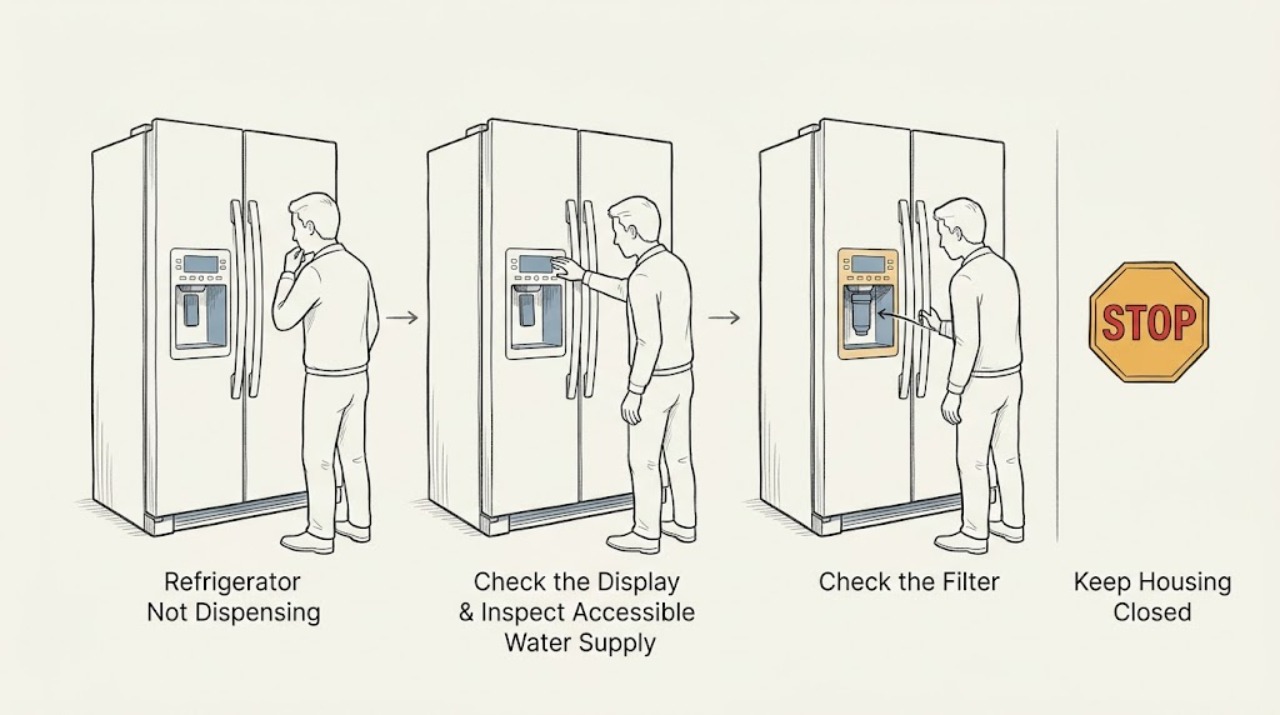
Work through in order
Diagnostic checks
Use only checks that match the exact appliance or system and its official guide.
-
Check 1
Record the complete Blomberg model identifier and inspect the accessible display for dispenser lock, vacation, Ice Machine OFF, filter, or error indications. Confirm the refrigerator's interior light or display responds and that the power plug is seated; do not remove a panel or force a button sequence.
Expected result: The display is dark, a dispenser or ice function is disabled, a lock or vacation mode is active, a filter or error indication is present, or the controls and power response look normal.
Next step: Correct only an obvious plug issue or the exact model's documented user setting. If the display remains dark, a mode cannot be changed, or an error persists, arrange qualified appliance service.
Stop if: Do not bypass a lock, bridge a control, use a damaged cord, or continue if there is smoke, arcing, burning odor, or water near electrical parts.
Why this matters
Why: A dark appliance or disabled mode can stop both water and ice without proving a valve or dispenser failure. A filter or error indication changes the next step to the model's documented maintenance or service path; normal controls move the check toward water flow and the outlet.
-
Check 2
For a model connected to a mains water line, inspect only the accessible shutoff, visible tubing, connection points, and filter indicator. Confirm the supply is open as the exact manual requires and look for a kink or leak; do not pull out a built-in refrigerator or disconnect a line under pressure.
Expected result: The supply is off, visible tubing is kinked, a connection is wet, a filter warning is active, or the accessible supply appears normal.
Next step: Correct only an obvious accessible shutoff or kink if the model manual permits, and replace or reset a filter only with the model-approved procedure. Turn the supply off and arrange service for any leak or inaccessible connection.
Stop if: Do not disconnect pressurized tubing, pierce a line, bypass a filter, or use the appliance if water is reaching electrical parts.
Why this matters
Why: A closed supply, kink, restricted filter, or leak can stop the dispenser and may also affect ice production. A normal visible supply shifts the problem toward the filter seat, internal valve, dispenser circuit, or an ice-only obstruction.
-
Check 3
With the dispenser disabled or the refrigerator unplugged as the model manual directs, inspect the user-accessible filter seating, drip tray, and dispenser opening. Remove only loose debris or a user-removable tray, and check whether a recent filter change was followed by the model's required purge or reset procedure; do not insert tools into the outlet.
Expected result: The filter is not seated as instructed, a warning remains after replacement, the drip tray or outlet has loose debris, the dispenser is dry after a recent installation, or the visible path is clear.
Next step: Reseat, purge, or reset only according to the exact manual. If the filter is damaged, the outlet remains blocked, or flow does not return after the documented procedure, stop and arrange appliance service.
Stop if: Do not use a sharp object, apply direct heat, remove a door liner, or continue if water leaks behind an inaccessible panel.
Why this matters
Why: An incorrectly seated or unprimed filter can restrict water, and air in a newly connected system can make initial flow irregular. A clear visible path with a normal supply makes an internal valve, switch, frozen line, or control fault more likely.
-
Check 4
Use the exact model's documented dispenser control to compare the symptoms: request water and, if equipped, use the ice control with the chute and bin unobstructed. Keep hands away from moving parts and observe only whether water flows, ice releases, both fail, or one function still works.
Expected result: Water dispenses but ice does not, ice dispenses but water does not, both fail, or the dispenser hums or clicks without output.
Next step: Record the working and failed functions and stop comparative testing. Arrange model-specific service for a persistent one-sided failure, no output with a normal supply, or any abnormal sound or leak.
Stop if: Do not reach into the chute, force an auger or bin, remove the door dispenser, or test a switch or valve while energized.
Why this matters
Why: One function working narrows the issue toward the other function's filter, chute, valve, sensor, or control path. Both functions failing together makes a shared supply, lock, control, or cooling condition more likely; sound without output does not prove which internal part is at fault.
-
Check 5
Check whether the refrigerator and freezer are cooling normally and note any recurring error status, unusually long compressor operation, or visible frost around an accessible air path. Do not scrape hidden ice or remove an evaporator or dispenser cover.
Expected result: Both compartments are warm, an error or sensor indication returns, only the dispenser is affected while cooling is normal, or the refrigerator appears to cool normally but the line or chute remains blocked.
Next step: Move perishable food to a known-safe cold appliance if cooling is unreliable, then arrange qualified service for a warm compartment, recurring error, inaccessible frost, or persistent no-output condition.
Stop if: Do not open the sealed system, chip ice, apply heat to a line or panel, test sensors, or continue operating through smoke, burning odor, or electrical damage.
Why this matters
Why: A warm refrigerator or recurring error can make dispensing a downstream symptom of a cooling or control fault. Normal cooling with one dispenser affected narrows the issue toward the water path, dispenser circuit, or ice chute, but an inaccessible frozen line still needs service diagnosis.
Use your observations
Decision map
Find the observation that best matches what you see, then follow the next safe action.
-
PATH 01Safety boundary
What you see
The refrigerator is dark, the dispenser or ice function is disabled, a lock or vacation mode is active, or an error or filter indication is shown.
Do this next
Use the exact model manual to restore the documented setting or complete its filter step. Arrange service if the control cannot be changed, the display stays dark, or the error returns.
Why this path and its safety boundary
Why it matters: A shared control, power, or documented maintenance state is more likely than two independent dispenser failures.
Safety stop: Do not bypass a lock or protective mode or dismantle the display or control panel.
-
PATH 02Safety boundary
What you see
The refrigerator cools, but the visible water supply is off or restricted, a filter warning remains, the filter was recently changed, or both water and ice stopped together.
Do this next
Correct only the accessible condition using the exact model procedure, then observe one normal dispense cycle. Arrange service for a leak, inaccessible connection, persistent no-flow, or a line that may be frozen behind a panel.
Why this path and its safety boundary
Why it matters: A shared water path, filter seating, air-filled line, or shutoff condition is more likely than an isolated dispenser motor.
Safety stop: Do not disconnect a pressurized line, pierce tubing, bypass the filter, or pull a built-in refrigerator forward by force.
-
PATH 03Safety boundary
What you see
Water works but ice does not, ice works but water does not, or the dispenser hums or clicks without output while the refrigerator cools normally.
Do this next
Record which output works and the exact control state, then arrange model-specific appliance service for internal diagnosis.
Why this path and its safety boundary
Why it matters: A function-specific chute, valve, filter path, sensor, switch, or control fault is more likely than a shared power loss. A community report about a different refrigerator found a dispenser circuit issue after cleaning and board replacement, but it is not evidence for a Blomberg repair or a safe do-it-yourself part replacement.
Safety stop: Do not reach into moving parts, remove a door panel, test energized components, or order a part based only on a similar-looking symptom.
-
PATH 04Safety boundary
What you see
Both compartments are warm, an error returns, water leaks behind an inaccessible panel, the line or chute is frozen out of reach, or no output remains after visible checks.
Do this next
Leave the affected function unused and arrange qualified appliance service. Provide the exact model, display indicators, cooling result, water-supply result, filter history, and which output failed.
Why this path and its safety boundary
Why it matters: A cooling, sensor, valve, control, frozen-line, or internal dispenser fault is more likely and cannot be safely confirmed through the user checks.
Safety stop: Do not open the sealed cooling circuit, dismantle the dispenser, test live wiring, or apply direct heat to hidden tubing or panels.
Helpful context
Understand the symptom
Separate a water-flow problem from an ice or control problem
Not dispensing may mean no water from the door, no ice from the ice chute, or both functions failing. A refrigerator can still cool while a dispenser is disabled, a filter is restricted, the visible supply is off, or the chute is blocked. If both water and ice stop together, check power, control modes, water supply, and cooling before assuming that one dispenser part failed. Blomberg's product range includes refrigerators with automatic ice makers, but the control layout and water arrangement depend on the model.
Use the exact model manual for water and ice settings
Find the model and serial label inside the refrigerator and use that model's manual. The opened Blomberg manual describes an Ice Machine ON/OFF control, a filter warning, and a dispenser that may initially flow irregularly while air leaves the system. Those details are useful examples, not universal button instructions for every Blomberg refrigerator. The official contact page also directs owners to identify the model and review its owner manual before support.
Keep water and electrical work within the safe boundary
Inspect only accessible controls, the visible water connection, a user-removable filter or drip tray, and the dispenser opening described by the model instructions. Unplug before cleaning and keep water away from lights and electrical parts. Do not disconnect a pressurized hose, pierce a frozen line, remove a door panel, test a valve or switch with live power, or open the refrigerator's sealed cooling system.
Safety boundary
Stop conditions
- Turn off the water supply and stop using the affected function for a leak, water near electrical parts, smoke, arcing, burning odor, exposed wiring, or a damaged power cord.
- Do not disconnect pressurized tubing, pierce frozen lines, apply direct heat, remove door or dispenser panels, reach into moving parts, or open the sealed cooling system.
- Do not bypass a dispenser lock, Ice Machine setting, filter requirement, sensor, valve, or other protective device.
- If the refrigerator is warm or displays a recurring error, protect perishable food in a known-safe cold appliance and arrange qualified service rather than repeatedly operating the dispenser.
When checks do not resolve it
Need a professional?
Safety scope: This article covers visible controls, accessible supply and filter observations, user-removable tray or bin checks, and visible cooling symptoms. Qualified service must handle panels, energized wiring, internal valves and sensors, pressurized connections, dispenser assemblies, and sealed cooling work.
Common questions
FAQ
Why is my Blomberg refrigerator water dispenser not working?
Check the exact model's lock or vacation setting, visible water supply, filter seating and warning, and dispenser opening. If the refrigerator cools normally but water remains unavailable after the documented checks, arrange service for the internal valve, line, switch, or control path.
Why do both the Blomberg water and ice dispensers stop together?
A shared power or control mode, water supply, filter condition, air-filled new line, or cooling issue is more likely than two unrelated failures. Check accessible conditions using the exact manual, then arrange service for a persistent shared failure.
Can a Blomberg filter stop the dispenser?
Yes. An incorrectly seated, restricted, or unprimed filter can reduce or stop water flow on compatible models. Use only the model-approved filter and purge or reset procedure; do not bypass the filter or assume a similar-looking filter fits.
Why does the dispenser make a sound but release no water or ice?
A sound without output can occur with a restricted water path, chute or bin obstruction, valve, switch, or control problem. Stop reaching into the mechanism, record whether the other function works, and arrange model-specific service if visible checks are normal.
Can I disconnect the water line or remove the dispenser panel myself?
Do not do so as a first user check. The opened manual describes water connections and warns about leaks; keep the supply and electrical work within the model instructions and use qualified service for pressurized connections, panels, internal valves, wiring, or sealed cooling work.
Read the exact guide
Official sources
- Water dispenser stopped working and I fixed itr/HomeMaintenance community · Community report about a different refrigerator brand with a blank display and no water or ice; not a Blomberg diagnosis and not a safe repair procedure.
- RefrigeratorBlomberg · Opened English Blomberg KFD9952PXD refrigerator manual; water connections, buttons, pressures, and features may differ on other models.
- FAQ | Blomberg AppliancesBlomberg Appliances · Official Blomberg FAQ; the exact refrigerator manual controls water, filter, and dispenser procedures.
- Water Filter | Blomberg AppliancesBlomberg Appliances · Official Blomberg filter page; compatibility and replacement procedure must be confirmed against the exact refrigerator model.
- Contact Us | Blomberg AppliancesBlomberg Appliances · Official Blomberg customer-care guidance for identifying the appliance and consulting the exact owner manual before support.
- 24" Counter-Depth Bottom Freezer Refrigerator With Ice Maker | Blomberg AppliancesBlomberg Appliances · Official Blomberg product page for a refrigerator family with automatic ice making; exact model documents control and dispenser differences.
Community feedback
Share a repair observation
Share a plain-text repair observation. Accepted observations are published automatically; this page may take a moment to update.