
On this page
Start here
Quick answer
First identify whether the missing output is drinking water, ice, or both, and whether your Beko refrigerator uses an internal tank or a plumbed water line. An empty tank, a closed or obstructed line, trapped air after installation or filter replacement, a restricted filter, a disabled ice maker, or ice stuck in the dispenser path can each stop dispensing without proving a failed valve or control. Follow the exact model manual for connections and filter handling, and purge air only by the model-approved procedure. If water leaks, the line or filter housing is damaged, or dispensing still fails after these checks, stop and arrange an authorised Beko service visit.
Before you begin
Safety first
- This article supports dry, user-accessible checks of the tank, visible supply condition, model-approved air purge, filter seating, ice-maker setting, icebox, and chute. It does not authorize hidden plumbing work, live electrical testing, panel removal, valve or control bypass, or internal component replacement.
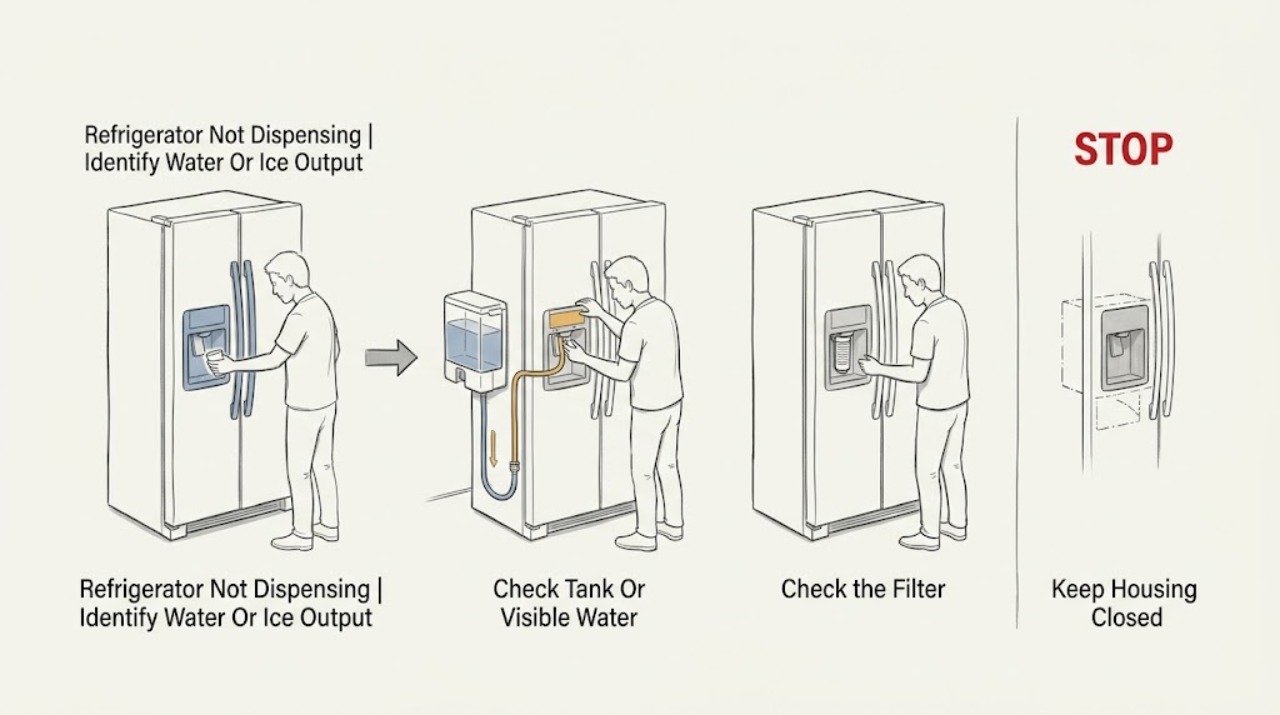
Work through in order
Diagnostic checks
Use only checks that match the exact appliance or system and its official guide.
-
Check 1
Use a dry container to test the affected control briefly and record whether the problem is the water spout, ice chute, both, or only one selection. Note whether the control responds, the refrigerator remains powered, and any recent installation, long period without use, or filter replacement.
Expected result: No water but ice works, no ice but water works, neither works, water sputters or briefly flows, or the problem began after connection or filter replacement.
Next step: Use the water-versus-ice branch that matches the result, then read the exact Beko manual before removing a filter, tank, icebox, or connection.
Stop if: Do not repeatedly hold a dry dispenser against an empty container, reach into a moving ice mechanism, or continue if water sprays toward electrical controls.
Why this matters
Why: One working function narrows the issue to that function's supply or outlet. Sputtering or a post-filter/post-installation failure makes trapped air or a disturbed connection plausible; failure of both water and ice points more broadly to supply, tank, filter, power, or control conditions.
-
Check 2
For a non-plumbed Beko model, inspect the user-accessible water tank and fill it as the manual directs. For a plumbed model, check only the visible shutoff or supply connection and hose for an obvious closed valve, kink, obstruction, break, or leak; do not pull the refrigerator out or loosen a fitting.
Expected result: The tank is empty or not seated, the visible supply is open and intact, a hose is kinked or damaged, a connection is wet, or the supply to the home is interrupted.
Next step: Refill and reseat only a user-accessible tank as directed, or restore only an obviously closed external supply if safe and model instructions permit. Arrange qualified plumbing or appliance service for a damaged, leaking, hidden, or inaccessible connection.
Stop if: Do not disconnect the water line, move an integrated appliance, turn a leaking fitting, or operate with water reaching electrical parts.
Why this matters
Why: A non-plumbed unit cannot dispense from an empty or mis-seated tank. On a plumbed unit, a closed, kinked, broken, or interrupted line can reduce or stop dispensing before an internal dispenser fault is established. A wet connection is a leak condition, not a reason to tighten a hidden fitting by guesswork.
-
Check 3
If the refrigerator was newly connected or its water filter was replaced, place a stable container under the spout and follow the exact Beko manual or support procedure that alternates dispensing and releasing the paddle to purge air. Keep the floor and controls dry.
Expected result: Water begins to flow after sputtering, the flow becomes steady, no water appears, or a connection or filter housing leaks during the purge.
Next step: Stop once the model procedure is complete and test a normal glass of water. If flow remains absent or a leak appears, stop using the dispenser and arrange authorised service with the filter-change or installation details.
Stop if: Do not improvise a continuous hold, exceed the model's procedure, run the dispenser dry, or continue when water is escaping around the filter or connection.
Why this matters
Why: Sputtering followed by steady flow supports trapped air as the immediate cause. No flow after the model-approved purge points toward the tank, connection, filter, pressure, valve, or control; a leak indicates a sealing or connection problem rather than air alone.
-
Check 4
Using the exact Beko manual, verify that the filter is the correct one for the appliance, fully seated, and due for replacement; inspect only the accessible filter area for an obvious misalignment or damage. For a plumbed model, follow the manual's pressure-related check rather than measuring or altering the household water system yourself.
Expected result: Dispensing improves with the model-approved filter check, the filter is mis-seated or damaged, the filter is overdue, removing the filter as the manual allows restores flow, or flow remains absent either way.
Next step: Install or replace only the exact model-compatible filter by the manual's procedure, purge air again if instructed, and retest. If flow is unchanged, the housing leaks, or the correct filter is uncertain, arrange authorised service.
Stop if: Do not force the filter, bypass a filter permanently, use an unverified cartridge, or remove a filter from a wet compartment without following the manual.
Why this matters
Why: A restricted, incorrectly seated, or damaged filter can reduce flow, while improvement without the filter indicates a filter or pressure-path restriction rather than proof of a failed dispenser. No change leaves the tank, supply, valve, paddle, wiring, and control unresolved.
-
Check 5
If the affected output is ice, check the exact manual for the ice-maker on/off control, verify that a non-plumbed tank or ice-maker reservoir is filled if your model uses one, and inspect the visible icebox and chute for a stuck clump without using force or sharp tools.
Expected result: The ice maker is off, the reservoir or tank is empty, ice is stuck in the chute or connections, the icebox is not seated, or the ice maker is active and the path is clear but no ice dispenses.
Next step: Restore only the model-documented on/off or tank setting, remove a loose visible clump using the supplied scoop if the manual permits, reseat the icebox as directed, and retest. Arrange service when the maker remains inactive, the chute repeatedly freezes, or no ice is produced despite normal supply.
Stop if: Do not chip ice with a knife, pour water into the icebox, reach into moving mechanisms, or bypass the ice-maker control.
Why this matters
Why: An inactive maker, missing water, an unseated icebox, or a visible ice blockage can stop ice output without proving an electrical failure. A clear path with water supply and maker settings normal makes a technical fault more likely.
-
Check 6
After the matching tank, supply, air-purge, filter, and ice-path checks, record the Beko model and serial number, dispenser type, filter history, visible line condition, and whether the appliance makes any sound or displays an alert when dispensing is requested. Keep the appliance dry and do not remove panels.
Expected result: Water or ice remains unavailable, a leak or damaged housing is present, a fault alert returns, only one dispenser function fails, or the output has returned to normal.
Next step: Book an authorised Beko service assessment and provide the model, output affected, filter and connection history, visible observations, and any alert. Stop using a leaking or electrically unsafe appliance.
Stop if: Do not test live wiring, bypass a valve or sensor, open the rear electrical compartment, or order a replacement part before model-specific diagnosis.
Why this matters
Why: Persistent failure after user-accessible checks is consistent with a valve, dispenser paddle, filter housing, ice-maker, sensor, wiring, or control fault, but these observations cannot identify the part. A returned output supports a supply, air, blockage, or setup cause rather than a confirmed component failure.
Use your observations
Decision map
Find the observation that best matches what you see, then follow the next safe action.
-
PATH 01Safety boundary
What you see
The refrigerator is non-plumbed with an empty tank, or water sputters and the failure began after installation or filter replacement.
Do this next
Fill and seat the tank if the model uses one, or complete the exact Beko air-purge procedure with a stable container. Retest once the flow is steady.
Why this path and its safety boundary
Why it matters: Missing tank water or trapped air is more likely than a failed dispenser control.
Safety stop: Stop for a filter-housing or line leak, or when the model's procedure does not restore flow.
-
PATH 02Safety boundary
What you see
A plumbed refrigerator has no water, the visible line is kinked or obstructed, the filter is mis-seated or overdue, or dispensing improves only when the model-approved filter check changes the path.
Do this next
Correct only a visible, safe supply condition and install the exact model-compatible filter by the manual. Arrange qualified service for hidden plumbing, low supply, leaks, or unchanged flow.
Why this path and its safety boundary
Why it matters: The external supply, connection, filter, or pressure path is more likely than the dispenser paddle itself.
Safety stop: Do not loosen hidden fittings, permanently bypass the filter, or move the appliance to reach the line.
-
PATH 03Safety boundary
What you see
Water dispenses normally but ice does not, and the ice maker is off, the reservoir is empty, the icebox is unseated, or a visible clump blocks the chute.
Do this next
Use the exact manual to activate the maker, restore water, seat the icebox, or clear a loose visible clump without sharp tools. Request service if the path repeatedly freezes or remains clear but produces no ice.
Why this path and its safety boundary
Why it matters: The ice-making or ice-delivery path is isolated from the water dispenser; a water-dispenser repair is not indicated by this pattern.
Safety stop: Do not chip the chute, pour water into the icebox, or reach into a moving ice mechanism.
-
PATH 04Safety boundary
What you see
The tank or supply, air purge, filter, and visible ice path are normal, but only water or only ice still fails to dispense.
Do this next
Arrange authorised Beko service with the model, filter history, connection type, output affected, and any sound or alert recorded during the request.
Why this path and its safety boundary
Why it matters: A function-specific valve, paddle, sensor, maker, wiring, or control fault is possible; the failed part cannot be identified safely from the symptom alone.
Safety stop: Do not bypass the dispenser control, probe wiring, or replace a valve or control by appearance.
-
PATH 05Safety boundary
What you see
Water leaks from a line, filter housing, dispenser area, or cabinet; the appliance shows electrical damage, an alert returns, or water is reaching controls or the floor.
Do this next
Stop dispensing and, only if the plug and area are dry and safely reachable, disconnect power as the manual directs. Close the accessible water supply if safe, protect the area, and arrange qualified appliance or plumbing service.
Why this path and its safety boundary
Why it matters: This is a water-containment or electrical safety condition, not a routine flow blockage.
Safety stop: Do not touch wet plugs or wiring, continue testing, or remove panels to locate the leak.
Helpful context
Understand the symptom
Separate water dispensing from ice dispensing
A Beko refrigerator may have a water dispenser, an ice maker, an ice dispenser, or a combination, and the water supply can be a refillable tank or a plumbed line. A glass that stays empty is a different decision from an ice chute that is blocked. Start by recording which control is being pressed, whether the pump or valve makes any sound, and whether the refrigerator's other functions remain normal.
Recent installation or filter work changes the first check
Beko says trapped air can remain in the water line after first connection or after a water-filter replacement. The manufacturer provides a controlled dispense-and-release procedure to purge that air. A few drops after dispensing can be normal on some models, but a continuing failure or a leak after connection needs model-specific support.
Use the model manual before touching a connection
Water-line routing, filter position, tank access, ice-maker controls, and dispenser layout vary by Beko model. Beko's manuals are selected by model number, and the refrigerator manual warns to disconnect the appliance for maintenance and not to wash it by spraying or pouring water. Keep checks to dry, visible, user-accessible areas.
Safety boundary
Stop conditions
- Do not touch a wet plug, outlet, cord, or wiring; do not continue dispensing when water is reaching electrical controls or the floor.
- Do not loosen hidden water connections, pull an integrated refrigerator out, open rear electrical covers, or use live electrical tests.
- Do not permanently bypass the water filter, force a filter or icebox, chip ice with a sharp tool, pour water into the icebox, or bypass an ice-maker control.
- Stop and arrange qualified service for a leaking or damaged line, filter housing, dispenser, or icebox; a recurring fault alert; or a failure that remains after the exact model procedure.
- Use the exact Beko model manual for tank, filter, pressure, ice-maker, and dispenser access; do not substitute another model's connection or reset procedure.
Only after diagnosis
Potential parts
- Beko refrigerator water filter
Consider this category only if the exact model's instructions and authorised diagnosis identify a restricted, damaged, incorrectly seated, or expired filter as the cause of poor or absent water flow.
Confirm the complete Beko model and the manufacturer's compatible filter information; do not run the dispenser with a leaking housing or permanently bypass the filter. - Beko refrigerator water inlet valve or dispenser valve
Consider this category only after authorised testing rules out the tank, supply, air, filter, pressure, and dispenser-control causes and identifies a valve fault.
Confirm the exact Beko model, water-system configuration, connectors, and manufacturer's fit information; do not replace or test the valve as a generic user repair. - Beko refrigerator ice-maker or dispenser component
Consider this category only when authorised diagnosis confirms that the maker or ice-delivery component is defective after water supply, settings, icebox seating, and visible blockage checks.
Confirm the exact Beko model and maker or dispenser configuration; do not substitute a component by appearance or bypass the maker control.
When checks do not resolve it
Need a professional?
Arrange authorised Beko service when the water or ice dispenser remains unavailable after the model-specific tank, connection, air-purge, filter, and ice-path checks; when a valve, paddle, sensor, maker, wiring, or control fault is suspected; or whenever there is a leak, damaged housing, recurring alert, or water near electrical parts. Use qualified plumbing assistance for a hidden or damaged household water connection.
Safety scope: This article supports dry, user-accessible checks of the tank, visible supply condition, model-approved air purge, filter seating, ice-maker setting, icebox, and chute. It does not authorize hidden plumbing work, live electrical testing, panel removal, valve or control bypass, or internal component replacement.
Common questions
FAQ
Why is my Beko refrigerator not dispensing water after a filter change?
Trapped air or a filter that is not seated correctly can interrupt flow. Follow the exact Beko manual or support procedure to purge air, then check the filter seating and visible connection for leaks. If no water flows after the model-approved procedure, arrange authorised service.
How do I know whether my Beko refrigerator uses a tank or a water line?
Check the exact model manual and the visible appliance layout. Beko says non-plumbed models dispense from a manually filled tank, while plumbed models use water connections that vary by model. Do not remove a panel or loosen a hidden connection to determine the type.
Why does my Beko refrigerator make ice but not dispense it?
Check whether the icebox is seated and whether ice is stuck in the visible chute or connections leading to the dispenser. Also confirm that the ice-maker is active according to the model manual. Do not chip the chute with a sharp tool; persistent failure needs authorised service.
Is a few drops from a Beko water dispenser normal?
Some Beko manuals state that a few drops after dispensing can be normal, especially around initial use or after water-system work. A continuing stream, recurring leak, wet filter housing, or water near electrical parts is not a routine drip; stop using the dispenser and arrange service.
When should I call a Beko service agent for a dispenser that does not work?
Arrange authorised service when the tank or supply, model-approved air purge, filter, and visible ice-path checks do not restore output, or whenever the line, filter housing, dispenser, or icebox leaks or is damaged. Internal valve, sensor, wiring, maker, and control diagnosis is model-specific.
Read the exact guide
Official sources
- How to fix an ice-maker that won't make any iceBeko · Official Beko support article for ice-maker symptoms; maker controls, reservoirs, and dispenser paths vary by model.
- Refrigerator User manualBeko · Official Beko manual for the listed refrigerator models; it notes that manuals can cover several models and explicitly marks variations, so it is not a universal instruction for every Beko refrigerator.
- Beko Manuals and User GuidesBeko UK · Official Beko manual portal; the user must select the exact refrigerator model before applying dispenser or filter instructions.
- Beko Support & Appliance AftercareBeko UK · Official Beko support hub; service and warranty availability depend on market and appliance.
- How to fix a refrigerator that won’t dispense water?Beko · Official Beko support article for refrigerator water dispensing; connections and filter procedures vary by model, so the installed model manual controls.
Community feedback
Share a repair observation
Share a plain-text repair observation. Accepted observations are published automatically; this page may take a moment to update.