
On this page
Start here
Quick answer
First separate the symptom: no water, no ice, or neither water nor ice. Check that the dispenser is not locked and the refrigerator door is fully closed; some Bosch models lock the dispenser when the door is open. For water, verify the supply valve is open, the visible hose is not kinked, and the exact model manual or Bosch filter finder identifies the installed filter correctly and does not call for replacement. For ice, check that ice production is enabled, the ice bin is fully seated, and accessible cubes are not frozen together in the chute; never reach into the ice maker. If both functions fail, a lock, supply/pressure, filter, control, or dispenser fault is more likely. Do not force parts or open the refrigerator; arrange Bosch service for leaks, an error, persistent failure, or any internal electrical or water-system issue.
Before you begin
Safety first
- Do not reach into the ice maker, force or chip a frozen chute, disconnect a pressurized water line, bypass a dispenser lock, open the dispenser housing, or access internal wiring. Use only the filter and chute procedure authorized in the exact Bosch manual. If a connection leaks or the cord/power area is wet or damaged, isolate water and power only from a safe position.
Work through in order
Diagnostic checks
Use only checks that match the exact appliance or system and its official guide.
-
Check 1
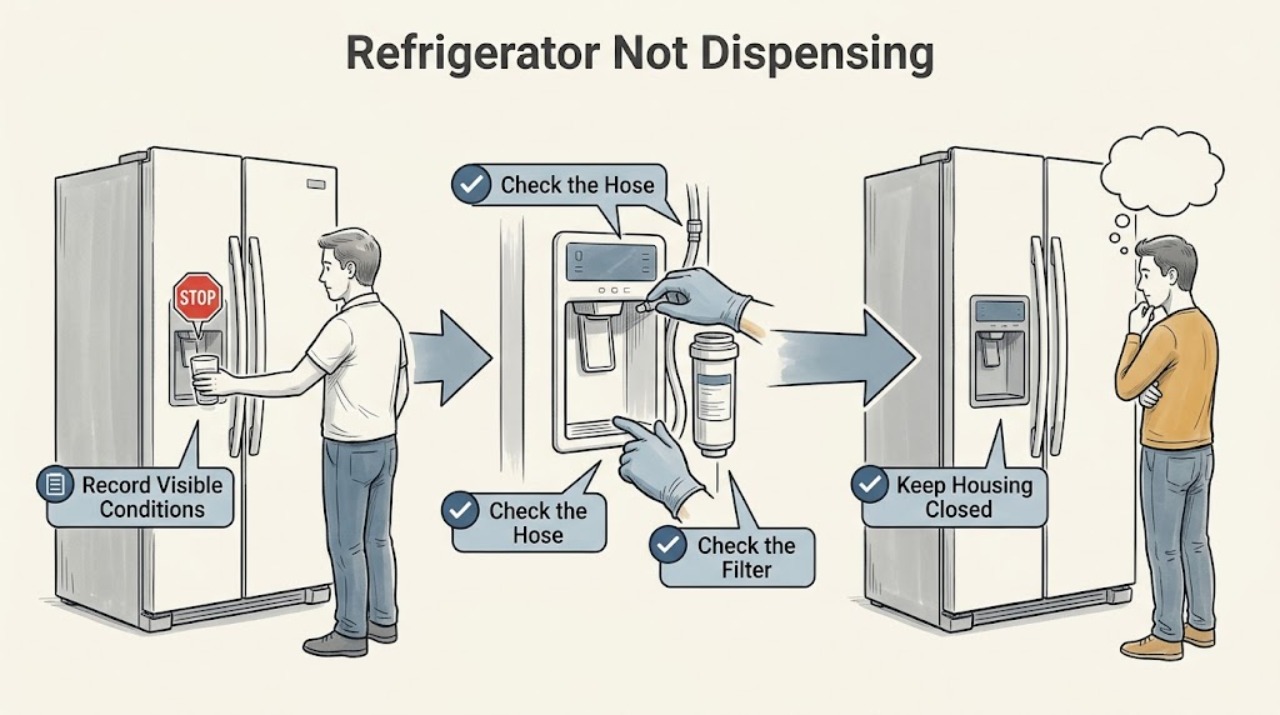
Separate the complaint into water, cubed/crushed ice, or both, and record the full Bosch model number. With the door closed, select the intended dispenser mode and note whether the panel responds, shows a lock/filter indication, or gives an error.
Expected result: Only water fails, only ice fails, both fail, the door is open, the panel is locked, or an error is displayed.
Next step: Close the door and release the lock only through the exact model's normal control. If an error remains or both functions still fail, continue only with the safe supply/filter observations below and then arrange service.
Why this matters
Why: Water-only and ice-only failures use different paths. A door or lock state can disable dispensing before a water valve or ice mechanism is involved, while an error or failure of both functions makes a shared control, supply, or service issue more likely.
-
Check 2
For no water, inspect only the accessible water connection and visible hose path: confirm the supply valve is open and the hose is not kinked, crushed, or visibly damaged. Do not pull the refrigerator out, loosen a connection, or use a pressure gauge unless a qualified installer is doing it.
Expected result: The supply is off, the hose is kinked/damaged, the visible connection is wet, or the visible supply path appears open and intact.
Next step: If safe, close the water supply when there is a leak and contact a qualified installer or Bosch service. If the valve was simply closed or the hose visibly kinked, correct only that accessible condition according to the manual; if water still does not dispense, stop and arrange service.
Why this matters
Why: Bosch manuals list no water supply, low pressure, and a kinked hose as water-dispenser causes. A wet or damaged connection adds a leak risk; an intact visible path does not rule out a blocked filter, frozen internal line, valve, or dispenser fault.
-
Check 3
Check the model-specific filter status and fit. Use Bosch's filter finder with the complete E-Nr. and replace a blocked, visibly reduced-flow, or overdue filter only if the exact manual permits a user replacement; do not substitute a cartridge by appearance or force a filter that does not seat.
Expected result: The filter indicator is active, water flow is reduced, the filter is correctly identified and seated, or an external/reverse-osmosis filter is in the supply.
Next step: Follow the exact model manual for replacement and any required flushing. If flow remains absent or the filter head leaks, stop using the dispenser and contact Bosch service; do not open the filter housing or alter the water system.
Why this matters
Why: Bosch identifies a blocked or due filter and low pressure from an external filtration system as possible dispenser causes. Filter families and bypass arrangements vary, so a filter that fits physically is not proof of compatibility.
-
Check 4
For no ice, verify from the controls that ice production is enabled, then check that the ice storage container is fully seated and that the accessible chute is not visibly blocked by cubes frozen together. Do not reach under or into the ice maker and do not chip ice with a sharp tool.
Expected result: Ice production is off, the bin is not fully seated, cubes are frozen together in the chute, or the bin and chute appear clear but no ice dispenses.
Next step: Use only the manual-approved control and accessible chute-clearing method for the exact model. If the ice maker or internal mechanism remains faulty, leave it off and arrange service rather than reaching into the mechanism or ordering an unverified part.
Why this matters
Why: Bosch lists the ice setting, an unseated container, and frozen-together chute cubes as distinct causes. A clear chute with no ice can instead reflect water supply/filter pressure, ice-maker, auger, or dispenser-control trouble.
-
Check 5
If the water and ice checks are normal but dispensing remains unavailable, record whether the panel is responsive, whether the dispenser works only with the door closed, whether an error is shown, and whether there is a leak, unusual noise, or a damaged cord. Do not run an internal self-test, cycle a valve by hand, or disconnect wiring.
Expected result: Both functions fail, the panel is unresponsive, an error persists, a leak is present, or the accessible checks are normal but only one function remains unavailable.
Next step: Keep the refrigerator connected only as needed for food safety, stop using the affected dispenser, and contact Bosch-authorized service. If water is leaking or the cord/power area is wet or damaged, isolate power and water only from a safe position and seek qualified help.
Why this matters
Why: Both functions failing or an unresponsive/error state makes a shared UI, lock, control, power, or water-system fault more likely. A single persistent water or ice failure after the matching path is clear can indicate a valve, filter head, ice maker, auger, or dispenser component that requires diagnosis.
Use your observations
Decision map
Find the observation that best matches what you see, then follow the next safe action.
-
PATH 01Next step
What you see
The dispenser does not respond for either water or ice, especially with the door open, a lock indicator, or an error.
Do this next
Use the dispenser only after the normal control restores it without an error or leak. If both remain unavailable or an error returns, arrange Bosch service and do not open the control panel.
Why this path and its safety boundary
Why it matters: Recovery after the documented door/lock action supports a shared user-control condition. Persistent failure of both functions makes a dispenser UI, control, power, or common supply fault more likely.
-
PATH 02Next step
What you see
Water does not dispense but ice may still work, and the visible supply valve, hose, and filter status show an obstruction or reduced-flow condition.
Do this next
Follow the exact manual's filter replacement/flushing instructions only. If flow does not return or any connection leaks, stop and call Bosch service or a qualified installer; do not disconnect a pressurized line.
Why this path and its safety boundary
Why it matters: Improvement after the matching accessible correction supports a supply, hose, pressure, or filter restriction. Persistent no-water with those conditions normal makes an internal line, valve, filter head, or dispenser control fault more likely.
-
PATH 03Next step
What you see
Ice does not dispense but water works, and ice production, the bin, or chute has a visible abnormal condition.
Do this next
Do not reach into the ice maker or force the chute. If the ice path remains unavailable after the manual-approved check, leave ice dispensing off and arrange Bosch service.
Why this path and its safety boundary
Why it matters: Recovery after the setting, container, or chute correction supports an ice-path condition. A clear, enabled ice system with no dispensing makes the auger, ice maker, chute sensor, or dispenser control more likely.
-
PATH 04Next step
What you see
Water and ice remain unavailable after door/lock, supply, filter, bin, and chute observations, or a leak/error is present.
Do this next
Stop using the dispenser and arrange Bosch-authorized service. If water reaches the electrical area or the cord is damaged, isolate power and water only when safe and use qualified emergency or electrical help as appropriate.
Why this path and its safety boundary
Why it matters: This pattern is outside a reliable user check and may involve a shared control, valve, water line, filter head, or dispenser assembly. A normal-looking exterior cannot clear an internal water or electrical fault.
Helpful context
Understand the symptom
A Bosch refrigerator that is not dispensing may have a water-path problem, an ice-path problem, or a shared control/lock condition. The two paths are not interchangeable: a glass with no water points toward supply, pressure, hose, or filter; ice-only failure points toward ice production, the bin, or the chute. Bosch manuals also vary by series, so identify the full E-Nr. before choosing a filter or control instruction.
Keep the checks at the user-accessible boundary. Do not reach into the ice maker, force a frozen chute, disconnect a pressurized water connection, bypass a lock, or open the dispenser housing. A filter may be under water pressure, and an internal valve, sensor, or control fault needs a trained technician; use only the replacement and procedure specified for the exact refrigerator model.
When checks do not resolve it
Need a professional?
Arrange Bosch-authorized service for persistent water or ice failure after the matching accessible checks, an unresponsive panel, a recurring error, a leaking filter head or connection, a suspected frozen internal line, a valve/ice-maker/auger fault, or any internal electrical issue. Use a qualified installer for supply pressure or plumbing problems and urgent help for water near energized parts.
Safety scope: Do not reach into the ice maker, force or chip a frozen chute, disconnect a pressurized water line, bypass a dispenser lock, open the dispenser housing, or access internal wiring. Use only the filter and chute procedure authorized in the exact Bosch manual. If a connection leaks or the cord/power area is wet or damaged, isolate water and power only from a safe position.
Have this ready
- Provide the complete Bosch E-Nr., whether water, cubed ice, crushed ice, or both fail, door/lock and filter indicators, supply-valve and hose observations, filter identity and replacement history, ice-bin/chute condition, any error, leak, unusual noise, and which model-approved check changed the symptom.
Common questions
FAQ
Why is my Bosch refrigerator not dispensing water?
Check the door/lock state first, then the accessible supply valve, visible hose, and exact model filter. Bosch lists no supply, low pressure, a kinked hose, and a blocked or due filter as possible causes. If those are normal and water still does not flow, arrange service rather than disconnecting a water line.
Why does my Bosch refrigerator make ice but not dispense it?
Check that the ice bin is fully seated and that cubes are not frozen together in the accessible chute. Bosch also lists a disabled ice maker, lock state, and dispenser fault. Do not reach into the ice maker; persistent failure needs Bosch service.
Can an open refrigerator door stop the Bosch dispenser?
On some Bosch models, yes. The KFD96 manual states that the ice and water dispenser is locked when the appliance door is open. Close the door and use the exact model's normal lock control; do not bypass the door sensor.
How do I choose a replacement filter for a Bosch refrigerator dispenser?
Use Bosch's Water Filter Finder with the complete E-Nr., including the slash and the two digits after it. Filter shapes are not enough to establish fit, and replacement frequency or flushing steps can vary by model.
Read the exact guide
Official sources
- Bosch Water Filter FinderBosch · Bosch refrigerator model-specific water-filter identification and replacement guidance
- Information for Use KFD96..Bosch · Bosch KFD96-series ice and water dispenser lock, filter, supply, pressure, chute, bin, and service troubleshooting
- Installation and Using InstructionsBosch · Bosch B36CL-series water dispenser, filter, water-supply, hose, and ice-maker troubleshooting
Community feedback
Share a repair observation
Share a plain-text repair observation. Accepted observations are published automatically; this page may take a moment to update.