
On this page
Start here
Quick answer
An Admiral washer that does not complete a cycle may be paused normally, waiting to rebalance, extending time to heat or reduce suds, unable to fill or drain, or stopping at a door or lid-lock condition. First record the stage, remaining-time behavior, water level, display lights or code, and whether the drum or basket is moving. Check only ordinary user controls, the closed door or lid, visible load balance, detergent amount, water supply, and accessible hose routing as your model manual allows. Do not bypass a lock, reach into a moving tub, open panels, or repeatedly reset the machine. If water remains, the appliance leaks, a lock will not release, a breaker trips, or the cycle still fails after safe checks and one model-approved reset, keep it safe and arrange qualified appliance service.
Before you begin
Safety first
- The reader-level scope is normal controls, safe observation, visible door or lid closure, accessible load and hose checks, and one model-approved reset. A qualified technician must handle lock or switch replacement, pump or valve access, cabinet disassembly, electrical diagnosis, internal hoses, sensors, motors, and controls.
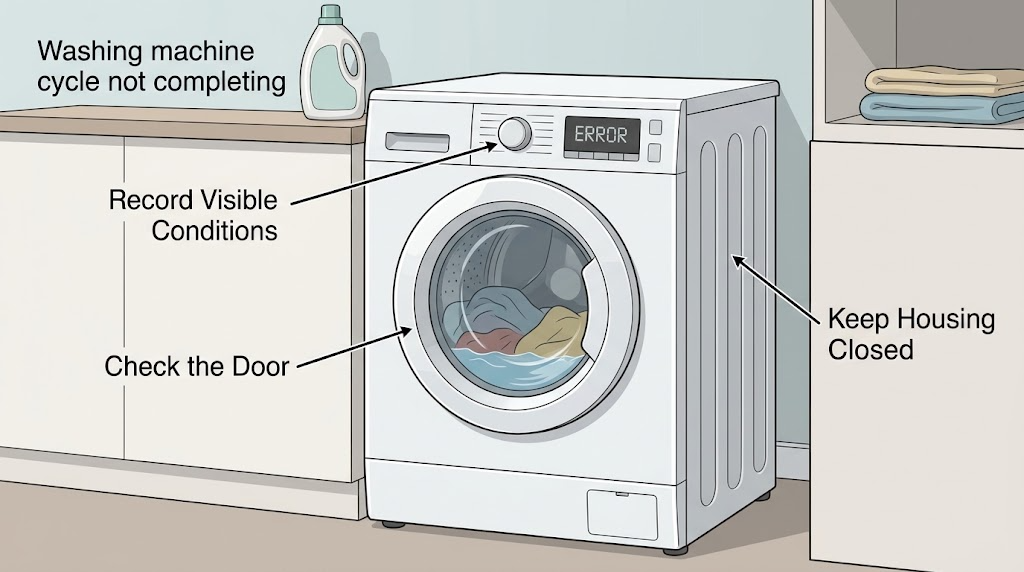
Work through in order
Diagnostic checks
Use only checks that match the exact appliance or system and its official guide.
-
Check 1
Without opening the appliance or reaching into the tub, record the selected cycle, the stage where it stops, the displayed time, lights or code, water level, and whether the drum or basket is still moving.
Expected result: Note a short pause, a time estimate that stays constant, repeated attempts to balance or drain, a door or lid-lock light, an error indication, standing water, or a completely unresponsive control.
Next step: Allow a documented normal pause to continue once without interrupting it. Photograph or transcribe any code and keep the model information ready; if the machine is unresponsive, leaking, or repeatedly stops at the same stage, stop the cycle and arrange service.
Stop if: Stop immediately for smoke, burning odor, sparks, exposed wiring, a water leak, abnormal heat, unsafe movement, or a tub or basket that is still moving when access is attempted.
Why this matters
Why: A held estimate can reflect load balancing, heating, or suds control rather than a failed timer. A repeated stop at fill, drain, spin, or locking points changes the diagnostic path; a code is model-specific and cannot be interpreted without the correct manual.
-
Check 2
With the machine stopped, check that the door or lid is fully closed and that no clothing, lint, or detergent residue is visibly preventing the latch from engaging; use normal controls only and do not bypass the lock.
Expected result: Record a firmly closed door or lid with a normal lock indication versus a visible obstruction, a door or lid that will not latch, a lock light that flashes, or a lock that remains engaged after the tub has stopped.
Next step: Remove only loose visible lint or residue with a damp cloth if the manual allows and close the door or lid normally. If the lock remains abnormal, water is present, or the cycle will not advance, keep the machine safe and request appliance service.
Stop if: Do not pry the door or lid, defeat or bridge a switch, reach into a locked tub, or force the appliance to operate with the safety lock open.
Why this matters
Why: Many washers will not fill, wash, drain, rinse, or spin unless the door or lid safety condition is satisfied. A clean-looking latch that still will not engage points to a lock, switch, alignment, control, or model-specific issue rather than permission to defeat the safety device.
-
Check 3
After the basket has completely stopped and the manual permits opening, observe whether the load is tightly packed, a single bulky item, visibly gathered to one side, or surrounded by excessive suds; do not reach into a moving tub.
Expected result: Record an evenly distributed load and normal suds versus a heavy or uneven load, a load that repeatedly shifts during spin, or abundant foam that persists into the attempted drain or spin.
Next step: Follow the model manual to reduce or redistribute the load and use only the detergent type and amount it specifies; do not add more detergent to correct foam. If the cycle still cannot complete, or the machine shakes, leaks, or stops again, arrange service.
Stop if: Stop for a moving basket, unstable appliance, a locked door with water inside, flooding, chemical exposure, or any need to dismantle the tub or pump area.
Why this matters
Why: An unbalanced or bulky load can make the washer spend extra time trying to balance before final spin. Excess detergent or non-HE detergent can prolong suds control and may interfere with pumping or spinning; these observations do not prove a motor, pump, or control failure.
-
Check 4
From outside the appliance, verify that the household water valves are open and that visible inlet hoses are not kinked; check the model manual before treating a particular hose arrangement as required.
Expected result: Record open supply valves and straight, dry hoses versus a closed valve, kink, leak, missing connection, or a cycle that stalls at fill or rinse.
Next step: Correct only an obvious closed valve or safe external kink, then use the model-approved cycle once to see whether filling resumes. Do not remove hoses or inlet screens as a test; arrange service for leaks, persistent no-fill behavior, or uncertain connections.
Stop if: Stop for spraying water, a damaged hose, a wet electrical area, a valve that will not close, or any need to disconnect a pressurized hose or open the washer cabinet.
Why this matters
Why: Restricted or absent incoming water can prevent a washer from advancing through a fill-dependent stage. A supply that looks normal while the machine still fails to fill points to an inlet screen, valve, pressure, control, or other condition that needs diagnosis.
-
Check 5
If water remains or the cycle stops before spin, inspect only the visible drain hose, standpipe, or utility-sink route for an obvious kink, dislodgement, or visible overflow; do not remove the hose, pump filter, or cabinet panel unless the exact manual gives a safe user procedure.
Expected result: Record a clear, correctly positioned visible hose route versus a kink, an unsecured hose, water returning to the washer, standing water, or a drain that backs up.
Next step: Correct only an obvious external hose position issue permitted by the manual and stop if water is contaminated or spilling. Arrange appliance service for persistent water, a repeat drain fault, or any internal access requirement.
Stop if: Do not tip the washer, open a pump filter with water inside, remove a cabinet, use a tool to clear an unknown blockage, or handle leaking or contaminated water near electrical equipment.
Why this matters
Why: A hose restriction, installation condition, or blocked household drain can prevent pumping and final spin. Water remaining with a clear external route shifts attention to the pump, filter, sensor, control, or internal hose, which cannot be identified safely from this check.
-
Check 6
Only after recording the symptom and completing safe external checks, use the reset or power-cycle procedure stated in the exact Admiral model manual; do not repeatedly reset to erase a recurring fault.
Expected result: Record whether the controls recover and one ordinary cycle completes, or whether the same stop stage, lock behavior, water level, or code returns.
Next step: If the problem returns or the cycle still does not complete, stop relying on resets and request qualified appliance repair with the model, cycle, code, water level, and prior observations.
Stop if: Do not reset a leaking, smoking, sparking, overheated, repeatedly tripping, or mechanically damaged washer, and do not disconnect power where doing so would expose you to water or electrical risk.
Why this matters
Why: A single reset may clear a temporary control interruption, but recurrence means the underlying fill, drain, balance, lock, sensor, or control condition remains unresolved. A reset does not make an unsafe machine safe to operate.
Use your observations
Decision map
Find the observation that best matches what you see, then follow the next safe action.
-
PATH 01Next step
What you see
The washer is quiet or performing its expected phase, the time display is an estimate, and there is no leak, error, abnormal odor, or unsafe movement.
Do this next
Allow the documented phase to finish once without interrupting it. If the display remains unchanged indefinitely or the same behavior repeats, record the stage and arrange service.
Why this path and its safety boundary
Why it matters: Balancing, heating, or reducing suds can extend the displayed time on some models.
-
PATH 02Next step
What you see
The door or lid will not close or lock, a lock light flashes, or the cycle will not advance until the safety lock condition is met.
Do this next
Use the exact model manual's safe latch and lock checks. Do not bypass the safety device; arrange appliance service if the lock remains abnormal or water is trapped inside.
Why this path and its safety boundary
Why it matters: The lock or its related switch, alignment, control, or visible obstruction can prevent fill, wash, drain, rinse, or spin.
-
PATH 03Next step
What you see
The load is bulky or uneven, the machine repeatedly tries to rebalance, or excessive suds are visible.
Do this next
After motion stops, follow the manual to redistribute or reduce the load and use the specified detergent amount. Request service if the cycle still stops, shakes, or leaves water.
Why this path and its safety boundary
Why it matters: Load balance and detergent conditions can delay final spin, add time, or interfere with pumping without proving a failed component.
-
PATH 04Next step
What you see
The washer stalls during fill or rinse and a household valve is closed or a visible inlet hose is kinked or leaking.
Do this next
Correct only the safe external condition allowed by the model manual. If filling remains abnormal or a hose leaks, stop and arrange appliance service.
Why this path and its safety boundary
Why it matters: Insufficient incoming water can prevent a fill-dependent stage from completing; a normal-looking supply does not rule out an internal valve or control issue.
-
PATH 05Next step
What you see
Water remains in the washer, the load is wet, the machine stops before spin, or the visible drain route is kinked, dislodged, or backing up.
Do this next
Do not open the pump or cabinet as a test. Correct only a clearly safe external hose position and request service for persistent water, backup, or an unresolved drain stop.
Why this path and its safety boundary
Why it matters: A drain restriction, installation condition, household drain, pump, filter, sensor, or control may be involved.
-
PATH 06Next step
What you see
The cycle fails again after one model-approved reset, returns the same code or stop stage, or controls remain unresponsive.
Do this next
Stop repeated resets and arrange qualified appliance diagnosis with the model, exact cycle, display behavior, water level, and all safe check results.
Why this path and its safety boundary
Why it matters: A temporary control interruption is not confirmed; the recurring issue may involve a lock, fill, drain, balance, sensor, motor, or control condition.
-
PATH 07Next step
What you see
There is smoke, sparks, burning odor, an electrical trip, a major leak, flooding, exposed wiring, violent movement, or a locked tub containing water that cannot be safely managed.
Do this next
Stop using the washer, keep people away, and seek appropriate urgent appliance or electrical help. Do not open panels or attempt to release the lock by force.
Why this path and its safety boundary
Why it matters: The appliance is no longer an ordinary troubleshooting situation and continued operation could increase injury, water, or electrical risk.
Helpful context
Understand the symptom
Record where the cycle stops
The displayed time is often an estimate rather than a fixed countdown. Official washer guidance says time can extend while a load balances, a heated cycle reaches temperature, or excess suds are reduced. Write down the selected cycle, stage, remaining-time behavior, water level, lights or code, and whether the machine is quietly pausing or repeatedly trying to advance.
Use the model manual for Admiral-specific controls
Admiral sells more than one washer style and model, so door, lid, control-lock, cycle, and reset behavior can differ. The official Admiral product page shows front-load, top-load, and washer-dryer products with different controls and programs. Use the model and serial information from the appliance to find the correct manual; do not apply a code meaning or reset sequence from another model.
Separate a simple operating condition from a fault
A closed door or lid, clear water supply, appropriate load, correct detergent amount, and unobstructed visible hose routing are reasonable external checks. Standing water, a leaking appliance, repeated failed locks, a persistent fill or drain problem, burning odor, or a cycle that stops at the same stage needs diagnosis rather than more resets or disassembly.
Safety boundary
Stop conditions
- Do not bypass a door or lid lock, reach into a moving tub, open the cabinet, handle a capacitor or wiring, or perform live electrical testing.
- Stop for smoke, sparks, burning odor, a major leak, flooding, exposed wiring, abnormal heat, violent movement, a repeatedly tripping breaker, or water near electrical equipment.
- Do not repeatedly reset the washer, use a code from another model, disconnect pressurized hoses, tip the appliance, or open a pump filter with water inside as a diagnostic test.
- Keep people and pets away from contaminated water and arrange qualified appliance service when a cycle repeatedly fails after safe external checks.
Only after diagnosis
Potential parts
- door or lid lock assembly
Consider only after diagnosis confirms that the lock or related switch prevents the cycle from advancing and visible closure or obstruction checks do not resolve it.
Confirm the exact Admiral model, lock style, electrical specification, and manufacturer fit information before ordering. - drain pump or pump filter
Consider only when diagnosis links standing water or a repeat drain stop to the pump or filter; a hose or household drain can create the same symptom.
Confirm the exact model, pump configuration, filter access, and manufacturer fit information; do not infer the part from wet clothes alone. - water inlet valve
Consider only after a technician confirms an internal fill failure with household valves, visible hoses, and model-specific requirements ruled out.
Match the exact model, valve ports, electrical specification, and manufacturer fit information before ordering.
When checks do not resolve it
Need a professional?
Arrange qualified appliance repair when an Admiral washing-machine cycle repeatedly stops at the same stage, remains stuck after one model-approved reset, leaves water, cannot lock or unlock normally, fails to fill or drain, leaks, shakes violently, or displays a recurring code. Seek urgent appliance or electrical help for smoke, sparks, burning odor, flooding, exposed wiring, or a repeatedly tripping breaker. Provide the model, selected cycle, stop stage, display behavior, water level, load and detergent observations, and safe hose or lock checks.
Safety scope: The reader-level scope is normal controls, safe observation, visible door or lid closure, accessible load and hose checks, and one model-approved reset. A qualified technician must handle lock or switch replacement, pump or valve access, cabinet disassembly, electrical diagnosis, internal hoses, sensors, motors, and controls.
Common questions
FAQ
Why does my Admiral washer stop before the cycle is finished?
It may be in a normal pause, balancing a bulky or uneven load, heating, reducing excess suds, waiting for water, unable to drain, or waiting for a door or lid lock. Record the stage and water level before choosing a repair path.
Can a washer's remaining time stay unchanged?
Yes. Remaining time can be an estimate and may hold while the washer balances, heats, or reduces suds. If it stays unchanged indefinitely, repeats at the same stage, or comes with water, an error, or unsafe behavior, arrange service.
What should I check if the Admiral washer stops before spin?
After the basket stops, observe whether the load is uneven or overly bulky, whether excessive suds are present, and whether water remains. Check only the visible drain-hose route allowed by the manual; do not open the pump or cabinet as a test.
Can I bypass the lid or door lock to finish the cycle?
No. The lock is a safety condition for tub movement. Close the door or lid normally and check only visible obstructions; if the lock will not engage or release normally, keep the washer safe and call for appliance service.
Should I keep resetting the washer if it does not complete?
Use the exact model manual for one reset or power-cycle attempt after recording the symptom. Repeated resets do not fix a recurring fill, drain, balance, lock, sensor, or control problem and can make diagnosis harder.
Read the exact guide
Official sources
- Lid Locking on a Top Load High Efficiency WasherWhirlpool Product Help · Official manufacturer guidance for applicable top-load washers; front-load Admiral machines use door behavior described by their own manual.
- Washer Not Draining or Spinning? Troubleshooting GuideWhirlpool Product Help · Official manufacturer troubleshooting guidance; internal pump and filter access varies by model and is not assumed for Admiral machines.
- Cycle Time is Not Advancing - Front Load WasherWhirlpool Product Help · Official manufacturer product-help guidance for a front-load washer; apply only where the Admiral model's manual and design are consistent.
- Not Starting or Not Operating - Front Load WasherWhirlpool Product Help · Official manufacturer product-help guidance for a front-load washer; exact Admiral behavior depends on model and manual.
- Checking the Fill Hoses if the Washer is not FillingWhirlpool Product Help · Official manufacturer installation and troubleshooting guidance; use only the connections and checks applicable to the Admiral model.
- Admiral Washing Machines - For up to 12kg loadsAdmiral Appliances · Official Admiral product page used to establish that controls and operating details vary by model; it is not a model-specific cycle-fault manual.
- How to Reset a WasherWhirlpool Product Help · Official manufacturer reset guidance; an Admiral washer's exact procedure and controls must come from its model manual.
Community feedback
Share a repair observation
Share a plain-text repair observation. Accepted observations are published automatically; this page may take a moment to update.