
On this page
Start here
Quick answer
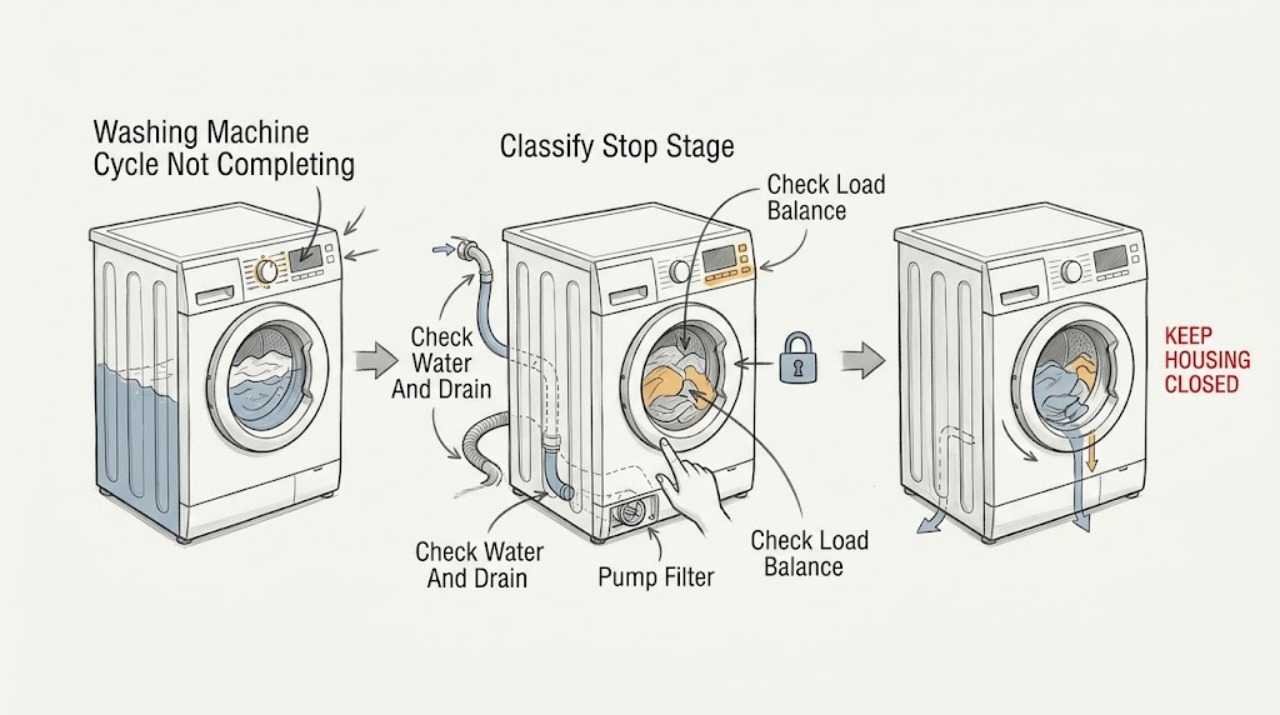
When a Beko washing-machine cycle does not complete, first note where it stops and whether water remains. Beko says an uneven load can make the washer stop its spin process to prevent damage; a full drum can also fail to spin when water has not drained, a drain hose or pump filter is blocked, or excess detergent has created foam. A delayed cycle, child lock, low water supply, closed door, or programme state can also make the timer appear stuck. Keep the door closed if water is visible, check only the normal programme and door controls, inspect visible hoses for kinks, and redistribute a load only with the drum stopped. If the machine still cannot drain or finish, a lock or error returns, it leaks, shakes severely, or a drive fault is suspected, stop and arrange qualified service rather than opening the cabinet or forcing another cycle.
Before you begin
Safety first
- This article covers reading the stop stage, visible hose observation, safe load redistribution with the drum stopped, normal programme controls, and one supervised cycle. Pump-filter water handling, cabinet removal, door-lock or drive work, wiring, live tests, and internal part replacement require qualified service.
Work through in order
Diagnostic checks
Use only checks that match the exact appliance or system and its official guide.
-
Check 1
Without opening the door or repeatedly pressing controls, note the stage where the cycle stopped: fill, wash, rinse, drain, spin, or final display. Record whether the timer is counting down and any code or flashing light.
Expected result: Water is entering, water remains, the drum tumbles but does not spin, the timer is paused, the machine returns to drain, or a warning appears.
Next step: Follow the matching water, load, control, foam, or service branch and keep the door closed whenever water or movement is present.
Stop if: Stop for smoke, burning odor, hot electrical parts, a leak, exposed wiring, or severe movement.
Why this matters
Why: The stop stage narrows the safe path: water left points to drainage, a skipped spin points to balance or drain state, and a paused timer can reflect water, heating, foam, or imbalance management. The symptom alone does not identify a component.
-
Check 2
If water remains or the washer stopped before spin, turn the machine off and inspect only the visible drain hose for a kink, crush, or obvious blockage. Check the pump-filter location only if the exact model guide gives a safe procedure and you can control the water discharge.
Expected result: The drum is empty, water remains, the hose is kinked or clogged, the pump filter is visibly accessible, or a leak starts.
Next step: Straighten only a plainly visible hose when safe, or use the model's documented drain procedure once. If water remains, the pump does not run, the filter cannot be safely accessed, or a leak appears, leave the washer off and arrange service.
Stop if: Do not open a filter or hose without a container and model-specific instructions, tip the appliance, or force the door over standing water.
Why this matters
Why: Beko says spin will not start until water has drained completely and lists a bent or clogged drain hose and pump filter as possible causes. Water or a leak changes the task from a programme issue to controlled drainage and service if it persists.
-
Check 3
When the drum is still, the door releases normally, and no standing water remains, inspect the load. Separate one bulky or highly absorbent item from tightly bunched laundry and reload a balanced load without overloading.
Expected result: The load is a single heavy item, very small, tightly bunched, overloaded, or already mixed and balanced.
Next step: Close the door and make one suitable spin or programme attempt while observing from outside. If the machine repeatedly redistributes, aborts, or shakes, stop and arrange service.
Stop if: Do not reach into a moving drum, hold the machine down, or keep restarting after severe vibration.
Why this matters
Why: Beko says an uneven load can make the machine stop its spin process to prevent damage and may require rearranging the laundry. A balanced load check does not explain a washer that cannot drain or a drum that turns freely with no drive.
-
Check 4
Look through the closed door for heavy suds and review whether more detergent than the product or detergent instructions recommend was used. Do not add chemicals to suppress foam or open the door while pressure or water is present.
Expected result: There is abundant foam, the detergent dose was high, the product stopped while trying to settle foam, or no unusual foam is visible.
Next step: Let the machine complete its safe foam-management stage if it is operating normally, then use the recommended detergent amount on a later load. If the cycle never resumes or foam overflows, stop the machine and arrange service.
Stop if: Do not open the door against water or suds pressure, pour in extra products, or run repeated hot cycles to clear foam.
Why this matters
Why: Beko says excess detergent can activate an automatic foam-dampening system and stop or extend a programme. If no foam is present, the cycle stop needs the water, load, control, or service branches instead.
-
Check 5
Check the normal control panel for a delay, pause, child lock, wrong programme, or unconfirmed Start/Pause action. Use only the model's documented cancellation or programme-change control and do not change the programme while the drum is moving or water is visible.
Expected result: A delay or child lock is active, the machine is paused, the programme is correct, or the controls do not respond.
Next step: Cancel the delay or child lock only with the exact model sequence, or allow a normal waiting stage to finish. If the controls remain locked or the programme returns to the same stop, arrange service.
Stop if: Do not force the selector, use undocumented button combinations, or bypass a child lock or door interlock.
Why this matters
Why: Beko says a delay can prevent a cycle from starting and that a child lock can prevent programme changes. Its troubleshooting material also notes that low water pressure, low voltage, heating, and imbalance can make the displayed time wait rather than count down.
-
Check 6
With the washer unplugged only through a safe accessible connection, the drum empty, and no water present, follow the exact model guide for any permitted external drum observation. Do not remove panels; record whether the drum has normal resistance and whether the programme ever reaches spin.
Expected result: The drum turns with no resistance, turns normally, remains locked, or the washer repeatedly stops before spin after drainage and load checks.
Next step: Leave the washer off and arrange authorised service, supplying the exact model and the stop-stage record. If a leak, lock failure, odor, or electrical warning is present, request prompt service.
Stop if: Do not open the cabinet, remove the belt, test motor wiring, release the lock manually, or continue a cycle with a suspected drive fault.
Why this matters
Why: Beko says a drum that turns with no resistance at all may indicate a damaged or broken drive belt, while repeated no-spin after balance and drainage checks can indicate another drive, control, or safety fault. This observation does not justify replacing a belt or motor as a user repair.
Use your observations
Decision map
Find the observation that best matches what you see, then follow the next safe action.
-
PATH 01Safety boundary
What you see
Water remains in the drum and the programme does not reach spin or finish.
Do this next
Use the exact model's normal drain procedure once, controlling discharge safely. If the drum remains full or a leak appears, leave the washer off and arrange service.
Why this path and its safety boundary
Why it matters: Beko says spin will not start until water has drained completely; a hose or pump-filter issue may be holding the cycle.
Safety stop: Do not force the door or open a filter or hose without a safe model-specific water procedure.
-
PATH 02Safety boundary
What you see
The washer tumbles or tries to spin, then stops, redistributes, or drains without completing the cycle.
Do this next
With the drum stopped and empty of standing water, rearrange a bulky or bunched load and make one supervised programme attempt. If the pattern repeats with a balanced load, arrange service.
Why this path and its safety boundary
Why it matters: The automatic imbalance system may be preventing harmful movement because the load is not distributed safely.
Safety stop: Do not hold the machine down or keep restarting after strong banging or walking.
-
PATH 03Safety boundary
What you see
The programme pauses with abundant suds or takes an unusually long time after a high detergent dose.
Do this next
Keep the door closed and let a normally operating machine manage the foam. Use the recommended dose on later loads; arrange service if the cycle does not resume or suds overflow.
Why this path and its safety boundary
Why it matters: Beko says the washer may stop to manage excess foam, so the timer may not behave like a normal completed cycle.
Safety stop: Do not add products to suppress foam, open the door against water or suds, or repeat the cycle indefinitely.
-
PATH 04Safety boundary
What you see
The timer appears stuck, the washer is paused, or a delay or child lock prevents the cycle from proceeding.
Do this next
Wait for a normal stage to finish or cancel the delay or lock with the exact model controls. If the controls remain unresponsive or the same stop returns, arrange service.
Why this path and its safety boundary
Why it matters: Beko documents waiting during water intake, heating, low supply conditions, or imbalance, and says delay or child-lock settings can block normal operation.
Safety stop: Do not force controls, switch programmes while water or movement is present, or bypass a safety lock.
-
PATH 05Safety boundary
What you see
Drainage, load, foam, and programme checks do not restore completion, or there is a leak, failed door lock, severe vibration, smoke, odor, or electrical warning.
Do this next
Turn the washer off, close the water tap if safely accessible, keep people away from any hazard, and arrange qualified or authorised appliance service with the recorded sequence.
Why this path and its safety boundary
Why it matters: A pump, drive, door interlock, control, supply, or other internal fault remains possible and cannot be confirmed safely from outside.
Safety stop: Do not open the cabinet, remove a pump or belt, test live wiring, release the door manually, or continue a damaged or leaking machine.
Helpful context
Understand the symptom
Locate the point where the programme stops
A cycle that stops while filling has a different path from one that washes but never drains, and a programme that drains but skips spin may be responding to load balance. Note the displayed time, selected stage, drum movement, water level, and any lights or codes before cancelling the programme. A timer that does not move can also reflect waiting for water, heating, or balance control rather than a failed timer.
Keep water and movement under control
If water is visible, do not force the door. If the washer is shaking, stop the cycle and wait until the drum is still. Beko's guidance treats drainage, balance, and foam as separate causes, so a single restart cannot safely diagnose all three.
Use the exact model instructions
Beko controls and programme names differ by model. The official pages provide general checks, while the opened troubleshooting document states that some reset or cancellation actions depend on the product model. Record the model number from the rating plate or paperwork before using a button sequence or emergency-drain procedure.
Safety boundary
Stop conditions
- Stop immediately for uncontrolled water, smoke, burning odor, hot electrical parts, exposed wiring, a failed door lock, or severe movement.
- Do not force the door, reach into a moving or water-filled drum, hold the machine down, or bypass a door or child safety lock.
- Do not open the cabinet, test live wiring, remove the pump or drive belt, alter controls, or use undocumented service procedures.
- Stop after the stop-stage, drain, load, foam, programme-state, and one supervised-cycle checks if the washer still does not finish or the fault returns; arrange qualified service.
When checks do not resolve it
Need a professional?
Arrange Beko-authorised or qualified appliance service when water remains after a permitted drain procedure, a balanced load and normal programme still do not finish, foam persists, the timer repeatedly stalls, the door will not lock, the drum has no normal resistance, or a fault returns. Stop promptly for smoke, burning odor, hot electrical parts, exposed wiring, uncontrolled water, leaks, or severe vibration.
Safety scope: This article covers reading the stop stage, visible hose observation, safe load redistribution with the drum stopped, normal programme controls, and one supervised cycle. Pump-filter water handling, cabinet removal, door-lock or drive work, wiring, live tests, and internal part replacement require qualified service.
Common questions
FAQ
Why does my Beko washing-machine cycle stop before it finishes?
Note the stage where it stops. Beko lists incomplete drainage, an uneven load, excess foam, low water or voltage conditions, delay or child-lock state, and programme controls as possible causes. Keep the door closed if water remains and use the matching branch rather than repeating the whole cycle.
Why is my Beko washer not completing the spin?
Check for water left in the drum, a kinked or blocked visible drain hose, a selected programme state, and an uneven or very small load. Beko says its balance system may stop spinning to prevent damage. If a balanced load and permitted drain check do not help, arrange service.
Can too much detergent make a Beko washing-machine cycle take too long?
Yes. Beko says excess detergent can create foam and activate an automatic foam-management stage, which can pause or extend the programme. Keep the door closed while the machine is operating normally and use the recommended dose on later loads; arrange service if the cycle never resumes or suds overflow.
What should I do if water remains when my Beko washer stops?
Do not force the door. Turn the washer off and inspect only the visible drain hose. Use a model-documented drain procedure once if it can be done safely and discharge is controlled. If water remains, the pump is silent, or a leak appears, leave it off and arrange service.
When should I stop troubleshooting a Beko washing machine that will not finish?
Stop for uncontrolled water, smoke, burning odor, exposed wiring, a failed door lock, severe shaking, a drum with no normal resistance, or a fault that returns after the drain, load, foam, programme, and one supervised-cycle checks. Keep the washer off and arrange qualified appliance service.
Read the exact guide
Official sources
- How to change the program on your washing machineBeko · Official Beko UK programme guide; used only for the caution that programme-change and cancellation actions vary by model and may retain water.
- Troubleshooting - Beko Washing Machine DocumentationBeko · Official Beko product-documentation troubleshooting page for a particular document set; use the exact model manual for control details.
- How to Solve Problems with Your Beko Washing MachineBeko · Official Beko UK support guide; used for general programme and control causes, with exact button sequences and electrical work left to the model manual or service.
- How to fix a washing machine that stops mid-cycleBeko · Official Beko US support article directly addressing a washer that stops partway through a programme; model controls and service limits remain model-specific.
Community feedback
Share a repair observation
Share a plain-text repair observation. Accepted observations are published automatically; this page may take a moment to update.