
On this page
Start here
Quick answer
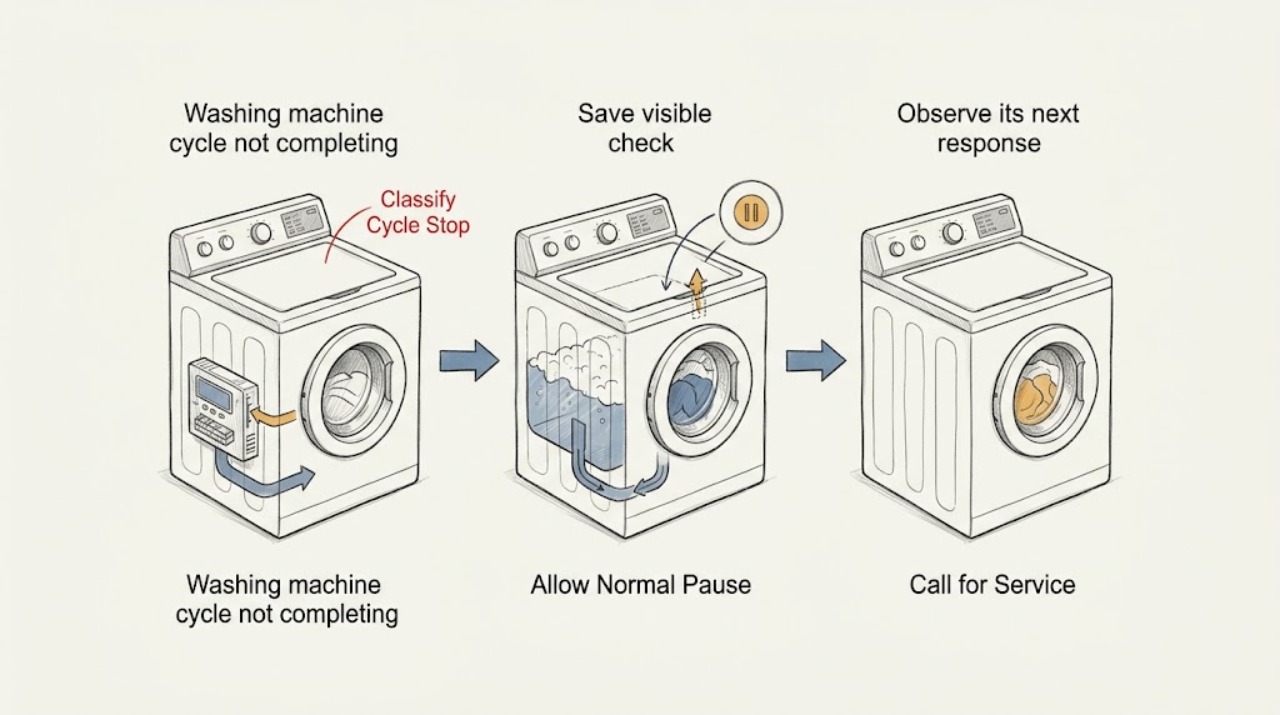
First determine whether the washer is in a normal pause or has stopped with a symptom. Amana guidance says some cycles pause during tumbling, soaking, steam, or load-balance correction, so allow the stated phase to continue while watching for a code or movement. If it truly stops, check the lid or door is closed and latched, redistribute a tightly packed or unbalanced load, use only the correct amount of HE detergent, and inspect the visible drain hose for kinks or an installation problem. Water left in the tub or wet clothes point toward a drain or spin issue; a flashing light or code should be recorded exactly. After safe external checks, one model-appropriate five-minute power reset may clear a temporary control interruption. Stop and arrange qualified Amana appliance or electrical service for leaking water near electrical parts, a damaged cord, repeated power trips, a door or lid that will not latch, a returning error, burning smell, smoke, or a cycle that still cannot complete.
Work through in order
Diagnostic checks
Use only checks that match the exact appliance or system and its official guide.
-
Check 1
Observe the Amana washer without opening a moving or locked drum and record the selected cycle, approximate phase, timer behavior, basket movement, water level, load wetness, flashing lights, and any displayed code.
Expected result: The washer is quietly paused, periodically tumbling or filling, stopped with water inside, stopped before spin, stopped after a loud shake, or showing a light or code.
Next step: Follow the matching pause, load, suds, water, drain, lid, or error branch below and avoid repeating Start without identifying the stopping point.
Stop if: Stop immediately for smoke, burning or electrical smell, sparking, a damaged cord, water near electrical parts, a leaking cabinet, or repeated breaker trips.
Why this matters
Why: A programmed pause or load-balancing attempt may be normal; water left behind or wet clothes shifts the investigation to draining and spinning. A flashing light or code is a fault clue that should be preserved rather than guessed at.
-
Check 2
If the washer has no warning, leak, or hazard symptom, leave the lid or door closed and allow the selected cycle's programmed pause, soak, steam phase, or balancing movement to continue for the interval described in the exact model manual.
Expected result: The washer resumes and completes, remains inactive with no phase change, or returns to the same stopping point with a light, code, or wet load.
Next step: If it resumes, monitor one cycle. If it remains stopped or repeats the symptom, continue with the load, suds, water, and drain checks rather than interrupting the cycle repeatedly.
Stop if: Do not force the lid or door, reach into the washer, or continue waiting if water leaks, the cabinet overheats, or an electrical warning appears.
Why this matters
Why: Amana manuals describe pauses during certain phases and, on some models, an initial steam phase in which the drum does not spin or fill. A return to the same stop after the expected phase is not explained by a normal pause alone.
-
Check 3
If the stop occurs during agitation or spin, stop the cycle using the normal control, wait until the basket is stationary and the lid or door permits safe access, then remove a few items or redistribute a tightly packed or single-heavy load evenly.
Expected result: The washer was shaking or noisy, the load is bunched to one side, clothes remain wet, or the cycle completes after the load is redistributed; alternatively the washer still stops or shows an imbalance indication.
Next step: Run one appropriate cycle with a balanced load; if the washer still cannot spin or complete, inspect the external drain path and arrange service if the condition recurs.
Stop if: Do not reach into a moving basket, force a locked lid or door, overload the machine again, or continue if the washer walks, bangs violently, or leaks.
Why this matters
Why: Amana says an unbalanced load can create noise and vibration, reduce spin speed, lengthen the cycle, leave clothes wet, and sometimes stop spinning while the washer attempts self-correction. A persistent stop with a balanced load points beyond simple loading.
-
Check 4
If the washer pauses, slows, or stops while wash water is unusually foamy, check the detergent label and the amount used after the cycle is safe to access; use only HE detergent in the amount specified for the load and model.
Expected result: There is excessive foam, regular non-HE detergent was used, the washer resumes after its suds-reduction behavior, or the same stop occurs with the correct detergent amount.
Next step: Follow the exact model manual's external suds-removal or drain-and-spin instruction once; do not add more detergent, then monitor whether the next cycle reaches completion.
Stop if: Do not add chemicals to force a result, open a locked door against water, or continue if foam or water reaches electrical controls.
Why this matters
Why: Amana explains that too much detergent or unsuitable detergent can create suds that slow or stop the washer. If the symptom persists with correct detergent, suds are not a sufficient explanation and another phase or fault must be checked.
-
Check 5
If the cycle stops before filling or shows a wash or water-level warning, confirm the accessible household hot and cold faucets are open, and inspect the visible inlet hoses for kinks or crushing without disconnecting a pressurized hose.
Expected result: A faucet is closed, an inlet hose is visibly kinked, the washer fills normally after a safe correction, or the washer still cannot fill and the warning returns.
Next step: Open a clearly closed faucet or restore a safe visible hose path, then make one normal start attempt; arrange service for a leak, damaged hose, persistent warning, or no fill.
Stop if: Do not loosen hose fittings, clean internal screens while the supply is pressurized, run with a leak, or continue if water reaches the power connection.
Why this matters
Why: Amana's washer guidance identifies water supply and hose conditions as causes of an incomplete fill or a persistent wash indication. A persistent no-fill condition after external checks may involve an inlet valve, sensor, wiring, or control that should not be opened by the reader.
-
Check 6
If water remains in the tub, the final spin is not reached, or clothes are still very wet, unplug only when the area is dry and safe, then inspect the visible drain hose for a kink, crushing, blockage at the accessible end, or incorrect placement; do not reach into the pump or open a wet cabinet.
Expected result: The hose is kinked or blocked at an accessible point, water drains after a safe correction, the hose appears clear but water remains, or the washer stops with a drain or spin indication.
Next step: Correct only a clearly visible hose problem and run one model-appropriate drain or spin test; stop and arrange service if water remains, the pump is inaccessible, or the problem returns.
Stop if: Do not remove a pump cover with water present unless the exact manual gives a safe procedure for that model, do not tip the washer, and stop for leaks or water near electrical parts.
Why this matters
Why: Amana identifies drain-hose installation, height, kinks, clogs, and tight sealing as possible reasons a washer cannot drain or spin. If the external path is clear but water remains, the pump, filter, control, or another internal condition may be involved.
-
Check 7
If the cycle stops at the lid or door transition, verify from outside that the lid or door is fully closed and latched, the load is not obstructing it, and any Control Lock indicator is addressed only with the exact model manual; press and hold Start only for the model's documented interval.
Expected result: The latch engages and the cycle resumes, a control-lock indicator remains, the lid or door will not latch, or the washer stops again at the same transition.
Next step: Run one cycle only when the latch is secure and the controls respond normally; arrange service for a failed latch, damaged seal, repeated lock indication, or recurring stop.
Stop if: Do not force the lid or door, insert tools into the latch, bypass an interlock, pull wiring, or open a locked drum containing water.
Why this matters
Why: Amana says the lid or door must be closed and latched for operation, and a control lock prevents touch commands on affected models. A latch that will not engage or a recurring stop at the latch can indicate a lock or control fault, not permission to bypass it.
-
Check 8
After the external checks show no leak, damage, or electrical hazard, disconnect the washer from its power source for the five-minute interval described in Amana's reset guidance, reconnect it, and make one normal cycle attempt while recording the result.
Expected result: The cycle completes once, the same phase and code return, the controls remain unresponsive, or the washer trips power again.
Next step: If the symptom returns, leave the washer off when unsafe and arrange qualified Amana appliance or electrical service with the cycle phase, load, water state, code, and checks already performed.
Stop if: Do not repeat the reset, remove panels, test live parts, use a damaged cord, or reconnect after smoke, smell, sparking, water intrusion, or a breaker trip.
Why this matters
Why: A successful one-time reset can clear a temporary control interruption, but a repeated symptom indicates an unresolved condition or internal fault. A power trip is an electrical safety event, not a reason to keep resetting.
Use your observations
Decision map
Find the observation that best matches what you see, then follow the next safe action.
-
PATH 01Safety boundary
What you see
The washer is quiet or moving intermittently during a documented soak, steam, balancing, or other programmed phase, with no code, leak, or hazard.
Do this next
Keep the lid or door closed and allow the exact model cycle to continue; reassess only if the phase does not end or the same stop repeats.
Why this path and its safety boundary
Safety stop: Stop for water leakage, overheating, smoke, electrical smell, sparking, or a locked lid or door that behaves abnormally.
-
PATH 02Safety boundary
What you see
The washer shakes, becomes noisy, slows or stops during spin, and clothes remain wet or are bunched together.
Do this next
Stop normally, wait for the basket to stop, redistribute or reduce the load, and run one appropriate cycle.
Why this path and its safety boundary
Safety stop: Arrange service if a balanced load still causes violent movement, repeated stopping, or leakage; do not reach into a moving basket.
-
PATH 03Safety boundary
What you see
The washer pauses or stops with excessive foam, especially after too much or unsuitable detergent was used.
Do this next
Use only model-approved HE detergent and the specified amount, then follow the model manual's external drain-and-spin or suds-removal instruction once.
Why this path and its safety boundary
Safety stop: Stop if foam or water reaches electrical parts, a locked door will not open safely, or the stop recurs with correct detergent.
-
PATH 04Safety boundary
What you see
The cycle does not progress from filling, a wash or water-level indicator flashes, or the washer cannot obtain the expected water level.
Do this next
Check that accessible hot and cold faucets are open and visible inlet hoses are not kinked; make one normal start attempt and arrange service if the warning persists.
Why this path and its safety boundary
Safety stop: Do not disconnect pressurized hoses or run the washer with a leak or water near electrical connections.
-
PATH 05Safety boundary
What you see
The washer stops near final spin, leaves water in the tub, or finishes with clothes unusually wet.
Do this next
Inspect only the visible drain-hose path for a kink, blockage, or incorrect placement, then perform one model-appropriate drain or spin test.
Why this path and its safety boundary
Safety stop: Arrange service if the hose is clear but water remains, the pump is inaccessible, a drain warning returns, or water leaks.
-
PATH 06Safety boundary
What you see
The cycle stops at a lid or door transition, a control-lock indicator is active, or Start commands do not engage the cycle.
Do this next
Close and latch the lid or door without force, use only the exact model's Control Lock instruction, and hold Start only as documented.
Why this path and its safety boundary
Safety stop: Do not bypass or force the interlock; arrange service for a latch that will not engage, a recurring lock indication, or a repeated stop at the same transition.
-
PATH 07Safety boundary
What you see
A code or flashing light returns, the same cycle phase repeatedly fails, controls stay unresponsive, or the washer trips power after one safe reset.
Do this next
Leave the washer off when unsafe, record the exact code and cycle conditions, and arrange qualified Amana appliance or electrical service.
Why this path and its safety boundary
Safety stop: Do not keep resetting, open panels, test live components, or reconnect after smoke, smell, sparking, water intrusion, or a breaker trip.
Helpful context
Understand the symptom
A pause is not automatically a failed cycle
An Amana washer can pause during a programmed tumble, soak, steam phase, or an attempt to redistribute a load. A cycle may also appear stalled when it is reducing suds or waiting for water-level or drain conditions. Note whether the timer changes, the basket moves intermittently, water remains, the load is wet, or a light flashes. That observation determines whether to wait, correct the load or hose, or stop for service.
Find the phase where the cycle fails
If the washer stops near the beginning, look at the lid or door, water supply, and control state. If it stops during wash, consider a normal programmed pause, excessive suds, or a tightly packed load. If it stops near spin and leaves water or wet clothes, focus on balance and the external drain path. Avoid opening a locked door or reaching into a moving or water-filled washer.
Reset once, then preserve the symptom
Amana describes a five-minute power disconnection as a possible control reset for some washer concerns, including incomplete cycles. Treat that as one controlled test, not a repair. If the same stopping point, light, code, leak, or no-drain condition returns, leave the washer off when unsafe and give service the exact cycle, load, water state, and result of the external checks.
Safety boundary
Stop conditions
- Stop immediately for smoke, burning or electrical smell, visible sparking, a damaged or hot cord or plug, water near electrical parts, a leaking cabinet, or repeated breaker trips.
- Stop using the washer when the lid or door will not latch, a locked drum contains water and will not release normally, or an error or flashing light returns after the model-specific external check.
- Do not bypass a lid or door interlock, reach into a moving basket, tip the washer, disconnect pressurized hoses, remove wet pump or control covers, or test live wiring.
Only after diagnosis
Potential parts
- drain pump assembly
Only consider this part if a qualified diagnosis finds that the external drain path is clear but the washer still cannot remove water or complete the spin phase.
Confirm the exact Amana model and manufacturer fit information before ordering; do not infer compatibility from a drain symptom alone. - lid or door lock assembly
Only consider this part if a qualified diagnosis confirms that the lid or door is correctly aligned but its lock signal prevents the cycle from continuing.
Confirm the exact Amana model and lock style before ordering; do not bypass or substitute an interlock based only on appearance.
When checks do not resolve it
Need a professional?
Arrange qualified Amana appliance or electrical service when the same phase repeatedly fails, a balanced load and visible drain path do not restore completion, a code or flashing light returns, the lid or door will not latch, controls remain unresponsive after one safe reset, water leaks or remains in the tub, or any electrical or burning symptom occurred.
Common questions
FAQ
Why does my Amana washer pause and not complete the cycle?
A pause can be normal during tumbling, soaking, steam, or load-balance correction. If the washer does not resume after the phase described in its model manual, note whether it has water, wet clothes, foam, a flashing light, or a code, then follow the matching external check.
Can an unbalanced load keep an Amana washer from finishing?
Yes. Amana says an unbalanced load can cause noise and vibration, reduce spin speed, lengthen the cycle, leave clothes wet, and sometimes stop spinning while the washer tries to redistribute the load. Stop normally, wait for the basket to stop, and redistribute or reduce the load.
Can too much detergent stop an Amana washer mid-cycle?
Excessive suds can slow or stop a washer. Use only HE detergent and the amount specified for the load and model. If the same stopping point occurs with correct detergent, investigate water, drain, latch, balance, or control symptoms instead of adding more detergent.
What should I check if water is left after the cycle?
Check only the visible drain hose for a kink, blockage at an accessible end, or incorrect placement, then perform one model-appropriate drain or spin test. If the hose is clear but water remains, the internal pump or another condition needs qualified service; do not open a wet cabinet.
How long should I unplug an Amana washer for a reset?
Amana's product-help guidance describes disconnecting the washer from power for five minutes before reconnecting it. Use that as one controlled reset only when there is no electrical or water hazard; a returning stop, code, or power trip needs service rather than repeated resets.
Why does the washer stop when the lid or door is closed?
The lid or door must be completely closed and latched for the washer to operate, and a Control Lock can prevent touch commands on affected models. Close it without force and use only the exact model manual's lock instruction. Do not bypass the interlock if it will not latch or the cycle stops there repeatedly.
Read the exact guide
Official sources
- Owner's ManualAmana · This Amana manual describes normal pauses, lid or door closure, load redistribution, suds, HE detergent, water and drain conditions, and the need to follow the exact model manual.
- Not Turning, Tumbling, or Spinning - Front Load WasherAmana · Amana covers longer or interrupted spin behavior from bulky or unbalanced loads, leveling, and visible drain-hose installation, kinks, and clogs.
- Not Starting - WasherAmana · Amana covers control lock, lid closure and latch, holding Start for the model's documented interval, and a five-minute control power reset.
- How to Reset a WasherAmana · Amana identifies incomplete cycles and error conditions as possible reasons for a reset, gives a five-minute power-cycle method, and directs readers to the model manual for reset details and Control Lock behavior.
- Stops Mid Cycle- WasherAmana · Amana explains that an unbalanced load can extend the cycle, reduce spin, leave clothes wet, trigger self-correction, or stop spinning, and directs persistent problems to service.
Community feedback
Share a repair observation
Share a plain-text repair observation. Accepted observations are published automatically; this page may take a moment to update.