
On this page
Start here
Quick answer
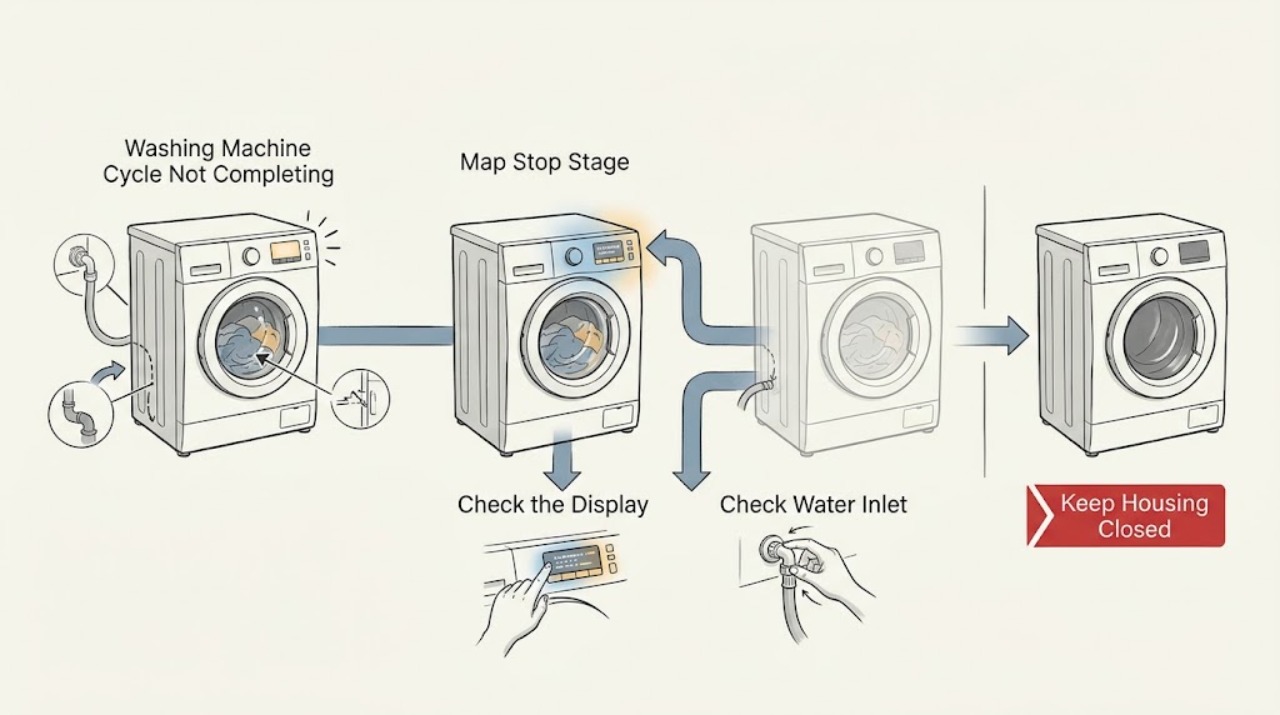
When an AEG washing machine cycle does not complete, note where it stops and whether water, wet laundry, an error code, or a locked door remains. AEG identifies imbalanced loads, blocked drainage, water-supply problems, an unsecured door, child lock, power interruption, and heating faults as different paths to check. First use normal controls to verify the selected programme and door, then observe the inlet hose, drain hose, load balance, and accessible filter area only as described in the exact manual. Stop and arrange qualified appliance service for a leak, burning smell, repeated electrical trip, a door that cannot be safely opened, a persistent error, or any check requiring live wiring, internal panels, or forced door release.
Before you begin
Safety first
- Normal controls and external observation only; no forced door release, live electrical test, panel removal, pressurized hose work, internal component replacement, or guessed part selection.
Work through in order
Diagnostic checks
Use only checks that match the exact appliance or system and its official guide.
-
Check 1
Without forcing the controls or door, record the selected programme, the approximate stage where the AEG washer stopped, any displayed code or padlock symbol, and whether the drum contains water or wet laundry.
Expected result: The programme stops during filling, washing or heating, draining, or spinning, with or without an error or water left in the drum.
Next step: Photograph the display and record the stage before attempting one normal restart. Use the matching branch below, and consult the exact AEG manual for any displayed code.
Stop if: Stop if the display shows a hazardous condition, the machine leaks, the drum or door is damaged, or the door cannot be handled without force.
Why this matters
Why: The stopping stage separates water-supply, heating, drainage, load-balance, door-lock, and control paths; a code may point to a model-specific fault but does not authorize internal repair.
-
Check 2
Check that the door is fully closed without laundry caught in the seal, the selected programme was started with the normal Start or Pause control, and no padlock or child-lock indication is active. Do not pry the door or remove the lock.
Expected result: The door closes normally and the programme starts, the door is obstructed or not latched, a padlock is shown, or the machine still stops with normal controls.
Next step: Remove only a plainly visible item preventing closure, disable child lock only using the model's documented controls, and retry once. If the door, lock, or cycle remains abnormal, arrange service rather than forcing it.
Stop if: Stop for a damaged door seal, broken handle, exposed lock wiring, trapped fingers, or a door that remains locked with water inside.
Why this matters
Why: AEG states that an incompletely closed door can prevent a programme from starting and that a padlock can indicate child lock. A normal latch and controls do not rule out a later water, drain, balance, heat, or internal fault.
-
Check 3
At the wall and behind the appliance only if safely accessible, confirm the water tap is open and the inlet hose is not visibly kinked, crushed, or disconnected. Do not loosen a pressurized connection or pull a heavy washer forward.
Expected result: The tap is closed, the inlet hose is kinked or obstructed, water supply appears normal, or the connection cannot be assessed safely.
Next step: Correct one plainly accessible tap or hose-position issue and retry once. If filling does not resume, an error returns, or access is unsafe, stop and provide the observation to qualified appliance service.
Stop if: Stop for spraying water, a leaking connection, wet electrical parts, unsafe access behind the appliance, or any need to remove a hose.
Why this matters
Why: AEG identifies inadequate water supply or a blocked or kinked inlet path as a reason a cycle can stop. A normal-looking hose does not prove adequate pressure or a working inlet valve.
-
Check 4
If the drum is safely accessible and the door is unlocked, observe whether laundry is tightly packed, gathered on one side, or unusually small for the selected programme. Redistribute the load without overloading and do not reach into a moving drum.
Expected result: The load is overloaded, uneven, very small, or reasonably distributed, and the stop occurs near the spin phase or with wet laundry.
Next step: Redistribute or reduce the load once as permitted by the manual, then select the documented drain or spin programme if appropriate. If the washer still stops or vibrates severely, stop using it and arrange service.
Stop if: Stop if water remains, the door is locked, the drum is moving, the washer is unstable, or correcting the load would require force.
Why this matters
Why: AEG explains that uneven or unsuitable loads can prevent a balanced spin and leave laundry wet. A balanced load makes an imbalance explanation less likely but does not clear a drain, motor, or control fault.
-
Check 5
Observe whether water remains in the drum and whether the external drain hose is visibly kinked or crushed. If the exact AEG manual identifies a user-accessible drain filter check, disconnect power safely first and follow only that procedure; do not open a filter while water may be hot or pressurized.
Expected result: The drum is full or partly full, the hose is obstructed, the accessible filter area shows a blockage, or the machine drains normally.
Next step: Correct only a plainly visible hose kink or a manual-approved accessible blockage, then run one documented drain test. If water remains, the fault returns, or the filter cannot be safely reached, keep the door closed and request service.
Stop if: Stop for hot water, leaking water, a locked door, a filter that will not turn by normal hand pressure, or any need to remove panels or use tools near wiring.
Why this matters
Why: AEG links mid-cycle stops and failed spin phases with drainage problems, including a blocked pump or filter. Normal drainage makes a blockage less likely but does not exclude a pump, sensor, or control fault.
-
Check 6
Note whether the display went blank, the washer lost power, the cycle stops early during a heated programme, or the machine shows a persistent code after one normal restart. Check the outlet only with a safe external test and do not reset a tripping breaker repeatedly.
Expected result: The display is blank, power is unstable, the stop consistently occurs during heating, or the appliance remains powered with no clear pattern.
Next step: If the socket is faulty, use a qualified electrician; if the washer remains faulty after one documented reset, or stops during heating, arrange qualified appliance service and provide the timing and code.
Stop if: Stop immediately for burning smell, smoke, sparks, hot plug, repeated breaker trip, exposed wiring, or a wet outlet.
Why this matters
Why: AEG connects blank displays with power or socket checks and identifies heating faults as a possible reason a cycle ends early. A repeated heating or power symptom can involve internal electrical parts, a sensor, or a heater and cannot be confirmed safely from outside.
Use your observations
Decision map
Find the observation that best matches what you see, then follow the next safe action.
-
PATH 01Next step
What you see
The door is not fully closed, laundry is caught in the seal, or a padlock symbol is displayed.
Do this next
Correct only the visible closure issue or use the model's documented child-lock controls, then retry once. Use service for a damaged seal, lock, handle, or persistent lock.
Why this path and its safety boundary
Why it matters: The programme may be blocked by the door interlock or child-lock setting rather than by the motor or pump.
-
PATH 02Next step
What you see
The cycle stops while filling and the tap is closed or the inlet hose is visibly kinked.
Do this next
Open the tap or correct one safe hose-position issue and retry once. If filling still fails or a code returns, arrange service.
Why this path and its safety boundary
Why it matters: The washer may not be receiving the water needed for the selected programme.
-
PATH 03Next step
What you see
The washer stops near spin with laundry gathered to one side, an overloaded drum, or a very small load.
Do this next
Redistribute or reduce the load as the manual permits and retry one drain or spin programme. Escalate if the washer still stops, vibrates, or leaves water.
Why this path and its safety boundary
Why it matters: The balance protection may be preventing the drum from reaching spin speed.
-
PATH 04Next step
What you see
Water remains in the drum, the drain hose is kinked, or the stop occurs before drain or spin.
Do this next
Correct only a visible hose kink or a manual-approved accessible blockage with power safely isolated. Request service if water remains or the fault repeats; do not force the door.
Why this path and its safety boundary
Why it matters: A drain path, pump, filter, or related control problem is more likely than a load-only issue.
-
PATH 05Next step
What you see
The cycle repeatedly stops early during heating, displays an error, or fails again after one normal restart with no simple obstruction.
Do this next
Record the code and timing, consult the exact manual, and arrange qualified appliance service. Do not test or replace a heater, sensor, lock, pump, or control from the symptom alone.
Why this path and its safety boundary
Why it matters: AEG treats heating, error-code, and internal faults as separate diagnostic paths that need model-specific guidance or professional inspection.
-
PATH 06Next step
What you see
The display is blank, the outlet is faulty, a breaker trips again, or there is smoke, burning smell, sparks, or a damaged cord.
Do this next
Stop using the washer, isolate power only if it can be done safely without contact with wet or damaged parts, and request qualified appliance or electrical service.
Why this path and its safety boundary
Why it matters: This is an electrical or safety condition, not a normal cycle interruption.
Helpful context
Understand the symptom
Use the stopping phase as the first clue
A cycle that stops during filling points toward a water or door condition; a cycle that stops before draining or spinning points toward drainage, load balance, or a selected hold option; a stop early in the wash can make heating or an error message relevant. The same symptom can have different causes on different AEG models, so record the display and the remaining water before changing settings.
Keep the inspection observational
Use the programme selector and other normal controls only. Do not force the door, reach into a moving drum, remove a rear panel, test live voltage, or work on wiring. If water is present, disconnect power only in a safe, dry manner and follow the exact manual for any user-accessible drain or filter procedure; do not open a filter against pressure or hot water.
What the result changes
An unbalanced load, kinked hose, closed tap, or plainly wrong option can sometimes be corrected once and retested. A recurring stop, persistent error, inability to drain, or a cycle that fails during heating needs a technician because the visible symptom does not identify the pump, valve, sensor, heater, lock, motor, or control board.
Prepare the service information
Record the model and serial information, selected programme, elapsed stage, display symbols or error code, water level, laundry condition, hose positions, recent power or plumbing changes, and whether the machine made unusual sounds. A clear timeline helps the service provider choose the correct AEG manual and diagnostic path.
Safety boundary
Stop conditions
- Water is leaking, hot, or present near the outlet, cord, controls, or other electrical parts.
- The door is locked with water inside, the handle or seal is damaged, or opening it would require force.
- The display shows a persistent error, the cycle fails during heating, or the machine repeatedly stops after a normal restart.
- The washer vibrates severely, makes unusual mechanical noise, emits smoke or a burning smell, or trips power again.
- A check requires removing a panel, testing live wiring, loosening a pressurized connection, or replacing a component.
When checks do not resolve it
Need a professional?
Call a qualified appliance professional when the safe door, control, supply, load, drain, and power observations do not restore one complete cycle, or immediately for leaks, electrical hazards, persistent errors, locked water-filled doors, or suspected heating and internal faults.
Safety scope: Normal controls and external observation only; no forced door release, live electrical test, panel removal, pressurized hose work, internal component replacement, or guessed part selection.
Common questions
FAQ
Why does my AEG washing machine stop before the cycle ends?
The stopping phase matters. AEG identifies load imbalance, water supply, drainage, error codes, heating issues, door closure, child lock, and power conditions as different possibilities. Record what remains in the drum and the display before choosing the next check.
What if my AEG washer stops with water inside?
Treat it as a drain-path clue. Observe the external drain hose and follow the exact manual only for a safe user-accessible filter check after power is isolated. Do not force the door or open a filter against hot or pressurized water; request service if water remains.
Can an unbalanced load prevent an AEG cycle from completing?
Yes. AEG explains that overloaded, very small, or uneven loads can prevent a balanced spin and leave laundry wet. Redistribute or reduce the load once as the manual allows, then use the documented drain or spin programme; recurring stops need service.
Should I replace a pump, heater, or door lock when the cycle stops?
No. A stopped cycle does not identify a failed part. Record the stage, code, water level, and observations, then use the exact AEG manual or qualified service. Internal electrical, heating, pump, lock, and control work is outside safe user checks.
Read the exact guide
Official sources
- Washing machine stops in the middle of a cycleAEG · Official AEG support article for washing machines and washer dryers; exact controls and safe access depend on model.
- Washing machine does not spinAEG · Official AEG support article used for the spin-phase branch; exact filter and programme steps vary by model.
- Washing Machine Troubleshooting: Common Problems and DIY FixesAEG · Brand-level troubleshooting context; use the exact appliance manual for model-specific procedures.
- Washing machine does not work / does not reactAEG · Official AEG support article for washing machines and washer dryers; button locations vary by model.
Community feedback
Share a repair observation
Share a plain-text repair observation. Accepted observations are published automatically; this page may take a moment to update.