
On this page
Start here
Quick answer
If an AEG dryer is not working, first identify whether it is completely dead, has a lit display but will not start, or starts and then stops. From outside the appliance, check the plug, outlet, breaker or RCD, then make sure the door is fully latched and that a delayed-start or child-lock setting is not preventing a cycle. For a condenser model, check the water tank, external drain hose and user-accessible lint filter or condenser. Perform only one reset described by the model manual, record any code or warning, and stop using the dryer if it trips power, smells hot or burnt, sparks, or has a damaged cord or door. If the external checks do not restore operation, keep it disconnected and arrange authorised service.
Before you begin
Safety first
- The reader should not open the cabinet, perform live electrical tests, bypass the door or thermal interlock, or continue using the appliance after smoke, burning odour, sparking, abnormal heat or repeated power trips.
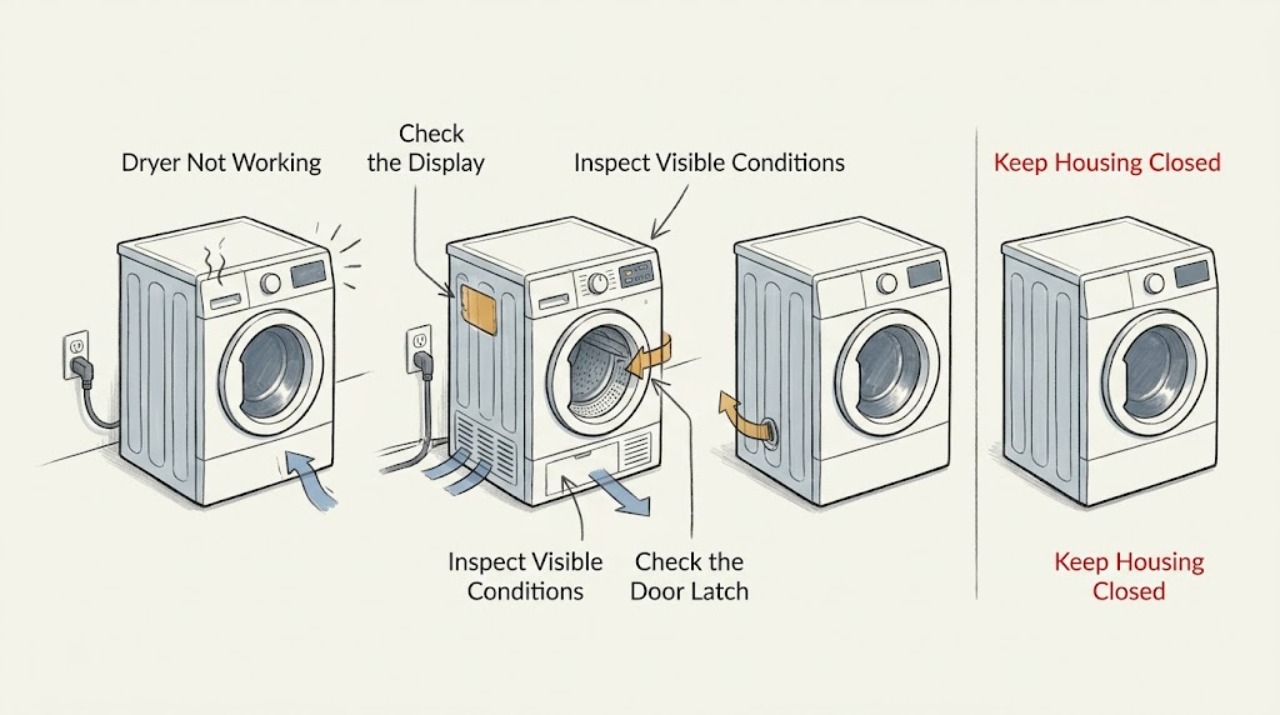
Work through in order
Diagnostic checks
Use only checks that match the exact appliance or system and its official guide.
-
Check 1
Try the power button once and note the exact state: no lights at all, a lit display with no response, a flashing start or padlock symbol, or a cycle that begins and stops.
Expected result: Record any displayed code, countdown, warning symbol, or water-tank indicator before changing settings.
Next step: Follow the matching power, control, or tank/drain branch below and keep the recorded symptom for service if the problem returns.
Stop if: Stop immediately if there is smoke, a burning smell, sparking, a visibly hot plug, a damaged cord or repeated power trips; do not continue operating the dryer.
Why this matters
Why: A dark panel makes the supply path the first branch; a lit panel narrows the check to controls, door interlock, programme conditions or a protection response. A code is model-specific evidence rather than proof of a particular failed part.
-
Check 2
With the dryer switched off, check that the plug is firmly seated and test the same outlet with a known-working appliance. Look at the breaker or RCD from the normal user position without removing covers.
Expected result: The other appliance works and no protective device has tripped, or the outlet is dead or the breaker/RCD trips again.
Next step: If the supply is normal, perform one model-directed reset: switch off, disconnect, wait for the period in the AEG manual, reconnect, and try once. If the supply is abnormal or trips again, stop and contact a qualified electrician; do not open the dryer.
Stop if: Do not replace an older fuse, remove an electrical cover, or perform live voltage tests unless you are a qualified professional working under the applicable safety procedure.
Why this matters
Why: A dead outlet or repeated trip is an installation or electrical-safety branch, not evidence that a dryer part should be replaced. If the outlet is live but the dryer remains dead, an internal fault becomes more likely.
-
Check 3
For a dryer with a lit control panel, close the door firmly and check the latch area for visible misalignment. Confirm that a drying cycle is selected and look for delayed-start, child-lock or energy-saving indications.
Expected result: The start control responds after the door is fully latched and the setting is cleared, or the door still will not enable a cycle and the panel remains locked or unresponsive.
Next step: Use the model manual for the exact lock or delayed-start control sequence, select a normal cycle and try once. If the latch or hinge is damaged, or the cycle still will not start after the settings check, arrange service.
Stop if: Do not force the door, defeat the interlock, tape a switch, or run the dryer with a damaged or misaligned door.
Why this matters
Why: AEG dryers inhibit starting when the door is not securely closed; delayed start, child lock and energy-saving mode can also make a working appliance appear inactive. A visibly broken hinge or latch can prevent the door switch from enabling.
-
Check 4
If the dryer starts and then stops, inspect only the user-accessible water tank and external drain route. Empty the tank if its indicator is lit, and check that an external hose is not twisted or kinked. Clean the lint filter and condenser only as the model manual allows.
Expected result: The tank indicator clears, the drain hose is free, or the filter/condenser is obstructed; alternatively, these checks are normal but the cycle still stops.
Next step: Restore the user-maintenance items, allow an overheated dryer to cool according to the model manual, and try one short supervised cycle. If it stops again, disconnect it and arrange service with the symptom and any code.
Stop if: Do not remove the cabinet, reach into moving or hot areas, bypass a thermal device, or keep running the dryer when it overheats, smells burnt or trips power.
Why this matters
Why: AEG says a full tank or drain problem can stop a cycle, and restricted airflow can prevent proper operation. A normal tank, drain and maintenance path shifts suspicion toward a sensor, protection response or internal fault rather than a blockage.
-
Check 5
After the external checks and one model-directed reset, compare the result with the AEG manual for the recorded code or symbol. Prepare the model identification, PNC or serial details if available, the failure mode, and what changed when the test was made.
Expected result: The dryer works normally, fails in the same way, or shows a code that the manual cannot resolve with user checks.
Next step: If it works, monitor the next cycle and keep the maintenance routine. If it fails again or the manual points to service, leave it disconnected and contact an AEG-authorised service centre with the recorded information.
Stop if: Do not dismantle internal components, probe live circuits, substitute an unverified part, or continue testing after a safety symptom.
Why this matters
Why: A one-time recovery suggests a temporary control or supply interruption, but a repeat failure or unresolved code needs diagnosis. A code alone does not justify ordering a control board, motor, sensor or other part without model-specific confirmation.
Use your observations
Decision map
Find the observation that best matches what you see, then follow the next safe action.
-
PATH 01Next step
What you see
The dryer remains dark after the plug, outlet and protective-device check.
Do this next
Keep it disconnected and arrange appliance service; if the outlet is dead or a breaker/RCD trips again, use a qualified electrician for the supply side.
-
PATH 02Next step
What you see
The panel lights but the start control flashes, a padlock or delay indicator is shown, or the door does not prove closed.
Do this next
Check the latch, selected cycle and model-specific lock or delay setting; a damaged hinge or persistent no-start requires service.
-
PATH 03Next step
What you see
The drum begins but the dryer stops with a tank, drain, airflow or overheating indication.
Do this next
Check the tank, external drain hose and permitted filter/condenser maintenance, then try one supervised cycle after the model-directed cool-down; recurring stops require service.
-
PATH 04Next step
What you see
The same failure returns, the code remains, or the manual does not provide a user check.
Do this next
Stop troubleshooting at the cabinet boundary, leave the dryer disconnected, and provide the model details, code, failure mode and checks to an authorised service centre.
-
PATH 05Next step
What you see
There is smoke, a burning odour, sparking, abnormal heat, a damaged cord or repeated breaker/RCD operation.
Do this next
Stop using the dryer. Disconnect it only if safe to do so, do not retry it, and seek qualified professional help.
Helpful context
Understand the symptom
Start by classifying what ‘not working’ means
A completely dark panel points toward the supply path or an internal power fault. A lit panel with no cycle is more often a door, lock, delay or programme condition. A cycle that begins and then stops can point to a full tank, restricted drain, overheating protection or airflow problem. This classification prevents replacing a part before the symptom has been separated.
Keep the checks external and model-specific
Use the controls and access panels intended for normal user maintenance only. AEG notes that settings, installation, maintenance and external factors can mimic a fault; the exact manual for the model takes precedence when a symbol or reset sequence differs.
Know when to stop
Do not open the cabinet, probe live wiring, bypass the door or thermal safety system, or keep retrying after smoke, burning odour, sparking, a hot plug or repeated breaker or RCD trips. Disconnect the appliance only if this can be done safely, leave it unused, and use an authorised appliance technician or qualified electrician as appropriate.
Only after diagnosis
Potential parts
- dryer door latch or hinge
Consider this category only when the door is visibly misaligned or damaged and the dryer will not recognise a closed door; the support guidance directs a broken hinge to service.
Confirm the exact AEG model and manufacturer fit information before ordering; do not bypass the door interlock. - dryer lint filter or condenser assembly
Consider this category only when the relevant user-maintenance component is damaged or missing after the airflow check; a dirty component should be cleaned, not automatically replaced.
Use the model manual and exact appliance identification to confirm the correct component and whether replacement is user-serviceable. - dryer power or control component
This is a service-diagnosis category only when the outlet is confirmed good and the dryer remains dead or unresponsive after the model-directed reset; the symptoms do not identify a specific board or component.
Do not order or fit an internal electrical component from the symptom alone; an authorised technician must confirm model fit and fault safely.
When checks do not resolve it
Need a professional?
Call an authorised appliance service centre when the dryer remains dead after a confirmed-good outlet and one model-directed reset, will not start with a damaged or misaligned door, stops repeatedly after tank/drain/airflow checks, or displays an unresolved code. Use a qualified electrician for a dead outlet or repeated breaker/RCD trips. Stop immediately for smoke, burning odour, sparking, abnormal heat or a damaged cord; disconnect only if safe and do not use the dryer until it has been checked.
Safety scope: The reader should not open the cabinet, perform live electrical tests, bypass the door or thermal interlock, or continue using the appliance after smoke, burning odour, sparking, abnormal heat or repeated power trips.
Common questions
FAQ
Why is my AEG dryer completely dead?
Check the plug, outlet and breaker or RCD from outside the appliance, then perform only the reset described in the model manual. If the outlet is good but the dryer remains dark, leave it disconnected and arrange service rather than opening the cabinet.
Why does my AEG dryer have power but not start?
Make sure the door is fully latched, a cycle is selected, and delayed start, child lock or energy-saving mode is not active. A damaged hinge or persistent no-start after the model-specific settings check needs service.
Why does the AEG dryer start and then stop?
Check the water tank, external drain hose and permitted lint-filter or condenser maintenance. A full tank, restricted drain or poor airflow can stop operation; a repeat stop after those checks should be diagnosed by service.
Should I keep trying an AEG dryer that smells hot or trips the power?
No. Stop using it, disconnect it only if safe, and seek qualified professional help. Do not bypass safety devices or perform live internal tests.
Read the exact guide
Official sources
- Tumble dryer has no powerAEG Support · AEG support guidance for a dryer that seems dead, does not react to the power button, or does not light up.
- What to check before contacting AEG consumer serviceAEG Support · AEG's general pre-service checklist for external supply, restart, maintenance, error documentation, model documentation and safe escalation.
- Tumble dryer does not start / does not workAEG Support · AEG support guidance for tumble dryers that do not start, appear not to work, have a blank display, or stop without an error message.
Community feedback
Share a repair observation
Share a plain-text repair observation. Accepted observations are published automatically; this page may take a moment to update.