
On this page
Start here
Quick answer
First identify whether the complaint is detergent left in the main dispenser or rinse aid not being released; they use different checks. For detergent, Amana says a pan handle, utensil, rack, overfilled compartment, caked or damp detergent, or an obstructed door can stop the dispenser opening or keep water from reaching it. Load so the lid can open, use automatic dishwasher detergent according to the package and model manual, and keep the compartment dry before filling. For rinse aid, confirm the reservoir is filled and use the model's adjustment guidance; this affects drying and spotting more than the main wash. If the dispenser is cracked, detached, still blocked after a safe cleaning and loading correction, or the dishwasher leaks or needs internal access, stop and arrange model-specific service rather than ordering a generic part.
Before you begin
Safety first
- This article covers identifying the dispenser symptom, external loading checks, ordinary-access residue and dryness checks, model-directed detergent and rinse-aid use, and service handoff. It does not authorize door disassembly, actuator or wiring tests, latch bypass, live electrical work, or generic part replacement.
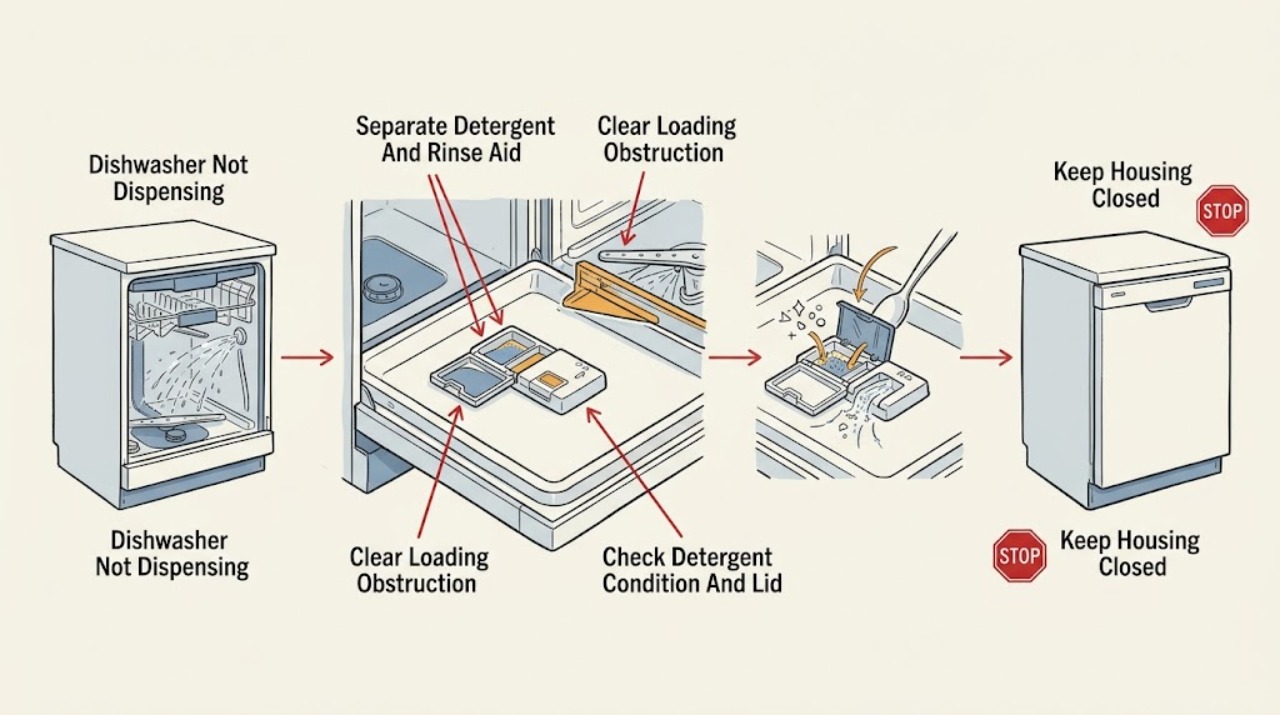
Work through in order
Diagnostic checks
Use only checks that match the exact appliance or system and its official guide.
-
Check 1
After the cycle is complete and the dishwasher is not running, identify what is not dispensing: detergent remains in the main cup, the detergent door stayed closed, rinse aid level does not change over normal use, or the real symptom is poor cleaning or wet dishes. Record whether the complaint is about the main wash or final rinse.
Expected result: The main detergent cup is full, the lid is closed or partly open, rinse aid is unchanged, or only drying and spotting performance is poor.
Next step: Use the detergent-door and detergent-condition checks for a full cup or closed lid. Use the rinse-aid checks for an unchanged reservoir or final-rinse symptom, and consult the model manual for any indicator behavior.
Stop if: Stop if the door, inner panel, seal, or dispenser is cracked, loose, leaking, or requires forced movement.
Why this matters
Why: These are different paths. Detergent release depends on a door that can open and a water path that can reach it; rinse aid release is a separate reservoir and adjustment question. Poor cleaning alone does not prove that detergent never dispensed.
-
Check 2
With the racks pulled out and the door open, check that no pan handle, utensil, dish, or rack position touches the detergent lid. Confirm that the middle spray arm can turn freely by hand while the dishwasher is idle, and reposition only the load or rack setting allowed by the model instructions.
Expected result: An item touches the dispenser, the upper rack is low enough to block it, the spray arm is obstructed, or the dispenser area is clear.
Next step: Rearrange the item or rack so the lid and spray arm have clearance, then use one normal cycle to observe the result. If the area was clear or the dispenser still remains full, continue to the detergent-condition check.
Stop if: Stop if an arm will not turn because of a mechanical obstruction that cannot be safely removed, if the dispenser is loose, or if movement would damage the door or rack.
Why this matters
Why: Amana says blocked items can keep the detergent door from opening and that a rack can block it in some positions. A blocked spray arm or water path can delay release and leave detergent residue even when the latch itself is intact.
-
Check 3
Inspect the main detergent compartment with the dishwasher idle. If powder or gel is caked, if the cup is wet, or if old detergent has clumped, remove only loose residue with a soft cloth and follow the model manual for cleaning. Fill with the automatic dishwasher detergent type and amount specified by the package and manual, without overfilling, and close the lid until it clicks normally.
Expected result: The cup is wet, detergent is caked or clumped, the compartment was overfilled, the lid now closes freely, or the lid still will not close or open.
Next step: Dry and clean only the ordinary-access dispenser surfaces, use fresh correctly stored detergent, and run one normal cycle. If the lid still cannot close or open, leave it unused and arrange service for the exact model.
Stop if: Stop for a broken dispenser, sharp plastic, water leaking into the door, a latch that requires force, or any need to access the actuator or wiring.
Why this matters
Why: Amana attributes poor release to wet or old detergent that sticks, caked detergent that interferes with closing, and overfilling that can bind the latch. A lid that remains mechanically broken or stuck after residue removal is not resolved by changing detergent.
-
Check 4
If the symptom is rinse aid rather than the detergent cup, check the rinse-aid reservoir level and lid while the dishwasher is idle. Refill only with the product specified by the model manual and use the manual's adjustment method; do not pour detergent into the rinse-aid reservoir or force the cap.
Expected result: The rinse-aid reservoir is empty or low, the level does not change over normal use, the adjustment is at a low setting, or the reservoir leaks or cannot close.
Next step: Refill and adjust only as the exact manual describes, then observe normal use. If the reservoir remains unchanged, leaks, or the symptom persists, stop and request service; do not replace the dispenser without model confirmation.
Stop if: Stop if rinse aid spills into electrical areas, the reservoir is cracked, the cap will not close, or a leak appears inside the door.
Why this matters
Why: Amana says rinse aid improves drying and reduces water spots and filming, and that the release amount can be adjusted. A reservoir that is full but never changes, leaks, or cannot close points to a model-specific dispenser issue rather than simply low rinse aid.
-
Check 5
For an unresolved dispenser complaint, record the exact model, whether detergent or rinse aid is affected, the dispenser and lid position after the cycle, loading obstructions, detergent condition, rinse-aid level or setting, spray-arm clearance, and any leak or door damage. Do not run repeated cycles with extra product.
Expected result: A documented loading, cleaning, detergent, or rinse-aid correction restores release; the same symptom returns; or the dispenser remains mechanically stuck or damaged.
Next step: Use the dishwasher normally only if it completes a cycle without leaks or abnormal behavior. Otherwise leave it off and provide the record to an Amana service provider.
Stop if: Stop for a leak, exposed wiring, a damaged inner door, repeated latch failure, or any need to remove panels or test the dispenser circuit.
Why this matters
Why: A successful low-risk correction narrows the cause but does not prove the dispenser actuator, inlet path, or control is healthy. A recurring or mechanically damaged dispenser needs model-specific diagnosis and possibly a model-specific replacement.
Use your observations
Decision map
Find the observation that best matches what you see, then follow the next safe action.
-
PATH 01Safety boundary
What you see
Detergent remains in the main cup and a pan handle, utensil, dish, rack, or excess detergent prevents the lid from opening or closing.
Do this next
Rearrange the load or rack, remove excess detergent, and run one normal cycle. If the lid still sticks or remains closed, arrange service.
Why this path and its safety boundary
Why it matters: Loading or latch obstruction is more likely than a failed dispenser motor or control. Amana specifically links blocked items and overfilling with a door that cannot open or close.
Safety stop: Do not pry the lid, bend the dispenser, bypass the latch, or remove the inner door.
-
PATH 02Safety boundary
What you see
The lid can move, but detergent is wet, old, clumped, caked, or left in the cup after the cycle.
Do this next
Clean ordinary-access residue with the model-approved method, dry the compartment, use fresh correctly stored detergent, and observe one normal cycle.
Why this path and its safety boundary
Why it matters: Moisture and detergent residue can make detergent stick or interfere with the lid, while a clear dispenser shifts attention to water access and service rather than a guaranteed component fault.
Safety stop: Do not scrape with metal tools, flood the door, or continue if the dispenser is cracked or leaks.
-
PATH 03Safety boundary
What you see
The detergent cup opens normally, but rinse aid remains unchanged or drying and spotting symptoms persist despite a full reservoir.
Do this next
Check the rinse-aid level and use only the exact manual's adjustment step. If the reservoir does not change, leaks, or remains full after normal cycles, arrange service.
Why this path and its safety boundary
Why it matters: This is a final-rinse reservoir and adjustment path, not proof that the main detergent dispenser failed. Amana also notes that level and cabinet squareness affect wash and sealing conditions.
Safety stop: Do not add detergent to the rinse-aid cup, force its cap, or disassemble the door.
-
PATH 04Safety boundary
What you see
Loading, detergent-condition, and manual-approved rinse-aid checks do not restore release, or the dispenser door is cracked, detached, or mechanically stuck.
Do this next
Leave the dishwasher unused if it leaks or cannot close, record the exact model and observations, and contact an Amana service provider for model-specific diagnosis.
Why this path and its safety boundary
Why it matters: A dispenser door, actuator, water path, wiring, or control issue remains possible, but the symptom does not identify a safe replacement part.
Safety stop: Do not order a generic dispenser, remove panels, probe wiring, or run repeated cycles with extra detergent.
Helpful context
Understand the symptom
Not dispensing can mean detergent or rinse aid
A detergent cup that is still full after a completed cycle is mainly a door, loading, detergent-condition, or water-access question. Rinse aid is released during the final rinse and its absence is more likely to show as wet dishes, spots, or filming. Check the correct reservoir before changing settings or assuming the dispenser assembly has failed.
The dispenser needs an unobstructed door and water path
Large pans, utensil handles, or a low upper rack can hold the detergent lid closed or prevent spray water from reaching it. Excess powder can also keep the lid from closing or make the latch bind. A clean, dry compartment and the detergent type and amount stated by the package and model manual are safer first corrections than scraping or forcing the mechanism.
When a dispenser problem is no longer an owner adjustment
If the door is cracked, detached, or still does not open after loading and residue checks, the exact model determines whether the door or dispenser assembly can be replaced. Do not remove the inner door, bypass the latch, probe the dispenser actuator, or order a part from the symptom alone. Arrange service if the dishwasher leaks, will not close, or needs internal access.
Safety boundary
Stop conditions
- Do not pry, bend, or bypass the detergent door or dishwasher door latch.
- Do not remove the inner door, probe the dispenser actuator, test wiring, or perform live electrical work.
- Do not mix detergent and rinse aid, overfill either reservoir, or run repeated cycles with extra product.
- Do not operate with a leaking dispenser, damaged seal, cracked door component, or water near electrical parts.
- Do not order a dispenser door, actuator, control, valve, or other part until the exact model and failed component are confirmed.
When checks do not resolve it
Need a professional?
Contact an Amana service provider when the detergent lid remains closed or mechanically damaged after safe loading and residue checks, detergent or rinse aid still does not release after the model-approved correction, the reservoir leaks, the dishwasher cannot close or seal, or diagnosis would require removing the inner door, testing an actuator or wiring, or replacing a dispenser assembly. Stop immediately for water entering electrical areas, exposed wiring, a sharp or detached dispenser part, or any need to force a latch.
Safety scope: This article covers identifying the dispenser symptom, external loading checks, ordinary-access residue and dryness checks, model-directed detergent and rinse-aid use, and service handoff. It does not authorize door disassembly, actuator or wiring tests, latch bypass, live electrical work, or generic part replacement.
Common questions
FAQ
Why is detergent still in my Amana dishwasher dispenser?
Check whether a pan handle, utensil, dish, or rack blocks the lid; whether the compartment is overfilled, wet, or caked; and whether the spray arm can reach the dispenser. Amana says these conditions can keep the door closed or make detergent stick. If the cup remains full after one documented correction, arrange service.
Could the upper rack stop an Amana detergent dispenser from opening?
Yes. Amana notes that items and, on some configurations, a low upper rack can block the detergent dispenser. Rearrange the load or rack only as the Use and Care Manual permits, then observe one normal cycle.
What should I check if Amana rinse aid is not dispensing?
Confirm that the rinse-aid reservoir is filled and use the exact model's adjustment guidance. Rinse aid mainly affects drying, water spots, and filming. If a full reservoir remains unchanged, leaks, or cannot close, stop and arrange service.
When does an Amana dishwasher dispenser need service?
Arrange service when the dispenser door is cracked, detached, or stuck after safe loading and residue checks, when detergent or rinse aid still does not release, or when the dishwasher leaks or needs door-panel or electrical access. Do not choose a replacement dispenser from the symptom alone.
Read the exact guide
Official sources
- Detergent Door will Not Open - DishwasherProduct Help | Amana · Official Amana Product Help article for dishwasher detergent-door concerns; rack layouts and dispenser designs vary by model.
- Detergent Remains at End of Cycle - DishwasherProduct Help | Amana · Official Amana Product Help article for detergent remaining after a cycle; exact dispenser and rack configurations vary by model.
- Detergent Door will Not Close - DishwasherProduct Help | Amana · Official Amana Product Help article; exact dispenser construction and replacement procedure depend on model.
- Not Dispensing Rinse Aid - DishwasherProduct Help | Amana · Official Amana Product Help article; rinse-aid layouts, settings, and leveling details vary by model.
Community feedback
Share a repair observation
Share a plain-text repair observation. Accepted observations are published automatically; this page may take a moment to update.