
On this page
Start here
Quick answer
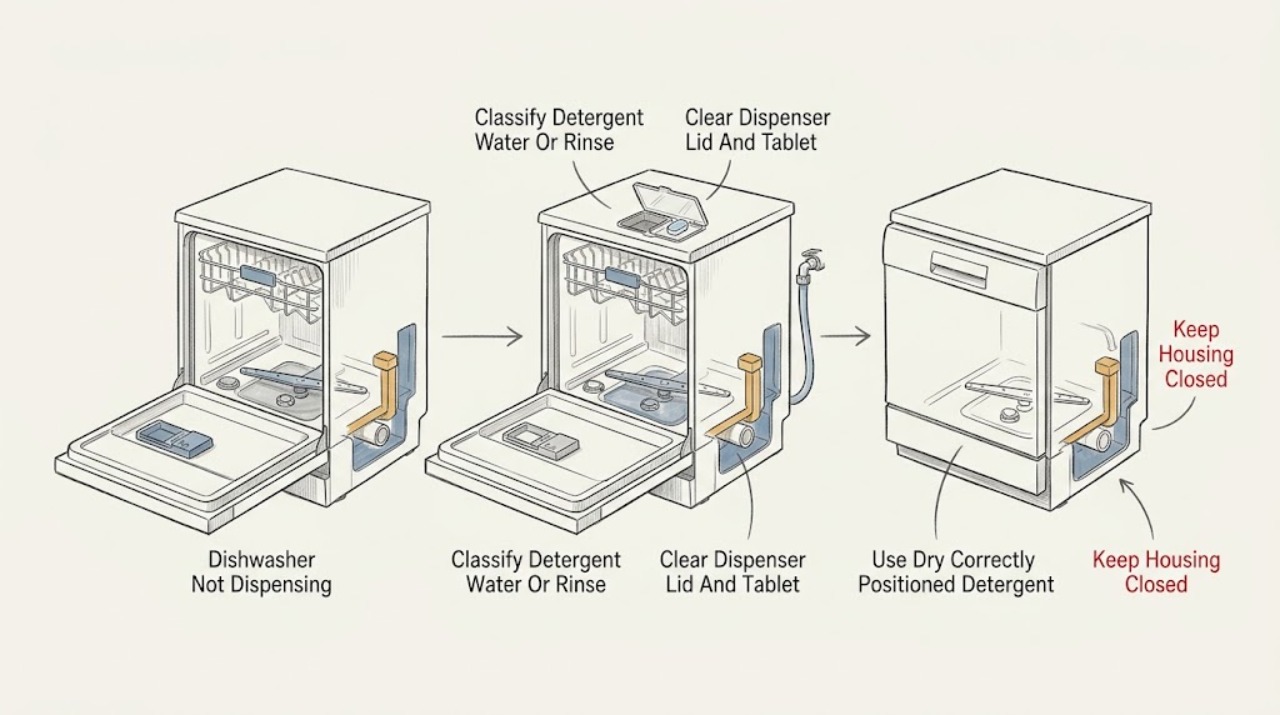
If a Bosch dishwasher is not dispensing detergent, first check whether the dispenser lid or tablet collecting tray was blocked by dishware, whether the tablet was placed flat, and whether the dispenser was dry. Bosch's official guidance says the dispenser opens automatically at the programmed time and that spray arms must rotate freely so water can reach and dissolve the detergent. With power isolated, rearrange any item blocking the lid or tray, clean accessible residue, check the spray arms and nozzles, and use the exact model manual for safe removal and refitting. If you mean that the dishwasher is not dispensing or drawing wash water, check the water supply and visible inlet hose instead; Bosch identifies water-supply, inlet-valve, float, and door-switch conditions as possible causes. If the dispenser stays closed after a correctly loaded test, water still does not enter, an error returns, there is standing water or a leak, or the dishwasher trips power, stop and arrange qualified Bosch service rather than replacing a dispenser or valve based on the symptom alone.
Before you begin
Safety first
- This article covers load clearance, dry detergent placement, removable spray arms and accessible filters, visible water-supply checks, model-manual lookup, and symptom recording. A qualified technician must handle live electrical tests, dispenser or inlet circuits, pumps, floats, door switches, wiring, controls, leaks, and panel removal.
Work through in order
Diagnostic checks
Use only checks that match the exact appliance or system and its official guide.
-
Check 1
After the cycle has ended and the dishwasher is safe to open, note whether detergent remains in a closed dispenser, is stuck in the tablet tray, is partly dissolved in the tub, or whether the tub has little or no wash water. Do not reach into a running dishwasher or handle hot water.
Expected result: The dispenser lid stayed closed, detergent is trapped in the tray, detergent is present but the spray arms appear not to have washed it away, or the dishwasher did not fill or spray water.
Next step: Follow the dispenser and loading checks for residue. If the machine is not filling or spraying, continue to the water-supply and spray-arm checks and record any displayed message.
Stop if: Stop for a leak, standing water near electrical parts, smoke, burning smell, a damaged cord, repeated trips, or hot water or steam that makes inspection unsafe.
Why this matters
Why: A closed lid points toward loading, dispenser dryness, or a dispenser mechanism. Detergent in the tray or partly dissolved points toward tray placement, cycle time, or water distribution. An empty or dry tub points toward the separate water-inlet, door, or wash-system path rather than detergent placement alone.
-
Check 2
With the dishwasher switched off and safe to handle, inspect the upper rack and tablet collecting tray. Move any plate, pan handle, fragrance dispenser, or other item that could block the detergent lid or tray, clean accessible detergent residue, and confirm the lid can close and latch normally. Do not force or dismantle the dispenser.
Expected result: Dishware blocks the lid or tray, the dispenser is dirty or sticky, the lid closes and latches normally, or the lid is cracked, loose, or mechanically damaged.
Next step: Rearrange the load and clean only accessible residue, then close the dispenser and run one suitable model-approved test. If the lid will not latch or remains closed after a clear load, arrange qualified service.
Stop if: Do not force a dispenser hinge, bypass its latch, insert tools into the mechanism, or operate with broken plastic or exposed parts.
Why this matters
Why: A loading obstruction can stop the automatic release even when the detergent compartment itself is intact. Residue can interfere with movement. A damaged or mechanically abnormal lid keeps a dispenser fault in view and is not solved by adding more detergent.
-
Check 3
For the next controlled test, use only dishwasher detergent and follow the exact model manual and detergent label. Put the tablet flat in the dispenser or use the instructed powder or liquid amount, and make sure the dispenser is dry before adding detergent. Do not put a tablet or other object in the collecting tray unless the model specifically instructs it.
Expected result: The tablet was upright, the dispenser was damp, detergent was clumped or old, the cycle was short, or the detergent was correctly positioned in a dry dispenser.
Next step: Correct only the loading or detergent condition and run one suitable cycle. If detergent still remains with a correctly positioned load, continue with the spray-arm and water checks rather than increasing the dose or changing internal parts.
Stop if: Do not use hand soap, unsuitable chemicals, excessive detergent, a wet water-soluble pouch, or any product that causes foam or a leak.
Why this matters
Why: Bosch says a flat tablet and a dry dispenser help the automatic release and dissolution process. A short cycle may not provide enough time for a tab to dissolve, while a correctly loaded dry dispenser shifts suspicion toward blocked water distribution or dispenser operation if residue returns.
-
Check 4
With power disconnected, turn the removable spray arms by hand to confirm they are not blocked by dishware, then inspect accessible nozzle holes and filters as shown in the exact model manual. Also confirm the water supply valve is open and the visible inlet hose is not kinked or damaged; do not move a fixed dishwasher or open an inlet valve.
Expected result: A spray arm cannot rotate, nozzles or filters contain food residue, the inlet hose is kinked or damaged, the water supply is off, or the arms, filters, hose, and supply appear normal.
Next step: Clear only reachable spray-arm or filter residue, refit parts correctly, restore an obviously closed supply valve, and run one test. If water still does not enter or detergent remains, stop and arrange qualified service.
Stop if: Do not reach into a pump, remove hidden hoses, use drain chemicals, operate without filters, or handle water near electrical components.
Why this matters
Why: Blocked spray arms or nozzles can prevent water from reaching the detergent, while a restricted or absent water supply can leave the wash system dry. A clear path with recurring residue or no fill makes an internal pump, inlet, float, door-sensing, or control fault more likely without identifying one specific part.
-
Check 5
Read the Bosch dishwasher model number from its rating label or documentation and use the corresponding owner manual or support path. Record whether the dispenser lid opened, the detergent position and condition, spray-arm movement, water entry, standing water, and any display or error indication after one controlled test.
Expected result: The detergent dispenses normally after the visible correction, or the lid remains closed, detergent remains, the dishwasher does not fill or spray, or an error returns.
Next step: Continue normal use only if the model-approved cycle completes without a safety symptom. Otherwise keep the dishwasher off, retain the observed error or residue pattern, and arrange Bosch or qualified appliance service.
Stop if: Do not open the door panel, test a dispenser or inlet circuit live, bypass the door or float switch, or order an internal part without model-specific diagnosis.
Why this matters
Why: A successful corrected cycle supports a loading, dryness, cycle, or accessible spray-path explanation. A repeatable failure after those checks needs model-specific diagnosis; the symptom alone does not prove a dispenser solenoid, inlet valve, pump, float, latch, or control failure.
Use your observations
Decision map
Find the observation that best matches what you see, then follow the next safe action.
-
PATH 01Safety boundary
What you see
Detergent remains in a closed dispenser and a plate, pan handle, tray, or other item obstructs the lid or tablet collecting tray.
Do this next
Rearrange the upper rack and tray, clean accessible residue, latch the dispenser normally, and test one model-approved cycle.
Why this path and its safety boundary
Why it matters: A loading obstruction is more likely than a proven dispenser-electrical fault because the automatic lid cannot open or the released tablet cannot fall into its intended tray.
Safety stop: Do not force the lid, bend the rack, or bypass the dispenser mechanism.
-
PATH 02Safety boundary
What you see
The dispenser opens or the tablet reaches the tray, but detergent remains because the tablet was upright, the dispenser was damp, the tray was blocked, or the cycle was short.
Do this next
Use a dry dispenser, place the tablet flat, clear the tray and spray-arm path, and choose a suitable model-approved cycle for one test.
Why this path and its safety boundary
Why it matters: Detergent placement, moisture, tray obstruction, cycle time, or water distribution is more likely than a lid that never opened.
Safety stop: Do not add excess detergent, put unrelated objects in the tray, or use unsuitable chemicals.
-
PATH 03Safety boundary
What you see
The dispenser and load are normal, but the tub has little or no wash water or the spray arms and nozzles show no sign of water distribution.
Do this next
Check the water valve and visible inlet hose, spray-arm rotation, and accessible filters with power isolated. If water still does not enter or spray, arrange Bosch service.
Why this path and its safety boundary
Why it matters: A water-supply, inlet-hose, inlet-valve, float, door-sensing, pump, or control condition is more likely than a detergent-dispenser placement problem; external observations cannot select the failed component.
Safety stop: Stop for a leak, standing water near electrical parts, damaged hose, or any need to access an internal valve, pump, float, or wiring.
-
PATH 04Safety boundary
What you see
The load, dry detergent placement, dispenser clearance, spray arms, filters, water valve, and visible hose are normal, but detergent still is not dispensed or the dishwasher repeatedly fails to fill or spray.
Do this next
Keep the dishwasher off and provide Bosch service with the model number, cycle, dispenser position, water level, spray-arm observation, and any error indication.
Why this path and its safety boundary
Why it matters: An internal dispenser mechanism, inlet, pump, sensor, door switch, or control fault is more likely than a user-accessible obstruction, but no specific replacement part is established.
Safety stop: Do not dismantle the inner door or base, perform live tests, bypass safety switches, or repeatedly run a faulty cycle.
Helpful context
Understand the symptom
First identify what is not dispensing
A detergent tablet or powder left in the dispenser after a cycle is different from a dishwasher that never fills or sprays water. Bosch's guidance treats the dispenser, tablet tray, spray arms, water supply, and door state as separate observations. Start with the residue and dispenser position, then use the water-inlet path only if the machine is not filling or the spray system is dry.
Loading can block the dispenser at the exact time it must open
The opened Bosch manual says the dispenser releases detergent automatically during the cycle and warns that dishware can obstruct its lid or the tablet collecting tray. A flat tablet in a dry dispenser and clear space around the lid allow the programmed release to happen. A short cycle can also leave a tab partly dissolved because there is less time for it to dissolve; use the model instructions before changing cycles or detergent.
Water distribution determines whether released detergent dissolves
If the dispenser opens but detergent remains, Bosch directs attention to spray-arm rotation and blocked nozzles. Clean only the removable parts and accessible nozzles described by the exact manual with power disconnected. Persistent no-fill, no-spray, leak, or error symptoms move beyond a detergent check and need service diagnosis.
Safety boundary
Stop conditions
- Stop using the dishwasher for a leak, water near electrical parts, smoke, burning smell, sparking, a damaged cord, repeated electrical trips, or a persistent safety or error indication.
- Disconnect power before cleaning removable spray arms, filters, or accessible detergent residue, and close the water supply before a hose check that could release water.
- Do not bypass the door, float, or dispenser safety mechanism; do not remove panels, access live wiring, reach into a pump, or force a stuck lid or spray arm.
- Do not select a dispenser, inlet valve, pump, solenoid, sensor, or control part from the symptom alone; obtain model-specific diagnosis first.
When checks do not resolve it
Need a professional?
Safety scope: This article covers load clearance, dry detergent placement, removable spray arms and accessible filters, visible water-supply checks, model-manual lookup, and symptom recording. A qualified technician must handle live electrical tests, dispenser or inlet circuits, pumps, floats, door switches, wiring, controls, leaks, and panel removal.
Common questions
FAQ
Why is detergent still in my Bosch dishwasher dispenser?
Check whether dishware blocked the dispenser lid or tablet tray, whether the dispenser was damp, and whether the tablet was placed flat. With power disconnected, clear accessible residue and obstructions, then test one model-approved cycle.
Can a dish block the Bosch detergent dispenser?
Yes. Bosch says dishware can obstruct the dispenser lid or tablet collecting tray. Rearrange the load so the lid and tray are clear; do not force the dispenser or place objects in the collecting tray unless the exact manual says to.
Why does a Bosch dishwasher tablet not dissolve?
A blocked tray or spray arm, an upright tablet, a damp dispenser, or a short cycle can leave residue. Clean and refit accessible parts with power isolated, place the tablet flat in a dry dispenser, and use the model's cycle guidance.
What if my Bosch dishwasher is not dispensing water?
Treat that as a water-flow symptom rather than a detergent-lid problem. Check the water supply valve and visible inlet hose, and note whether the tub fills or spray arms move. Bosch identifies inlet, float, and door-switch conditions as possible causes; persistent no-fill needs service.
When should I call Bosch service for a dispenser problem?
Arrange service when the dispenser remains closed after loading and detergent checks, water will not enter or spray, an error returns, there is a leak or standing water, or diagnosis would require the inner door, pump, valve, wiring, or control to be opened.
Read the exact guide
Official sources
- Dishwasher tab not dissolvingBosch · Official Bosch dishwasher support page; country-specific layout may vary, so the exact model manual controls access and cycle details.
- Dishwasher Troubleshooting: Dishwasher is not getting waterBosch Home Appliances · Official Bosch US dishwasher support page; it applies when the appliance is not drawing wash water, not as proof of a detergent-dispenser failure.
- Use and Care Manual SHP65CC5UC | BoschBosch Home Appliances · Official Bosch US dishwasher manual for SHP65CC5UC; use the exact dishwasher model manual when dispenser design or cycle behavior differs.
- Bosch Dishwasher Troubleshooting & Repair Guide | Bosch – Fix Common Dishwasher ProblemsBosch Home Appliances · Official Bosch US dishwasher troubleshooting guide; use the exact owner manual for model-specific controls and disassembly limits.
- Bosch Owner Support for Dishwashers | Bosch – Error Codes, Parts, Repairs, Troubleshooting, Cleaning & MaintenanceBosch Home Appliances · Official Bosch US dishwasher support hub; use the appliance model number to select the applicable manual and service path.
Community feedback
Share a repair observation
Share a plain-text repair observation. Accepted observations are published automatically; this page may take a moment to update.