
On this page
Start here
Quick answer
For detergent left in an LG dishwasher dispenser, first distinguish a dispenser lid that never opened from detergent that stayed behind after opening. Keep the compartment dry, use the amount and type specified for the model, and keep tall dishes or a low upper rack from blocking the lid. An empty-cycle test that still leaves the dispenser closed points to service rather than a detergent change.
Before you begin
Safety first
- Disconnect power before cleaning only accessible residue. Do not force the latch, remove panels, or probe dispenser wiring. Stop immediately for a leak or burning/electrical smell.
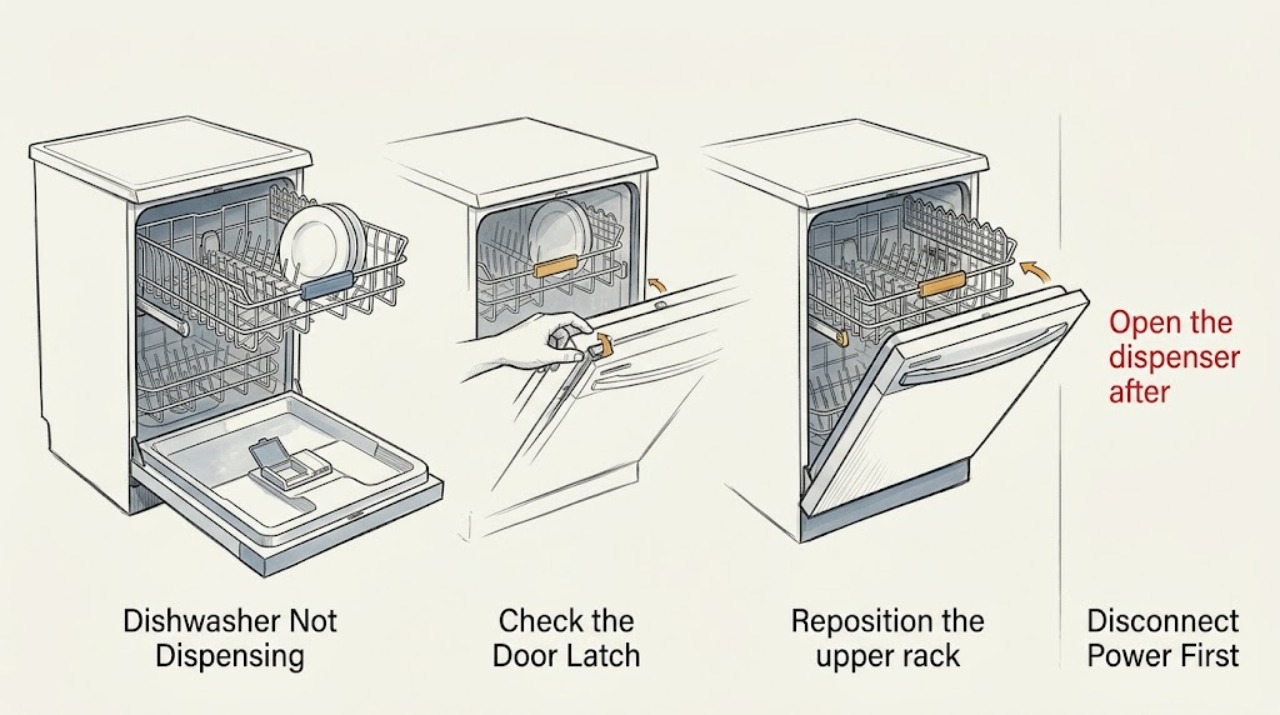
Work through in order
Diagnostic checks
Use only checks that match the exact appliance or system and its official guide.
-
Check 1
Open the dispenser after the cycle and note whether its lid opened, whether the detergent is dry or pasted in place, and which cycle was selected.
Expected result: The lid is closed; the detergent is hardened or wet; a small amount remains; or the Quick cycle was used.
Next step: Continue with the matching physical check; do not add more detergent to the same load or assume a closed lid is a failed pump.
Why this matters
Why: A blocked lid, moisture or clumping, excess detergent, and a cycle that does not include a rinse lead to different corrections.
-
Check 2
Before the next load, wipe water from the dispenser and your hands, use the detergent type and amount specified in the LG manual, and close the lid until its latch engages.
Expected result: The compartment stays dry and the lid clicks shut, or detergent still sticks, overflows, or leaks before the cycle starts.
Next step: Do not force the latch. If the lid will not close securely or detergent leaks before operation, stop loading detergent and arrange inspection.
Why this matters
Why: Drying the compartment and using the model-approved amount removes common moisture and overfill causes; a lid that will not latch is a separate mechanical issue.
-
Check 3
Reposition the upper rack and any tall plate, pan, or utensil near the dispenser so the lid has clear space to open and the spray path is not blocked.
Expected result: The rack is in its lowest position, a large item is in front of the dispenser, or the lid opens freely after the load is rearranged.
Next step: Run one test load with the dispenser unobstructed. If the symptom disappears, keep that load pattern; if the lid remains closed, perform the empty-cycle test.
Why this matters
Why: LG documents that rack position and large items can prevent the lid from opening fully or keep water spray from reaching the compartment.
-
Check 4
Run an empty cycle with the dispenser loaded according to the model instructions, then inspect whether the lid opened and the compartment emptied.
Expected result: The dispenser opens and empties when nothing blocks it, or it stays closed or leaves the detergent behind.
Next step: If it fails the empty test, stop at external checks and request model-specific repair. Do not remove panels or probe the dispenser wiring.
Why this matters
Why: Opening during an empty test points to loading or rack interference; failure in the unobstructed test points to a dispenser or control problem that is not safely identified from the symptom alone.
Use your observations
Decision map
Find the observation that best matches what you see, then follow the next safe action.
-
PATH 01Next step
What you see
The lid opens in an empty cycle but not with dishes loaded
Do this next
Use the owner's loading pattern, raise or reposition the upper rack as allowed by the model, and keep the area in front of the lid clear.
Why this path and its safety boundary
Why it matters: A rack position or tall item is blocking the dispenser rather than the dispenser mechanism being proven faulty.
-
PATH 02Next step
What you see
The lid opens but wet, hardened, or excessive detergent remains
Do this next
Clean and dry the accessible compartment, use the model-approved detergent amount, and avoid adding detergent to a cycle that LG says does not use it.
Why this path and its safety boundary
Why it matters: Moisture, clumping, excess product, or the selected cycle can explain residue without proving a failed dispenser.
-
PATH 03Next step
What you see
The dispenser stays closed during an unobstructed empty-cycle test
Do this next
Request qualified service and provide the model, detergent type, cycle, and result of the empty test.
Why this path and its safety boundary
Why it matters: The mechanical release or its control path needs model-specific inspection.
-
PATH 04Next step
What you see
There is a burning smell, a leak, a damaged latch, or repeated electrical symptom
Do this next
Stop using the dishwasher and arrange qualified service; do not force the lid or run another load to test it.
Why this path and its safety boundary
Why it matters: The issue has crossed the boundary for user-accessible dispenser checks.
Helpful context
Understand the symptom
Detergent left behind is not one diagnosis
A dispenser can be physically blocked by the load, can hold damp or hardened detergent, or can fail to open when the dishwasher is empty. The empty-cycle result is useful because it separates a loading problem from a mechanism that needs service.
When checks do not resolve it
Need a professional?
Request service when the dispenser stays closed during an empty-cycle test, the latch is damaged, detergent leaks before starting, or the symptom returns after the compartment and loading checks.
Safety scope: Disconnect power before cleaning only accessible residue. Do not force the latch, remove panels, or probe dispenser wiring. Stop immediately for a leak or burning/electrical smell.
Have this ready
- Provide the LG model number, detergent type, selected cycle, whether the lid opened, rack position, and empty-test result.
Common questions
FAQ
Why is detergent still in my LG dishwasher dispenser after a cycle?
Check whether the lid opened. A large dish or low upper rack can block it; moisture and hardened or excessive detergent can also remain. A Quick cycle may leave detergent because LG says it does not include a rinse.
Should I run the dishwasher empty to test the dispenser?
Yes, use the model instructions and an empty cycle as a functional check. If the lid opens empty, the loaded rack likely interfered; if it does not, arrange service rather than opening the appliance.
When should I stop troubleshooting the dispenser?
Stop if the lid fails the unobstructed empty-cycle test, will not latch, or there is a leak, electrical or burning smell, or damaged hardware. Request qualified service.
Read the exact guide
Official sources
- [LG Dishwasher] Detergent Remains in the DispenserLG USA Support · LG dishwasher detergent amount, moisture, residue, cycle, and loading guidance
- Dispenser Does Not Open CompletelyLG USA Support · LG dishwasher dispenser lid clearance, rack position, and empty-cycle test
- LG Dishwasher – Using Detergent and AdditivesLG USA Support · LG dishwasher detergent compartment dryness, lid latch, and approved detergent use
Community feedback
Share a repair observation
Share a plain-text repair observation. Accepted observations are published automatically; this page may take a moment to update.