
On this page
Start here
Quick answer
First identify what failed: a detergent cover that stays shut, detergent left in the cup after the cycle, a damp or caked product that does not dissolve, or rinse aid that is not released or needs refilling. Frigidaire says the detergent cup is designed to open automatically, but a dish or pan can block the cover or prevent spray-arm water from reaching it; fresh detergent stored dry is less likely to remain caked. A quick or fast cycle may have model-specific detergent placement instructions, so follow the exact manual rather than forcing the cover. The rinse-aid dispenser is next to the detergent cup on supported designs and releases a measured amount during the last rinse; check its level and do not overfill. With the dishwasher stopped and power isolated before handling the dispenser, clear only visible loading obstruction, wipe up detergent or rinse-aid spills, and arrange service if the latch, actuator, control, or dispenser still fails. Do not mix this diagnosis with a refrigerator or water dispenser issue.
Before you begin
Safety first
- The user may stop the cycle, isolate power before handling the dispenser or load, clear visible loading obstructions, use fresh model-approved products at documented amounts, wipe spills, and inspect model-documented accessible spray or filter areas. Qualified personnel must handle the dispenser assembly, latch actuator, dosing mechanism, sensor, wiring, controls, live testing, and any wet or electrically damaged appliance.
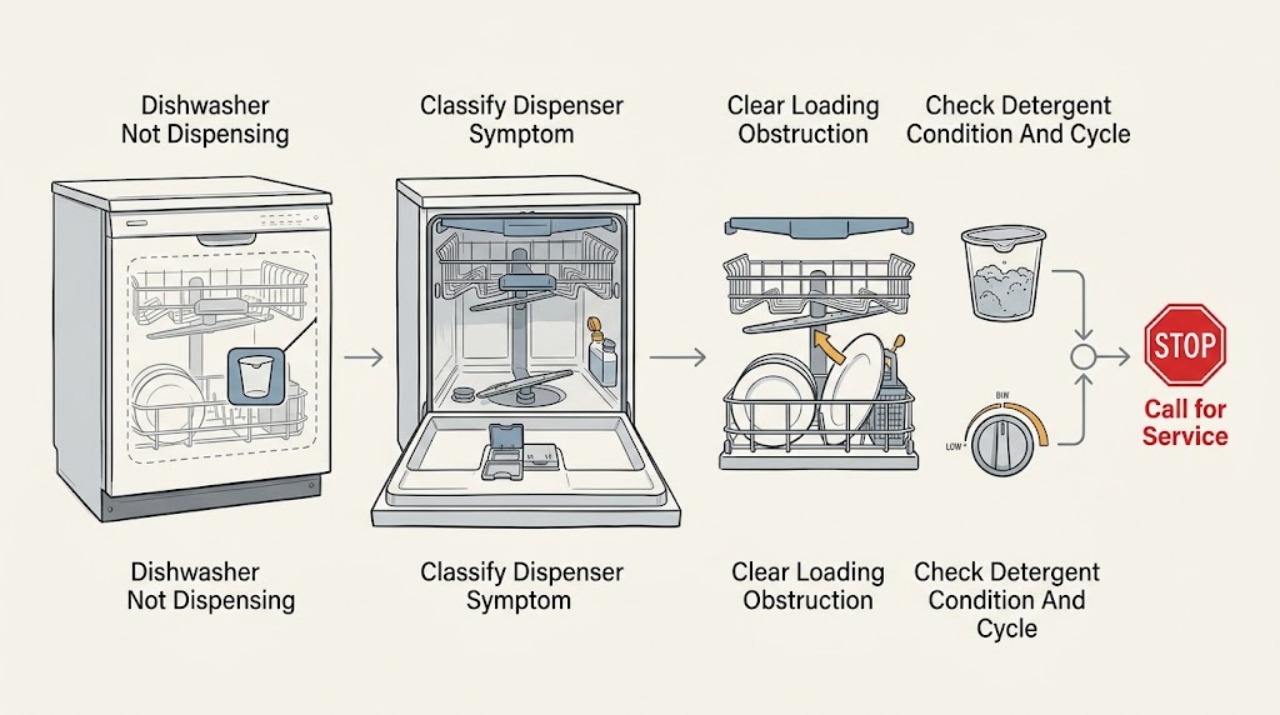
Work through in order
Diagnostic checks
Use only checks that match the exact appliance or system and its official guide.
-
Check 1
After the cycle is complete and the dishwasher is stopped, identify whether the failure concerns the main detergent cup, the rinse-aid reservoir, or both. Note whether the detergent cover is still closed, whether powder/tablet residue remains, whether the rinse-aid indicator shows a refill state, and which programme was used.
Expected result: The detergent cover is closed; the cover opened but detergent remains; detergent is damp or caked; rinse aid is low or unchanged; or the symptom occurs only on one cycle.
Next step: Follow the matching detergent-cover, detergent-residue, programme, or rinse-aid check. Keep the exact model manual available because dispenser layouts and cycle instructions vary.
Stop if: Do not insert tools into the latch, run a hand through a moving spray arm, mix cleaning chemicals, or handle detergent or rinse aid with wet hands near power.
Why this matters
Why: A closed cover points toward loading, cover/latch, programme, or actuator conditions. Residue after an opened cover points toward spray reach, detergent condition, water temperature, or cycle choice. Rinse-aid behavior follows a separate reservoir and last-rinse path.
-
Check 2
With the dishwasher stopped and safely isolated before handling the load, inspect the detergent cover and its visible opening area for a plate, pan, utensil, rack edge, or other item that could block free opening or spray-arm reach. Reposition only the visible load obstruction and close the door normally.
Expected result: A dish or pan was directly in front of the cover, the spray arm was shielded, the cover now opens freely by its normal latch action, or no loading obstruction is visible.
Next step: Run one model-approved cycle with the dispenser unobstructed and inspect the cover afterward. Escalate if the same obstruction-free failure returns.
Stop if: Do not force, pry, or hold the dispenser cover open, remove the latch, or place hands near moving spray components while powered.
Why this matters
Why: A clear obstruction can explain detergent left in the cup without a failed dispenser mechanism. If the cover remains shut after the load is clear, the latch, cover, programme, actuator, or control path becomes more likely.
-
Check 3
Inspect the detergent without touching it to your eyes or mouth: check whether powder is damp or caked, a packet is stuck, the product is fresh automatic-dishwasher detergent, and the amount follows the exact model and water-hardness guidance. Check whether the selected quick or fast programme has a separate tablet-placement instruction.
Expected result: The product is damp, caked, old, excessive, the wrong detergent type, or placed contrary to the selected cycle; or it is fresh, correctly dosed, and placed as directed.
Next step: Replace compromised detergent with fresh product, store it dry, follow the model's programme instruction, and make one normal observation. Do not increase the dose to compensate for residue.
Stop if: Do not use hand dish soap or other non-dishwasher detergent, mix products, exceed the fill line, or scrape caked detergent with a sharp tool.
Why this matters
Why: A product or programme mismatch can look like non-dispensing even after the cover opens. A fresh, correctly dosed product in the documented location with residue remaining points beyond product choice toward spray reach, water temperature, dispenser, or control.
-
Check 4
For a rinse-aid complaint, locate the reservoir next to the detergent cup and inspect only the visible cap, indicator, liquid level, and spills. Refill to the indicated level with the exact model-approved liquid rinse aid and close the cap normally; wipe up any spill before another cycle.
Expected result: The indicator shows refill, the reservoir is empty or overfilled, rinse aid has spilled, the cap does not close, or the level and cap are normal but drying or rinse-aid release remains abnormal.
Next step: Correct only the visible level or spill condition and observe one model-approved cycle. If the cap, reservoir, or automatic dosing remains abnormal, arrange service.
Stop if: Do not overfill, pour detergent into the rinse-aid reservoir, force the cap, or run the dishwasher with substantial rinse-aid foam or a chemical spill inside.
Why this matters
Why: A low level or spill is a reservoir-maintenance issue, while a normal level with a persistent release symptom may involve the cap, dosing mechanism, programme, or control. Rinse aid is dispensed during the last rinse, so it cannot be judged from the detergent cover alone.
-
Check 5
After the load and product checks, inspect only the visible spray-arm openings and filter area as the exact manual permits, then run one normal cycle without opening the door during operation. Record whether the dispenser cover opened and whether water reached the cup; do not remove the dispenser assembly or test its actuator.
Expected result: The spray arm or filter is visibly blocked, water reaches the cup and detergent dissolves, the cover never opens despite clear loading, or the cup and rinse-aid reservoir remain abnormal after the documented checks.
Next step: Clean only model-documented accessible parts with power isolated. If the dispenser still does not operate, provide the model, cycle, product, loading, and post-cycle observations to qualified service.
Stop if: Do not open the dispenser body, access wiring, make a live test, bypass a latch, or run the appliance with a leak, foam overflow, smoke, burning odor, or electrical damage.
Why this matters
Why: A visible spray restriction can explain residue. A clear spray path with a cover, latch, dosing, or control failure points toward an internal mechanism that cannot be safely identified from outside.
Use your observations
Decision map
Find the observation that best matches what you see, then follow the next safe action.
-
PATH 01Safety boundary
What you see
The detergent cover was blocked by a dish, pan, utensil, rack edge, or spray-arm obstruction and opens normally after the load is repositioned.
Do this next
Run one model-approved cycle with the cup unobstructed and inspect the cover afterward. Keep tall items out of its opening path.
Why this path and its safety boundary
Why it matters: Loading clearance is more likely than a failed latch or actuator. Frigidaire specifically identifies a blocked dispenser or blocked spray reach as a cause of detergent remaining.
Safety stop: Do not force the cover, hold it open, or reach into the dishwasher while the spray arm or cycle is active.
-
PATH 02Safety boundary
What you see
The detergent cover opens but powder, gel, or a tablet remains or is only partly dissolved; the product is damp/caked, old, incorrectly dosed, or the spray cannot reach the cup.
Do this next
Use fresh automatic-dishwasher detergent stored dry, follow exact dosage and quick/fast-cycle instructions, clear visible spray reach, and make one normal observation. Escalate if fresh product still remains with an unobstructed cup.
Why this path and its safety boundary
Why it matters: Detergent condition, spray reach, water temperature, and cycle choice are more likely than a cover-latch failure. The Frigidaire dissolving guidance treats these as separate checks.
Safety stop: Do not add extra detergent, use hand soap, scrape the cup with sharp tools, or mix products.
-
PATH 03Safety boundary
What you see
The complaint concerns rinse aid: its indicator shows refill, the reservoir is empty or overfilled, the cap is not closed, or rinse aid has spilled and produced foam.
Do this next
Refill only to the indicated level with model-approved rinse aid, close the cap, wipe spills, and observe one normal cycle. Arrange service if the reservoir or dosing remains abnormal.
Why this path and its safety boundary
Why it matters: This is a separate last-rinse reservoir issue, not evidence that the main detergent door failed. Level, cap, dosage, spill, and cycle behavior are the supported user-level checks.
Safety stop: Do not put detergent in the rinse-aid reservoir, overfill it, or continue a cycle with foam overflow or a chemical spill.
-
PATH 04Safety boundary
What you see
The load is clear, the correct fresh product is used as directed, spray reach is normal, and the detergent cover, rinse-aid dosing, or dispenser latch still fails repeatedly.
Do this next
Stop forcing the dispenser and arrange qualified Frigidaire dishwasher service. Provide the exact model, cycle, detergent/rinse-aid type, loading result, and post-cycle cover/level observations.
Why this path and its safety boundary
Why it matters: An internal latch, actuator, dispenser assembly, sensor, wiring, or control fault is possible, but the public user checks cannot identify a safe replacement part.
Safety stop: Do not remove the dispenser, access wiring, bypass the latch, perform live testing, or order a dispenser assembly from the symptom alone.
Helpful context
Understand the symptom
Define “not dispensing” before touching the cup
On this page, dispensing means the dishwasher's detergent cup or rinse-aid reservoir—not a refrigerator water or ice dispenser. A detergent door that never opens, an empty-looking cup with poor cleaning, a tablet that remains, and rinse aid that needs refill are different observations. Record which product was loaded, where it was placed, what the cover looked like after the cycle, and which programme was selected.
Loading can block the dispenser without a broken part
Frigidaire says the detergent dispenser must be able to open freely and receive spray-arm water. A tall plate, pan, utensil, or rack position can hold the cover shut or shield the cup, leaving detergent behind. With the dishwasher stopped, inspect the visible clearance and spray-arm path; do not force the cover or assume a latch or actuator failure until the load has been ruled out.
Moisture and programme choice affect what remains
Old, damp, or caked detergent may fail to dissolve even if the cover opened. Frigidaire recommends fresh automatic dishwasher detergent stored in a cool, dry location. Its guidance also calls out quick or fast cycles, where tablet placement can be programme-specific. Use the exact model and cycle instructions; do not compensate for a suspected dispenser problem by increasing detergent beyond the recommended amount.
Rinse aid is a separate last-rinse system
Rinse aid is not released with the main detergent door. On supported Frigidaire designs, its reservoir is next to the detergent cup and releases a measured amount during the last rinse. A dark or clear indicator can show a refill state, while overfilling or spilling rinse aid can cause foam. Check only the visible cap, level, and spill condition described by the model guide; an internal dosing failure needs service.
Safety boundary
Stop conditions
- Stop using the dishwasher for foam overflow, a chemical spill that cannot be safely wiped, water near electrical parts, smoke, burning odor, sparking, a hot or damaged cord, or a repeated electrical trip.
- Do not mix detergent and rinse aid, use hand dish soap, exceed dispenser fill lines, or place products in the wrong reservoir.
- Do not pry or bypass the detergent latch, hold the cover open, access dispenser wiring, perform live testing, or remove the dispenser assembly.
- Do not assume a detergent residue symptom proves the dispenser is broken; first distinguish loading, product condition, spray reach, programme, and rinse-aid-specific behavior.
When checks do not resolve it
Need a professional?
Arrange Frigidaire dishwasher service when the detergent cover remains closed after the load is clear, fresh product and the model-documented cycle are used correctly but residue persists, rinse-aid dosing or the reservoir remains abnormal, or any leak, foam, electrical, odor, heat, or repeated-failure symptom is present.
Safety scope: The user may stop the cycle, isolate power before handling the dispenser or load, clear visible loading obstructions, use fresh model-approved products at documented amounts, wipe spills, and inspect model-documented accessible spray or filter areas. Qualified personnel must handle the dispenser assembly, latch actuator, dosing mechanism, sensor, wiring, controls, live testing, and any wet or electrically damaged appliance.
Common questions
FAQ
Why is detergent still in my Frigidaire dishwasher dispenser after the cycle?
Check whether a dish, pan, utensil, rack, or spray-arm path blocked the cover or prevented water from reaching the cup. If the cover opened, also check for damp or caked detergent, freshness, amount, and the exact programme instruction. Fresh product in an unobstructed cup that still remains needs service diagnosis.
Why does my Frigidaire dishwasher detergent door not open?
First rule out a plate, pan, utensil, rack edge, or other load obstruction. If the cover still does not open with clear loading and the correct cycle, the latch, actuator, or control may need service. Do not pry or bypass the cover.
Can a quick or fast cycle change where detergent goes?
Frigidaire's detergent guidance says quick or fast cycles may have separate tablet-placement instructions. Follow the exact model and cycle guide rather than assuming every programme uses the covered cup in the same way.
Why is my Frigidaire dishwasher rinse aid not dispensing?
Rinse aid uses a separate reservoir next to the detergent cup and is released during the last rinse on supported designs. Check the visible indicator, liquid level, cap, and spills; do not overfill. A normal level and closed cap with persistent dosing or drying symptoms needs model-specific service.
When should I stop using a Frigidaire dishwasher with a dispenser problem?
Stop for foam overflow, a chemical spill that cannot be safely wiped, water near electrical parts, smoke, burning odor, sparking, a hot or damaged cord, or a repeated electrical trip. Do not open the dispenser or control area; isolate power safely and arrange qualified service.
Read the exact guide
Official sources
- Dishwasher - Water LeakingFrigidaire · Supports the safety boundary for excessive detergent, spilled rinse aid, oversudsing, and keeping products in the dispenser; it does not diagnose the dispenser actuator.
- Dishwashers - How much detergent to use in my dishwasher?Frigidaire · Supports loading clearance, spray-arm reach, fresh detergent, water-hardness/dosage guidance, and the quick/fast-cycle tablet-placement distinction; exact model instructions govern any variation.
- Dishwasher - Dispenser and Detergents GuideFrigidaire · Supports the covered-cup automatic-opening behavior, dispenser latch, detergent placement, fresh/dry storage, and model-specific service boundary for Frigidaire dishwashers.
- Dishwasher Detergent Not DissolvingFrigidaire · Supports distinguishing residue after an opened dispenser from a closed-cover failure and checking spray reach, water temperature, detergent freshness, and product choice.
- Dishwasher Rinse Aid GuideFrigidaire · Supports the rinse-aid-specific branch: adjacent reservoir, automatic last-rinse release, indicator/refill behavior, dosage, cap, and spill/oversudsing precautions; exact model controls access and settings.
- Dishwasher - Not CleaningFrigidaire · Supports the inference that detergent remaining in the dispenser can indicate a loading obstruction and that filter, glass trap, and spray-arm blockage are separate visible checks; it is not a dispenser repair manual.
Community feedback
Share a repair observation
Share a plain-text repair observation. Accepted observations are published automatically; this page may take a moment to update.