
On this page
Start here
Quick answer
First distinguish a detergent cup that stayed closed from detergent that stayed in an open cup, and distinguish both from rinse aid not dispensing. For a standard detergent cup, GE says to keep tall dishes and handles from blocking the cover, remove old residue, line pods up so they do not bind the cover, and use fresh, loose powder. If detergent remains in an open cup, GE points to water not reaching the cup, blocked spray arms, low incoming water temperature, or a filter restriction; do not perform a live test to prove that. If the dishwasher has SmartDispense, changing between incompatible detergent formulas can create a gel that the pump cannot move and service is required if the model-specific purge does not clear it. Rinse aid is injected only during the final rinse and GE recommends service when no rinse aid is being dispensed. Check the exact GE model manual before using any cup-opening or bulk-dispenser procedure, and stop if the dispenser, door, wiring, or tub is damaged.
Before you begin
Safety first
- The owner may inspect loading, detergent residue, accessible spray arms/filter restrictions, cup position, rinse-aid level, and model-approved SmartDispense instructions with the dishwasher off and safe to open. Qualified service must handle the door panel, latch, timer/control, circulation/inlet system, rinse-aid mechanism, SmartDispense pump, wiring, and live tests.
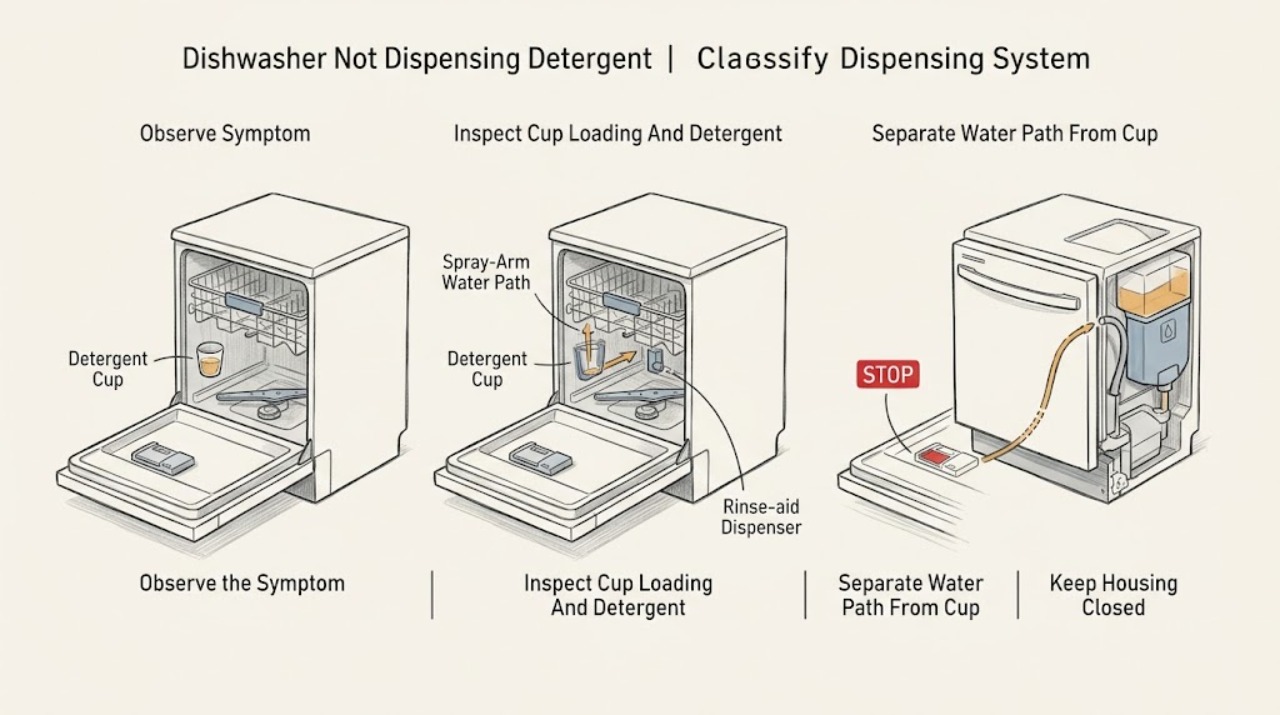
Work through in order
Diagnostic checks
Use only checks that match the exact appliance or system and its official guide.
-
Check 1
After the cycle has ended and the dishwasher is safe to open, record the complete GE model number and identify what remains: a closed detergent cup, an open cup with detergent, an empty rinse-aid reservoir that never falls, or a SmartDispense bulk-detergent warning/poor wash symptom. Photograph the cup position before cleaning it.
Expected result: The cup stayed closed, the cup opened but detergent remains, only rinse aid is not being used, or the machine has a bulk SmartDispense tank.
Next step: Follow the matching branch and exact owner's manual. Do not run an extra cycle solely to reproduce the issue or infer a part from the first observation.
Stop if: Stop if the cup, door, tub, cord, or control area is cracked, loose, leaking, overheated, or electrically damaged.
Why this matters
Why: Each pattern has a different water, latch, detergent, final-rinse, or bulk-pump path. GE uses multiple cup designs and model-specific support, so the model number prevents applying the wrong procedure.
-
Check 2
With the dishwasher not running, inspect the standard detergent cup and its cover. Move tall dishes, pot handles, and utensils away from it; wipe old residue from the opening; check that a pod is not binding the cover; and discard powder that is damp, hard, or lumpy. Use only the cup-closing method shown for the exact model.
Expected result: A dish blocks the cover, residue or a pod binds the latch, powder is lumpy, or the cup is clean, clear, and still does not open.
Next step: Correct only the visible loading or detergent condition, close the cup as the manual shows, and monitor the next normal cycle. If the clean cup still stays closed, arrange service rather than forcing the cover.
Stop if: Do not pry the cup open, bend the latch, insert tools into the dispenser, or work on the door while energized.
Why this matters
Why: GE lists loading obstruction, old detergent residue, pod placement, and lumpy powder as user-visible causes of a cup that does not open or dispense. A clean, unobstructed cup shifts suspicion toward the timer/control or dispenser mechanism.
-
Check 3
If the cup opened but detergent remains, inspect the accessible spray-arm holes and filter area for visible restrictions and confirm the spray arms can rotate freely by hand only when the dishwasher is off. Use the exact manual for safe cleaning. Do not enter the tub during a cycle or measure hot water inside the appliance.
Expected result: Spray holes or filter area are visibly restricted, the arm cannot rotate freely when off, the cup is open but dry, or the accessible water path is clear.
Next step: Clean only the model-approved accessible restrictions. If the cup remains open and dry or spray arms do not move during normal operation, stop troubleshooting at the tub and arrange service.
Stop if: Do not run a cycle with the door open, reach into moving spray arms, remove the circulation system, or perform live water/voltage tests.
Why this matters
Why: GE says detergent left in an open cup often means water is not being directed into it or the water temperature is too low, and specifically points to spray-arm blockage, cup opening, and filter restrictions. A clear path does not prove a circulation-pump or inlet fault.
-
Check 4
If the complaint is rinse aid, identify the reservoir, fill indicator/window/dipstick, and cap using the exact manual; do not confuse a low reservoir with a failed release. If the dishwasher has SmartDispense, record whether the detergent formula was recently changed and follow only the model-matched tank-purge guidance. Do not mix cleaners or formulas in the tank.
Expected result: Rinse aid is empty or at the expected low indication, the rinse-aid reservoir remains full after cycles, SmartDispense was recently changed between formulas, or no bulk tank exists.
Next step: Fill or check rinse aid only as the exact manual permits. For SmartDispense, use the support article matching the dishwasher's top/front-control design; if purging does not clear the tank, arrange service.
Stop if: Do not force a rinse-aid cap, add detergent to a rinse-aid reservoir, mix formulas, insert tools into the bulk tank, or disassemble the pump.
Why this matters
Why: GE says rinse aid is injected mechanically during the final rinse and recommends service when none is dispensed. GE also says incompatible SmartDispense formula changes can create gel that the pump cannot move; this does not apply to a standard cup.
-
Check 5
If the cup remains closed after unobstructed loading, detergent remains despite a clear cup and spray path, rinse aid is not released, or a SmartDispense tank remains clogged after the exact purge, stop using the dispenser for diagnosis and document the model, detergent type, cup position, and cycle result for service.
Expected result: The failure repeats without a visible loading, residue, detergent, filter, spray-arm, rinse-aid fill, or model-approved SmartDispense purge explanation.
Next step: Arrange qualified GE dishwasher service with the evidence record. Keep the appliance off if there is leakage, a damaged dispenser, burning odor, smoke, sparks, or water near electrical components.
Stop if: Do not replace a pump, valve, board, latch, or dispenser from the symptom alone; do not open the door panel or perform live tests.
Why this matters
Why: A repeating fault may involve a latch, timer/control, circulation or inlet path, rinse-aid mechanism, SmartDispense pump, or wiring. GE's public checks do not identify which internal part failed.
Use your observations
Decision map
Find the observation that best matches what you see, then follow the next safe action.
-
PATH 01Safety boundary
What you see
The standard detergent cover is still closed at the end of the cycle.
Do this next
Clear only visible obstructions and residue, use fresh correctly positioned detergent, and confirm the exact cup-closing method. If it still stays closed, arrange service.
Why this path and its safety boundary
Why it matters: Loading obstruction, residue, pod placement, lumpy detergent, latch, timer, or control behavior is more likely than a spray-arm water-delivery problem because the cup did not open.
Safety stop: Do not pry or force the cover, turn a mechanical timer unless the exact manual authorizes it, or open an electronic control housing.
-
PATH 02Safety boundary
What you see
The detergent cup is open, but detergent remains after the cycle.
Do this next
Inspect accessible spray arms, filter restrictions, cup loading, detergent freshness, and the model's water-temperature guidance. If the cup stays dry or spray arms do not operate, use service.
Why this path and its safety boundary
Why it matters: Water may not have reached the cup, spray-arm holes or the filter area may be restricted, the water may be too cool, or the detergent may not dissolve. This pattern does not prove that the cup latch failed.
Safety stop: Do not run a door-open test, take live temperature/voltage measurements, or remove circulation components.
-
PATH 03Safety boundary
What you see
Detergent operation is normal, but the liquid rinse-aid level does not fall or the dishes lose the expected rinse-aid effect.
Do this next
Check the exact model's fill indicator and cap, wipe any spill, and use service if rinse aid still is not released. Do not substitute detergent in the reservoir.
Why this path and its safety boundary
Why it matters: Rinse aid is a separate reservoir that GE says releases during the final rinse; a low/empty reservoir is different from a full reservoir that never dispenses.
Safety stop: Do not force the cap, insert tools into the release mechanism, or disassemble the door dispenser.
-
PATH 04Safety boundary
What you see
The GE dishwasher has SmartDispense bulk detergent, the detergent formula was changed, and detergent is not being pumped or a clog/poor-wash condition appears.
Do this next
Use only the model-matched top-control or front-control purge guidance. If the tank remains clogged, stop and arrange service.
Why this path and its safety boundary
Why it matters: GE says mixing chlorine-based and enzyme-based formulas can form a gel that the SmartDispense pump cannot move. This architecture and diagnosis do not apply to a normal single-use cup.
Safety stop: Do not mix more detergent or cleaners into the tank, insert tools, bypass the pump, or open the dispenser assembly.
Helpful context
Understand the symptom
A closed cup and an open cup mean different things
If the detergent cover is still closed at the end of a cycle, look first at loading, latch, residue, pod placement, and model-specific cup design. If the cover opened but detergent remains, the water path, spray-arm movement, temperature, or detergent condition becomes more relevant. These are not the same failure and should not be given the same part diagnosis.
Standard cups, rinse aid, and SmartDispense are separate systems
GE's standard detergent cup sits inside the door. Rinse aid is released during the final rinse, while SmartDispense models meter bulk detergent through a pump. Confirm which system your GE dishwasher has before following a support article or selecting a replacement part.
Keep hot water and service checks within the safety boundary
Use only the exact model's owner guidance for detergent, temperature, cup, and dispenser procedures. Do not reach into a running dishwasher, defeat a door latch, probe wiring, open the dispenser housing, or mix chemicals in a SmartDispense tank. Stop using the appliance if a damaged cup leaks detergent or water reaches electrical parts.
Only after diagnosis
Potential parts
- model-matched detergent cup or latch assembly
Consider only when a qualified technician confirms that the cover remains closed or fails to latch because the dispenser/latch assembly is defective after loading, residue, pod, and timer/control checks.
GE uses sliding, round-handle, and flip-up cup designs across models; verify the complete model number and official fit information. - model-matched rinse-aid dispenser mechanism
Consider only when the reservoir is correctly filled and the exact model's service diagnosis confirms that rinse aid is not released because of an internal dispenser mechanism fault.
Rinse-aid access and mechanism vary by model; no part should be selected from a low level or drying symptom alone. - model-matched SmartDispense pump or tank assembly
Consider only for a confirmed SmartDispense model when the model-matched purge fails and qualified service identifies a pump/tank fault rather than incompatible formula gel.
SmartDispense is not present on every GE dishwasher; verify the model architecture and official fit information before ordering.
When checks do not resolve it
Need a professional?
Arrange GE dishwasher service when the detergent cup remains closed after visible obstruction/residue/pod checks, detergent remains in an open cup with a clear accessible water path, no rinse aid is released from a correctly filled reservoir, or a SmartDispense tank remains clogged after the model-matched purge. Stop and disconnect power when there is a cracked or leaking dispenser, burning odor, smoke, sparks, or water near electrical components. Do not force the cup, open panels, mix SmartDispense formulas, or perform live tests.
Safety scope: The owner may inspect loading, detergent residue, accessible spray arms/filter restrictions, cup position, rinse-aid level, and model-approved SmartDispense instructions with the dishwasher off and safe to open. Qualified service must handle the door panel, latch, timer/control, circulation/inlet system, rinse-aid mechanism, SmartDispense pump, wiring, and live tests.
Common questions
FAQ
Why is the detergent still in my GE dishwasher cup?
First see whether the cup stayed closed or opened. A closed cup points to loading, residue, pod placement, lumpy powder, latch, or control issues. An open cup points to water not reaching it, blocked spray arms or filter, low temperature, or detergent that did not dissolve.
Can a dish stop a GE dishwasher detergent cup from opening?
Yes. GE says pot handles, tall items, and other dishes should not touch or block the cover. Clear the obstruction with the dishwasher off and use the exact model's cup-closing method; do not pry the cover open.
Why is my GE dishwasher rinse aid not dispensing?
Confirm that the correct model reservoir is filled and its cap/indicator is intact. GE says rinse aid is released during the final rinse and recommends service when no rinse aid is being dispensed. Do not add detergent to the rinse-aid reservoir.
What is different about a GE SmartDispense clog?
SmartDispense is a bulk-detergent system, not the standard door cup. GE says changing between incompatible detergent formulas can form a gel that the pump cannot move. Follow only the purge instructions matching the dishwasher's control design; persistent clogging needs service.
Should I replace the detergent dispenser when it does not dispense?
Not from the symptom alone. Check the cup state, loading, residue, detergent, spray path, rinse-aid architecture, and SmartDispense applicability first. A replacement cup, latch, rinse-aid mechanism, or pump is conditional on the exact model and a qualified diagnosis.
Read the exact guide
Official sources
- Dishwasher - Rinse Aid DispenserGE Appliances · GE dishwasher rinse-aid dispenser operation, filling, model variation, and no-dispensing service guidance
- Dishwasher - Detergent Cup OperationGE Appliances · GE dishwasher detergent cup location, closing/opening behavior, and model-dependent cup operation
- Dishwasher - Detergent Cup Did Not OpenGE Appliances · GE dishwasher detergent cup designs, loading obstructions, residue, pod/powder condition, and cup-not-opening diagnosis
- Dishwasher - SmartDispense™ Issue: Poor Wash, Detergent not Dispensing or Dispenser CloggedGE Appliances · GE dishwasher SmartDispense bulk-detergent formula-change clog and service boundary
- User Manual & Care for PDW7300GBBGE Appliances · GE Profile PDW7300GBB dishwasher identity and exact-model owner's manual/support routing
- Dishwasher - Detergent Stuck in CupGE Appliances · GE dishwasher detergent remaining in an open cup, spray-arm, filter, cup, and water-temperature checks
- Dishwasher - How to Get the Best Wash PerformanceGE Appliances · GE dishwasher loading, spray-system clearance, water-temperature, detergent freshness, and rinse-aid performance
Community feedback
Share a repair observation
Share a plain-text repair observation. Accepted observations are published automatically; this page may take a moment to update.