
On this page
Start here
Quick answer
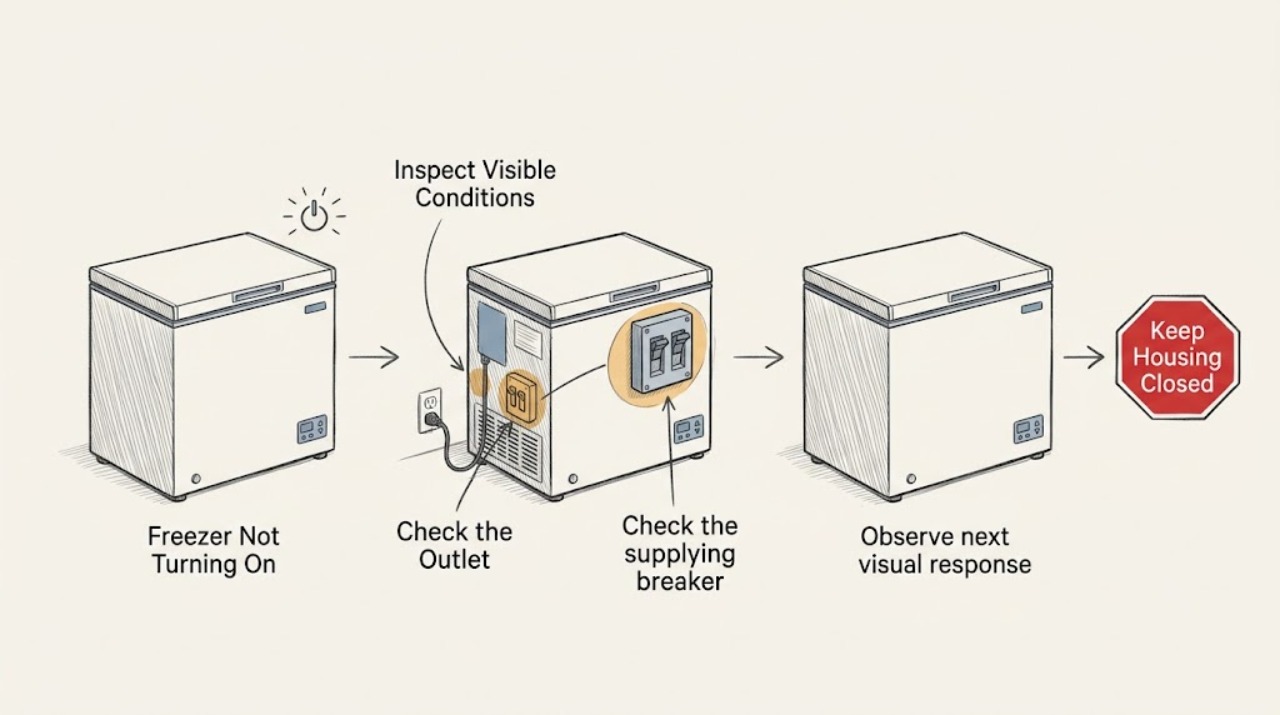
If an Amana freezer is not turning on, first check whether its indicator light, interior light, display, alarm, or compressor sound shows any sign of power. Confirm the power cord is fully seated in a grounded outlet and that the outlet is not controlled by a switch; do not use an extension cord. Check the appropriate breaker or GFCI once when the area is dry and there is no damage, and verify that the temperature control or power control is on according to the exact Owner's Manual. If the breaker trips again, the cord or outlet is hot or damaged, the freezer stays dark, or it has power but will not run, stop resetting or opening the appliance and arrange qualified appliance service or an electrician.
Work through in order
Diagnostic checks
Use only checks that match the exact appliance or system and its official guide.
-
Observe the freezer's power and operating signs
With the door or lid closed as much as possible, observe the interior or indicator light, display or control response, alarm, and any compressor or fan sound. Note whether the freezer is completely dark, has a light but no motor sound, or is running but not cooling; do not remove covers or reach behind the cabinet.
Expected result: There is no light or control response, an indicator is on but the compressor is silent, the freezer hums or cycles, an alarm sounds, or the light works while the freezer remains warm.
Next step: Record the exact signs and continue with external supply checks only when there is no heat, odor, water, or visible damage. Keep the door closed while the diagnosis continues.
Stop if: Stop for smoke, a burning odor, arcing, a hot plug or cord, water near electrical parts, a damaged cabinet, or unexpected sounds from the appliance.
Why this matters
Why: A completely dark unit points toward power, control, or an internal electrical fault. A powered unit that does not run is not necessarily a supply failure and may need appliance service. A running but warm freezer is a cooling or airflow diagnosis rather than proof that the freezer has no power.
-
Check the plug and outlet without moving internal parts
From a dry position, verify that the freezer power cord is fully seated in its grounded outlet and that the outlet is not controlled by a wall switch. Inspect only the accessible plug, cord, and outlet face for looseness, scorching, cracked insulation, or moisture. If the outlet is dry and undamaged, use a small household lamp to check whether it supplies power; do not use an extension cord.
Expected result: The plug is loose, the outlet is switched off, the lamp also fails, the cord or outlet is damaged or wet, or the outlet appears normal but the freezer remains dark.
Next step: Restore only an obviously switched-off outlet when it is dry and safe, then observe the freezer once. Leave a damaged or dead outlet unused and request an electrician; request appliance service when the outlet works but the freezer does not.
Stop if: Do not force the plug, use an extension cord or power strip, touch wet electrical equipment, repair the cord, remove the outlet cover, or continue after heat, sparks, or a burning smell.
Why this matters
Why: A loose plug, switched outlet, or dead outlet can explain a no-power freezer. Damage or moisture makes the outlet unsafe to keep using. A normal outlet with a dark freezer shifts the fault toward the breaker, control, cord connection, or internal appliance electronics.
-
Check the supplying breaker or GFCI once
If the plug and outlet are dry and undamaged, identify the breaker or GFCI that supplies the freezer without removing an electrical-panel cover. If it is visibly tripped, reset it once according to its normal operation and observe the freezer from a safe distance; do not reset a device that trips again.
Expected result: The breaker or GFCI was tripped and stays on, it trips again immediately, it will not reset, or it was already on while the freezer remains without signs of power.
Next step: Record the reset result. If it trips again or will not reset, leave it off and call an electrician or qualified appliance technician; if it stays on but the freezer remains dark, proceed only to the model control check before arranging service.
Stop if: Do not repeatedly reset the breaker or GFCI, open the panel, bypass protection, use a different circuit with an extension cord, or continue near smoke, heat, water, or damaged wiring.
Why this matters
Why: A single tripped protective device can interrupt power after an overload or event. A repeated trip or failure to reset can indicate a fault in the circuit, outlet, cord, or freezer and is not evidence that more resets are safe. A device that was already on shifts attention back to the outlet, control, or appliance.
-
Verify the freezer control is on using the exact manual
Use the freezer's model-specific Owner's Manual to identify the temperature or power control and its normal on/off operation. Check whether a recent outage, surge, cleaning, defrost, or move could have left the control off; use only the documented external control and do not remove a panel to reach it.
Expected result: The control is off, the model requires a documented power-button action after an outage, the control responds but the motor does not start, or the control is already on and unresponsive.
Next step: Restore the control only according to the manual and observe once. If there is no response or the freezer still does not operate, stop changing settings and request Amana-authorized appliance service or qualified repair.
Stop if: Do not guess a button sequence, remove the control housing, bypass a thermostat or safety device, alter wiring, or keep restarting an unresponsive freezer.
Why this matters
Why: A freezer can appear dead when its control was turned off or needs the model's documented restart action. A responding control with no operation or an unresponsive control after normal power is more consistent with an appliance fault than a simple setting.
-
Separate a power fault from an internal appliance fault
After the external outlet, protective device, and documented control checks, record whether the freezer has any light, sound, alarm, or cooling response and whether food is warming. Inspect only the visible cord, plug, cabinet exterior, and accessible floor for heat, water, or damage; do not pull the freezer apart or test internal components.
Expected result: The outlet and breaker are normal but the freezer is dark, the freezer has power but will not run, it runs but is not cooling, a cord or cabinet is damaged, or food is warming rapidly.
Next step: Keep the door closed, record the model and serial information and the checks already performed, and arrange qualified appliance service; call an electrician when the outlet or circuit remains suspect.
Stop if: Do not open the cabinet, access the compressor or control board, test capacitors or live wiring, bypass a safety device, or continue operating a hot, smoking, wet, or damaged freezer.
Why this matters
Why: Normal household supply with no freezer response points toward an internal appliance or control fault. Power with no compressor response is not solved by another reset. Visible damage, water, or rapidly warming food raises the urgency and requires service rather than further DIY testing.
Use your observations
Decision map
Find the observation that best matches what you see, then follow the next safe action.
-
PATH 01Safety boundary
What you see
The outlet is dead, the plug is loose, or the breaker or GFCI is tripped and does not remain reset.
Do this next
Leave the circuit safe and request an electrician to diagnose the outlet, circuit, or protective device before reconnecting the freezer.
Why this path and its safety boundary
Safety stop: Do not repeatedly reset protection, use an extension cord, open the panel, or use a hot, wet, or damaged outlet.
-
PATH 02Safety boundary
What you see
The outlet and protective device are normal, but the model's control is off or requires its documented restart operation after an outage, surge, cleaning, or move.
Do this next
Use the exact Owner's Manual control procedure once and observe whether the freezer resumes normal operation.
Why this path and its safety boundary
Safety stop: Do not guess the sequence, bypass the control, or open the control housing.
-
PATH 03Safety boundary
What you see
Lights or controls work, but the compressor or freezer operation does not start, or the unit stays warm.
Do this next
Keep the door closed and request qualified appliance service for the control, start, cooling, or internal electrical system.
Why this path and its safety boundary
Safety stop: Do not repeatedly cycle power, change internal settings, access the compressor or control board, or test live components.
-
PATH 04Safety boundary
What you see
A known-good outlet and stable protective device are available, the documented control is on, and the freezer remains dark or unresponsive.
Do this next
Stop troubleshooting and arrange Amana-authorized appliance service; provide the model, serial information, and the observed power path.
Why this path and its safety boundary
Safety stop: Do not open the cabinet, replace internal parts, bridge wiring, or continue operating a damaged appliance.
-
PATH 05Safety boundary
What you see
There is smoke, burning odor, heat, arcing, water near electrical parts, visible cord or cabinet damage, or rapidly warming food.
Do this next
Stop using the freezer, isolate power only from a safe accessible control if possible, keep the door closed, and seek prompt qualified service or electrical help.
Why this path and its safety boundary
Safety stop: Do not touch wet electrical equipment, move a damaged appliance, open the cabinet, or continue resetting power.
Helpful context
Understand the symptom
Confirm that this is a power failure, not only a cooling complaint
A freezer that is warm can still have power, while a freezer that is completely dark or silent may have an interrupted supply. Look for the model's indicator light, interior light, control response, alarm, or compressor sound without moving panels or reaching into electrical parts. If there is power but the compressor does not start, treat that as an appliance fault rather than repeatedly cycling the outlet or changing settings at random.
Keep the first checks external
The safe homeowner checks are the plug, accessible outlet, switch-controlled outlet, breaker or GFCI, and the documented freezer control. A lamp or other small appliance can help show whether an outlet is live when it is dry and undamaged. Do not use an extension cord, open the freezer cabinet, remove a control cover, or test internal wiring; a repeated trip or damaged electrical part needs qualified service.
Protect food while arranging service
If the freezer has lost power, keep the door or lid closed as much as possible. Record when the failure began, whether the control was recently changed, and whether there was a power interruption or surge. If food is thawing, move it only when necessary and follow local food-safety guidance; do not make repeated electrical resets or start a repair inside the appliance just to restore cooling quickly.
Only after diagnosis
Potential parts
- freezer power cord or outlet component
Consider this category only when an electrician or qualified technician confirms visible cord or outlet damage and identifies the correct repair for the exact installation.
Confirm the appliance's electrical requirements, outlet configuration, grounding, and local code; no homeowner replacement or fit is assumed from a dark freezer. - freezer control or start component
Consider this category only after qualified service confirms that the outlet and protective device are good but an internal control or start component has failed.
Confirm the exact freezer model and service documentation before any part decision; internal electrical repair is not a user diagnostic step.
When checks do not resolve it
Need a professional?
Request appliance service when a known-good outlet and stable breaker or GFCI do not restore operation, the freezer has power but will not run, the control is unresponsive, or the freezer remains warm. Call an electrician for a dead or damaged outlet, repeated breaker or GFCI trips, damaged cord, or any circuit concern. Seek prompt help for smoke, burning odor, arcing, heat, water near electrical parts, or rapidly warming food.
Common questions
FAQ
Why is my Amana freezer not turning on?
The power cord or outlet may be interrupted, a breaker or GFCI may have tripped, or the freezer control may be off after an outage or cleaning. If those checks are normal but the freezer remains dark or will not run, an internal appliance fault needs qualified service.
Can I plug my Amana freezer into an extension cord to test it?
No. Amana's guidance says not to use an extension cord for the freezer. Check the original grounded outlet and its protective device from a dry, undamaged position, then arrange electrical or appliance service if the supply is not reliable.
What if the Amana freezer light works but the freezer is not running?
That means the freezer may have power even though the compressor or cooling system is not operating. Check the model's documented control setting once, keep the door closed, and request appliance service rather than repeatedly cycling power or opening the cabinet.
What should I do if the breaker trips when I plug in the freezer?
Do not keep resetting it. Leave the circuit off, keep away from heat, smoke, water, or damaged wiring, and have an electrician or qualified appliance technician determine whether the circuit, outlet, cord, or freezer is at fault.
Read the exact guide
Official sources
- Freezer Not Freezing? Solve This and Other Freezing ProblemsAmana · Supports checking the freezer control, grounded outlet and cord, switched outlet and extension-cord boundary, breaker or fuse, and professional escalation.
- Owner's ManualAmana · Supports checking plug, control, fuse or breaker, keeping the freezer closed during a power interruption, documenting food condition, and contacting an electrician when operation problems continue.
- Not Powering On - Not Operating - Chest FreezerAmana Product Help · Supports checking the grounded outlet and cord, avoiding an extension cord, checking a breaker or GFCI, confirming the freezer is on, and contacting service when the issue continues.
- Setting the Controls for a FreezerAmana Product Help · Supports verifying that a freezer is turned on and consulting the exact manual when some models require a documented power-control operation after an outage or surge.
Community feedback
Share a repair observation
Share a plain-text repair observation. Accepted observations are published automatically; this page may take a moment to update.