
On this page
Start here
Quick answer
Start by separating a completely dead freezer from one that has power but is not cooling. Check that the cord is fully inserted, the accessible outlet and breaker are on, and the freezer’s control is not set to OFF. If it was transported on its side, follow Danby’s model instructions before reconnecting it. Do not use an extension cord, open electrical covers, or puncture refrigerant tubing. If the outlet and controls are normal but the freezer remains dead, the breaker trips again, the cord is damaged, or cooling does not return after a safe restart, leave it unplugged and arrange qualified Danby service.
Before you begin
Safety first
- The user may inspect the accessible plug, outlet, breaker or fuse, user controls, and model-directed placement or ventilation. Do not use an extension cord, open electrical or sealed-system covers, probe live circuits, puncture refrigerant tubing, or bypass protective devices.
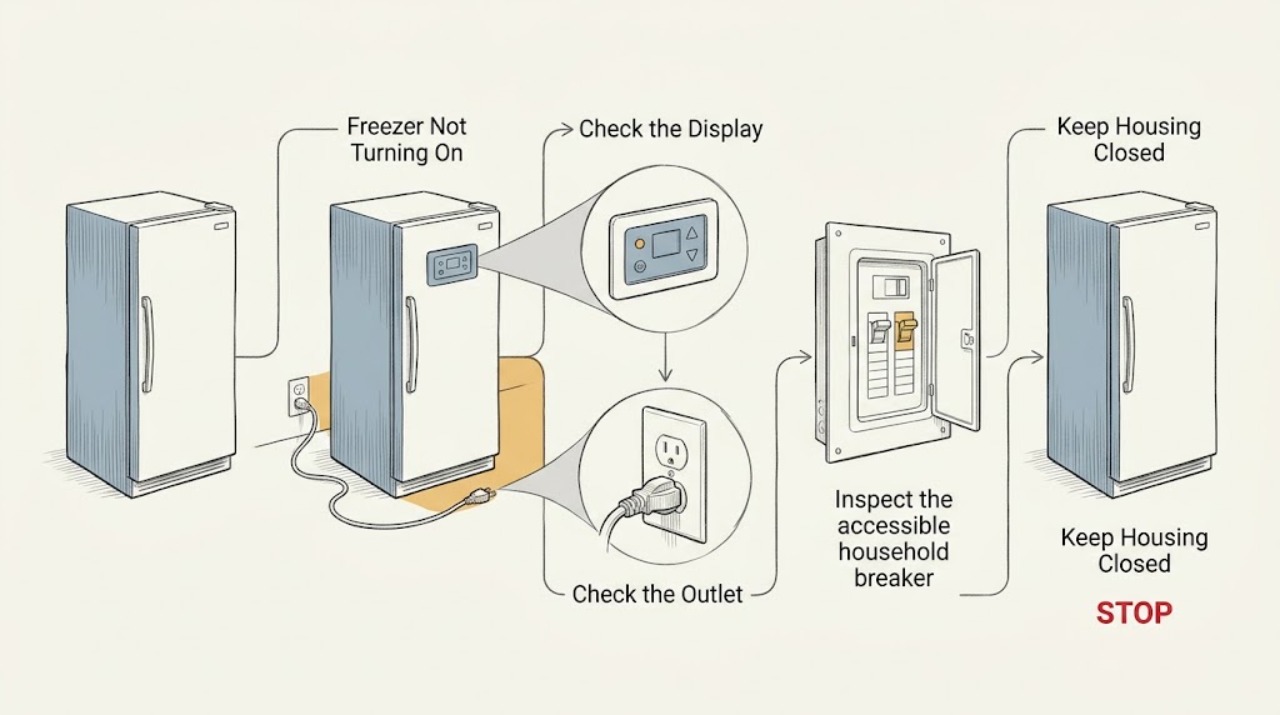
Work through in order
Diagnostic checks
Use only checks that match the exact appliance or system and its official guide.
-
Check 1
With the freezer closed, check whether any indicator, interior light, fan, or compressor sound is present and whether the cabinet is cold. Do not remove a panel or reach behind a grille while checking.
Expected result: There is no visible or audible operation, or the unit has signs of power but is not cooling normally.
Next step: Follow the matching branch and record the exact symptom, especially whether the unit was recently moved or whether any breaker opened.
Stop if: Stop for smoke, a burning smell, arcing, a damaged cord, refrigerant tubing damage, or repeated electrical trips.
Why this matters
Why: A completely inactive freezer points first to the power path or control state; operation without cooling points toward temperature setting, airflow, compressor, or sealed-system diagnosis instead of a simple outlet check.
-
Check 2
Confirm the power cord is fully seated in the intended wall outlet and inspect the plug and cord for visible damage; if safe, test the outlet with a small known-working appliance rather than opening the freezer or outlet.
Expected result: The plug is loose, the outlet is dead, the cord is damaged, or the outlet works and the freezer remains inactive.
Next step: Correct only an obvious loose plug or use a properly installed outlet. Do not use an extension cord or an outlet controlled by an unintended wall switch; arrange electrical or appliance service if the cord or outlet is defective.
Stop if: Stop for frayed insulation, a hot or scorched plug, moisture, loose receptacle parts, exposed conductors, or a need to alter household wiring.
Why this matters
Why: A loose plug or dead outlet can explain a completely inactive freezer; a damaged cord is a hazard; a working outlet with no operation shifts the fault inside the appliance or to its control setting.
-
Check 3
Inspect the accessible household breaker or fuse panel for the freezer circuit and compare the appliance’s required supply with the rating information on its label; do not repeatedly reset a breaker or replace a fuse with a different type or rating.
Expected result: A breaker is tripped, a fuse is open, the supply rating is uncertain, or the protective device is normal but the freezer has no operation.
Next step: If a protective device opens again, leave the freezer unplugged and arrange qualified electrical or appliance diagnosis. If supply is uncertain, have a qualified electrician verify it instead of opening the freezer.
Stop if: Stop for repeated trips, a burning smell, arcing, a panel that is wet or damaged, or any need to work inside the electrical enclosure.
Why this matters
Why: Danby manuals list no power, a blown fuse or tripped breaker, an unplugged cord, and wrong voltage as no-operation causes; a repeat trip can indicate a fault rather than a resettable nuisance.
-
Check 4
With power connected only as the model manual permits, verify that the user-accessible power switch or temperature control is not OFF and that the freezer mode, where the model provides one, is selected; do not force a dial or open the control housing.
Expected result: The control is OFF, set to a non-freezer mode, or set normally while the freezer remains inactive or does not cool.
Next step: Correct only an obvious user setting using the model instructions, then allow the appliance time to respond. If there is still no operation or cooling, arrange service rather than replacing a control part by symptom.
Stop if: Stop for a seized or broken control, a damaged display, smoke, unusual heat, or any need to remove the control panel.
Why this matters
Why: A control state can prevent compressor operation without proving a failed component; a normal setting with no response makes an internal control, start, or supply fault more plausible but does not identify it.
-
Check 5
If the freezer was recently transported or installed, check whether it was kept upright for the period required by its exact Danby manual before connection; also confirm that accessible ventilation openings are not blocked. Do not start disassembling the cabinet to inspect the cooling system.
Expected result: The freezer was laid on its side or back, was connected immediately after moving, or it has been upright and ventilated according to the manual.
Next step: If recently moved, follow the exact manual’s upright-settling instruction before another connection attempt. If it was already settled and remains inactive or warm, arrange qualified service.
Stop if: Stop for damaged tubing, a refrigerant smell or fluid, an enclosed installation, blocked fixed vents, or any need to puncture ice or open a sealed system.
Why this matters
Why: Danby states that settling upright after transport reduces the chance of cooling-system malfunction; blocked ventilation or an unsuitable installation can also affect operation, but neither condition proves a sealed-system failure.
-
Check 6
Arrange qualified Danby service when the freezer remains inactive after the accessible plug, outlet, breaker or fuse, control, and transport checks, or when it powers on but does not cool; provide the model, supply observations, and any recent move.
Expected result: No safe external correction restores operation, a protective device trips again, or the compressor or fan behavior is abnormal with loss of cooling.
Next step: Keep the freezer unplugged for electrical or physical hazards and use Danby’s support or authorized service path for model-specific diagnosis. Protect food according to applicable food-safety guidance if cooling has been lost.
Stop if: Stop for smoke, burning smell, arcing, damaged cord, repeated trips, refrigerant-tubing damage, or a rapidly warming freezer.
Why this matters
Why: The remaining fault may involve the start circuit, thermostat or electronic control, compressor, wiring, airflow, or sealed refrigerant system and cannot be assigned to one part from the no-start symptom.
Use your observations
Decision map
Find the observation that best matches what you see, then follow the next safe action.
-
PATH 01Next step
What you see
The outlet is dead or the freezer plug is loose, while the cord and receptacle can be addressed safely.
Do this next
Arrange qualified service and follow the exact model guidance.
Why this path and its safety boundary
Why it matters: Correct the accessible connection or obtain qualified electrical help. Do not use an extension cord or modify the outlet to make the freezer run.
-
PATH 02Next step
What you see
The breaker has tripped or a fuse is open.
Do this next
Arrange qualified service and follow the exact model guidance.
Why this path and its safety boundary
Why it matters: One safe check of the accessible protective device is reasonable, but a repeat trip means leave the freezer unplugged and arrange qualified diagnosis.
-
PATH 03Next step
What you see
The user-accessible switch or temperature control is OFF or in the wrong mode.
Do this next
Arrange qualified service and follow the exact model guidance.
Why this path and its safety boundary
Why it matters: Set it correctly using the exact model manual and allow the appliance time to respond. If it remains inactive, do not infer a failed control without service diagnosis.
-
PATH 04Next step
What you see
The freezer was laid on its side or back or connected immediately after transport.
Do this next
Arrange qualified service and follow the exact model guidance.
Why this path and its safety boundary
Why it matters: Follow the exact Danby manual’s upright-settling instruction before reconnecting. If the unit remains dead or warm afterward, arrange service.
-
PATH 05Next step
What you see
Indicators or compressor activity are present but the freezer does not cool normally.
Do this next
Arrange qualified service and follow the exact model guidance.
Why this path and its safety boundary
Why it matters: Check only the user setting and accessible airflow or installation conditions. If cooling does not return, arrange qualified refrigeration service rather than replacing a compressor or sealed-system part by guesswork.
-
PATH 06Next step
What you see
The freezer remains dead after safe checks, or there is smoke, burning smell, arcing, damaged wiring, repeated trips, or refrigerant damage.
Do this next
Arrange qualified service and follow the exact model guidance.
Why this path and its safety boundary
Why it matters: Leave it unplugged and arrange qualified Danby or electrical service. Do not open the cabinet, bypass a protective device, or puncture tubing.
Helpful context
Understand the symptom
First identify what ‘not turning on’ means
A blank display or absent interior light is a power-path symptom, while a running compressor or fan with no cooling is a cooling-path symptom. Chest and upright models can have different controls and indicators, so use the exact model manual. Danby’s freezer FAQ begins with checking that the unit is plugged in and turned on; a model manual then adds outlet, fuse or breaker, and correct-supply checks.
Check only accessible power and controls
Inspect the plug, outlet, breaker or fuse, and user-accessible temperature control without opening the cabinet. Do not use an extension cord or improvise a voltage test. If the unit was recently moved, follow the model’s upright-settling instruction before reconnecting it. A freezer that remains dead with normal accessible supply needs diagnosis, not repeated resets.
Protect the sealed system
Danby manuals warn about flammable refrigerant and say not to puncture refrigerant tubing or use unapproved defrosting methods. A compressor, start device, control, wiring, or sealed-system fault cannot be identified safely from a blank cabinet alone. Keep the freezer unplugged for smoke, heat, damaged wiring, a repeated trip, or signs of refrigerant damage and arrange qualified service.
Safety boundary
Stop conditions
- Smoke, arcing, burning smell, a hot or damaged cord, exposed wiring, or repeated breaker or fuse operation.
- Refrigerant tubing damage, suspected refrigerant leak, oil or fluid, or an attempt to chip ice or puncture a sealed area.
- A freezer that remains warm or rapidly loses cooling after power returns.
- An outlet, plug, control, or cabinet that is wet, cracked, scorched, unstable, or otherwise physically damaged.
- Any need to open electrical or sealed-system covers, probe live circuits, bypass a protective device, or replace an internal part without diagnosis.
Only after diagnosis
Potential parts
- power cord or plug assembly
Consider this category only if the cord is visibly damaged and a qualified technician confirms it is the cause of the no-power symptom.
Confirm the exact model and approved electrical specification; do not splice or improvise a cord. - thermostat or temperature control
This category is conditional on normal accessible power and a technician finding that the control is not commanding operation.
Model-specific control fit and safe electrical isolation must be confirmed before replacement. - compressor start component
Consider only after a qualified diagnosis of abnormal compressor starting with correct supply and control settings.
Do not access the compressor electrical compartment; confirm the exact model and approved repair. - compressor or sealed-system component
Only qualified refrigeration service should consider this category after no-cooling and power checks rule out simpler causes.
Sealed-system work and refrigerant handling are model-specific and are not inferred from a no-start symptom.
When checks do not resolve it
Need a professional?
Arrange qualified Danby service when the freezer remains inactive after safe power, control, and transport checks, when it powers on but does not cool, or immediately for electrical, physical, or refrigerant safety symptoms.
Safety scope: The user may inspect the accessible plug, outlet, breaker or fuse, user controls, and model-directed placement or ventilation. Do not use an extension cord, open electrical or sealed-system covers, probe live circuits, puncture refrigerant tubing, or bypass protective devices.
Common questions
FAQ
Why is my Danby freezer completely dead?
Check the plug, outlet, accessible breaker or fuse, and user-accessible control. If the outlet works and the freezer remains inactive, leave it unplugged and arrange qualified service rather than opening the cabinet.
Should I reset the breaker if my Danby freezer will not turn on?
Check the accessible breaker or fuse once, but do not repeatedly reset it. If it opens again, leave the freezer unplugged and have the electrical supply or appliance diagnosed.
What if my Danby freezer was moved on its side?
Follow the exact model manual’s upright-settling instruction before reconnecting. Danby’s cited guidance uses approximately six hours for an upright model, but the reader’s manual controls; service is needed if the freezer remains dead or warm.
The freezer has power but is not cooling. Is that the same problem?
No. Indicators or compressor activity with no cooling is a cooling-path symptom. Check only the user setting and accessible ventilation or installation conditions; persistent no-cooling needs qualified diagnosis.
Can I open the back of a Danby freezer to make it turn on?
No. Do not open electrical or sealed-system covers, probe live circuits, use an extension cord, or puncture refrigerant tubing. Arrange qualified appliance or electrical service for an internal fault.
Read the exact guide
Official sources
- OWNER’S MANUAL — CONVERTIBLE UPRIGHT FRIDGE AND FREEZER — DUF140E1WDDDanby Products · Official Danby manual for the listed DUF140E1WDD convertible model; exact model instructions control for other appliances.
- The freezer is not cooling properly. What should I do?Danby USA · Official Danby USA FAQ for freezers; exact model manuals control model-specific installation and restart requirements.
- UPRIGHT FREEZER — Owner’s Manual — DUFM085A2BSLDDDanby Products · Official Danby owner manual for the listed DUFM upright model; exact model instructions control for other freezers.
- Freezers FAQsDanby USA · Official Danby USA freezer FAQ category; individual model manuals control exact operating and service steps.
- CHEST FREEZERS — Owners ManualDanby Products · Official Danby chest-freezer owner manual; use the exact manual for the reader’s model and freezer type.
Community feedback
Share a repair observation
Share a plain-text repair observation. Accepted observations are published automatically; this page may take a moment to update.