
On this page
Start here
Quick answer
If a Beko freezer is not turning on, first distinguish a completely unpowered appliance from one that has power but is not cooling. Check the plug, outlet, isolator, and the model's indicator lights without opening the cabinet. A green mains light or a compressor hum means the freezer may already be running, while a persistent red high-temperature light means it is not yet cold enough and needs attention if it remains on for hours. Keep the door closed during a power cut, and do not dismantle or electrically test the freezer. If there are no safe signs of power, the unit keeps warming, or there is burning smell, damaged wiring, or repeated tripping, stop and arrange qualified appliance service.
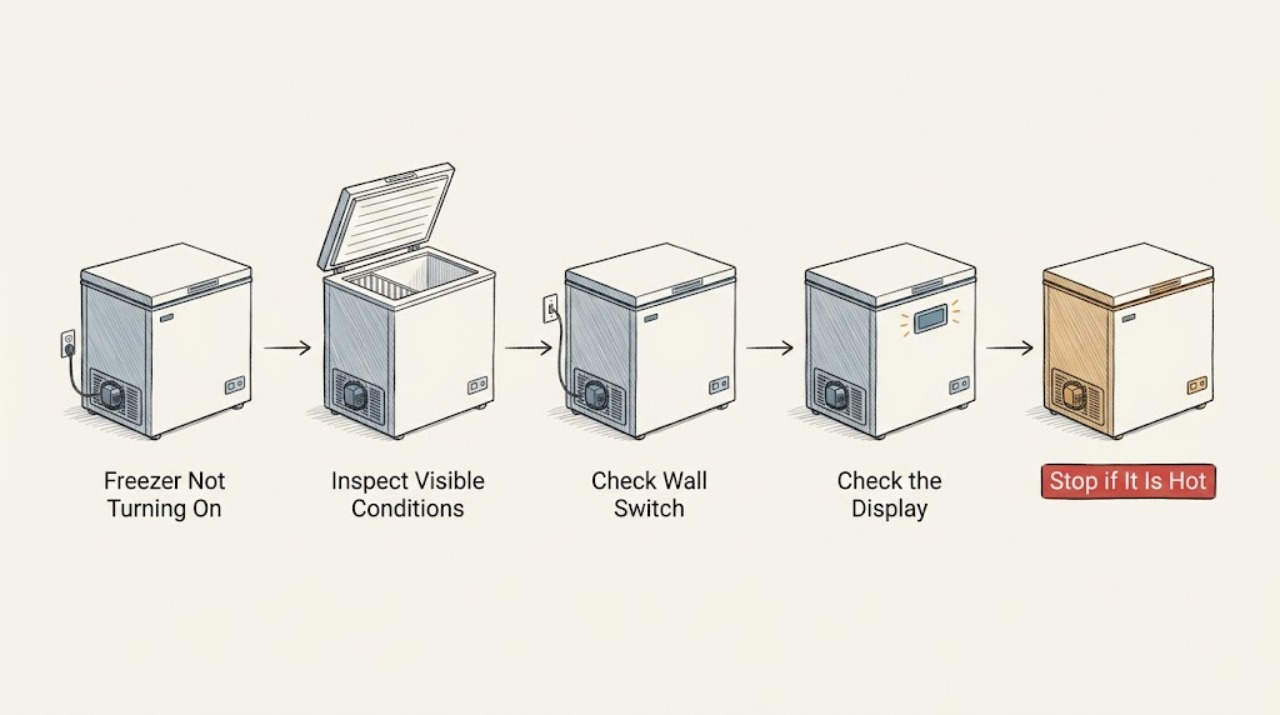
Work through in order
Diagnostic checks
Use only checks that match the exact appliance or system and its official guide.
-
Check 1
Look at the freezer without removing any panels: check whether an internal or external indicator is lit, whether the control display responds, whether the cabinet light works if fitted, and whether you can hear a steady compressor hum after the door has been closed.
Expected result: A green mains indicator or compressor hum suggests the appliance has power and may be running. No light, no display, and no sound point more strongly to the supply, plug, control setting, or an internal electrical fault, but they do not prove which one.
Next step: If there are signs of power, continue with the setting, airflow, and temperature-warning checks. If there are no signs of power, continue only with the safe plug and outlet check; do not open the cabinet.
Why this matters
Why: Beko states that a humming compressor usually means the freezer is switched on and that the green indicator shows mains connection on models with these lights.
-
Check 2
Visually check that the plug is fully seated, the freezer's accessible wall switch or isolator is on, and the household outlet has power by using a small known-working appliance if doing so is dry and safe. Do not use an extension lead as a substitute for a proper appliance connection.
Expected result: If the outlet or isolator is dead, the freezer cannot turn on and the house supply needs attention. If the outlet works but the freezer remains completely dark and silent, the fault is likely within the freezer's supply or controls.
Next step: Restore only a simple switched-off isolator. If a breaker or residual-current device trips again, leave the freezer off and have a qualified electrician or appliance technician investigate.
Stop if: Stop for a hot plug, scorch mark, damaged cord, water near the outlet, sparking, smoke, or repeated tripping.
Why this matters
Why: This check separates a household power interruption from an appliance fault without exposing the user to the freezer's internal wiring.
-
Check 3
Check the temperature control or display setting against the model manual. On dial models, make sure it has not been left at the cooling-off position; on electronic models, check for a holiday, standby, or fast-freeze mode that changes the normal indication.
Expected result: A control set to off or standby explains a powered but non-cooling freezer. A normal cooling setting with a compressor hum means the freezer is on, so the next question is whether airflow, frost, or sealing is limiting cooling.
Next step: Correct only an obvious setting issue, then close the door and allow the appliance to run. If the setting is normal but the freezer continues warming, continue to the load, seal, and frost check.
Why this matters
Why: Beko notes that temperature controls and indicator meanings vary by model, so a manual-specific interpretation is safer than guessing from a symbol.
-
Check 4
Inspect the interior without moving the freezer: check whether tightly packed food blocks vents, whether the door seal closes evenly, and whether thick frost is covering the walls or restricting airflow. Do not force drawers and do not scrape ice with a knife or other sharp object.
Expected result: Blocked airflow, an incomplete door seal, or heavy frost can make a powered freezer appear not to work. Beko specifically points to overload, restricted airflow, poor sealing, and frost build-up as possible causes when a freezer is no longer running effectively.
Next step: Rearrange only loose items that visibly block an air path and make sure the door closes normally. If the freezer is not frost-free and the manual permits manual defrosting, use the isolated defrost action below; if the seal is damaged or the problem persists, arrange service.
Why this matters
Why: This is a cooling-performance branch, not proof that the compressor or thermostat has failed.
-
Check 5
For a non-frost-free model with substantial frost, follow the model manual and Beko's safe defrost approach: turn the appliance off and unplug it at the wall, protect the floor, let the ice melt naturally, dry the interior completely, and then restore power. Never speed defrosting with sharp tools or by disturbing sealed components.
Expected result: If cooling returns after a complete, safe defrost, frost-restricted airflow was a plausible contributor. If the freezer remains unpowered or warm after it is dry and restarted, defrosting did not resolve the underlying fault.
Next step: Allow the freezer time to cool before judging the result. If it remains silent, fails to cool, or the fault returns quickly, stop and arrange professional diagnosis rather than repeating defrosts indefinitely.
Why this matters
Why: Beko distinguishes manual-defrost models from frost-free models and warns that sharp objects can damage the appliance; the manual controls the exact procedure for the assigned model.
-
Check 6
If a red high-temperature indicator remains on, note whether the compressor is humming, whether the freezer has recently been powered on or defrosted, and whether the door seal is closing. Keep the door shut while the cabinet recovers; do not repeatedly cycle the power or open the rear cover.
Expected result: A red light is a high-temperature warning, not by itself proof that the freezer has no power. Beko advises contacting service if the red indicator remains on for hours; no compressor activity or continued warming makes escalation more urgent.
Next step: If the red warning remains or food is thawing, arrange qualified appliance service. If there is burning smell, smoke, water near electrics, damaged wiring, or repeated tripping, stop using the freezer immediately and isolate power only from a safe accessible point.
Stop if: Stop immediately for smoke, burning smell, sparking, damaged wiring, or water contacting electrical equipment.
Why this matters
Why: This distinguishes a powered freezer that has not reached temperature from a completely dead appliance and protects the food while the condition is assessed.
Use your observations
Decision map
Find the observation that best matches what you see, then follow the next safe action.
-
PATH 01Safety boundary
What you see
The compressor hums or a green mains indicator is lit.
Do this next
Treat the freezer as powered and check the control setting, door seal, airflow, frost, and red temperature warning rather than replacing a power component.
Why this path and its safety boundary
Safety stop: Perform only the safe visual plug, isolator, and outlet check. If the supply is present but the freezer stays dark and silent, call for service.
-
PATH 02Safety boundary
What you see
The household outlet or accessible isolator has no power.
Do this next
Leave the freezer closed and address the household supply safely. A recurring breaker or residual-current trip needs a qualified electrician or appliance technician.
Why this path and its safety boundary
Safety stop: If the freezer still has no lights or sound, stop at the external checks and arrange qualified appliance service.
-
PATH 03Safety boundary
What you see
The freezer is powered but the dial or display is off, in standby, or at a cooling-off setting.
Do this next
Restore the model-approved cooling setting and observe one normal run with the door closed.
Why this path and its safety boundary
Safety stop: Continue with the seal, load, airflow, and frost checks.
-
PATH 04Safety boundary
What you see
Heavy frost or visibly blocked airflow is present on a non-frost-free model.
Do this next
Use the manual-approved, unplugged natural defrost procedure; do not chip the ice. If cooling does not return after the interior is dry, call for service.
Why this path and its safety boundary
Safety stop: Persistent warming, a damaged seal, or a red warning needs qualified diagnosis.
-
PATH 05Safety boundary
What you see
There is smoke, burning smell, sparking, water near electrical parts, damaged wiring, or repeated tripping.
Do this next
Stop immediately, isolate power only from a safe accessible point, keep clear of damaged parts, and call a qualified technician or electrician.
Why this path and its safety boundary
Safety stop: If the freezer remains unpowered or does not cool after the safe checks, arrange appliance service and keep the door closed while waiting.
Helpful context
Understand the symptom
Start with the symptom, not a part replacement
A dark display does not always mean the cooling system is off, and a quiet freezer does not by itself identify the fault. Some models have internal indicator lights rather than a front display. Check whether the compressor hums, whether the green mains indicator is lit where fitted, and whether food is actually warming. This separates a power-supply problem from a cooling, airflow, or temperature-warning problem.
Protect the food while you diagnose
Keep the freezer door closed as much as possible if power has been lost or the cabinet is warming. Move food only when you have a safe cold-storage plan, and follow local food-safety guidance for anything that has thawed. Do not chip ice with a sharp object or use the freezer while water is reaching electrical parts.
Only after diagnosis
Potential parts
- freezer thermostat or temperature sensor
Consider this only after a qualified technician confirms a temperature-control fault rather than a supply, airflow, or frost issue.
Confirm the complete Beko model identification and the technician's diagnosis before obtaining a replacement. - freezer control module
Consider this only when professional testing identifies an internal control fault while the external supply is sound.
Control modules are model-specific and must be verified by a qualified technician; do not fit one based only on a dark indicator.
Common questions
FAQ
How do I know if my Beko freezer has power?
Look for a green mains indicator where your model has one and listen for a compressor hum. If both are absent, check the accessible plug, isolator, and outlet without opening the freezer; if the supply is present but the cabinet remains dark and silent, arrange service.
What does a red light mean on a Beko freezer?
The red indicator is a high-temperature warning. It does not necessarily mean the freezer has no power, but if it remains on for hours or food continues thawing, arrange qualified service.
What should I do with the food during a freezer power cut?
Keep the freezer door closed to slow warming and avoid repeated checks. Follow local food-safety guidance for any food that has thawed, and address the appliance fault once the supply is stable.
Read the exact guide
Official sources
- What temperature should a freezer be?Beko UK · Beko freezer temperature controls and model-specific indicator guidance
- My appliance is no longer running?Beko UK · Beko freezer compressor, overload, airflow, door seal, and frost checks
- How to defrost a freezerBeko UK · Beko freezer manual defrost safety and frost-related airflow maintenance
- What do the indicator lights mean?Beko UK · Beko freezer green mains, amber fast-freeze, and red high-temperature indicators
- I have lost the power to my appliance due to a power cut. What should I do to keep my food frozen?Beko UK · Beko freezer power-loss food-protection guidance
Community feedback
Share a repair observation
Share a plain-text repair observation. Accepted observations are published automatically; this page may take a moment to update.