
On this page
Start here
Quick answer
If an Amana gas oven is not igniting, first note whether the control responds, the igniter clicks, the cooktop works, and the oven was recently installed or reconnected. Check only the normal oven setting, a fully closed door, accessible external signs of power, and whether the main gas supply is visibly available; do not remove panels, adjust the regulator, or repeatedly try to ignite a burner. Amana notes that ignition depends on a proper electrical ground and gas supply, and that an oven regulator shutoff can stop gas to the oven while the cooktop still works. Stop for any gas odor, smoke, sparking, abnormal flame, or suspected electrical fault and arrange qualified appliance or gas service.
Before you begin
Safety first
- Observation only. No repeated ignition attempts, gas purging, regulator or gas-line adjustment, range movement, panel removal, igniter or burner access, live electrical testing, or flame testing.
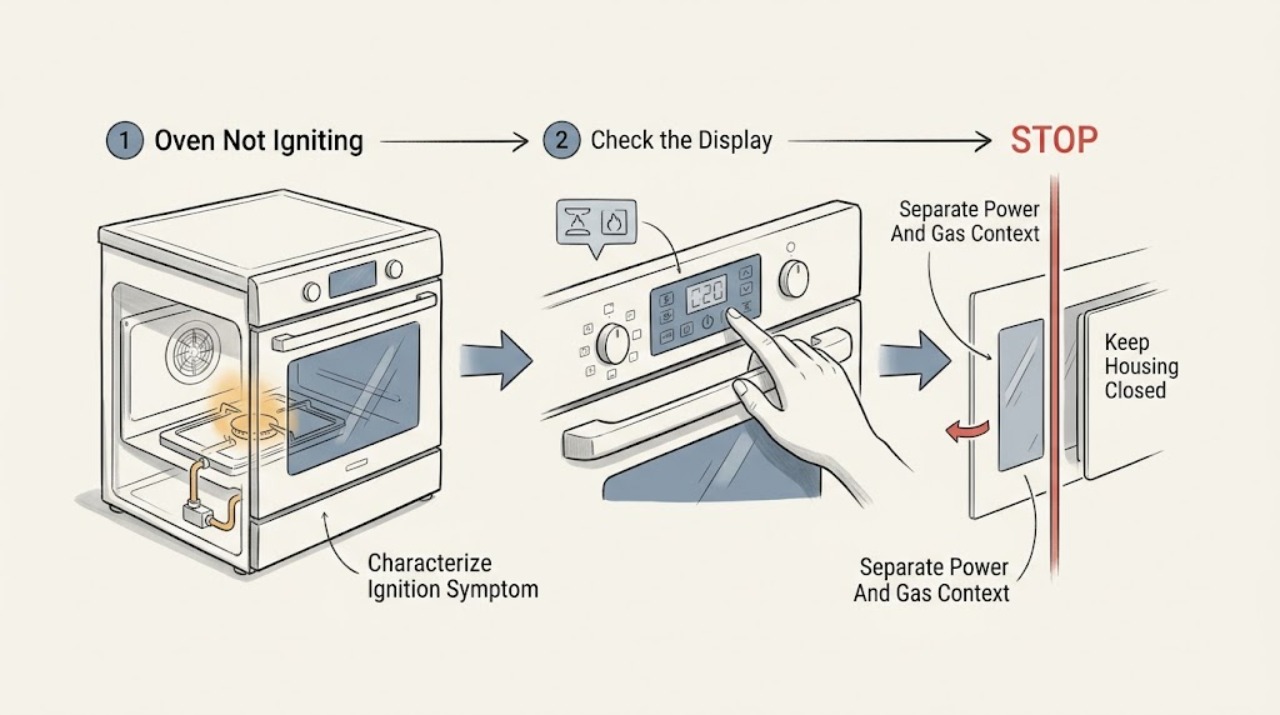
Work through in order
Diagnostic checks
Use only checks that match the exact appliance or system and its official guide.
-
Check 1
With the oven control returned to its normal off state before inspection, record what happens during one normal start attempt: does the display respond, does the igniter click, does a flame appear, and does the oven stop without heating? Note whether the cooktop burners work and whether the symptom is constant or intermittent.
Expected result: The oven clicks but does not light; the oven does not click; the oven lights and then goes out; the cooktop works while the oven does not; or the whole range is unresponsive.
Next step: Stop making start attempts and record the pattern, model identifier, and any display message. Follow the clicking, no-click, or whole-range branch without opening the oven or trying to force ignition.
Stop if: Stop immediately for gas odor, a delayed boom, smoke, sparking, an abnormal flame, or a burning smell.
Why this matters
Why: Clicking, no clicking, a failed flame, and whole-appliance loss point to different decision paths. Cooktop operation does not prove that the oven gas path is open, because Amana documents a separate oven regulator shutoff on some gas ranges.
-
Check 2
Confirm from the front that the intended bake or broil function is selected, any delay-start or control-lock indication is not holding the cycle, and the oven door is fully closed. Look at the storage drawer only from the outside for an obviously overfilled condition; do not remove an obstruction near the igniter or cover the oven bottom.
Expected result: The door is not fully closed; a delay, lock, or unfamiliar mode is displayed; the controls respond normally; or the storage drawer or oven bottom appears to interfere with the burner area.
Next step: Use the exact Amana owner's manual to clear a normal control-state issue. If anything would need to be removed from the burner area, if the drawer is stuck, or if the symptom remains, stop and arrange qualified service rather than reaching toward the igniter.
Stop if: Stop if the door, drawer, liner, or burner area is hot, damaged, obstructed in a way that requires tools, or contaminated with spilled material.
Why this matters
Why: A door, mode, or control-state issue can prevent a cycle from starting without proving a failed ignition component. Amana warns that items in the storage drawer or a liner on the oven bottom can interfere with ignition or air and gas flow, but the exact remedy is model-specific.
-
Check 3
Without opening an electrical panel or moving the range, note whether the display and interior light have power, whether the plug and receptacle appear intact if they are safely visible, whether other range functions operate, and whether the range was recently installed or reconnected to gas.
Expected result: The display is blank; other range functions work; the power connection is visibly damaged or uncertain; the range was recently reconnected; or the installation history is unknown.
Next step: If power or grounding is uncertain, leave the range off and arrange a qualified electrician or appliance technician. If recent reconnection preceded the symptom, provide that history to a qualified gas-appliance professional; do not move the range, adjust the gas line, or perform a gas test.
Stop if: Stop for a hot or damaged cord, loose receptacle, water near electrical parts, exposed wiring, gas odor, or any need to access the rear of the range.
Why this matters
Why: Amana states that oven igniter operation depends on a grounded, operational power path and that air can be trapped in a gas line after reconnection. A blank display or uncertain grounding is an electrical-service question, while recent gas work requires model-specific commissioning rather than improvised purging.
-
Check 4
If there is no gas odor and the gas range is stable, note whether the home's main gas shutoff is visibly in its normal position without touching it, and whether the cooktop works while the oven does not. Do not slide the range out, reach behind it, or adjust a pressure-regulator lever.
Expected result: The cooktop works but the oven does not; the main gas supply appears unavailable; the regulator location or position is not visible; or the gas status is uncertain.
Next step: Record the visible pattern and arrange a qualified appliance or gas professional to verify the supply and regulator for the exact model. If the main gas status is uncertain, do not create a test flame or repeatedly start the oven.
Stop if: Stop for any gas odor, hissing, an unstable range, a hard-piped or strained connection, or a need to move the appliance.
Why this matters
Why: Amana documents that the oven pressure-regulator shutoff can be off while cooktop burners still receive gas, so cooktop operation cannot rule out an oven gas-path issue. An uncertain or rear-mounted valve must not be treated as a homeowner adjustment.
-
Check 5
If gas is smelled when the oven is not safely operating, or if a flame is yellow, noisy, delayed, or otherwise abnormal, stop using the range and keep people away. Do not light an appliance, touch switches, adjust controls, or try to locate a leak.
Expected result: There is no odor and no abnormal flame; a gas odor is weak or uncertain; or the odor is strong, persistent, or accompanied by hissing, smoke, or flame.
Next step: Leave the building or odor area when appropriate, then contact the gas supplier or emergency services from a safe location and follow their instructions. Do not return or restore gas until the responsible responder says it is safe. If no hazard is present, continue only with the external checks and exact manual.
Stop if: Any gas odor, hissing, smoke, flame outside the normal burner pattern, or carbon-monoxide alarm ends all troubleshooting immediately.
Why this matters
Why: A gas-odor or abnormal-combustion observation is an emergency safety condition, not an ignition troubleshooting branch. Amana directs the reader outside to contact the gas supplier and to use emergency responders if the supplier cannot be reached.
-
Check 6
If the oven still does not ignite after the safe external checks, document the exact model, whether clicking occurs, whether the cooktop works, any visible control indication, and the timing of the failure. Do not remove the igniter, burner, oven bottom, control panel, or regulator cover.
Expected result: The fault persists, returns intermittently, or requires access to an internal ignition, gas, or electrical component.
Next step: Arrange Amana-designated or otherwise qualified appliance service and provide the recorded pattern and model information. Keep the range unused until assessed if ignition is unreliable or gas has accumulated.
Stop if: Stop if diagnosis would require opening a panel, live testing, gas-component adjustment, a flame test, or repeated ignition attempts.
Why this matters
Why: A persistent no-ignition symptom can involve the igniter, ignition control, gas valve, regulator, wiring, or burner path, but the symptom alone cannot identify which part is failed or compatible.
Use your observations
Decision map
Find the observation that best matches what you see, then follow the next safe action.
-
PATH 01Next step
What you see
The Amana oven clicks during a normal start attempt but no flame appears.
Do this next
Stop repeated attempts, verify only the normal control and door state, and arrange qualified appliance service if the flame does not appear promptly or the condition recurs.
Why this path and its safety boundary
Why it matters: The ignition system is attempting to operate, but gas delivery, ignition, burner condition, airflow, or a control component cannot be distinguished from the sound alone.
-
PATH 02Next step
What you see
The oven does not click or show the expected start response.
Do this next
Check the external display, normal mode, door, and visible power context without opening anything. If those are normal or uncertain, request qualified appliance or electrical service.
Why this path and its safety boundary
Why it matters: Power, control state, ignition control, wiring, or a model-specific interlock may be involved.
-
PATH 03Next step
What you see
Cooktop burners work but the oven will not ignite.
Do this next
Do not slide the range or adjust the regulator. Provide the model and symptom to a qualified gas-appliance technician for an exact installation and ignition check.
Why this path and its safety boundary
Why it matters: Amana documents that some gas ranges have an oven regulator shutoff separate from the home's main gas supply, so working cooktop burners do not prove that the oven gas path is available.
-
PATH 04Next step
What you see
The range was recently installed or reconnected to gas before the no-ignition symptom began.
Do this next
Keep the range off if ignition is unreliable and have the qualified installer or gas-appliance professional verify the connection and startup.
Why this path and its safety boundary
Why it matters: Air can be present in a recently reconnected gas line, but purging or commissioning the line is not a generic homeowner procedure and must respect the exact installation.
-
PATH 05Next step
What you see
Gas odor, hissing, smoke, delayed ignition, flame outside the normal burner pattern, or a carbon-monoxide alarm is present.
Do this next
Leave or keep clear, avoid switches and appliance controls, and contact the gas supplier or emergency services from a safe location. Do not return until cleared.
Why this path and its safety boundary
Why it matters: Immediate fire, explosion, or combustion risk overrides all diagnostic checks.
-
PATH 06Next step
What you see
External checks are normal but the oven still will not ignite or the ignition fault keeps returning.
Do this next
Arrange qualified Amana appliance service and provide the model, click/no-click result, cooktop result, control response, installation history, and any photos.
Why this path and its safety boundary
Why it matters: Internal ignition, gas, electrical, or control diagnosis is required; the symptom does not justify selecting a part.
Helpful context
Understand the symptom
“Not igniting” can describe several different observations: the oven never starts, the igniter clicks but no flame appears, the oven heats intermittently, or the cooktop works while the oven does not. Amana's public guidance treats those patterns differently. A click can be a normal ignition attempt, but continued clicking without ignition, no click, or a gas odor changes the next step.
Keep this guide to observation and normal user controls. Do not open the oven bottom, remove the igniter shield, move the range to reach the regulator, adjust gas pressure, test live wiring, or replace an ignition or gas component. Gas appliances can create fire, explosion, carbon-monoxide, burn, or electric-shock risks when serviced incorrectly.
Safety boundary
Stop conditions
- For a gas odor, hissing, smoke, delayed ignition, abnormal flame, or carbon-monoxide alarm, leave the area, avoid switches and appliance controls, and contact the gas supplier or emergency services from a safe location.
- Do not repeatedly attempt ignition after an unsuccessful start, create a test flame, purge gas, adjust the regulator, move the range, or alter the gas line.
- Do not remove the oven bottom, igniter shield, control panel, access covers, or wiring; do not perform energized electrical checks or live gas testing.
- Stop for a hot or damaged cord, exposed wiring, water near electrical parts, a burning smell, sparking, or an unstable range, and arrange qualified appliance or electrical service.
Only after diagnosis
Potential parts
- oven igniter
Consider this category only after qualified diagnosis identifies an ignition-system fault; clicking or no-clicking alone does not establish a failed igniter.
Confirm the exact Amana model and fit information before ordering; replacement requires safe gas and electrical service procedures. - oven safety gas valve or regulator component
Consider this category only when a qualified technician confirms that gas is not being delivered through the oven path and identifies the failed component.
Match the exact model, fuel type, and installation requirements with a qualified professional; do not adjust or replace gas components from symptoms alone. - oven ignition control or wiring assembly
Consider this category only when professional testing links the no-click or intermittent ignition symptom to a control or wiring fault.
Confirm model-specific fit and electrical requirements with a qualified appliance technician before selecting any component.
When checks do not resolve it
Need a professional?
Arrange qualified appliance service for a persistent or intermittent no-ignition fault, clicking without flame, no expected ignition response, a cooktop/oven mismatch, recent gas reconnection, or any need to access internal gas or electrical parts. Gas odor, smoke, abnormal flame, delayed ignition, or a carbon-monoxide alarm requires immediate safety escalation.
Safety scope: Observation only. No repeated ignition attempts, gas purging, regulator or gas-line adjustment, range movement, panel removal, igniter or burner access, live electrical testing, or flame testing.
Common questions
FAQ
Why can the Amana cooktop work while the oven will not ignite?
Amana documents a separate oven pressure-regulator shutoff on some gas ranges, so working cooktop burners do not prove that gas is reaching the oven burner. Do not move the range or adjust the regulator; provide the model and symptom to a qualified professional.
Is clicking from an Amana gas oven always a failure?
No. Amana describes short clicking during ignition as a normal attempt to detect the flame. Clicking that continues without ignition, or a new pattern with delayed ignition or abnormal flame, needs the gas-odor and service boundaries in this article.
What should I check if the Amana oven does not click at all?
Record whether the display responds, the door is fully closed, the intended mode is selected, and the range has visible power. If those observations are normal or uncertain, do not open the oven or test wiring; arrange qualified appliance or electrical service.
What should I do if I smell gas while the oven will not ignite?
Do not light an appliance or operate switches or controls. Leave the odor area, keep people away, and contact the gas supplier or emergency services from a safe location. Do not return or restore gas until the responsible responder says it is safe.
Read the exact guide
Official sources
- Owner's ManualAmana · Supports the general gas-range safety and ignition-symptom distinctions shown in the opened Amana manual; the assigned topic has no model, so model-specific instructions are intentionally omitted.
- Range Troubleshooting: Why Your Range Isn't WorkingAmana · Supports the external control and recent gas-reconnection observations for an Amana oven that does not ignite.
- Clicking Noise in a Gas OvenAmana · Supports the distinction between normal short igniter clicks and an oven that clicks without a stable flame.
- Oven Not Working - Cooktop Working - Clicking - Product HelpAmana · Directly supports the branch where the Amana cooktop works or the oven igniter clicks without a stable oven flame.
- Oven Not Working - Gas - Product HelpAmana · Directly supports the assigned Amana gas-oven no-ignition topic, while exact controls and procedures remain model-specific.
- Range Troubleshooting: Cleaning, Maintenance and OdorsAmana · Supports the emergency stop boundary when an Amana gas oven or range produces an unexpected gas odor.
Community feedback
Share a repair observation
Share a plain-text repair observation. Accepted observations are published automatically; this page may take a moment to update.