
On this page
Start here
Quick answer
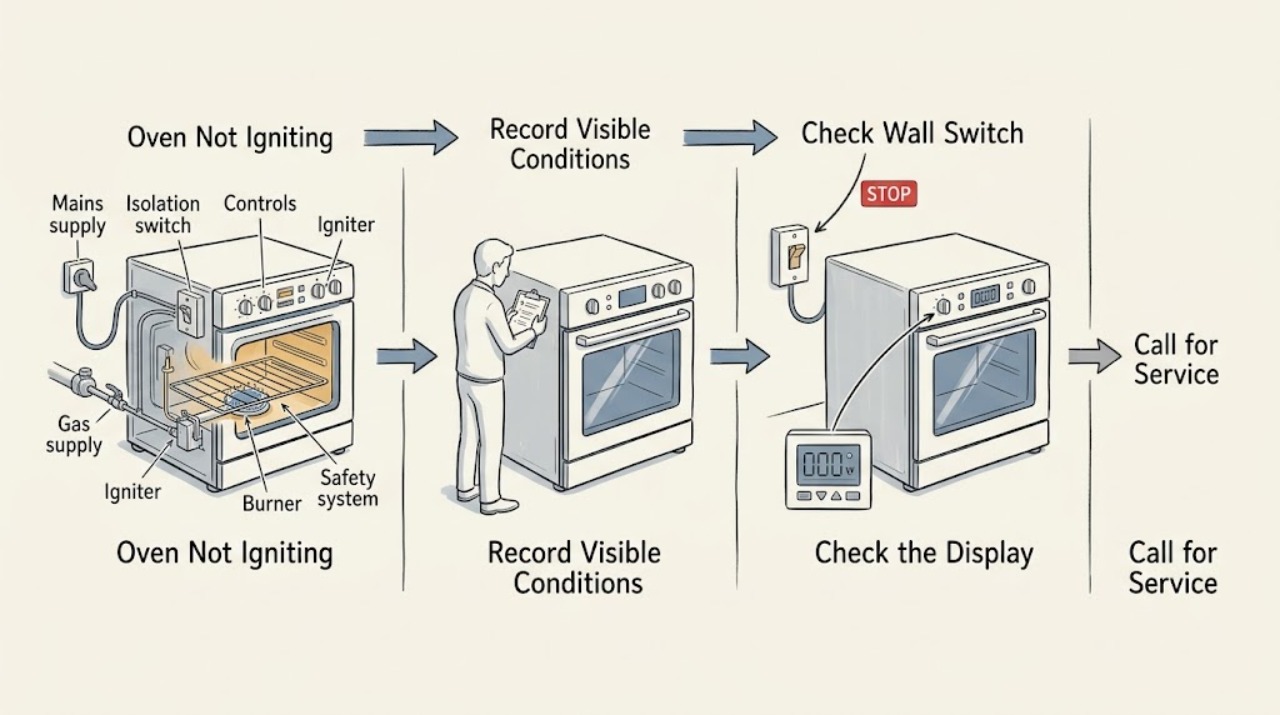
If a DeLonghi oven is not igniting, first establish whether it is an electric oven that is not powering or heating, or a gas model whose burner will not light. Check the mains plug, outlet, and isolation switch as DeLonghi's oven guidance directs, then confirm the timer, control, and heating programme are selected according to the model manual. For a gas-capable cooker, check only the external gas shutoff and supply and stop immediately if you smell unburned gas; never keep trying to ignite it or open the oven cabinet. A cooktop igniter or burner-cap check is not proof of the oven burner design, so use the exact manual for accessible cleaning or alignment. If the oven has power but the burner still will not light, the igniter clicks without a flame, a flame will not stay lit, or any gas, electrical, smoke, or overheating warning appears, stop and arrange qualified appliance or gas service.
Work through in order
Diagnostic checks
Use only checks that match the exact appliance or system and its official guide.
-
Check 1
Identify whether the DeLonghi appliance is electric, gas, or a combined cooker, and record the exact failure: no display, no response to controls, an electric element that stays cold, no spark, a clicking igniter with no flame, or a flame that lights and then goes out. Do not remove a panel to identify the fuel system.
Expected result: A dead display points to power or control supply; a powered oven with no heat points to the selected programme or heating path; clicking without a flame is a gas-supply or ignition branch; a flame that drops out is a combustion or safety branch.
Next step: Continue with the mains and isolation-switch check for any oven type. If gas is involved and there is an odor or uncontrolled flow, stop immediately and use qualified gas service.
Why this matters
Why: These are different faults with different hazards. Treating an electric heating complaint as a gas ignition problem, or repeatedly opening a gas appliance, can create an unsafe diagnosis.
-
Check 2
Check the plug, outlet, and external isolation switch without opening the oven. Confirm the outlet powers another simple appliance and that the oven's isolation switch is on; inspect the cord and plug visually for cuts, scorching, looseness, or moisture.
Expected result: If the test appliance also fails, the outlet or supply circuit is the likely branch. If the outlet works but the oven display and controls remain dead, the oven's power path or control may be faulty. A damaged cord, scorch mark, or moisture is a stop condition.
Next step: Do not use a damaged cord or outlet. Have a dead supply checked by a qualified electrician; if the supply is good and the oven remains dead, arrange appliance service rather than removing a cover.
Why this matters
Why: DeLonghi's oven FAQ specifically says to check mains power or the isolation switch. Establishing stable supply prevents a user from misdiagnosing a dead oven as an igniter failure.
-
Check 3
With the oven cool and no gas odor, confirm the model's timer or clock, selector, temperature control, and start sequence from the exact instruction manual. Make sure a valid cooking mode and temperature are selected; do not assume that a light, fan, or control position means the burner has ignited.
Expected result: If the display responds and the oven starts after a valid mode or timer sequence, the earlier problem was a control-selection condition. If the oven has power and a valid request but no heat or ignition, the fault is beyond the user control sequence.
Next step: Run one supervised start attempt using only the manual's sequence. If the oven does not respond, shows an alert, or requires an internal check, stop and arrange qualified service.
Why this matters
Why: DeLonghi's oven support separates “won't turn on” from other oven FAQ topics, including manual and electronic timer behavior. Model controls vary, so a generic ignition sequence is not safe to invent.
-
Check 4
For a gas model only, inspect the external gas shutoff and visible supply connection without loosening anything. If the manual identifies an accessible burner control, turn it only as instructed and listen briefly for the normal ignition sequence; never use a match or lighter to test the oven.
Expected result: No gas sound with a powered ignition request can indicate a closed supply or a valve or control fault. Gas sound without ignition, a strong odor, or a flame that will not remain stable is not a user-adjustment branch.
Next step: If the supply is visibly off and the manual allows the user to open it, restore it without tools and make one controlled attempt only. For gas odor, leaks, uncontrolled flow, no ignition after supply is confirmed, or a flame that goes out, stop and call qualified gas service.
Why this matters
Why: DeLonghi's related gas-lighting guidance says the supply valve must be on and the household supply working, but an oven's burner and safety system can differ from a cooktop. Gas symptoms need a conservative stop boundary.
-
Check 5
For a model with a user-accessible igniter or burner area, follow the exact manual's cool, powered-off inspection procedure. Look for visible grease or residue, a displaced cap, or an obstruction only where the manual permits access; do not apply a solvent, flood the burner, or remove an oven burner or cover by guessing.
Expected result: A correctly positioned, clean, accessible burner part may restore ignition on a matching design. If the oven igniter is hidden, damaged, wet, cracked, or still fails to light after the permitted inspection, the cause is not established by the related cooktop guidance.
Next step: Reassemble only the parts the manual identifies and allow them to dry completely before one supervised attempt. If ignition remains absent or gas is present without a stable flame, stop using the oven and arrange qualified service.
Why this matters
Why: DeLonghi lists clean igniters and a flat burner cap for its cooktop lighting problem, but the oven may use a different igniter and flame-safety arrangement. Model-specific access is essential.
-
Check 6
If the oven is electric, observe whether the display, fan, and selected mode respond, but do not judge ignition by looking for a visible element glow. DeLonghi notes that some oven elements may not visibly glow; compare the complete heating result with the model manual instead.
Expected result: A powered electric oven that never warms on a valid mode has a heating, control, or safety fault even if no gas is involved. A lower element that is not visibly glowing is not alone proof of failure.
Next step: Run no further test if the oven smells burnt, smokes, trips its supply, or becomes abnormally hot. Otherwise arrange qualified appliance service for persistent no-heat after the manual control and supply checks.
Why this matters
Why: The word “igniting” can be inaccurate for an electric oven. Separating visible glow from actual temperature avoids unsafe access and an incorrect gas diagnosis.
-
Check 7
After at most one controlled attempt, record any alert code, clicking pattern, spark, flame color and stability, temperature response, odor, leak, or electrical trip. Do not repeatedly cycle gas or power to make the oven ignite.
Expected result: A recurring alert, clicking with no flame, failure to heat with stable power, or a flame that extinguishes indicates an internal ignition, valve, sensor, control, or heating fault. Gas odor, smoke, burning smell, exposed wiring, or repeated breaker operation is an immediate safety warning.
Next step: Stop using the oven, isolate power only when safe, and arrange qualified appliance or gas service. Provide the model, fuel type, controls, sound or spark behavior, and exact display or flame observations.
Why this matters
Why: The remaining diagnosis requires qualified access and model-specific parts information. Repeated ignition attempts can accumulate unburned gas, while panel removal exposes live and hot components.
Use your observations
Decision map
Find the observation that best matches what you see, then follow the next safe action.
-
PATH 01Next step
What you see
The oven has no display or control response and the test appliance also fails at the outlet.
Do this next
Treat the outlet, isolation switch, or household supply as the next branch and use qualified electrical help if it cannot be safely restored. Do not open the oven.
-
PATH 02Next step
What you see
The outlet works, the oven display responds, but a valid programme and temperature do not start heating.
Do this next
Use the exact manual's timer and control sequence once. If the oven still does not heat or shows an alert, arrange qualified appliance service rather than testing internal elements or controls.
-
PATH 03Next step
What you see
A gas model has no gas sound when a permitted ignition request is made, and there is no gas odor.
Do this next
Check only the visible external shutoff and supply status against the model manual. If supply is present but there is still no ignition, stop and use qualified gas service.
-
PATH 04Next step
What you see
A gas igniter clicks or sparks but no stable burner flame appears.
Do this next
Stop attempting ignition, do not use a match or lighter, ventilate only as local gas-safety guidance permits, and arrange qualified gas or appliance service.
-
PATH 05Next step
What you see
The model manual permits an accessible igniter or burner inspection and visible residue or misalignment is found.
Do this next
Follow only the cool, powered-off manual procedure and reassemble correctly before one supervised attempt. Do not transfer a cooktop cleaning or burner-cap procedure to a hidden oven burner.
-
PATH 06Next step
What you see
The oven has gas odor, uncontrolled gas flow, smoke, a burning smell, exposed wiring, abnormal heat, a leak, or a repeated electrical trip.
Do this next
Stop immediately, avoid switches and ignition attempts, leave the hazard area if needed, isolate power only when safe, and follow local gas or electrical emergency guidance before arranging qualified service.
Helpful context
Understand the symptom
Separate no power from no flame
“Not igniting” can mean the oven display is dead, an electric element does not heat, a gas igniter does not spark, or a burner lights and then goes out. Record the appliance type, control response, clicking or sparking, gas smell, flame behavior, and whether the cooktop or other household appliances work. The correct check depends on the model and fuel type; DeLonghi's cooktop lighting advice is related evidence, not a universal oven procedure.
Gas and electrical stop boundary
If you smell gas, hear uncontrolled gas flow, see a yellow or unstable flame, or suspect a leak, do not operate switches, use a flame to test the supply, or keep attempting ignition. Leave the area if needed and follow local gas-emergency guidance. For electrical symptoms, do not remove panels, test live terminals, bypass an ignition or flame-safety device, or replace parts by guesswork. Use qualified appliance or gas service for an internal ignition fault.
When checks do not resolve it
Need a professional?
Professional diagnosis is appropriate for persistent no-ignition after the external power and model-approved control checks, for any internal gas or electrical component, or for a recurring alert or safety symptom.
Common questions
FAQ
What should I check first when a DeLonghi oven will not ignite?
First identify whether the oven is electric or gas and whether it is completely dead. Check the plug, working outlet, and isolation switch, then confirm the model's timer and cooking controls. Do not open the cabinet or repeatedly attempt a gas ignition.
Why does my DeLonghi gas oven click but not light?
A click without a stable flame can involve the external gas supply, an igniter, a burner path, or a safety control. Check only the external supply as the model manual permits; stop for gas odor or continued failure and arrange qualified gas service.
Can I clean the DeLonghi oven igniter myself?
Only if the exact manual identifies the igniter as user-accessible and gives a cool, powered-off cleaning procedure. DeLonghi's related cooktop guidance mentions clean igniters, but that does not authorize opening or cleaning a hidden oven burner.
Is an electric DeLonghi oven failing to ignite if the element does not glow?
Electric ovens do not use a gas ignition sequence, and a heating element may not visibly glow on every model or heating mode. Judge the complete heating result after confirming power and controls; persistent no-heat needs qualified service.
When should I stop troubleshooting a DeLonghi oven ignition problem?
Stop for gas odor, uncontrolled gas flow, smoke, a burning smell, exposed wiring, abnormal heat, water near electrics, or a repeated breaker trip. Avoid switches and ignition attempts as appropriate, isolate power only when safe, and arrange qualified gas, electrical, or appliance service.
Read the exact guide
Official sources
- The cooktop wont light.De'Longhi · Official De'Longhi cooktop FAQ used for related gas ignition mechanics only; gas-oven burner access, ignition sequence, and flame-safety details must be confirmed in the exact oven or cooker manual.
- The oven won’t turn on.De'Longhi · Official De'Longhi oven FAQ; its power and isolation-switch check applies to a no-start symptom, while fuel-specific ignition decisions still require the exact model manual.
- Domande frequenti su De'Longhi OvensDe'Longhi · Official De'Longhi oven FAQ index showing separate topics for oven start, timer, electronic timer, alerts, and heating behavior; it supports using the model-specific manual rather than an invented ignition sequence.
Community feedback
Share a repair observation
Share a plain-text repair observation. Accepted observations are published automatically; this page may take a moment to update.