
On this page
Start here
Quick answer
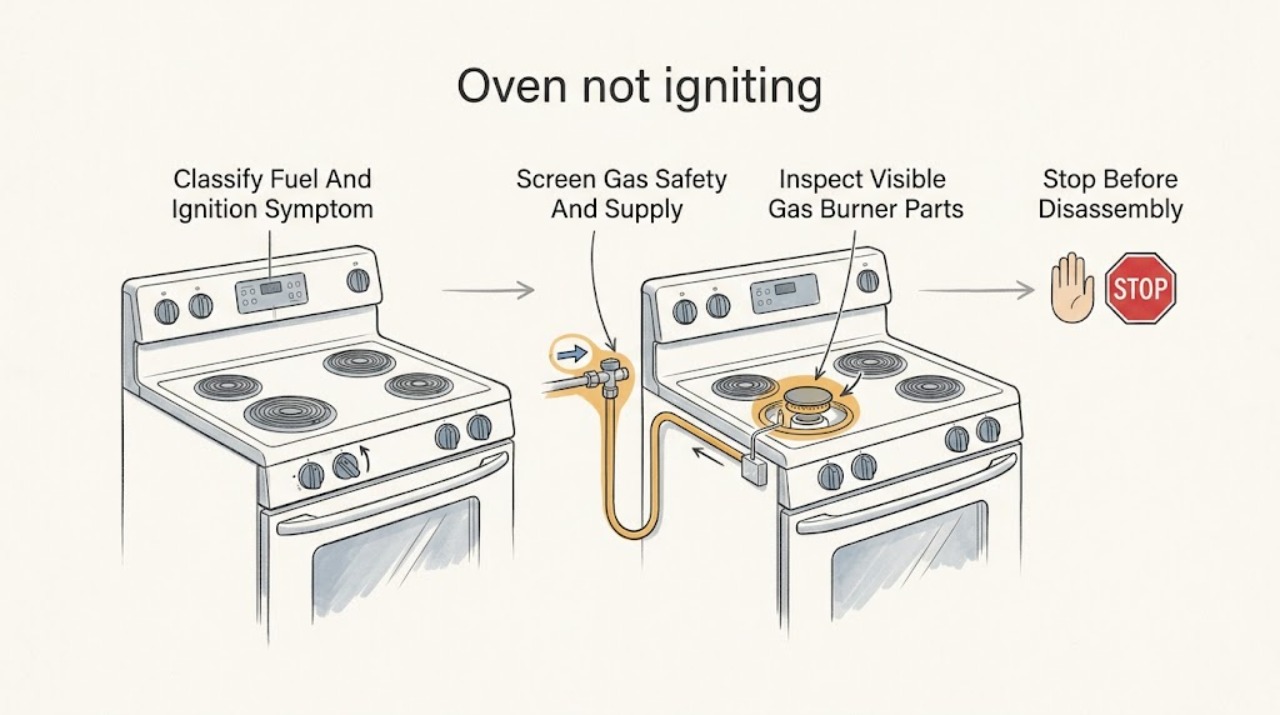
First identify whether this is a gas AEG oven or a conventional/electric oven described as not igniting. For a gas cooker, distinguish no spark, spark with no flame, and a flame that goes out; turn the control off promptly after a failed attempt and stop immediately for gas odor. For an electric oven, check the selected heating function and temperature, clock, Demo or Child Lock, door closure, and an accessible fuse or RCD only when safe. If the display is dark, protection trips again, a flame will not stay lit, or the oven still will not heat after these external checks, leave internal ignition, heating-element, sensor, and control diagnosis to an AEG-authorised engineer or qualified electrician.
Work through in order
Diagnostic checks
Use only checks that match the exact appliance or system and its official guide.
-
Check 1
With the appliance off and cool, identify whether the AEG oven is gas or electric and record the exact symptom: no display, no clicking or spark, spark with no flame, flame that goes out, a display that accepts settings but produces no heat, or only one heating function that fails.
Expected result: No spark, spark without flame, and flame-out are different gas paths. A dark display or an active display with no heat is an electric/control path and should not be diagnosed as a gas igniter fault.
Next step: Follow the matching gas or electric branch below and record the model/PNC information for model-specific instructions.
Stop if: Do not continue if there is gas odor, smoke, burning odor, water near electrical parts, damaged glass, exposed wiring, or a protection device that trips.
Why this matters
Why: The fuel type and failure stage determine whether the next safe check is supply and visible burner condition or clock, lock, function, and power state.
-
Check 2
For a gas AEG cooker, verify that every gas control is off before checking from a safe position for gas odor. If there is no odor, note whether the appliance has electrical power for ignition and whether a clearly accessible gas supply has been intentionally closed; do not loosen a gas connection.
Expected result: No electrical power can explain no spark, while no gas supply can explain a spark with no flame. Gas odor, hissing, or an uncertain connection changes the situation to an immediate stop condition.
Next step: If a clearly identified external supply was accidentally switched off, have the installer or qualified professional confirm the correct state. Otherwise turn the control off and arrange authorised service.
Stop if: Do not operate switches near a gas odor, relight repeatedly, adjust gas pressure, or remove panels to locate a leak.
Why this matters
Why: AEG identifies electrical supply, a blown fuse, and gas connection among possible ignition paths, but a supply observation does not prove that an internal igniter, valve, or burner is safe.
-
Check 3
If this is a freestanding AEG gas cooker and there is no gas odor, inspect only the cool, visible burner cap and crown for incorrect seating, debris, or moisture. Do not remove an oven base, burner shield, injector, or concealed ignition assembly.
Expected result: A visibly displaced, wet, or blocked cap/crown can prevent ignition or flame stability; correctly seated dry visible parts with the same failure point toward ignition, thermocouple, gas, or control diagnosis.
Next step: Correct only an obvious visible seating issue according to the model manual, then make no more than one normal ignition attempt. If it fails, turn the control off and arrange service.
Stop if: Do not scrape hidden jets, poke the igniter, disassemble the burner, or continue attempts after delayed ignition or an abnormal flame.
Why this matters
Why: AEG lists burner-cap/crown position and moisture or debris as causes in its gas-ignition guidance, but an oven burner may be hidden and is not a safe generic cleaning project.
-
Check 4
For an electric AEG oven, select the intended heating function and manual temperature, confirm any on-screen prompt, and check the display for a flashing clock, Demo/d, SAFE/padlock, Duration, or End setting. Confirm that the door closes normally.
Expected result: The oven may begin a normal cycle after a valid function, temperature, clock, and control state are set; a persistent no-heat condition with a responsive panel indicates a possible door, element, relay, sensor, or control fault.
Next step: Use the exact AEG model manual to clear a lock, Demo mode, or timer state. If the display accepts a correct selection but the oven stays cold, stop at external checks and arrange service.
Stop if: Do not guess hidden codes, force the door, bypass an interlock, or open the controls to look for a relay or element.
Why this matters
Why: AEG documents settings, clock, timing, Demo, Child Lock, display prompts, and door closure as conditions that can prevent an oven from heating without an ignition-part failure.
-
Check 5
If the electric oven display is dark or several functions fail, check the accessible fuse box or RCD once only when there is no smell, smoke, water, exposed damage, or other electrical hazard. Do not remove the oven from its cabinet or open an electrical cover.
Expected result: A tripped fuse or RCD can explain a dark display or whole-oven failure; a device that trips again, will not stay reset, or leaves the oven inactive indicates a supply, installation, or appliance fault.
Next step: If the device stays on and the oven recovers, observe one normal cycle. If it trips again or the oven remains dead, leave it isolated and contact a qualified electrician or authorised appliance service.
Stop if: Do not change fuse ratings, bypass the RCD, touch conductors, or repeatedly reset a protection device.
Why this matters
Why: AEG notes that a dark display with a tripped fuse or RCD may indicate a power-source or installation problem, and repeated protection action should not be treated as a normal reset.
-
Check 6
Record the AEG model/PNC, fuel type, exact display or prompt, selected function, clock/lock state, door behavior, gas clicking or spark behavior, visible burner condition, fuse/RCD response, and what happened after each safe external check.
Expected result: A precise sequence distinguishes no-spark supply faults, spark-without-flame gas faults, flame-stability faults, and electric control or heating faults without requiring the user to open the appliance.
Next step: Give the record to an AEG-authorised engineer or qualified electrician and leave the appliance unused when the fault persists or any hazard is present.
Stop if: Do not order or install an igniter, thermocouple, heating element, sensor, or control assembly from the symptom alone.
Why this matters
Why: Ignition and no-heat symptoms can involve different parts and safety controls; a guessed igniter, element, or control board is not a diagnosis.
Use your observations
Decision map
Find the observation that best matches what you see, then follow the next safe action.
-
PATH 01Safety boundary
What you see
A gas odor, hissing, delayed ignition, flashback, smoke, or an abnormal flame is present, or the burner does not ignite promptly.
Do this next
Turn the control off if safe, avoid electrical switches or sparks, leave the area, and contact the appropriate emergency or gas authority and qualified appliance service.
Why this path and its safety boundary
Why it matters: This is a fuel and fire-safety situation, not a routine igniter adjustment.
Safety stop: No further ignition attempts, burner cleaning, panel removal, or gas-connection work.
-
PATH 02Safety boundary
What you see
A gas AEG cooker has no spark or clicking at the ignition control and there is no gas odor.
Do this next
Check only the safe external supply state and stop if the fuse trips or the issue persists; arrange authorised service or qualified electrical diagnosis.
Why this path and its safety boundary
Why it matters: Electrical supply, fuse, ignition control, or wiring may be involved; no spark does not identify a failed igniter alone.
Safety stop: Do not access ignition wiring, replace a fuse with a different rating, or open the gas appliance.
-
PATH 03Safety boundary
What you see
A gas AEG appliance sparks or clicks but the oven/burner does not light, with no gas odor.
Do this next
Turn the control off after one brief normal attempt, use the model manual, and arrange qualified service for persistent failure.
Why this path and its safety boundary
Why it matters: Gas supply, visible cap/crown position on an applicable cooker, ignition alignment, or a gas-control fault may be involved.
Safety stop: Do not keep clicking, remove concealed burner parts, or adjust the gas path.
-
PATH 04Safety boundary
What you see
A gas flame lights but goes out when the control is released or cannot remain stable.
Do this next
Turn the control off, inspect only cool visible parts if applicable, and arrange authorised service if the flame does not remain stable.
Why this path and its safety boundary
Why it matters: Burner cap/crown position, moisture or debris, thermocouple, gas supply, or control may be involved; the cause is model-specific.
Safety stop: Do not bypass the thermocouple or safety control, hold the knob indefinitely, or continue using an unstable flame.
-
PATH 05Safety boundary
What you see
An electric AEG oven has a working display but does not heat, and it shows a flashing clock, Demo/d, SAFE/padlock, active timing, or an unconfirmed prompt.
Do this next
Clear the state using the exact model manual, confirm the function and temperature, and arrange service if the state will not clear or returns.
Why this path and its safety boundary
Why it matters: A control state can prevent heating without proving that an element or sensor has failed.
Safety stop: Do not guess service codes, bypass locks, or access the control electronics.
-
PATH 06Safety boundary
What you see
Only one electric AEG heating function remains cold while another function heats and settings, door, clock, and lock are correct.
Do this next
Stop using the failed function and arrange model-specific appliance diagnosis.
Why this path and its safety boundary
Why it matters: A function-specific element, selector, relay, or control path may be faulty; the symptom does not identify the part.
Safety stop: Do not test live elements or remove the rear panel to compare functions.
-
PATH 07Safety boundary
What you see
The electric oven display is dark, several functions are cold, or the fuse/RCD trips again.
Do this next
Leave the appliance isolated and contact a qualified electrician or AEG-authorised service engineer.
Why this path and its safety boundary
Why it matters: A supply, installation, common control, or wiring fault is possible and repeated resets may be unsafe.
Safety stop: No repeated resets, cabinet removal, conductor testing, or fuse-rating changes.
Helpful context
Understand the symptom
Clarify what not igniting means
AEG uses ignition language for gas cookers, while many AEG ovens are electric and present the same user complaint as no heat. A gas symptom can be no clicking or spark, clicking without flame, or a flame that extinguishes. An electric symptom is usually a dark or active display with no heating. The fuel type and exact observation determine the safe next check.
Control states can block an electric oven
Before assuming an electric heating element failed, check that a heating function and temperature are selected, the clock is set, no Duration or End program is delaying operation, and Demo or Child Lock is not active. AEG also notes that some rotary-knob models require display prompts to be confirmed and that the door must close correctly.
Keep ignition and electrical work professional
Do not open an oven cavity or gas burner compartment to look for a spark, test a live element, alter a gas connection, or bypass a door or safety control. If an external supply check and model-specific control check do not restore operation, the correct boundary is an authorised service engineer or qualified electrician.
Safety boundary
Stop conditions
- Stop immediately for gas odor, hissing, delayed ignition, flashback, abnormal flame, smoke, burning odor, fire, shock, water near electrical parts, exposed wiring, or damaged glass/door.
- Do not open the oven or gas appliance, remove burner shields or rear covers, test live wiring or elements, alter gas connections, or bypass a thermocouple, door interlock, or other safety control.
- Do not repeatedly click a gas igniter, relight a failed burner, or reset a fuse/RCD that trips again.
- Do not use a guessed Demo/Child Lock code or hidden service setting to overcome a no-heat state.
- Do not order or install an igniter, thermocouple, heating element, sensor, relay, or control board until the exact model and failed diagnostic are confirmed.
Only after diagnosis
Potential parts
- gas igniter or ignition electrode
Only relevant when a qualified diagnosis confirms that supply and visible burner conditions are normal but the model's ignition component is not producing or positioning a usable spark.
Confirm the exact AEG model/PNC, fuel configuration, and approved fitment before ordering; no-spark behavior alone does not establish compatibility. - flame-sensing thermocouple or safety device
Only relevant when a flame lights but will not remain stable and a technician confirms the sensing or safety path rather than cap position, moisture, gas supply, or control.
Gas safety components are model-specific and require qualified installation and leak/safety verification. - oven heating element or function-specific heater
Only relevant when one electric heating function remains cold after settings, clock, lock, door, and supply are verified and a technician isolates the heater circuit.
Confirm the exact AEG model/PNC, element position, rating, and fitment from the model documentation before ordering. - oven selector, relay, sensor, or control assembly
Only relevant when supply is sound and a qualified diagnosis identifies a control, selector, relay, or temperature-sensor fault affecting ignition or heating.
Control and sensor assemblies are model-specific; do not infer a board or selector fault from a no-ignition symptom alone.
When checks do not resolve it
Need a professional?
Arrange AEG-authorised service for persistent gas no-spark, spark-without-flame, or flame-out symptoms after the safe external checks., Call a qualified electrician or appliance engineer when the electric oven remains dark, several functions stay cold, the fuse/RCD trips again, or a control state returns., Use emergency or gas-authority guidance for gas odor, smoke, fire, flashback, or suspected carbon-monoxide or combustion danger.
Have this ready
- AEG model/PNC and whether the appliance is gas, electric, or a freestanding cooker
- No-spark, spark/no-flame, flame-out, dark-display, or active-display/no-heat symptom
- Exact display, clock, Demo, Child Lock, or prompt behavior
- Fuse/RCD behavior, door closure, visible burner condition, and any recent installation or power cut
- Any gas odor, smoke, abnormal flame, burning odor, water, or damage
Common questions
FAQ
What does AEG oven not igniting mean if it is electric?
For an electric AEG oven, treat the phrase as a no-heat symptom: check the heating function and temperature, clock, Demo or Child Lock, door closure, and safe external power state. Persistent no heat needs professional diagnosis of the heating and control circuits.
Why does my AEG gas oven click but not light?
The gas supply, electrical ignition supply, visible burner condition, or internal ignition path may be involved. Turn the control off after a brief failed attempt; if the problem persists, do not keep clicking or open the burner compartment—arrange authorised service.
Why does an AEG gas flame go out after ignition?
A misplaced, wet, or obstructed visible burner part, gas supply issue, thermocouple, or safety control may be involved. Turn the control off, inspect only cool visible parts if applicable, and stop using the appliance if the flame will not remain stable.
Can a flashing clock stop an AEG oven from heating?
Yes. AEG says a flashing clock can indicate that the time was not set after installation or a power cut. Set it using the exact model manual, then select the function and temperature again; ongoing no heat needs service.
When should I stop troubleshooting an AEG oven ignition fault?
Stop for gas odor, hissing, delayed ignition, abnormal flame, smoke, burning odor, exposed wiring, water near electrical parts, damaged glass, or a fuse/RCD that trips again. Do not perform internal gas or live electrical work.
Read the exact guide
Official sources
- The oven with rotary knob does not startAEG · AEG ovens with a display and single rotary knob; exact controls vary by model.
- Gas Hob Ignition Won't SparkAEG · AEG gas hobs and freestanding gas cookers; use only the applicable visible-burner principles for a gas oven and follow the oven model manual.
- Oven does not heat upAEG · AEG built-in, double, compact, and cooker ovens; model-specific instructions take precedence.
Community feedback
Share a repair observation
Share a plain-text repair observation. Accepted observations are published automatically; this page may take a moment to update.