
On this page
Start here
Quick answer
Start by separating no ice production from ice that is made but not dumped or dispensed. Confirm the ice maker is on using the exact Amana manual, check that the freezer is cold enough and the refrigerator doors close normally, then inspect only the visible water shutoff, supply line, filter seating, and ice-bin or ejector-area obstruction. Amana identifies restricted water, a warm freezer, an ice maker that is off, and filter problems as common causes; low water pressure can also cause slow or no ice production. After correcting one obvious external condition, allow the model's normal ice-making time before judging the result. If water leaks, the line is damaged, the ice maker repeatedly jams, or the freezer is not maintaining temperature, stop forcing the mechanism and arrange qualified service. Do not dismantle the inlet valve, bypass controls, or work on live wiring.
Before you begin
Safety first
- Owner checks are limited to normal controls, visible bin and mold observations, accessible filter seating, visible water-line condition, ordinary temperature observations, and a safe external shutoff. Internal valve, motor, sensor, wiring, sealed-system, and live electrical work require qualified service.
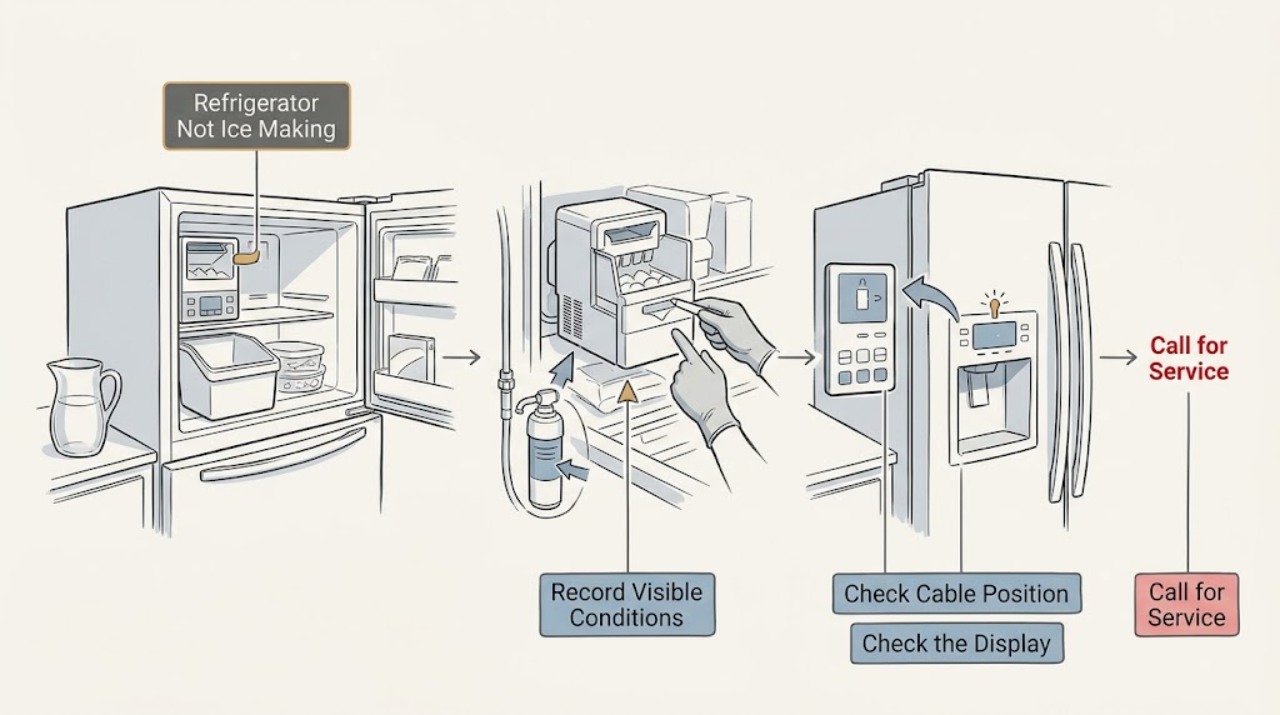
Work through in order
Diagnostic checks
Use only checks that match the exact appliance or system and its official guide.
-
Check 1
Record the exact Amana model and inspect the ice maker and storage bin from the normal user position. Determine whether the bin is empty, contains frozen cubes, contains clumped ice, or is full while the dispenser fails. Check the model manual before touching a wire arm, switch, or display control.
Expected result: No cubes are present, cubes are frozen in the mold, cubes are present but not dumped, the bin is full, the ejector area is visibly jammed, or the ice maker appears turned off.
Next step: Use the matching branch below and the exact manual. If a visible, loose clump can be removed without forcing the mechanism, clear only that obstruction. If cubes are frozen in place, the arm is stuck, or the symptom returns, stop manipulating it and arrange service.
Stop if: Do not pry the ejector, insert tools into the mechanism, remove covers, or bypass the ice-maker shutoff.
Why this matters
Why: An empty mold points toward water, temperature, or ice-maker control; frozen cubes that do not eject point toward an ejector or harvest problem; a full or clumped bin can be a storage or dispensing problem rather than no ice production. The control style cannot be inferred from the Amana brand alone.
-
Check 2
Confirm the ice maker is on using the installed model's normal control, wire arm, or switch. If it has a model-documented reset control, use only that procedure once; otherwise do not press an unknown button or repeatedly power-cycle the refrigerator.
Expected result: The ice maker was off, the control is on, the model has no reset control, or the control returns to off or fails to respond.
Next step: Turn it on only as the manual directs, then allow the normal production interval and check the mold again. If it will not stay on, repeatedly buzzes without water, or produces no ice with normal water and freezer conditions, request service.
Stop if: Do not bypass the shutoff arm, defeat a door or bin interlock, or keep an unconnected ice maker running.
Why this matters
Why: Amana identifies an accidentally switched-off ice maker as a common cause, but a control that will not stay on or respond can indicate a control or ice-maker fault. An ice maker left on without a water supply may buzz and can contribute to abnormal cold conditions.
-
Check 3
Check the freezer temperature display and the refrigerator doors from the user side. Confirm the freezer is cold enough according to the exact manual, doors close fully, and the appliance has had time to recover after installation, a large warm-food load, or frequent door opening.
Expected result: The freezer is warmer than the model's normal range, doors remain ajar or rub, the refrigerator was recently installed or heavily loaded, or the freezer is cold and doors close normally.
Next step: Correct only an obvious door obstruction or loading issue, keep doors closed, and allow the manual's recovery time. If the freezer cannot reach or hold the model's normal temperature, arrange refrigerator service before replacing an ice-maker part.
Stop if: Do not adjust sealed-system controls, remove interior panels, or continue using the refrigerator if there is a serious temperature or electrical fault.
Why this matters
Why: Ice production depends on freezer temperature. Warm conditions or a door that admits warm air can delay or stop ice production without proving the ice maker itself failed. A stable, cold freezer makes a water-path or ice-maker branch more likely.
-
Check 4
Inspect the visible water supply path without pulling hard on the refrigerator: confirm the household shutoff is open, look for a kink, crack, or leak, and check whether the refrigerator was pushed back against the wall. Do not loosen a connection; if a connection must be disturbed, follow the exact installation instructions with water and power safely isolated.
Expected result: The valve is closed, the line is kinked or damaged, water is leaking, the line appears normal, or the refrigerator uses a reverse-osmosis system or another pressure-reducing setup.
Next step: Open only an obviously closed shutoff if safe, relieve an external kink without stressing the line, and stop for any leak or damage. If pressure remains uncertain, have a licensed plumber or appliance technician assess it; do not perform an improvised pressure test.
Stop if: Do not operate with a leaking or cracked line, replace plumbing without the installation manual, or remove the inlet valve.
Why this matters
Why: Amana links a restricted or damaged line and low pressure to slow or no ice production. A reverse-osmosis system can reduce pressure further. A normal visible line does not prove that the inlet valve, internal tubing, or fill path is working.
-
Check 5
If the water filter was recently installed, remove or reseat it only as the exact Amana manual describes and confirm it locks and seals. Check the dispenser's water flow only from the normal user control, then allow the ice maker its ordinary production time; do not use a filter-bypass procedure unless the manual explicitly supports it.
Expected result: Water flow changed after the filter was reseated, the filter was not locked, the dispenser is slow or has no flow, the filter is overdue or clogged, or water flow seems normal but the ice maker remains empty.
Next step: Correct the filter installation or replace it only with the model-compatible filter specified by the manual. If flow stays poor, there is a leak, or ice production does not return after the normal interval, arrange service.
Stop if: Do not force the filter housing, run with a leaking seal, or substitute a filter without checking model compatibility.
Why this matters
Why: Amana says an incorrectly seated or clogged filter can reduce or stop flow to the ice maker and can cause filter-housing leaks. Normal dispenser flow makes a completely blocked filter less likely, but it does not prove the ice-maker fill circuit is clear.
Use your observations
Decision map
Find the observation that best matches what you see, then follow the next safe action.
-
PATH 01Next step
What you see
The ice maker was off or the freezer was recently installed, warmed, or heavily loaded, and the water line and filter show no obvious problem.
Do this next
Turn the ice maker on using the exact manual and allow its normal production interval. If no cubes appear after the freezer is stable and the supply is available, continue to service diagnosis rather than repeatedly resetting it.
Why this path and its safety boundary
Why it matters: A disabled ice maker or insufficient recovery time is more likely than a proven component failure. Amana's manuals describe a delay after installation and after substantial ice removal before production reaches normal output.
-
PATH 02Next step
What you see
The freezer is warm or doors do not close fully, while the ice maker is on and water checks are otherwise normal.
Do this next
Correct only a visible door or loading issue and allow the model's recovery time. If the freezer remains warm, leave the ice maker alone and arrange refrigerator service.
Why this path and its safety boundary
Why it matters: Temperature or warm-air entry is more likely to be limiting production than an isolated ice-maker fault. A refrigerator that cannot maintain temperature needs a broader cooling diagnosis.
-
PATH 03Next step
What you see
The mold is empty and the shutoff valve, visible line, freezer temperature, ice-maker control, and filter appear normal, but the ice maker never refills.
Do this next
Stop repeated resets and arrange qualified Amana refrigerator service. Provide the model, whether the dispenser flows water, the filter history, freezer condition, and what the ice mold looked like.
Why this path and its safety boundary
Why it matters: An internal fill path, inlet valve, sensing, or ice-maker control issue is possible, but the external symptom cannot identify a compatible failed part.
-
PATH 04Next step
What you see
Frozen cubes remain in the mold or ejector area, or cubes are made but do not dump into the bin.
Do this next
Clear only a loose, visible bin obstruction if the exact manual permits it. If the mold or ejector remains stuck, keep the ice maker off if the manual directs and arrange service.
Why this path and its safety boundary
Why it matters: This is a harvest or ice-bin path symptom rather than proof that the water supply is absent. Forcing the mechanism can damage the ice maker and does not distinguish a jam from a motor, thermostat, or control fault.
-
PATH 05Next step
What you see
A line or filter leaks, the refrigerator buzzes without a connected water supply, the water pressure is inadequate, or the ice maker control will not stay on.
Do this next
Close the water shutoff for a leak, leave the ice maker off when it is not connected to water, and arrange qualified appliance or plumbing service as appropriate.
Why this path and its safety boundary
Why it matters: The water or control condition can prevent production and may cause water damage or abnormal operation. It is not safe to keep cycling the ice maker while the underlying condition is unresolved.
Helpful context
Understand the symptom
First identify where the ice process stops
“Not making ice” can mean the ice maker never fills, ice forms but does not eject into the bin, the bin is full or blocked, or the dispenser cannot deliver ice that is already made. Look at the ice maker and bin rather than assuming a dispenser fault. The exact Amana refrigerator design matters: a wire shutoff arm, a switch, and a display control are not interchangeable, so use the manual for the installed model.
Water and cold air are separate requirements
An ice maker needs both a sufficiently cold freezer and a usable water path. Amana lists a closed or restricted supply, a kinked line, a poorly seated filter, and low pressure as causes of low or no ice production. A refrigerator that is too warm, or whose doors do not close fully, can also reduce ice output. Correct only an obvious external condition and give the appliance the model's normal recovery time before making another diagnosis.
Do not force the ice maker
The owner-level checks stop at the control, visible bin, accessible filter, visible supply line, and ordinary temperature observations. Do not pry a stuck ejector, dismantle the fill valve, remove panels, bypass the shutoff or door control, or probe wiring. A leak, damaged tubing, repeated jam, or freezer that cannot hold temperature needs qualified diagnosis rather than a guessed replacement part.
When checks do not resolve it
Need a professional?
Arrange qualified refrigerator service when the freezer is stable and cold, the ice maker is enabled, water and filter checks are normal, but no ice is produced after the model's normal interval; when the ejector or mold repeatedly jams; or when the control does not respond. Stop for a leaking or damaged water line, a refrigerator that cannot maintain temperature, or electrical damage. Do not dismantle the inlet valve, ice maker, panels, wiring, or sealed cooling system.
Safety scope: Owner checks are limited to normal controls, visible bin and mold observations, accessible filter seating, visible water-line condition, ordinary temperature observations, and a safe external shutoff. Internal valve, motor, sensor, wiring, sealed-system, and live electrical work require qualified service.
Common questions
FAQ
Why is my Amana refrigerator not making ice when the ice maker is on?
Check the freezer temperature, visible water shutoff and line, filter seating, and whether the mold is empty or holding frozen cubes. Amana lists restricted water, a warm freezer, filter problems, and an ice maker that is off as common causes. If those observations are normal and no ice appears after the model's normal interval, arrange service instead of forcing the mechanism.
Can a water filter stop an Amana refrigerator from making ice?
Yes. Amana says a clogged or incorrectly installed filter can reduce or stop water flow to the ice maker and can cause a leak at the filter housing. Reseat or replace it only according to the exact model manual. If water flow stays poor or ice production does not return, arrange service.
Does low water pressure cause an Amana ice maker to stop making ice?
It can. Amana associates low pressure with slow or no ice production and with small or hollow cubes. Check only the fully open shutoff, visible kinks, filter condition, and any reverse-osmosis setup. A licensed plumber or appliance technician should assess uncertain pressure; do not improvise a pressure test or alter plumbing without the installation instructions.
What should I do if Amana ice cubes are frozen in the ice maker?
Do not pry or force the ejector. Check the exact manual for the model's safe jam-clearing instruction and remove only a loose, visible obstruction if permitted. If the mold or ejector remains stuck, the jam returns, or the ice maker makes a buzzing sound without water connected, turn it off as directed and arrange service.
Read the exact guide
Official sources
- Not Making Ice - RefrigeratorAmana Product Help · Official Amana Product Help page for a French-door bottom-freezer refrigerator family; use the installed model's manual for exact layout and procedures.
- How to Check the Water Supply LineAmana Product Help · Official Amana Product Help installation-support page; plumbing type and service access depend on the installed model and local code.
- Owner's ManualAmana · Official Amana owner's manual for a specific refrigerator family; use the manual matching the installed model for controls and timing.
- Ensuring Correct Water PressureAmana Product Help · Official Amana Product Help page for refrigerators with water and ice features; pressure requirements and plumbing setup must be checked for the exact model.
- Not Making Ice - Side by Side RefrigeratorAmana Product Help · Official Amana Product Help page for side-by-side refrigerators; door-hinge connections and control layouts vary by model.
- Ice Maker Not Working - TroubleshootingAmana Product Help · Official Amana Product Help page for full-size refrigerator ice makers; exact controls and access vary by model.
Community feedback
Share a repair observation
Share a plain-text repair observation. Accepted observations are published automatically; this page may take a moment to update.