
On this page
Start here
Quick answer
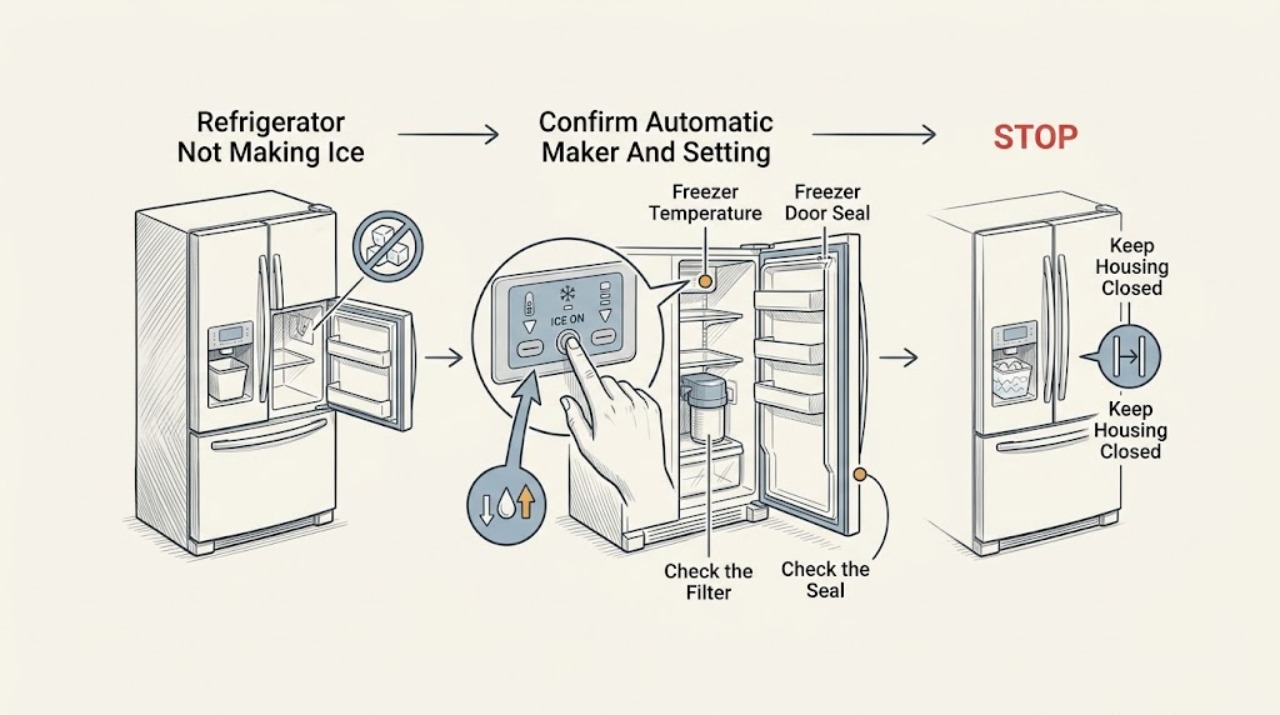
This guide applies only to a Daewoo model that actually lists an automatic ice maker; a freezer with a manual ice tray or an ice bucket is not the same system. First confirm the exact model and whether its ice maker is switched on, then allow the model's documented startup or recovery time after installation, a power event, or a setting change. Check the freezer temperature against the exact Daewoo manual, confirm the freezer door and ice-maker compartment seal normally, and keep the compartment closed while it reaches temperature. Next check the household water shutoff, visible supply line, and any model-approved filter for a kink, restriction, expired status, or incorrect seating. If the control is on, the freezer is cold enough, the wait period has passed, and water still does not reach the ice maker, or the ice-maker mechanism is silent, stuck, or shows an error, stop repeated tests: an internal inlet valve, ice-maker motor or sensor, harness, or control fault needs Daewoo or qualified appliance service.
Before you begin
Safety first
- The user may identify the model, read the controls, inspect door closure and visible tubing, follow the exact filter instructions, and handle a documented removable tray or bucket without force. Qualified service personnel must handle valves, hidden tubing, ice-maker covers, motors, sensors, harnesses, controls, sealed cooling parts, and live testing.
Work through in order
Diagnostic checks
Use only checks that match the exact appliance or system and its official guide.
-
Check 1
Read the Daewoo model label and exact manual. Confirm that the installed appliance has an automatic ice maker, identify whether the maker is in the freezer or another compartment, and check the documented Ice On, Ice Off, service, holiday, or similar setting without removing panels. Note whether the appliance was newly installed, recently powered, or just switched on.
Expected result: The model has no automatic maker, an Ice Off or equivalent indicator is active, the feature is enabled, or the maker has not yet had the documented startup time.
Next step: If there is no automatic maker, stop this procedure and use the manual-tray or ice-bucket instructions. If the maker is off, enable it only as the manual shows and wait the documented interval. If it is on and the wait has passed, continue with temperature and sealing checks.
Stop if: Do not borrow a test-button sequence from another model, bypass a sensor or door switch, or open the ice-maker housing.
Why this matters
Why: A missing feature, off setting, or normal startup delay does not establish a failed component. Daewoo feature and control layouts vary by model.
-
Check 2
Check the displayed freezer temperature or thermometer reading against the exact Daewoo manual and inspect the freezer door, gasket, and any ice-maker cover from the outside. Confirm that packages are not preventing closure, the door closes fully, and frost or a gap is not warming the maker. Keep the door closed during the model's recovery period.
Expected result: The freezer is warmer than the manual's ice-making range, the door or cover does not seal, frost is abnormal, or the temperature and seal appear normal.
Next step: Correct only an accessible obstruction or normal door-closing issue and allow the documented recovery time. If the freezer cannot reach its setting, frost is heavy, or the door needs hinge, gasket, or panel work, arrange refrigerator service before diagnosing the ice maker.
Stop if: Do not chip frost, remove an evaporator cover, adjust sealed refrigeration parts, or use a heater to force ice production.
Why this matters
Why: An ice maker cannot freeze water on schedule if the compartment is too warm or warm air enters through a poor seal. A normal temperature and seal make the water path or maker mechanism more likely.
-
Check 3
From a dry, safe position, check that the household water shutoff serving the refrigerator is open and inspect only the visible supply tubing for a kink, crush point, or leak. If this Daewoo model uses a water filter, check the exact manual for its approved type, replacement status, and seating. Do not loosen fittings or disconnect a pressurized line.
Expected result: The shutoff is closed, the visible line is kinked or leaking, the filter is restricted, expired, incorrect, or not seated, or the visible path is normal.
Next step: Correct only a clearly accessible shutoff, line position, or model-documented filter installation, then follow the exact purge or startup instruction once. If the line is hidden, leaking, or water still does not reach the maker, stop and arrange service or plumbing help as appropriate.
Stop if: Do not pull the refrigerator, remove a water valve, force a filter, or test the inlet line with the appliance energized.
Why this matters
Why: No water supply or insufficient flow can prevent the ice-maker mold from filling. A filter can also reduce flow when it is restricted or incorrectly installed. A normal external path does not rule out an internal valve or hidden line fault.
-
Check 4
Inspect only the documented accessible ice tray, bucket, or maker opening. Look for an empty or overfilled bin, clumped ice, a tray or bucket that is not seated, an ejector obstruction, or visible damage. If the exact Daewoo manual provides a user reset, perform it only once after the setting, temperature, seal, and water checks; otherwise do not press or move a hidden mechanism.
Expected result: The bin or tray is misseated, ice is clumped or blocking movement, the maker is visibly damaged, the model has a documented reset, or the accessible parts are clear and correctly seated.
Next step: Clear only loose visible ice and restore the documented seating; use the model-specific reset once if permitted, then wait for the stated recovery period. If the part is stuck, damage is visible, or the maker remains inactive, call service.
Stop if: Do not force a frozen bucket or tray, chip ice with a sharp object, use a hair dryer or improvised heat, remove an ice-maker cover, or press a test control repeatedly.
Why this matters
Why: A full, jammed, or misseated storage part can stop production or ejecting without proving a motor failure. A reset is model-specific and repeated testing can overflow the mold or jam the ice path.
-
Check 5
Record the exact model, automatic-maker location, setting, elapsed wait time, freezer temperature, door and frost condition, water shutoff and visible line result, filter status, tray or bucket seating, any error message, and whether the maker is silent, humming, clicking, or moving. Give this record to Daewoo support or a qualified appliance technician.
Expected result: Ice production returns after an external correction, the maker remains silent or stuck with normal accessible conditions, water never enters the mold, an error persists, or electrical or refrigerant symptoms appear.
Next step: Stop repeated cycles and arrange Daewoo or qualified appliance service. If the water supply itself is abnormal, use a plumber for that portion; if there is an appliance hazard, leave the refrigerator out of service as appropriate.
Stop if: Do not open the maker or control compartment, probe wiring, perform live voltage checks, bypass a sensor, or replace a valve or motor from the symptom alone.
Why this matters
Why: Recovery after a setting, temperature, water, filter, seating, or waiting correction supports that condition as the immediate cause. Persistent no-ice with those checks normal makes an internal valve, fill tube, motor, sensor, harness, control, or cooling fault more likely; a sound alone cannot identify the part.
Use your observations
Decision map
Find the observation that best matches what you see, then follow the next safe action.
-
PATH 01Safety boundary
What you see
The exact Daewoo model lists a manual ice tray, an ice bucket without an automatic maker, or no ice-making feature.
Do this next
Use the model's manual-tray or storage instructions and stop this automatic-maker procedure.
Why this path and its safety boundary
Why it matters: There is no automatic ice-maker system matching this diagnosis; a missing batch is not evidence of a failed valve or motor.
Safety stop: Do not add water to an automatic mechanism or modify the freezer to install a maker.
-
PATH 02Safety boundary
What you see
The maker is switched off, the refrigerator was recently installed or powered, or the documented recovery interval has not elapsed.
Do this next
Enable the maker with the exact Daewoo control and wait the documented time with the doors closed. Do not repeatedly reset or test it.
Why this path and its safety boundary
Why it matters: The ice cycle may not have started or completed yet, so this pattern does not prove a fault.
Safety stop: Do not bypass an Ice Off control, door switch, or sensor.
-
PATH 03Safety boundary
What you see
The maker is on, but the freezer is above the manual's ice-making range, the door or maker cover does not seal, or frost is abnormal.
Do this next
Correct only an accessible closure or loading problem and address a cooling, gasket, hinge, or frost fault through qualified service if it persists. Reassess ice production after the documented recovery time.
Why this path and its safety boundary
Why it matters: A warm compartment or air leak is more likely than a failed water valve until cooling and sealing are restored.
Safety stop: Do not remove evaporator covers, chip frost, or adjust sealed-system parts.
-
PATH 04Safety boundary
What you see
The maker is on and cold enough, but the shutoff, visible line, or filter is abnormal, or no water reaches the mold during the model-documented fill process.
Do this next
Correct only the visible shutoff, line, or model-approved filter condition and follow one documented purge or startup sequence. Call a plumber for a household supply problem and appliance service for a hidden or internal fault.
Why this path and its safety boundary
Why it matters: The supply, flow, or filter path is more likely than an ejector fault; if the external path is normal, an internal valve or hidden line becomes more likely.
Safety stop: Do not disconnect tubing, remove the valve, force a filter, or test water pressure at a pressurized fitting yourself.
-
PATH 05Safety boundary
What you see
The maker is confirmed, on, cold enough, supplied, and correctly seated, but it remains silent, stuck, unresponsive after the model-specific reset, or shows a persistent error.
Do this next
Stop repeated tests and arrange Daewoo or qualified appliance service with the recorded model and observations.
Why this path and its safety boundary
Why it matters: An internal valve, fill tube, motor, sensor, ejector, harness, control, or cooling fault is more likely; the symptom does not identify a safe replacement part.
Safety stop: Do not open panels, probe wiring, perform live tests, or force the tray, bucket, motor, or reset control.
Helpful context
Understand the symptom
Confirm that this is an automatic ice-maker problem
Daewoo does not use one refrigerator layout for every model. Its official product pages show side-by-side models with an Ice & Water Dispenser, while a different Daewoo refrigerator may have an ice maker and bucket but no water dispenser, or only a manual ice tray. Read the model number and feature list first. If the appliance has no automatic ice maker, there is no ice-maker fault to diagnose; follow the manual-tray instructions instead.
Separate a new or paused cycle from a true no-ice fault
Ice production is delayed when the maker has just been enabled, the refrigerator has just been installed or powered, the freezer is warming after a long door opening, or the ice bin has recently been emptied. Use the exact Daewoo manual's recovery interval rather than repeatedly pressing a test or reset control. A freezer that is not reaching its documented operating temperature points to a cooling or door-sealing problem before it points to the ice-maker motor.
Keep the water and internal mechanism boundaries clear
A closed household shutoff, kinked visible line, or restricted filter can prevent the fill valve from supplying the mold. Once those accessible conditions are normal, the valve, fill tube, motor, sensor, wiring, or control is behind the service boundary. Do not remove covers, force an ice tray, probe wiring, or use a live test. If the ice bucket is frozen in place, do not force it or apply a hair dryer; use the exact manual or service support.
Safety boundary
Stop conditions
- Stop using the appliance and isolate power only from a safe, dry location for smoke, burning odor, damaged wiring, water near electrical parts, a hot cord, or repeated protection trips.
- Do not open the ice-maker, valve, control, or door-panel enclosure, disconnect water tubing, probe wiring, or perform live electrical checks.
- Do not force a frozen bucket or tray, chip ice with sharp objects, use a hair dryer or improvised heat, or press a test/reset control repeatedly.
- Do not assume every Daewoo refrigerator has an automatic ice maker, water connection, filter, dispenser, or the same reset sequence; confirm the exact model manual first.
- If the setting, waiting period, temperature, seal, supply, filter, and accessible tray or bucket checks do not restore production, stop repeated cycles and arrange Daewoo or qualified appliance service.
When checks do not resolve it
Need a professional?
Safety scope: The user may identify the model, read the controls, inspect door closure and visible tubing, follow the exact filter instructions, and handle a documented removable tray or bucket without force. Qualified service personnel must handle valves, hidden tubing, ice-maker covers, motors, sensors, harnesses, controls, sealed cooling parts, and live testing.
Common questions
FAQ
Why is my Daewoo refrigerator not making ice?
First confirm that the exact Daewoo model has an automatic ice maker and that it is enabled. Allow the documented startup time, then check the freezer temperature and door seal, the water shutoff and visible line, and any model-approved filter. If those conditions are normal but no water reaches the mold or the maker remains unresponsive, arrange service rather than opening the mechanism.
How do I know whether my Daewoo ice maker is turned off?
Use the exact model manual and look for its Ice On, Ice Off, service, holiday, or equivalent indicator. Daewoo control layouts vary, so do not assume another brand's button sequence. If the maker is off, enable it as documented and wait the stated recovery time before judging production.
Can freezer temperature stop a Daewoo refrigerator from making ice?
Yes. If the freezer is warmer than the exact Daewoo manual's ice-making range, or the door or ice-maker cover does not seal, water may not freeze on schedule. Check the displayed setting, door closure, loading, and visible frost only. A freezer that cannot reach its setting needs cooling or refrigerator service.
Can a water filter or shutoff cause a Daewoo ice maker to stop?
Yes. A closed supply, kinked visible line, or restricted or incorrectly seated filter can reduce the water reaching the mold. Correct only a clearly accessible condition allowed by the Daewoo manual and do not disconnect a pressurized line. If the visible path is normal but the mold stays dry, an internal valve or hidden line needs service.
Should I reset a Daewoo ice maker that is not producing ice?
Only if the exact Daewoo manual documents a user reset for that model, and only after checking the setting, temperature, water path, and seating. Do not repeatedly press a test control, force a tray or bucket, or use a hair dryer on frozen parts. If the maker does not respond or the reset fails, call qualified service.
Read the exact guide
Official sources
- Reset the ice maker in the fridge compartment or Side-by-Side freezerSamsung Electronics · Used only to support the principle that reset controls and bucket seating are model-specific and repeated tests can jam or overflow an ice maker; do not use its button sequence on a Daewoo model unless the Daewoo manual documents it.
- DAEWOO CSMSBS4EDVA8 90 CM Side by Side with E Class, 513 LDaewoo · Official Daewoo product page used to confirm an example of a refrigerator with an Ice & Water Dispenser and electronic controls; it does not establish the layout of every Daewoo model.
- Samsung ice maker is not workingSamsung Electronics · Official manufacturer guidance used as general platform context for the diagnostic sequence; apply only the exact Daewoo manual's controls, temperatures, filters, and reset instructions to a Daewoo appliance.
- Freezer too cold on Samsung refrigeratorSamsung Electronics · Used for general safety context that a disconnected water line should not leave an ice maker running and that settings/environment affect ice production; the exact Daewoo model manual controls the actual setting and procedure.
- DAEWOO CSMSBS4ELVB8 90 CM Side by Side with E Class, 513 LDaewoo · Official Daewoo product page used to confirm a second dispenser-equipped configuration and model-specific control/feature variation; do not transfer its controls or parts to another model.
Community feedback
Share a repair observation
Share a plain-text repair observation. Accepted observations are published automatically; this page may take a moment to update.