
On this page
Start here
Quick answer
Start by confirming that your Blomberg model actually has an automatic ice maker and that the ice function is on. Check that the ice container is correctly positioned under the maker, the freezer is at its intended temperature, the water supply and any model-specific filter are not blocked, and the freezer door and airflow are normal. A newly installed system may need one to two days to build a full amount of ice. If there is still no ice after these external checks, do not dismantle the non-removable ice maker or water system; arrange authorised service.
Before you begin
Safety first
- Do not dismantle the non-removable ice maker, open electrical or evaporator covers, probe a live valve, chip ice from tubing, or bypass a control. Turn off the water valve for an active leak and unplug before any model-approved filter or container handling. Use qualified service for internal refrigeration, water, or ice-maker work.
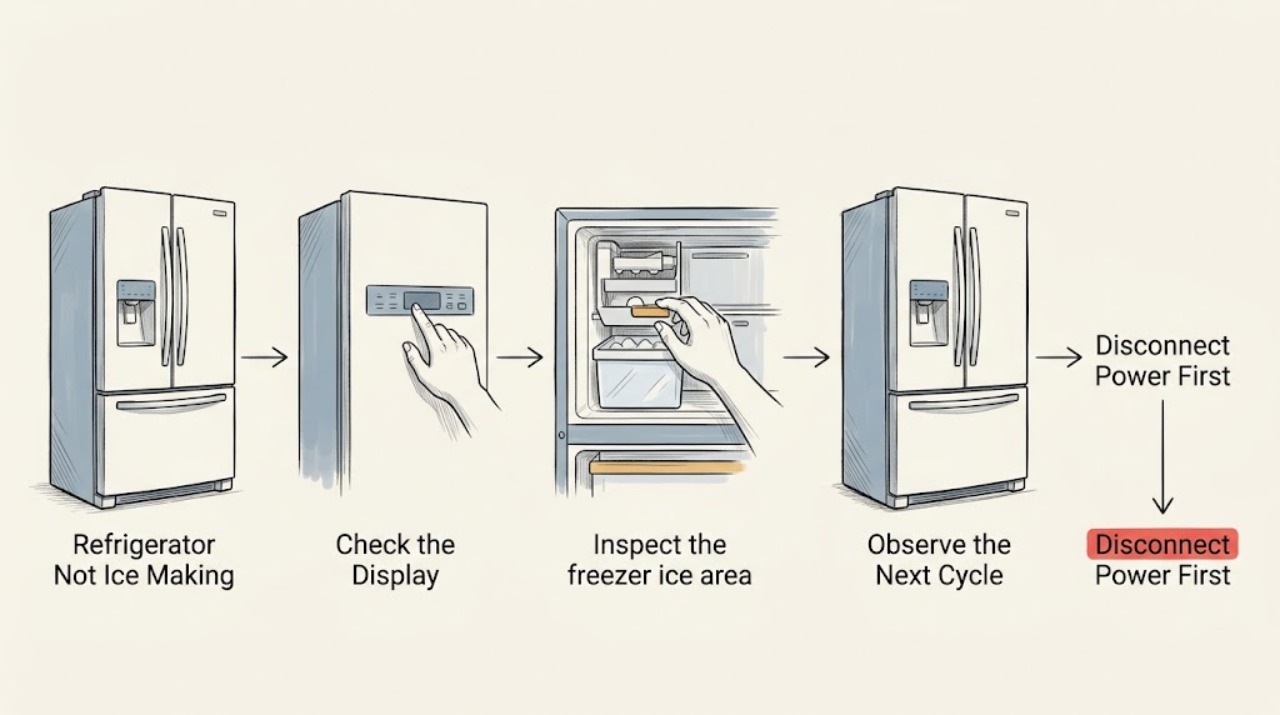
Work through in order
Diagnostic checks
Use only checks that match the exact appliance or system and its official guide.
-
Check 1
Check the exact model manual and control panel to confirm that an automatic ice maker is fitted. If the panel has an Ice or Ice Off control, make sure the ice function is enabled; do not assume a manual ice tray is an automatic maker.
Expected result: The refrigerator has no automatic ice maker, the ice function is off, or an automatic maker is present and switched on.
Next step: Use the exact model instructions to enable the feature if it was off. If the model has only a manual tray, fill and position that tray as directed; if an enabled automatic maker remains empty, continue with the physical checks.
Why this matters
Why: A missing or disabled feature explains an empty ice bin without a mechanical fault. An enabled maker moves the diagnosis to container position, temperature, water delivery, or the maker itself.
-
Check 2
Inspect the freezer ice area with the refrigerator operating normally. Confirm that the ice container is directly under the ice maker, has not been moved to another location, and is not already full of fused cubes that prevent new ice from being collected.
Expected result: The container is missing, mispositioned, full or packed with stuck cubes, or correctly positioned and able to receive ice.
Next step: Reseat the container exactly as shown and remove only loose, accessible stuck cubes without forcing the maker. If the container cannot seat, the maker is guarded, or the ice is frozen into the mechanism, stop and arrange service.
Why this matters
Why: Blomberg's manual says the container must be in place under the ice machine and warns not to change its location. A missing or obstructed container can make the maker appear not to work even if it is producing ice.
-
Check 3
Measure the freezer temperature with a suitable appliance thermometer or check the model display. Confirm that the freezer is at the model's ice-making range and that rapid freezing or another temporary mode is not being mistaken for normal operation. For the opened manual's model family, the example freezer setting is -18°C.
Expected result: The freezer is warmer than intended, temperature is stable at the model setting, or the reading cannot be trusted because no stable measurement was taken.
Next step: Correct the setting according to the exact manual, keep the door closed, and allow the freezer to stabilise before checking the bin again. If the freezer cannot hold the setting or shows heavy frost, move to the airflow and service branch.
Why this matters
Why: Ice production depends on the freezer reaching its operating temperature. Blomberg's documentation uses -18°C as a recommended freezer setting in the opened manual and says to allow a new system time to produce its full amount; a warm or unstable freezer makes a water-valve diagnosis premature.
-
Check 4
For a plumbed model, inspect only the visible water tap, hose, and connection for a closed valve, kink, leak, or obvious blockage. If the model has an internal or external water filter, check its installation and replacement status using the exact manual; leave the ice function off while accessing a filter if the manual requires it.
Expected result: The water valve is closed, the hose is kinked or leaking, the filter is missing or overdue, or the visible supply and filter arrangement look correct.
Next step: Open a closed valve only when there is no leak, straighten an accessible hose without pulling it, and use the model procedure for a filter. Stop immediately for an active leak or any work requiring a rear panel, valve, or tubing disassembly.
Why this matters
Why: An interrupted water path can prevent the maker from filling. The opened Blomberg manual documents optional water connections and filters and warns to turn off a leaking valve; a normal visible supply shifts attention to temperature, control, or the internal maker.
-
Check 5
Check the freezer door seal, visible frost, and loading around air vents. Make sure packages do not block the air path or press against the door, and look for a freezer fan that is silent only when the door is open if your model's design permits an external listening check.
Expected result: The door seal has a gap, frost restricts airflow, food blocks a vent, the freezer is overpacked, or the seal and airflow are normal.
Next step: Rearrange food and clean the accessible seal. If the model permits manual defrosting, follow the exact manual; do not use a sharp tool or open evaporator covers. Arrange service if frost returns or ice production does not resume after stabilisation.
Why this matters
Why: Blomberg identifies a compromised seal, restricted airflow, overloading, or frost buildup as conditions that can prevent the freezer from operating correctly. If the freezer is cold and clear but the enabled maker still produces no ice, an internal ice-maker or fill fault becomes more likely.
Use your observations
Decision map
Find the observation that best matches what you see, then follow the next safe action.
-
PATH 01Next step
What you see
The model has no automatic maker, the ice function was off, or the container was missing or out of position.
Do this next
Leave the control and container in the model-specified positions. If the maker is enabled and correctly positioned but the bin remains empty after the model's initial production period, continue with temperature and water checks.
Why this path and its safety boundary
Why it matters: This result makes configuration or collection position the likely cause rather than a failed ice-making mechanism.
-
PATH 02Next step
What you see
The freezer is too warm, overpacked, heavily frosted, or has a poor door seal while the ice maker is enabled.
Do this next
Keep the freezer at the model setting and avoid blocking vents. If it cannot hold temperature or frost returns, stop troubleshooting the ice maker and arrange authorised refrigeration service.
Why this path and its safety boundary
Why it matters: Improvement after the freezer condition is corrected makes temperature or airflow the likely contributor. Persistent warmth or frost points to a freezer or defrost fault rather than a simple empty ice bin.
-
PATH 03Next step
What you see
The automatic maker is on, the container is correctly positioned, the freezer is stable and cold, and the visible water path or filter is correct, but no ice is produced.
Do this next
Leave the ice function off if the model permits, isolate a leaking water supply, and contact Blomberg-authorised service. Provide the model, freezer temperature, control state, and the water and container checks already completed.
Why this path and its safety boundary
Why it matters: This pattern is more consistent with an internal fill valve, inlet path, sensor, control, or ice-maker assembly fault that cannot be distinguished safely from outside. The manual's maker is non-removable on the opened model family.
Helpful context
Understand the symptom
“Not making ice” can mean different things: the refrigerator may not include an automatic maker, the feature may be off, the container may be out of position, the freezer may not be cold enough, water may not be reaching the maker, or a new installation may simply be filling its first batch. Confirm which system your model has before treating an empty bin as a failure. Blomberg's manuals also warn that optional features and layouts vary by model.
Keep the checks external or limited to the removable container and model-approved filter access. Do not open the ice-maker housing, bypass an interlock, probe a water valve, or chip at frozen tubing. If water is leaking, switch off the supply where accessible and isolate the refrigerator before arranging service.
Only after diagnosis
Potential parts
- refrigerator ice-maker water inlet valve or fill assembly
Consider this only after a technician confirms that the ice function, container, freezer temperature, visible water supply, and filter are correct and that the maker is not receiving or controlling its fill water.
Confirm the full refrigerator model and the manufacturer's fit information before ordering; water valves and fill assemblies vary by model and connection type.
When checks do not resolve it
Need a professional?
Arrange Blomberg-authorised service when an enabled automatic maker remains empty after the model's initial production period despite a correctly positioned container, stable freezer temperature, clear airflow, and normal visible water supply; or when there is a leak, heavy recurring frost, a failed valve, or an internal maker fault.
Safety scope: Do not dismantle the non-removable ice maker, open electrical or evaporator covers, probe a live valve, chip ice from tubing, or bypass a control. Turn off the water valve for an active leak and unplug before any model-approved filter or container handling. Use qualified service for internal refrigeration, water, or ice-maker work.
Have this ready
- Provide the exact model and serial details, whether the maker is automatic, the Ice control state, the freezer temperature and measurement method, the container position, the time since installation or last ice, water-line and filter observations, and any leak or frost pattern.
Common questions
FAQ
How long should a Blomberg refrigerator take to make ice after installation?
For the opened Blomberg manual's model family, the system may take around one to two days to produce a full amount of ice. Confirm that the automatic maker is on and that its container is under the maker before treating the initial delay as a fault.
Why is my Blomberg ice bin empty even though the refrigerator is cold?
Check that the ice function is enabled, the container is correctly positioned under the maker, and a plumbed water valve or model-specific filter is not interrupting supply. If those conditions are correct and the bin remains empty after the initial production period, arrange service.
Can a blocked or overfilled freezer stop a Blomberg refrigerator from making ice?
It can interfere with airflow and freezer performance. Blomberg recommends checking overloading, frost buildup, the door seal, and the evaporator fan where the model has one. Restore airflow and allow the freezer to stabilise before diagnosing the ice maker itself.
Should I remove the ice maker to repair it?
No. The opened Blomberg manual identifies the ice machine as non-removable for its documented model family, and internal water or electrical work is not a safe user check. Turn off a leaking water supply and arrange authorised service instead.
Read the exact guide
Official sources
- Why is my fridge too cold?Blomberg · Blomberg refrigerator temperature measurement, temperature controls, airflow, door seals, ambient conditions, and professional boundary
- Refrigerator User ManualBlomberg · Blomberg refrigerator automatic ice-maker operation, container position, temperature settings, water connection, filter, airflow, and model-specific service boundaries
- My Blomberg freezer is no longer running?Blomberg · Blomberg freezer airflow, door seal, frost, compressor/fan clues, and professional-service guidance relevant to ice production
Community feedback
Share a repair observation
Share a plain-text repair observation. Accepted observations are published automatically; this page may take a moment to update.