
On this page
Start here
Quick answer
For an Amana ASD2575BRS00 that stopped making ice after its water pipes froze, treat the freeze as a water-recovery and possible damage event before assuming the ice maker failed. Keep the maker off if you see a leak, cracked tubing, wet electrical area, or a jam; otherwise use the Amana model lookup to confirm the exact controls, verify that the household supply has recovered, inspect only visible tubing and the filter housing, confirm a stable freezer temperature, and check that the maker and bin are in the manual's normal position. Compare the dispenser flow if fitted, then observe one ordinary cycle from outside. Do not heat a frozen line, force an ejector or test cycle, loosen a pressurized fitting, or order a valve or ice-maker assembly from a similar model.
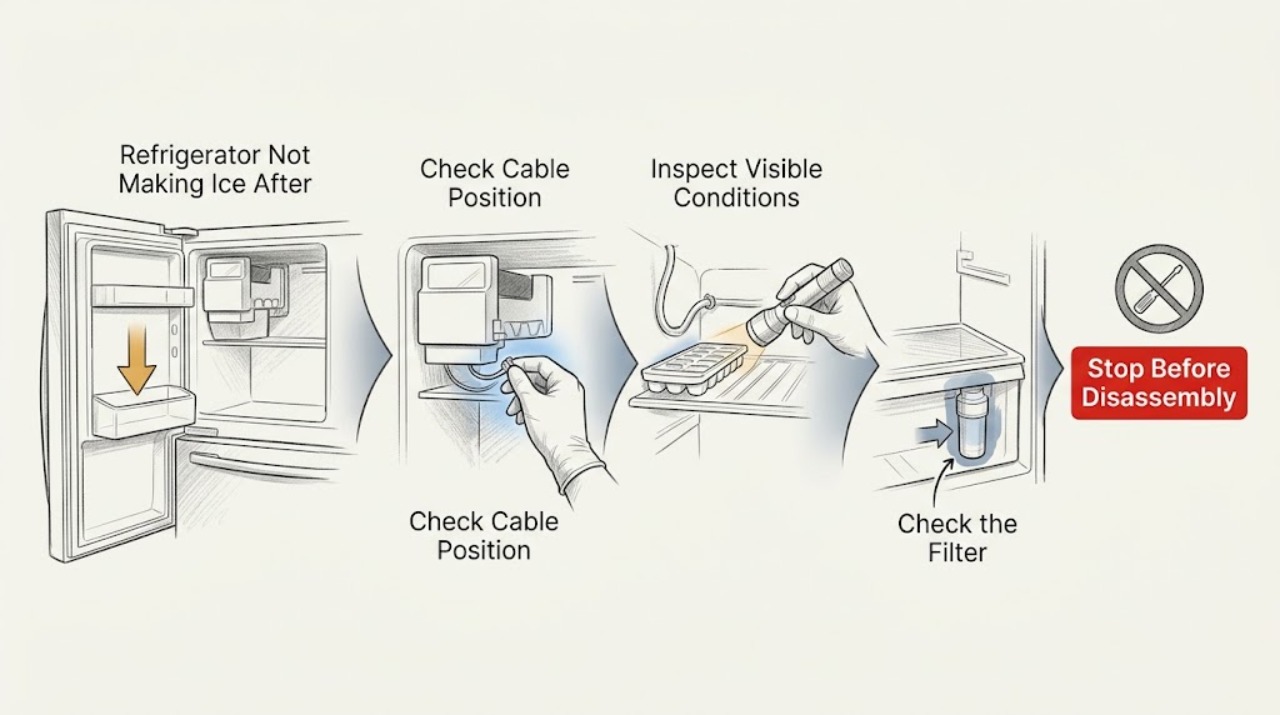
Work through in order
Diagnostic checks
Use only checks that match the exact appliance or system and its official guide.
-
Check 1
Confirm the complete model number at the refrigerator's interior label and use Amana's model-number lookup for ASD2575BRS00 before relying on a control diagram. With the mechanism still, identify the ice-maker switch or wire arm and check that the storage bin is fully seated; correct only a clearly documented off position or loose bin.
Expected result: The label confirms ASD2575BRS00 and the control is in the manual's ON position, or the control is still OFF, the bin is displaced, or a cube is visibly wedged.
Next step: Do not force the arm, reach into moving parts, or use an unidentified reset or test sequence. If a cube is under tension or the maker is overfilled, leave it off and arrange service.
Why this matters
Why: A maker left OFF after the freeze event, an unseated bin, or an accessible obstruction can stop production without proving a failed component. A normal setting moves the decision to water recovery and freezer condition.
-
Check 2
Without pulling the refrigerator or loosening a fitting, inspect only the accessible supply tubing, shutoff area, and filter housing after the reported freeze. Look for a visible kink, crushing, crack, wet connection, frost that is still present, or a valve that is plainly closed.
Expected result: The line is clear and dry, or it remains frozen/restricted, is damaged, or shows any water near the housing or electrical area.
Next step: Ease only a plainly visible kink without moving the appliance. Do not apply a heat gun, pour hot water into the line, push the refrigerator against the wall, or disconnect a pressurized connection. Stop water use and obtain qualified service for damage or a leak.
Why this matters
Why: Amana identifies restricted or turned-off supply, kinks, and freeze-related damage to tubing or valves as water-path concerns; a dry visible line does not prove that household pressure or an internal valve is normal.
-
Check 3
If the ASD2575BRS00 has a dispenser, make one brief normal water-dispense observation. If a filter was recently changed or disturbed while restoring water, follow the model instructions to verify its outside seating; compare flow before and after filter removal only when the filter procedure permits it.
Expected result: The dispenser is dry or weak, sputters after the filter was disturbed, flows normally, or the filter housing leaks.
Next step: Follow only the model's filter procedure and flush after a filter change as directed. Do not bypass a filter as a permanent fix, repeatedly dispense against a leak, or diagnose an inlet valve from flow alone.
Why this matters
Why: Weak or absent water at both dispenser and maker points toward the shared supply, pressure, filter, or tubing path. Normal dispenser flow makes an ice-maker fill or harvest symptom more plausible but does not prove a valve or maker part.
-
Check 4
Check the freezer display or a reliable reading without selecting an extreme setting, and note whether frozen food is solid and whether cooling has been stable since the freeze. Amana's general ice-maker guidance gives 0–5°F (-17 to -15°C) as the operating range for ice production; use the exact model literature for control instructions.
Expected result: The freezer is stable in that range, or it is warmer/unstable, has abnormal frost, or has a cooling fault.
Next step: Keep the doors closed while normal cooling returns and protect food if it has warmed. Do not open sealed refrigeration or electrical compartments; arrange service if the freezer cannot maintain normal cooling.
Why this matters
Why: A warm or unstable freezer can suppress the ice-making cycle even after water returns. A cold, stable freezer shifts attention to water delivery and the maker's fill or harvest behavior.
-
Check 5
With the maker confirmed ON and the bin seated, observe one ordinary cycle from outside the mechanism. Note whether it makes a brief fill sound, leaves the mold dry, contains water but does not release cubes, or buzzes without water; do not touch the ejector or insert tools.
Expected result: The maker fills and later fails to harvest, buzzes without water, never calls for water, or remains silent with normal freezer temperature and water flow.
Next step: Turn the maker OFF if it buzzes continuously, overfills, leaks, or jams, and request qualified diagnosis. Do not pour hot water into a fill tube, force a cycle, or replace a part based only on this symptom.
Why this matters
Why: A fill attempt without release points more toward harvest or sensing; a buzz without water keeps supply restriction and inlet delivery in consideration; no call for water or silence needs model-specific diagnosis because the observation does not identify one failed part.
-
Check 6
Record the complete model, the time the supply froze and recovered, maker control position, bin condition, dispenser result, filter history, freezer reading, visible line condition, and the exact fill/harvest sound before contacting service.
Expected result: The record points mainly to shared low flow, a post-freeze leak or restriction, warm cooling, a maker fill attempt, a harvest failure, or a silent maker.
Next step: Give the technician the model label and these observations. Keep the maker or refrigerator off when a leak, overfill, wet electrical area, smoke, burning odor, or unsafe frost/ice condition is present.
Why this matters
Why: This sequence helps a technician separate an upstream supply problem from an ice-maker assembly, fill tube, inlet valve, sensing, or control issue without turning a symptom into a part diagnosis.
Use your observations
Decision map
Find the observation that best matches what you see, then follow the next safe action.
-
PATH 01Next step
What you see
After the reported freeze, both the dispenser and ice maker have weak or absent water, or the visible line/filter area shows frost, a kink, or a leak.
Do this next
Keep the maker off, correct only a plainly visible routing issue, and have a qualified person assess pressure, tubing, valve, filter housing, and leaks. Do not heat, disconnect, or pressurize-test the line yourself.
Why this path and its safety boundary
Why it matters: The shared water path remains the stronger lead; a thawed line can still have a restriction or freeze-related damage, and the dispenser result does not prove that an internal valve is good.
-
PATH 02Next step
What you see
Water flow is normal and the freezer is cold and stable, but the maker remains silent or never fills after its control and bin are confirmed normal.
Do this next
Use the complete model information and one recorded ordinary-cycle observation for model-specific service diagnosis; do not force a test cycle or order a visually similar assembly.
Why this path and its safety boundary
Why it matters: An ice-maker control, sensing, fill path, or inlet delivery issue is more plausible than a household supply problem, but this pattern does not identify a replaceable part.
-
PATH 03Next step
What you see
The maker receives water but cubes do not release, the bin is overfilled, or the mechanism jams after being turned back on.
Do this next
Turn the maker off and arrange qualified appliance service. Do not touch a mechanism under tension, pour hot water into it, or continue cycling it to reproduce the symptom.
Why this path and its safety boundary
Why it matters: The supply has reached the mold, so harvest, sensing, or an internal obstruction becomes more plausible; the freeze history still warrants checking for leaks or damage rather than assuming a single part.
-
PATH 04Next step
What you see
The freezer is warm or unstable, or any water reaches electrical areas, the tubing/valve is cracked, smoke or burning odor appears, or the maker leaks or overfills.
Do this next
Stop using the maker and appliance when safe, keep clear of wet electrical areas, shut off the water supply only if safely accessible, and obtain prompt qualified service. Do not restart to test the hazard.
Why this path and its safety boundary
Why it matters: Continued operation can cause food loss, water damage, shock, or fire risk; ice production is no longer the only problem.
Helpful context
Understand the symptom
Why the freeze history changes the first check
Amana's winterizing guidance warns that freezing can damage refrigerator tubing, valves, and reservoirs. A line that has thawed can still be restricted, leaking, or unable to deliver enough water. The checks below therefore separate water recovery and visible damage from the maker's own setting, freezer condition, and fill or harvest behavior.
Only after diagnosis
Potential parts
- refrigerator water inlet valve
Consider only if model-specific diagnosis shows that the recovered supply path is adequate but the valve does not deliver water during a normal fill request.
Confirm ASD2575BRS00 fitment and the manufacturer's service information before ordering; a similar Amana or Whirlpool appearance is not proof of compatibility. - ice-maker fill tube
Consider only if qualified diagnosis finds a model-specific frozen, cracked, or obstructed fill tube after the supply and filter path are verified.
Do not heat, probe, or replace the tube based solely on a freeze history; verify the complete model and service documentation. - refrigerator ice-maker assembly
Consider only if the freezer, supply, filter, bin, and normal-cycle observations lead a qualified technician to an internal harvest or sensing fault.
Verify complete ASD2575BRS00 compatibility and any reused wiring or shutoff components with the manufacturer before purchase.
When checks do not resolve it
Need a professional?
Call qualified appliance service if water does not return after safe visible checks, a line/filter housing/valve leaks or shows freeze damage, the freezer cannot cool normally, the maker buzzes without water, overfills, jams, or remains inactive with normal supply and temperature. Stop immediately for water near electrical parts, smoke, a burning odor, or any need to open sealed refrigeration or electrical compartments.
Read the exact guide
Official sources
- Does the Water Filter Need to be Replaced?Amana Product Help · Amana refrigerator filter flow and post-filter air/flow checks
- Manuals and Guides | AmanaAmana · Amana refrigerator owner manual lookup for the complete ASD2575BRS00 model
- Ice Maker Not Working - Troubleshooting - Product Help | AmanaAmana Product Help · Amana refrigerator ice-maker troubleshooting
- Winterizing a RefrigeratorAmana Product Help · Amana refrigerator water-system freeze prevention and freeze-damage context
- How to Turn the Freestanding Ice Maker OnAmana Product Help · Amana refrigerator ice-maker on/off controls and safe model-specific identification
- Ensuring Correct Water PressureAmana Product Help · Amana refrigerator water pressure and shared dispenser/ice-maker flow symptoms
- Not Dispensing Water - Side by Side Refrigerator - Product Help | AmanaAmana Product Help · Amana side-by-side refrigerator visible supply-line, filter, and pressure checks
Community feedback
Share a repair observation
Share a plain-text repair observation. Accepted observations are published automatically; this page may take a moment to update.