
On this page
Start here
Quick answer
For the KitchenAid KRQC506MPS, a water line that was just connected does not mean the ice maker should produce ice immediately. First confirm that the line and shutoff are on, the freezer is at its normal cold operating condition, and the model's ice-maker control is enabled. KitchenAid says a recently installed refrigerator or ice maker may need 24 hours before ice production begins and up to 72 hours for full production. If the ice maker was left on while disconnected, turn it off until the water connection is ready; KitchenAid warns that this can cause buzzing and abnormal cold conditions. After the wait, compare the visible water supply and, if this model has an accessible dispenser, its flow and filter seal. A dry mold or no fill with a cold freezer and normal controls needs model-matched service; do not disconnect pressurized tubing, force the mechanism, or order an inlet valve or ice-maker assembly from the symptom alone.
Before you begin
Safety first
- Do not disconnect a pressurized water line, pull the refrigerator by its tubing, open the water valve or electrical enclosure, insert tools into the ice maker, force cubes or an ejector, pour hot water into a fill path, bypass a sensor, or perform energized testing. Stop for a leak, overfill, water near electrical parts, warming food, repeated buzz with no supply, or an appliance that cannot be safely sealed or cooled.
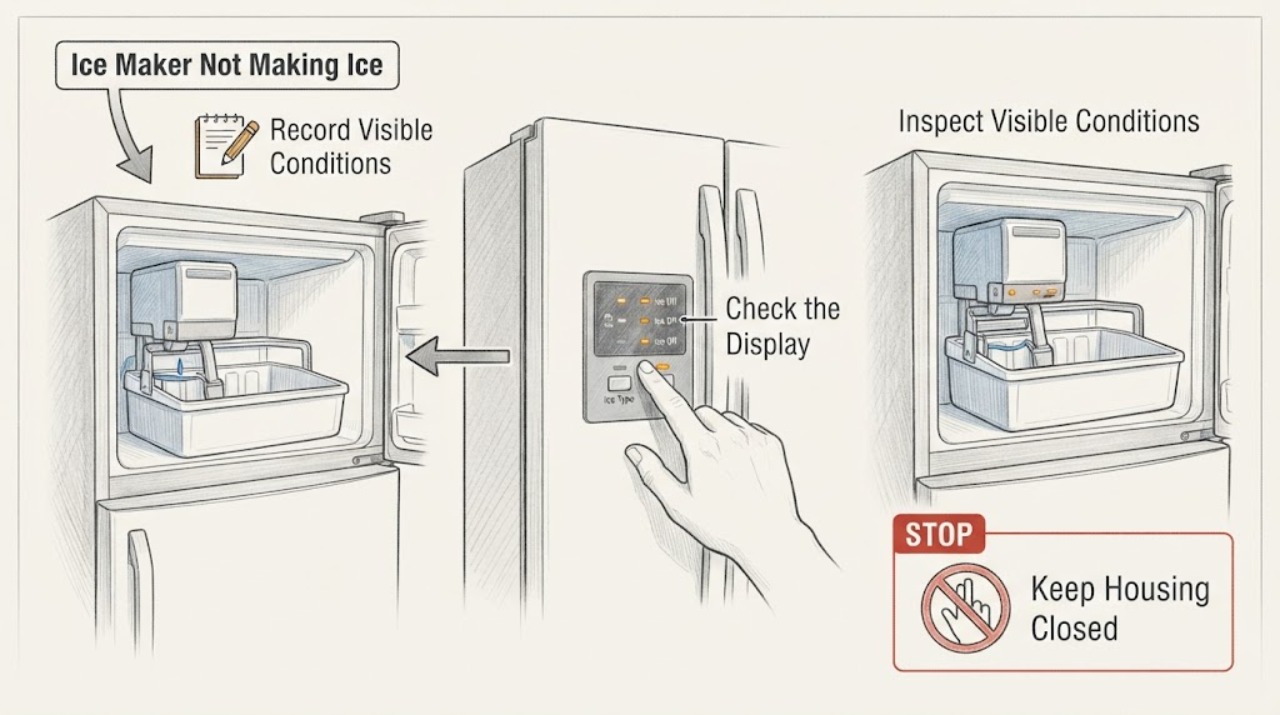
Work through in order
Diagnostic checks
Use only checks that match the exact appliance or system and its official guide.
-
Check 1
Record the complete model as KRQC506MPS from the refrigerator label and note when the water line was connected, whether the refrigerator was already cold, whether the ice maker was left on while disconnected, and whether any ice or water appeared afterward. Use KitchenAid's model lookup for the exact manual and do not rely on a near-model control diagram.
Expected result: The model is confirmed, the line was just connected after a long unused period, the maker was on while disconnected, or the model label/manual does not match.
Next step: Keep the exact model, connection date, and any display or indicator photos for later checks. If the identity cannot be confirmed, stop model-specific troubleshooting and obtain the correct manual.
Stop if: Do not press an unidentified test button, pull the refrigerator by the water tubing, or disconnect a line that may still be pressurized.
Why this matters
Why: This distinguishes a normal post-connection wait from a water-supply or control fault. The exact model matters because KitchenAid uses different ice-maker layouts and reset controls across refrigerator platforms.
-
Check 2
If the water line was just connected, confirm that the refrigerator has already reached its normal cold operating condition and allow the KitchenAid startup interval before judging production: at least 24 hours for ice production to begin and up to 72 hours for full production. Keep the ice maker off while a water connection is absent; after the line is ready, enable it only using the KRQC506MPS manual's visible control.
Expected result: Less than 24 hours have passed, 24 hours have passed but the bin is not full, more than 72 hours have passed with no ice, or the maker was left on with no water line.
Next step: Wait through the applicable interval while keeping the freezer closed as much as practical and the maker correctly enabled. If no production follows 72 hours, continue with the safe water and filter observations and arrange service if the maker remains dry.
Stop if: Do not repeatedly reset or cycle the refrigerator to accelerate production, and do not run the ice maker dry to reproduce a buzz.
Why this matters
Why: No cubes during the first day can be normal startup delay, and a partially filled bin before three days does not by itself prove failure. KitchenAid warns that an enabled maker without a water supply can buzz and produce abnormal operating conditions. More than the stated startup interval with no fill requires a water-path and service decision.
-
Check 3
From the front or another safe accessible position, inspect only the visible water line and shutoff status. Look for a kink, crushing against the cabinet, a wet connection, or an obviously closed shutoff. Correct only a visible kink that can be eased without moving the refrigerator; if any hose work is needed, shut off water at a safe accessible valve first and use qualified service.
Expected result: The line is kinked or crushed, a connection is wet or disconnected, the shutoff appears closed, or the visible line is clear and dry.
Next step: Ease a harmless visible kink only if the appliance stays in place and the connection remains dry. For leaks, disconnections, pressure questions, or tubing access behind the refrigerator, stop and arrange qualified appliance or plumbing service.
Stop if: Do not loosen a fitting while pressurized, pull the appliance out by the tubing, open the water valve or electrical enclosure, or continue with a wet connection.
Why this matters
Why: KitchenAid says the refrigerator must have a cold-water supply and that a kink can reduce water flow. A clear dry external line lowers the probability of an external restriction but does not rule out an internal valve, fill path, filter, or ice-maker problem.
-
Check 4
If the KRQC506MPS installation includes an accessible water dispenser, make one normal brief water dispense observation and check from the front that the filter is fully seated and sealed. Follow the exact manual for any filter removal, flushing, or replacement; do not remove a filter as a pressure-bypass experiment.
Expected result: Water flow is normal, slow or absent, sputters after the connection or filter change, or water appears at the filter housing.
Next step: Use only the model-documented filter seating and flushing procedure. Stop for a leak, water near electrical parts, or a model configuration without an accessible dispenser, and provide the flow result to service.
Stop if: Do not force the filter, run without a required filter seal, bypass the filter housing, or add pressure or water directly to the ice maker.
Why this matters
Why: Normal water flow makes a shared supply restriction less likely and leaves the ice-maker call for water, fill path, inlet valve, or harvest process in consideration. Weak flow or a filter-housing leak points first to supply, filter seating, or sealing rather than proving an ice-maker assembly failure.
-
Check 5
After the startup interval and safe external checks, observe the ice-maker compartment only from outside the mechanism. Record whether the mold contains frozen cubes, is empty and dry, fills with water, or releases cubes into the bin. Listen only for a brief fill sound versus a repeated buzz; do not reach into the mechanism or insert a tool.
Expected result: The mold fills and releases, contains frozen cubes that do not release, stays dry with normal water flow, or the maker buzzes repeatedly without filling.
Next step: If the maker fills and releases, check only the model-documented bin position. If it stays dry, jams, or buzzes repeatedly, leave the maker off and arrange model-specific appliance service with the recorded sequence.
Stop if: Do not force the ejector, thaw the mold with hot water, remove covers, bypass a sensor, or order a valve or ice-maker assembly from this observation alone.
Why this matters
Why: Filling and releasing indicates production is working even if dispensing or bin position is a separate issue. Frozen cubes that remain point toward harvest or sensing. A dry mold or repeated buzz keeps the water call, inlet valve, fill path, or control in consideration; the observation cannot identify a part.
-
Check 6
Check the freezer display and other frozen food to confirm that the compartment is maintaining normal freezing conditions, and verify that the doors and drawers close and seal normally. Use the KRQC506MPS manual for the proper temperature setting; do not force an extreme setting or open an access panel.
Expected result: The freezer is cold and stable, is warm or unstable, or a door or drawer remains ajar or does not seal.
Next step: Correct only a visible door or drawer obstruction and allow the refrigerator to recover under the manual's normal setting. Arrange service if cooling or sealing remains abnormal or if the ice maker stays dry after recovery.
Stop if: Do not dismantle door hinges, adjust sealed-system parts, or keep testing the maker when food is warming or water is entering electrical areas.
Why this matters
Why: KitchenAid lists freezer temperature among the causes of ice-maker problems. A warm compartment or poor seal can suppress production without proving an ice-maker component failure; stable freezing narrows attention back to controls and water delivery.
Use your observations
Decision map
Find the observation that best matches what you see, then follow the next safe action.
-
PATH 01Next step
What you see
The line was connected less than 24 hours ago, the freezer is already cold, and the maker is enabled according to the exact manual.
Do this next
Leave the refrigerator closed as much as practical and reassess after the applicable interval. Do not order parts or repeatedly reset the maker during this window.
Why this path and its safety boundary
Why it matters: The most likely decision is still normal post-installation delay, not a failed valve or ice-maker assembly. KitchenAid allows 24 hours to begin production and up to 72 hours for a full bin.
-
PATH 02Next step
What you see
The maker was left on before the water line was connected, or it buzzes while the line is absent or the shutoff is closed.
Do this next
Turn the maker off using the exact manual control until a secure water connection is available. Once connected, check externally for leaks and use the manual's startup procedure; use service for any persistent buzz or leak.
Why this path and its safety boundary
Why it matters: KitchenAid warns that an enabled ice maker without a water supply can buzz and contribute to abnormal cold conditions. This is a supply-state problem, not proof of a failed inlet valve.
-
PATH 03Next step
What you see
More than 72 hours have passed, the freezer is cold, the maker is enabled, the visible line is dry and clear, and an accessible dispenser has normal flow, but the mold remains dry.
Do this next
Leave the maker off and arrange qualified KitchenAid appliance service with the model, connection date, filter state, flow result, and dry-mold observation. Do not perform a pressurized or energized component test.
Why this path and its safety boundary
Why it matters: The startup and shared external supply explanations are less likely. The ice-maker call for water, internal fill path, inlet valve, sensor, or control remains possible, but the dry-mold observation cannot distinguish them.
-
PATH 04Next step
What you see
The mold contains frozen cubes that never release, while the freezer is cold and water supply observations are normal.
Do this next
Do not force the ejector or thaw the mechanism with a tool or hot water. Keep the maker off if it binds and arrange model-matched service.
Why this path and its safety boundary
Why it matters: The evidence shifts from initial water connection to the harvest or sensing side. A stuck cube or failed harvest process still does not identify a safe owner-replaceable part.
-
PATH 05Next step
What you see
The line or filter housing is wet, water reaches electrical areas, the maker overfills, the freezer cannot stay cold, or a door will not seal.
Do this next
Stop the ice maker and refrigerator if safe, shut off water before any hose work, keep clear of wet electrical areas, protect or discard food as appropriate, and obtain qualified appliance or plumbing service. Do not restart merely to reproduce the fault.
Why this path and its safety boundary
Why it matters: The situation has crossed the ordinary startup-troubleshooting boundary and may involve water damage, electrical risk, food-safety risk, or uncontrolled filling.
Helpful context
Understand the symptom
Why the recent connection changes the first decision
The KRQC506MPS is an exact KitchenAid four-door refrigerator model with an automatic ice maker, but the official model page currently exposes no downloadable manual in its page response. KitchenAid's general installation guidance is therefore useful for the startup decision—allow 24 hours for production and up to 72 hours for a full bin—while the exact manual remains the authority for the visible switch, control path, and filter procedure. Do not substitute a test button or control layout from another KitchenAid platform.
Separate water delivery from ice harvesting
After the startup wait, a dry mold or no fill keeps the water supply, filter, inlet valve, fill path, and ice-maker call for water in consideration. A mold that fills but does not release cubes points to a harvest or sensing side. KitchenAid's public guidance does not let an owner identify one of those parts from the symptom alone, so the safe endpoint is a documented observation and model-matched service rather than a pressurized hose test or guessed replacement.
Only after diagnosis
Potential parts
- refrigerator water inlet valve or water-control path
Consider only when service confirms that the model has normal cooling and controls but the ice maker does not receive water after the line, filter, and external supply are verified.
Confirm KRQC506MPS, revision, market, and the technician's diagnosis against KitchenAid fit information; no valve fit is established by a dry mold or a recent connection alone. - refrigerator ice-maker assembly or harvest/sensing component
Consider only when service observes a cold, enabled maker that fills or attempts to harvest but has a verified harvest or sensing fault.
Use the exact KRQC506MPS model and revision. Do not substitute a nearby four-door KitchenAid assembly or use a test-button result from another platform. - refrigerator water filter
Consider only if the exact manual and service evidence show a clogged, incorrectly seated, or expired filter is restricting flow or leaking at its housing.
Confirm the filter model, seal, and installation instructions for KRQC506MPS; do not bypass a filter housing or infer a filter requirement from the absence of ice.
When checks do not resolve it
Need a professional?
Arrange qualified KitchenAid appliance service when no ice is produced after 72 hours with normal cooling, an enabled maker, and a dry external water path; when the mold stays dry despite normal accessible water flow; when cubes freeze but do not harvest; or when a leak, overfill, jam, repeated buzz, filter-housing problem, or cooling issue appears. Use qualified plumbing service for a supply-line or shutoff problem.
Safety scope: Do not disconnect a pressurized water line, pull the refrigerator by its tubing, open the water valve or electrical enclosure, insert tools into the ice maker, force cubes or an ejector, pour hot water into a fill path, bypass a sensor, or perform energized testing. Stop for a leak, overfill, water near electrical parts, warming food, repeated buzz with no supply, or an appliance that cannot be safely sealed or cooled.
Have this ready
- Provide the exact KRQC506MPS model and market, water-line connection date, whether the maker was on while disconnected, startup wait completed, freezer condition, maker-control state, visible line and shutoff observations, filter state, dispenser flow if present, mold status, sounds, and any leak or food-safety concern.
Common questions
FAQ
How long should the KitchenAid KRQC506MPS ice maker take after I connect the water line?
KitchenAid's general installation guidance says to allow 24 hours for ice production to begin and up to 72 hours for full production. That wait assumes the refrigerator is cold and the maker is enabled according to the exact model instructions.
Should the ice maker be on while the water line is disconnected?
No. KitchenAid warns that leaving an ice maker on without a connected water supply can cause buzzing and abnormal cold conditions. Keep it off until the water connection is secure, then use the KRQC506MPS manual to enable it.
The water line is connected but the ice mold is dry. Is the inlet valve bad?
Not necessarily. A dry mold can also involve a kinked or restricted supply, filter seating, the ice-maker call for water, the fill path, a sensor, or control. Verify only the safe external checks and have the exact model diagnosed before replacing a valve.
Can I remove the filter to test whether the KRQC506MPS makes ice?
Follow the exact KRQC506MPS manual for filter checks. KitchenAid says an improperly installed or clogged filter can reduce flow or leak, but do not use an improvised filter bypass or remove a filter while the housing is wet or under uncertain pressure.
Read the exact guide
Official sources
- Ice Maker Not Working - TroubleshootingKitchenAid · Opened the official KitchenAid refrigerator ice-maker troubleshooting page for general supply, temperature, control, and filter checks; it does not assign a component to a KRQC506MPS symptom.
- Not Making Ice - RefrigeratorKitchenAid · Opened the official KitchenAid Product Help article in the Quad Door Refrigerator path, the product-family path that matches KRQC506MPS; exact control and reset details remain model-manual dependent.
- KRQC506MPS | KitchenAidKitchenAid · Opened the official KitchenAid Owner's Center page for the exact KRQC506MPS model; the page identifies the model and exposes no downloadable documents in the current page response.
- KitchenAid Manuals & LiteratureKitchenAid · Opened the official KitchenAid manuals page to verify that the exact model number should be entered to retrieve the matching owner, installation, and service literature.
- Why is it Not Making Ice after InstallationKitchenAid · Opened the official KitchenAid installation-support article for the general post-installation wait. Its page tag is undercounter refrigeration, so it supports the general time distinction only; it is not claimed as a KRQC506MPS-specific manual.
Community feedback
Share a repair observation
Share a plain-text repair observation. Accepted observations are published automatically; this page may take a moment to update.