
On this page
Start here
Quick answer
KitchenAid's official KRSC503ESS owner page identifies this as a 22.7 cu. ft. counter-depth side-by-side refrigerator with exterior ice and water, but it does not publish 39-47-48-45 as a normal user-facing error code. Treat that sequence as an unverified diagnostic readout or raw note, not as four confirmed failed parts. Start with the ordinary ice-production path: confirm the ice maker is on and the bin and doors are seated, check freezer cooling, compare one normal water dispense with the ice symptom, and inspect the accessible filter and water line. If the freezer is cold, water flow is normal, and the mold stays dry or the maker fails to harvest, stop experimenting and give the complete model suffix and observed sequence to qualified service; do not enter service mode, bridge wiring, or order a valve or ice-maker assembly from the numbers alone.
Before you begin
Safety first
- Do not enter service or diagnostic mode, bridge the door/ice-maker circuit, force an ejector arm, insert tools into the maker, heat a fill tube, loosen a pressurized water fitting, open electrical covers, or test energized wiring. Stop for water near electrical parts, overfill, smoke, burning odor, damaged wiring, loss of cooling, or a repeated breaker trip.
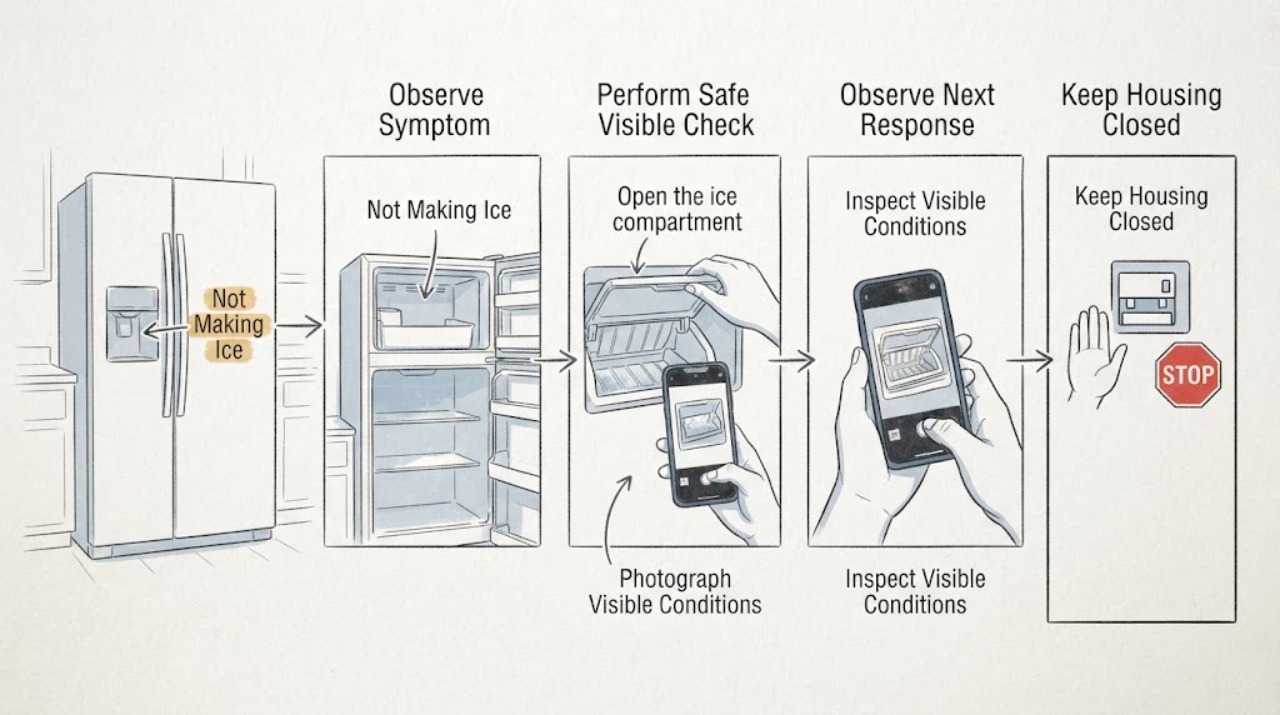
Work through in order
Diagnostic checks
Use only checks that match the exact appliance or system and its official guide.
-
Check 1
Photograph the display and write down exactly when 39-47-48-45 appears: during ordinary operation, after a power interruption, or only after a diagnostic/test screen. Record the complete rating-label model and suffix, serial number, market, and whether the display shows a code, a test number, or a parenthesized result. Do not press more buttons to make the sequence repeat.
Expected result: The sequence appears only in a test/diagnostic screen, or it appears on the normal user display and cannot be matched to the public KRSC503ESS owner resources.
Next step: Keep the photo and complete identity for service. Exit any test screen only using the exact model documentation if it clearly provides that instruction; otherwise stop pressing controls and continue with the ordinary no-ice checks below.
Why this matters
Why: KitchenAid's public KRSC503ESS page identifies the refrigerator but does not define this four-number sequence as a normal user error code. An exact-model community report also describes version-dependent diagnostic numbering, so the numbers cannot safely be mapped to four parts.
-
Check 2
Open the ice compartment or inspect the bin only from the normal user-accessible area. Note whether the bin contains cubes, the mold is dry, cubes are frozen in the mold, the bin is overfilled, or the ejector area is visibly jammed. Do not insert tools, force an ejector arm, or use heat to thaw a tube.
Expected result: Cubes are already in the bin, the mold is dry, frozen cubes remain in the mold, or the ejector area is visibly jammed.
Next step: For cubes in the bin, check only the bin/chute position and accessible clumping described by the manual. For a dry mold, continue to the water and cooling checks. For a jam or overfill, turn the maker off if the normal control allows it and arrange service rather than forcing the mechanism.
Why this matters
Why: Cubes in the bin shifts the problem toward dispensing or bin position rather than production. A dry mold keeps water delivery and the ice-maker fill call in consideration. Frozen cubes that do not release keep harvest or sensing in consideration, but neither pattern identifies a replacement part by itself.
-
Check 3
From the normal user-accessible area, verify that the ice maker is on, the ice bin is firmly seated, and both refrigerator doors close fully. Look for a control lock or other displayed state only if the exact manual documents it. Do not force a shutoff arm or press an unidentified test button.
Expected result: The maker is off, the bin is not seated, a door remains ajar, or the visible controls and bin position are correct.
Next step: Correct only a plainly visible on/off, bin, or door condition documented by the manual. If the visible setup is correct and the mold remains dry or fails to harvest, do not enter service mode; continue with water/cooling observations and arrange model-specific service if the condition persists.
Why this matters
Why: KitchenAid's manual says an off maker, an incorrectly positioned bin, or a door that is not fully closed can stop or suppress ice production without proving an ice-maker assembly failure. A normal switch position does not prove that the internal valve or harvest mechanism responds.
-
Check 4
Make one ordinary water-dispense observation from the front and compare its flow with the ice symptom. Inspect only the visible supply line and filter area for a kink, a wet connection, an apparently closed shutoff, or a filter that is not seated. Do not pull the refrigerator by the tubing, loosen a pressurized fitting, or bypass the filter.
Expected result: Water flow is normal, weak or absent, sputtering after a filter change, or accompanied by a wet filter housing or line.
Next step: Ease only a visible kink that can be corrected without moving the refrigerator. Follow the exact manual to reseat or replace a filter; if there is a leak, disconnected tube, pressure question, or water near electrical parts, shut off water from a safe accessible point and use qualified service.
Why this matters
Why: The manual lists an unconnected or incompletely open supply, a kinked line, a misinstalled filter, inadequate pressure, and reverse-osmosis supply as possible causes of reduced ice. Normal dispenser flow makes a shared external restriction less likely but does not prove that the ice-maker fill valve or internal tube works.
-
Check 5
Check the freezer's actual cooling condition without opening panels: compare the freezer with the condition of other frozen food, make sure the door closes and seals, and note whether the refrigerator was recently installed, reconnected, or had a large amount of ice removed. Do not force an extreme setting or repeatedly power-cycle the refrigerator.
Expected result: The freezer is maintaining normal cold operation, is warm or unstable, a door is not closing, the refrigerator is newly connected, or much of the bin was recently emptied.
Next step: Correct a visible door or loading problem and follow the exact manual's normal setting and startup guidance. If cooling is poor, food is warming, or ice production does not resume after the documented recovery period, arrange qualified refrigeration service rather than diagnosing the four numbers as a compressor, sensor, or valve failure.
Why this matters
Why: The KitchenAid manual connects no or low ice with an incompletely closed door, a new installation, and recovery after a large amount of ice was removed. It gives a normal startup wait and full-production wait for the listed model family; local market documentation should control if it differs.
-
Check 6
After the safe external checks, observe one normal production interval from outside the mechanism and record only the sequence: the mold stays dry, water enters but cubes never release, cubes release normally but the dispenser does not deliver, or there is a continuous buzz/overfill. Do not enter a diagnostic mode, reach into the mechanism, heat the fill tube, or test energized wiring.
Expected result: The freezer is cold, controls and bin are correct, dispenser flow is normal, and the mold stays dry; or the mold fills but does not harvest; or cubes exist but only dispensing fails.
Next step: Keep the maker off for continuous buzzing, a jam, overfill, or water leakage. Give service the exact suffix, photo of the display, freezer condition, dispenser result, bin/mold observation, and the timing of the four-number sequence; do not order a part from the sequence alone.
Why this matters
Why: A dry mold with normal water flow narrows the next professional assessment to the ice-maker call for water, inlet valve, fill path, sensing, or control. A filled mold that does not release points to a harvest-side assessment. Cubes already present make a dispenser/bin issue more likely. The observed sequence still does not identify which component failed.
Use your observations
Decision map
Find the observation that best matches what you see, then follow the next safe action.
-
PATH 01Next step
What you see
39-47-48-45 appears only after a test screen, or the exact model suffix and display context are missing.
Do this next
Stop interpreting or repeating the sequence. Preserve the photo and model/serial details, use only the ordinary no-ice checks in the matching manual, and ask qualified service to identify the correct technical sheet for that exact version.
Why this path and its safety boundary
Why it matters: The sequence is not established as a public user-facing error code for KRSC503ESS. Version-specific diagnostic numbering is possible, and translating each number into a failed part would be speculation.
-
PATH 02Next step
What you see
The freezer is cold and the ice maker is on, but the dispenser and ice maker both have weak or absent water; the filter area or visible line is kinked, wet, or recently changed.
Do this next
Follow the exact manual to correct a visible filter or line condition. Shut off water before any hose work; use qualified service for leaks, pressure questions, or water near electrical parts.
Why this path and its safety boundary
Why it matters: A shared supply, filter, pressure, or visible line issue is more likely than an isolated harvest fault, although the exact cause is not proven.
-
PATH 03Next step
What you see
The freezer is cold, the maker and bin are correctly positioned, dispenser water flow is normal, and the mold remains dry or the maker repeatedly buzzes without filling.
Do this next
Turn the maker off if the normal control permits it and arrange qualified KitchenAid refrigerator service. Do not enter service mode, force a fill, heat the tube, or replace the valve or assembly solely from 39-47-48-45.
Why this path and its safety boundary
Why it matters: The evidence shifts toward the ice-maker call for water, inlet valve, fill path, or control response, but it does not distinguish those parts from an internal wiring or sensor condition.
-
PATH 04Next step
What you see
The mold contains frozen cubes but they do not release, the ejector is visibly jammed, or cubes are present in the bin but do not dispense.
Do this next
Use only the manual's accessible bin/chute or plastic-utensil guidance; do not force the arm or use sharp tools. Arrange service if the maker remains jammed or fails to harvest after the safe check.
Why this path and its safety boundary
Why it matters: The symptom separates a harvest or dispensing path from the no-water production path. The manual's safe user checks do not prove a motor, sensor, auger, or ice-maker assembly failure.
-
PATH 05Next step
What you see
Water reaches the bin or electrical area, the maker overfills, the freezer cannot stay cold, or there is smoke, burning odor, damaged wiring, or a repeated breaker trip.
Do this next
Stop the ice maker and refrigerator if it is safe to do so, keep clear of wet electrical areas, shut off water before hose or overfill service, protect food, and obtain qualified appliance service. Do not restart to reproduce the sequence.
Why this path and its safety boundary
Why it matters: The problem has crossed the observation-only boundary and continued cycling can add water, food-safety, electrical, or mechanical risk.
Helpful context
Understand the symptom
What the four-number sequence does and does not prove
The KRSC503ESS Owner's Center identifies the appliance and its exterior ice-and-water configuration, but the public model page does not provide a user-facing table for 39-47-48-45. An exact-model Reddit report describes those numbers in a diagnostic context and also warns that code documents for a newer version do not match the older refrigerator. That is useful evidence that the sequence should be preserved for a technician, not a reliable basis for translating 39, 47, 48, and 45 into four replacement parts.
Use the ice-production path first
The KitchenAid manual that lists KRSC503ESS among its applicable models separates no ice from a dispensing jam. Look for cubes in the bin or ice mold, verify the maker and bin position, then check cooling and water delivery. The manual's market-specific instructions should control any temperature, pressure, or startup detail; do not borrow a service-test sequence from another version.
Only after diagnosis
Potential parts
- refrigerator ice-maker assembly
Consider this only after a qualified diagnosis confirms a harvest, sensing, or internal ice-maker fault. The four-number sequence alone does not identify this assembly.
Confirm the full model suffix, market, revision, and manufacturer fit information before ordering; do not use a part from another diagnostic version. - refrigerator water inlet valve
Consider this only when the exact-model diagnosis confirms the valve is not delivering water after supply, filter, pressure, and fill-path checks. Normal or weak dispenser flow alone is not proof.
Verify exact model suffix and fitment with KitchenAid or a qualified provider; do not infer valve failure from code 45 or any unverified sequence. - ice-maker fill tube
Consider this only if a qualified inspection finds a confirmed obstruction or damage in the model-matched fill path; do not heat, probe, or thaw the tube as a home test.
Confirm the complete model and revision before sourcing any tube; the reported numbers do not establish compatibility.
When checks do not resolve it
Need a professional?
Request qualified service when the exact KRSC503ESS suffix and the context of 39-47-48-45 cannot be verified, when the ordinary controls, bin, cooling, water, filter, and visible-line checks are normal but the mold remains dry or fails to harvest, or when any leak, jam, continuous buzz, overfill, or cooling problem persists.
Safety scope: Do not enter service or diagnostic mode, bridge the door/ice-maker circuit, force an ejector arm, insert tools into the maker, heat a fill tube, loosen a pressurized water fitting, open electrical covers, or test energized wiring. Stop for water near electrical parts, overfill, smoke, burning odor, damaged wiring, loss of cooling, or a repeated breaker trip.
Have this ready
- Provide the full rating-label model and suffix, serial number, market, a photo of the normal display and any test-screen sequence, whether cubes are in the bin or mold, freezer condition, one water-dispenser observation, filter and line observations, and what changed before the no-ice symptom.
Common questions
FAQ
Are 39, 47, 48, and 45 confirmed KitchenAid KRSC503ESS error codes?
They are not established here as a normal user-facing error-code set. The public KRSC503ESS owner page does not define that sequence, and an exact-model community report says diagnostic numbering differs by version. Preserve the display context and exact suffix instead of assigning a part to each number.
The refrigerator dispenses water normally. Why is it still not making ice?
Normal dispenser flow lowers the likelihood of a shared external supply restriction but does not prove that water reaches the ice-maker mold. Check the maker's on state, bin and door position, freezer cooling, and filter seating. If the mold remains dry, a qualified provider must assess the fill call, valve, fill path, sensing, wiring, or control.
Can I run the KitchenAid diagnostic tests to interpret the four numbers?
Not as a general user step. Do not enter service mode or repeat unidentified tests from another version. Give the display photo and exact model suffix to qualified service so the correct technical documentation can be used.
Should I replace the ice maker or water valve first?
No. The manual lists several external causes of no ice, and the four-number sequence does not select a component. Correct only a clearly documented filter, line, door, bin, or on/off condition; obtain a model-specific diagnosis before ordering a part.
Read the exact guide
Official sources
- W10768783B v01.fmKitchenAid · The official manual file explicitly lists KRSC503ESS among its applicable models and provides model-family user troubleshooting for ice, water, doors, bins, and startup. It is a Spanish-market document; local market documentation controls where instructions differ, and it does not define the reported four-number sequence.
- KRSC503ESS | KitchenAidKitchenAid · Directly identifies the topic model as a 22.7 cu. ft. counter-depth side-by-side refrigerator with exterior ice and water and exposes the public model resource list; it does not define reported sequence 39 47 48 45 as a user-facing code.
- Kitchenaid KRSC503ESS - Ice Maker Not Icing - All sorts of fun details insideReddit, r/appliancerepair · Exact-model community context only. The post reports cold compartments, normal door-water dispensing, a dry ice tray, and version-dependent diagnostic numbering; it is not authoritative evidence of what 39, 47, 48, or 45 means and does not establish a verified repair.
Community feedback
Share a repair observation
Share a plain-text repair observation. Accepted observations are published automatically; this page may take a moment to update.