
On this page
Start here
Quick answer
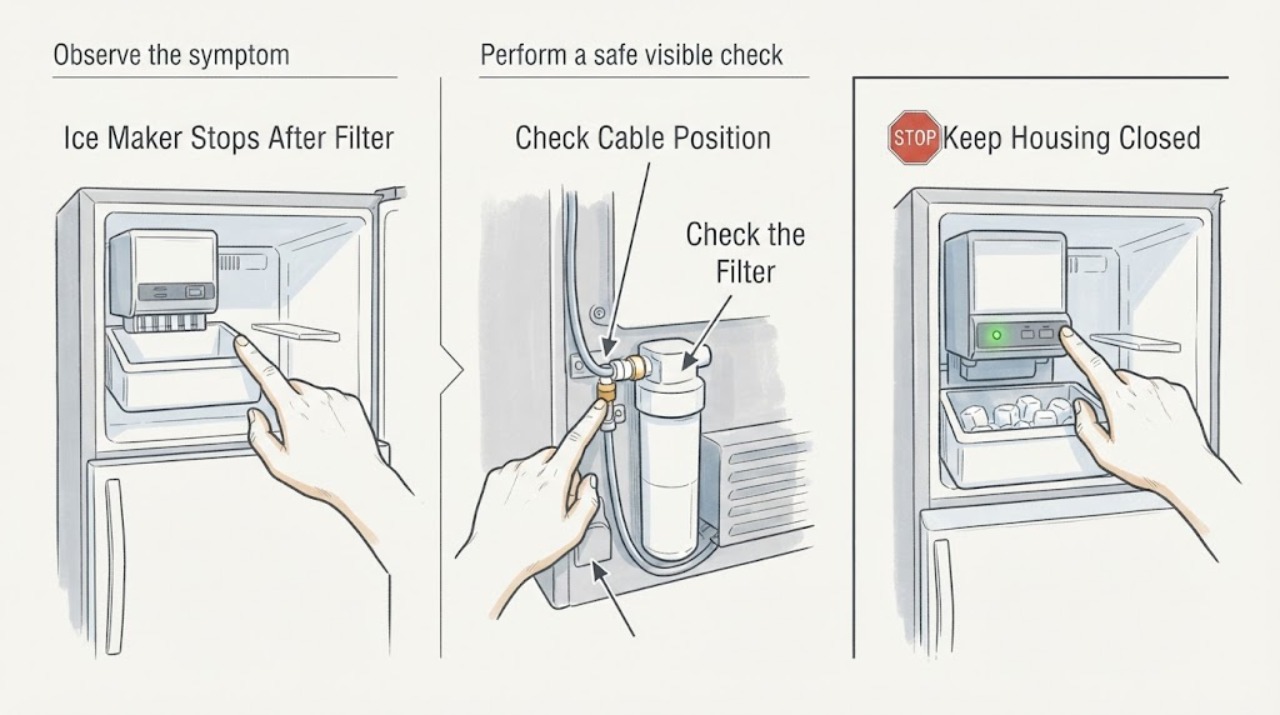
For a Kenmore Coldspot 106.56662500 whose ice maker worked briefly after a filter change and then stopped, treat the timing as evidence about the water path—not proof that the ice-maker assembly is bad. First photograph the model label and confirm the ice maker is on, the bin or shutoff arm is not stopping production, and the freezer is cold and sealed. Then compare normal water-dispenser flow with its earlier behavior, review the filter's exact seating and model match using the Kenmore manual, and observe whether the ice mold is dry, partly filled, or holding frozen cubes. A brief improvement after the filter was installed makes filter seating, flow restriction, trapped air, or a shared supply problem worth checking before any part is ordered; it does not identify a valve or ice-maker component. Stop for leaks, water near electrical parts, smoke, burning odor, a jammed mechanism, or warming food, and arrange qualified service rather than forcing a harvest cycle or opening the assembly.
Work through in order
Diagnostic checks
Use only checks that match the exact appliance or system and its official guide.
-
Check 1
Stop the ice maker and protect food if the freezer is warming. If there is a water leak, water near electrical parts, smoke, a burning odor, visible wiring, repeated power trips, or a jammed mechanism, keep the refrigerator off and arrange prompt qualified service. Otherwise photograph the rating label and transcribe the full model exactly as 106.56662500 (including any suffix), then write down the filter-change date, how long ice returned, and when production stopped.
Expected result: The label matches 106.56662500 and the change-after-filter timeline is clear, or the identity/timeline is uncertain or a safety symptom is present.
Next step: For a hazard, keep the appliance isolated and request service. For a confirmed model without a hazard, continue with the bin, freezer, dispenser, and filter checks while preserving the timeline for the technician.
Stop if: Do not keep powering a leaking, smoking, sparking, overheated, or electrically wet appliance, and do not open the ice-maker cover or cabinet.
Why this matters
Why: The exact model is needed for Kenmore's matching manual, and the brief response after the filter is a useful water-path clue but not a component diagnosis. A hazard moves the case out of user checks.
-
Check 2
From the normal user-accessible area, confirm that the ice maker is enabled according to the 106.56662500 manual and that the bin is seated. If this design has a wire shutoff arm or visible full-bin sensing area, check only that it is not raised, blocked, or packed with ice; do not force the arm or reach into the ejector.
Expected result: The control is off, the bin or arm is out of position, ice is packed around the sensing area, or the control and bin are normal.
Next step: Correct only the harmless position shown by the exact manual and allow normal production time. If the arm will not move freely, the bin will not seat, or ice is jammed, keep the maker off and arrange service.
Stop if: Do not force the ejector, bridge contacts, remove the assembly, or run an improvised harvest test.
Why this matters
Why: A control or full-bin signal can pause production without a water or ice-maker failure. Normal position leaves freezer temperature and water delivery as the safer next decisions.
-
Check 3
Check the freezer door and gasket from outside and confirm that frozen food is firm and no broad frost or loading obstruction is affecting the compartment. If a water dispenser is present, use it briefly in the normal way and compare its flow with the period before the filter change; do not disconnect a line or move the refrigerator across a wet floor.
Expected result: The freezer is warm or poorly sealed, the dispenser is weak or dry, the dispenser flow is normal while ice production is absent, or the refrigerator has no dispenser.
Next step: Remove only a visible door or loading obstruction and use the matching manual's temperature guidance. Record the dispenser comparison and arrange service for persistent warmth, a failed seal, a leak, or water-line work.
Stop if: Do not test cooling parts, disconnect the supply line, pressure-test plumbing, or continue if food is warming or water reaches electrical equipment.
Why this matters
Why: A warm freezer can stop ice production, and weak water at both outlets makes a shared supply, filter, line, or inlet path more plausible. Normal dispenser flow narrows attention to the ice-maker fill or harvest path but does not prove a valve or assembly fault.
-
Check 4
Use the Kenmore manual lookup with the complete model number to verify the cartridge and housing procedure. Inspect only the accessible filter cap or housing for an obvious loose fit, leak, or filter that is not locked as the manual describes; do not assume a similarly numbered Kenmore filter fits. If the manual authorizes a user-level filter reseat or flush, follow only that procedure and record whether dispenser flow changes afterward.
Expected result: The filter is not the model's specified cartridge, is not seated or sealed, flow changed after installation, the housing leaks, or the filter and flow appear normal.
Next step: Correct only the documented filter position or flush step, then compare water flow and ice-mold behavior without forcing a cycle. If the housing leaks, flow stays abnormal, or the filter identity cannot be verified, keep water/ice use off as appropriate and call qualified service.
Stop if: Do not pry the housing, bypass the filter with an unapproved cap, add chemicals, remove tubing, or use tools inside the ice-maker compartment.
Why this matters
Why: The filter timeline makes seating, fit, trapped air, or restriction a high-value first branch, but Kenmore's general filter page does not establish this old model's exact cartridge or replacement part. A leak or unchanged flow requires service rather than repeated filter swaps.
-
Check 5
Without initiating a forced test cycle, adding water to the mold, removing the ice maker, or touching wiring, observe the mold and ejector area during normal operation over a safe period. Record whether the mold stays dry, receives only a partial fill, freezes cubes that remain, or contains no cubes while the freezer and controls are normal.
Expected result: The mold is dry, water reaches it but does not freeze, frozen cubes remain in place, or the ice maker is silent despite a cold freezer and normal controls.
Next step: Record the pattern and request qualified Kenmore/refrigeration service with the filter timeline, dispenser comparison, freezer condition, and mold observation. Do not order an inlet valve or complete ice-maker assembly solely from this pattern.
Stop if: Stop for a jammed ejector, exposed heater or wiring, unusual heat or smell, a leak, or any need to bridge contacts, probe voltage, force-fill the mold, or remove the assembly.
Why this matters
Why: A dry mold keeps water delivery, filter/flow, fill path, valve outlet, or control in the decision set; water that does not freeze points back toward freezer conditions; frozen cubes that remain point toward harvest mechanics. None of these observations selects a part without model-matched testing.
Use your observations
Decision map
Find the observation that best matches what you see, then follow the next safe action.
-
PATH 01Next step
What you see
Ice production returned briefly immediately after the filter was installed, then stopped again, and dispenser flow is also weaker than before.
Do this next
Use the exact Kenmore manual to verify the filter and any authorized flush step, compare flow without disassembling the line, and call service if flow remains poor, the housing leaks, or a pressure/valve test would be needed.
Why this path and its safety boundary
Why it matters: The shared water path—filter identity, seating/seal, trapped air, household supply, kinked line, or inlet path—is more relevant than a filter change proving an ice-maker assembly failure.
-
PATH 02Next step
What you see
The dispenser flow is normal, the freezer is cold and sealed, the bin and shutoff position are normal, but the mold remains dry.
Do this next
Keep hands and tools out of the mechanism and request model-specific service with the exact dry-mold observation. Do not force-fill, bridge contacts, or buy a complete assembly by visual similarity.
Why this path and its safety boundary
Why it matters: The problem is more localized to the ice-maker fill or control path, but a dry mold cannot distinguish a fill tube, valve outlet, control, or ice-maker assembly on this old model.
-
PATH 03Next step
What you see
The mold contains frozen cubes, but they remain in place while the freezer is cold and the ice maker is enabled.
Do this next
Do not force the cubes or initiate a forced cycle. Arrange appliance service for the exact model and provide the timing, bin position, and frozen-cube observation.
Why this path and its safety boundary
Why it matters: Water reached the mold and froze, so the first water-supply branch is less likely; harvest, ejector, heater, motor, or control behavior still requires safe model-matched diagnosis.
-
PATH 04Next step
What you see
The freezer is warm, the door does not seal, food is soft, or broad frost is present while ice production has stopped.
Do this next
Correct only visible door or loading issues documented by the manual, protect food, and request refrigeration service for persistent warmth, heavy frost, or an internal cooling diagnosis.
Why this path and its safety boundary
Why it matters: A cooling, door-seal, or airflow condition can prevent normal ice production and should be resolved before an isolated ice-maker part is blamed.
-
PATH 05Next step
What you see
A leak occurs at the filter housing or fill area, water is near electrical equipment, the ice maker smells hot, power trips, or the mold/arm is physically jammed.
Do this next
Stop using the ice maker, disconnect power or water only from a safe position, protect food, and seek prompt qualified appliance service. Do not restore power repeatedly or remove the assembly.
Why this path and its safety boundary
Why it matters: The case has crossed the ordinary user-check boundary and may involve water, electrical, or mechanical hazards.
Helpful context
Understand the symptom
The supplied identity is Kenmore Coldspot 106.56662500. Kenmore's official manual page tells owners to enter the complete model number to reach the matching refrigerator documentation, so keep the punctuation-free label transcription and any full suffix with the service request. Do not substitute a generic Kenmore or Whirlpool procedure just because the first three digits look familiar.
The important clue is the sequence: the ice maker improved for a short time after a filter change, then stopped. A matching public report for this exact model describes that same pattern and later records only limited ice after water was forced into the tray; it does not establish that the filter, valve, or ice-maker assembly was the confirmed cause. Use the timeline to decide what to observe next, not to authorize a part by guesswork.
Kenmore's filter product guidance is not a fitment list for this old model. It describes a filter's rated replacement interval and model-dependent compatibility, while the exact manual must control the cartridge, housing, seating, and any flush procedure for 106.56662500. A filter that briefly restores production is therefore a reason to recheck seating and water flow safely, not evidence that a complete ice maker must be replaced.
When checks do not resolve it
Need a professional?
Arrange qualified Kenmore or refrigeration service when the freezer is cold, the ice maker is enabled, and the mold remains dry; when frozen cubes will not harvest; when the filter housing or fill area leaks; when water flow stays weak; when freezer temperature or door sealing is abnormal; or whenever diagnosis would require disconnecting a line, pressure testing, electrical testing, panel removal, or an ice-maker assembly. Stop immediately for smoke, burning odor, sparking, water near electrical parts, repeated power trips, a jammed mechanism, warming food, or an unusually hot component. Give the technician the complete 106.56662500 model label, filter identity/date, the brief post-filter recovery timeline, dispenser-flow comparison, freezer condition, bin/arm position, and mold observation. Do not force-fill the mold, bridge contacts, repeatedly reset the refrigerator, or replace a valve or ice-maker assembly from the symptom alone.
Common questions
FAQ
Does the brief return of ice after a filter change prove the ice maker is failing?
No. It makes filter seating, cartridge fit, trapped air, flow restriction, or a shared water path worth checking first. A matching public report for 106.56662500 describes the same short-lived improvement without confirming a lasting repair or a failed assembly.
How do I verify the correct filter for Kenmore 106.56662500?
Use Kenmore's manual lookup with the complete model number and follow the matching manual's filter and housing instructions. Kenmore's general filter product page is not a compatibility confirmation for this older model, so do not rely on a similar-looking cartridge or a generic part listing.
What does a dry ice mold mean after the dispenser still works?
It keeps the ice-maker fill or control path in the decision set, but it does not identify a fill tube, inlet valve, control, or complete ice-maker assembly. Record the dry-mold result and have the exact model diagnosed without forcing a cycle or opening the mechanism.
Should I force water into the mold to test the Kenmore ice maker?
No. Forced filling can create a misleading result and adds water and mechanical risk. Observe the mold during normal operation and let qualified service perform any model-specific test with power and water hazards controlled.
Read the exact guide
Official sources
- Refrigerator Water Filter 500-Gallon Capacity | KenmoreKenmore · General Kenmore filter product guidance; not a compatibility confirmation for Kenmore 106.56662500.
- Kenmore ManualsKenmore · Official Kenmore manual lookup; owners must enter the complete model number to retrieve the matching refrigerator documentation.
- Kenmore 'Fridge fails to make ice (young/old widow needs advice)Reddit r/appliancerepair · Exact model and symptom timeline only; the thread reports attempts and suggestions, not a confirmed repair or manufacturer-approved procedure.
Community feedback
Share a repair observation
Share a plain-text repair observation. Accepted observations are published automatically; this page may take a moment to update.