
On this page
Start here
Quick answer
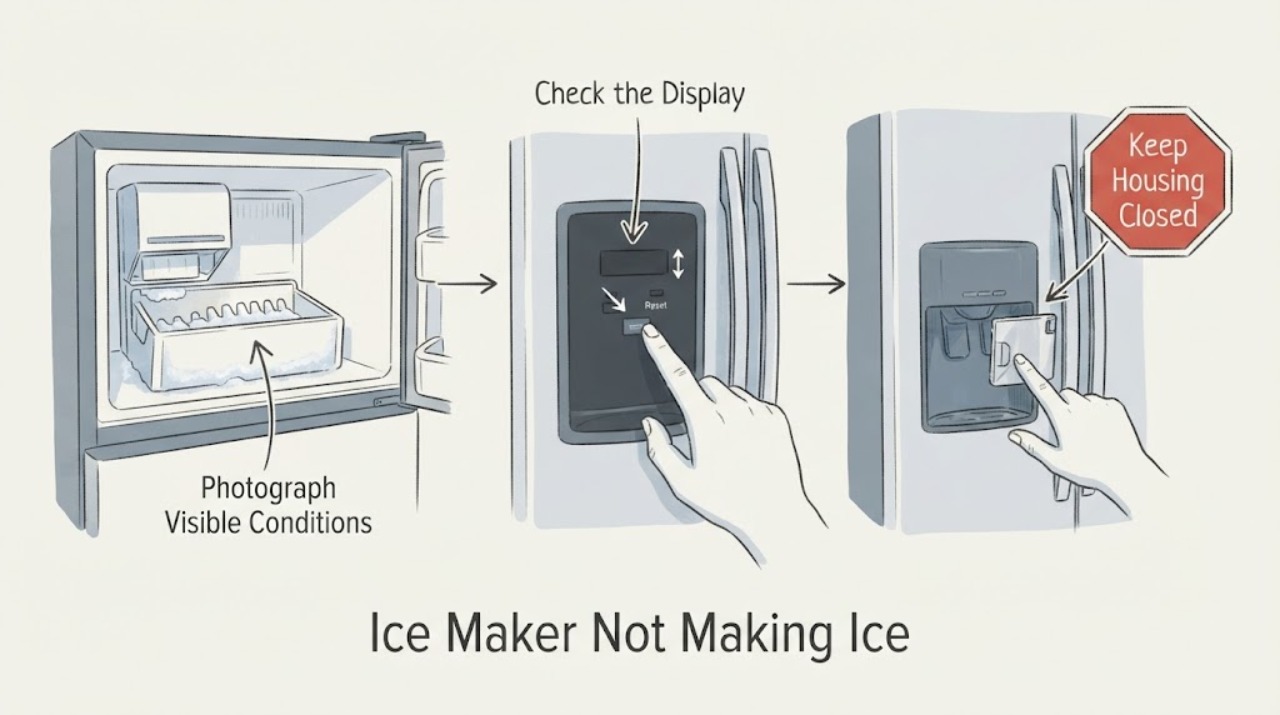
First photograph the display and rating label so the rental manager or Miele can confirm whether the unit is the KF 1813 Vi 04 and whether the code is shown as F0121, F121, or another sequence. Miele's F121 guidance identifies the ice maker as the fault area: check only that the water supply is open and look from outside for dripping at the accessible connection or ice forming around the maker. Miele says low pressure can make the intake valves drip and cause a mechanical ice blockage, so report that pattern to the facility manager or a plumber rather than trying to clear the mechanism. If there is no water-path symptom, the ice maker may have a mechanical or electrical fault and should go to Miele Service. Do not remove panels, thaw or chip the ice maker, test pressure, or keep resetting the appliance.
Before you begin
Safety first
- Do not remove panels, pull out the built-in refrigerator, loosen water fittings, test water pressure or valves, chip or heat ice from the mechanism, touch ejector parts, bypass sensors, or install an unconfirmed filter or valve. Keep the ice maker off if there is dripping, visible ice blockage, or water damage.
Work through in order
Diagnostic checks
Use only checks that match the exact appliance or system and its official guide.
-
Check 1
Before clearing the code, take a photo of the entire display and the rating label, and record the full model exactly as printed, including KF 1813 Vi 04 if present. Confirm that the appliance is in the United States/Canada documentation family before using the Miele US instructions.
Expected result: The display clearly shows F0121, F121, or a different code, and the label either matches KF 1813 Vi 04 or shows another model/market.
Next step: If the code or model does not match, stop applying this page and give the photo and label to the facility manager or Miele. If it matches, continue with external checks only.
Stop if: Do not enter service mode, remove the front or rear panels, or order a part from the code alone.
Why this matters
Why: Miele's opened support page uses F121, while the assigned topic uses F0121. A leading-zero difference must not be silently treated as the same code, and a KF 1803/1813 family manual does not prove fit for every suffix or market.
-
Check 2
With hands and the floor dry, look only at the accessible water shutoff, visible supply line, and the area around the ice-maker connection. Confirm the shutoff is open and the line has not been visibly kinked or crushed; do not pull the integrated refrigerator out or loosen a fitting.
Expected result: The supply is closed, the visible line is kinked, there is active dripping, or ice is forming around the ice-maker inlet; alternatively, the visible path is open, dry, and undamaged.
Next step: For a closed or visibly kinked line, notify the facility manager before moving the built-in unit. For a leak or ice-forming pattern, leave the ice maker off and contact the facility manager or a plumber; if the installation side is normal, continue to the next check and arrange Miele Service if the code returns.
Stop if: Do not disconnect the water line, chip ice, thaw the mechanism with heat, measure pressure yourself, or tighten a concealed fitting.
Why this matters
Why: The KF 1813 Vi documentation requires an open cold-water supply, a separate shutoff, and a 25–80 psi supply. Miele says low pressure can make the intake valves drip and cause ice to form on the maker, leading to a mechanical blockage. A dry, open visible path does not rule out an internal valve or pressure problem.
-
Check 3
Check the visible control state without opening the appliance: the refrigerator/freezer is on, the ice-maker control is enabled, the ice container is seated and completely closed, and no loose cubes are visibly blocking the container exit. Do not reach into the ejector mechanism.
Expected result: The appliance or ice maker is off, the container is not fully seated/closed, or loose ice is visibly blocking the exit; otherwise these conditions are correct.
Next step: Correct only the obvious control or container position described by the manual, then wait for the documented production interval. If the code remains or the container cannot seat normally, stop and contact Miele Service or the facility manager.
Stop if: Do not force the drawer, insert tools, touch moving ejector parts, or dismantle the ice maker.
Why this matters
Why: Miele's KF 1813 Vi instructions state that the maker must be connected to the household water supply, enabled, and used with the container correctly positioned and closed. A correct control/container state makes the F0121 water-path or appliance-fault branches more relevant.
-
Check 4
If this is the first start after installation or a long period out of service, allow the freezer to reach operating temperature and wait through the manual's startup interval. The KF 1813 Vi instructions say first ice can take up to 10 hours; do not repeatedly toggle the maker while waiting.
Expected result: Ice begins to drop after the interval and no fault returns, or no ice appears and F0121/F121 returns or remains visible.
Next step: If ice production begins and the code stays away, monitor normally. If the code returns or no ice persists, provide the photos and observations to the facility manager and request Miele Service; do not try an internal reset sequence.
Stop if: Do not run the maker with a visible leak, an ice blockage, or an unconfirmed water connection.
Why this matters
Why: A first-start delay can be normal, but a persistent fault after the control, container, and visible water checks is not explained by waiting alone. In a rental, repeated resets can also obscure the original code needed by the service provider.
-
Check 5
Compare the complete F0121/F121 observation with the two safe service routes: installation-side signs go to the rental facility manager or plumber, while an open, dry supply with a returning code goes to Miele Service. Provide the model suffix, market, code photo, water-path photo, and whether the freezer is otherwise cooling.
Expected result: There is a visible leak/ice formation or supply issue, or the water path appears normal but the code and no-ice symptom persist.
Next step: For an installation-side pattern, keep the maker off and contact the facility manager/plumber. For a normal visible path with a returning code, request Miele Service through the manager or the authorized service route.
Stop if: Do not replace the water filter or valve, remove covers, bypass the ice-maker sensor, or use an unconfirmed part solely because F0121 is displayed.
Why this matters
Why: Miele distinguishes low-pressure/installation causes from a mechanical or electrical ice-maker fault. The distinction changes who should assess the next step; it does not authorize the tenant to test the valve or ice-maker assembly.
Use your observations
Decision map
Find the observation that best matches what you see, then follow the next safe action.
-
PATH 01Next step
What you see
The complete display is not clearly F0121/F121, or the rating label is not KF 1813 Vi 04 / the applicable Miele market family.
Do this next
Stop at identification, photograph the label and display, and ask the facility manager or Miele to confirm the exact model and code before further troubleshooting.
Why this path and its safety boundary
Why it matters: The code and manual identity are not sufficiently matched; applying F121 guidance to another Miele refrigerator could send the fault to the wrong water or control path.
-
PATH 02Next step
What you see
F0121/F121 is present and the visible supply is closed or kinked, or water is dripping and ice is forming around the ice-maker water path.
Do this next
Keep the ice maker off, avoid moving the built-in unit, and contact the rental facility manager or a plumber. Do not chip the ice or open the water connection.
Why this path and its safety boundary
Why it matters: This pattern is more consistent with an installation-side supply or low-pressure condition that can create a mechanical ice blockage than with a simple container-position issue.
-
PATH 03Next step
What you see
The supply is visibly open and dry, the ice maker and container are correctly positioned, the freezer is cold, but F0121/F121 returns or no ice persists after the documented interval.
Do this next
Leave the maker out of service and request Miele Service through the facility manager, providing the code, exact model, and photos. Do not perform internal testing.
Why this path and its safety boundary
Why it matters: The visible setup checks have not identified an installation-side cause; Miele's F121 guidance treats a mechanical or electrical ice-maker fault as a service issue.
-
PATH 04Next step
What you see
The appliance was newly installed or the ice maker was off for an extended period, no fault returns, and ice appears within the manual's startup interval.
Do this next
Monitor the maker normally and follow the manual's food-safety instruction for discarding initial ice. Contact the facility manager if production stops again or the code reappears.
Why this path and its safety boundary
Why it matters: The symptom was a normal startup delay or an obvious user-level setup state, not evidence of a failed valve or control board.
Helpful context
Understand the symptom
F0121 is not a generic freezer-temperature message. Miele's public support page is titled F121 and describes the ice maker as the fault area. Because the assigned appliance is a rental and the display may include a leading zero, preserve a photo of the complete code and the model label before trying anything. The opened Miele US documentation covers the KF 1813 Vi family and its plumbed ice maker; the suffix 04 and market still need to be confirmed against the appliance label.
The useful distinction is what you can observe without opening the built-in refrigerator. A drip or ice forming around the ice-maker water path after F0121/F121 makes a water-pressure or installation-side blockage more likely. A correctly open water supply with no visible leak or ice, while the code returns, points more toward an appliance fault. Both patterns belong with the facility manager or qualified service rather than an internal DIY repair.
When checks do not resolve it
Need a professional?
Use the rental facility manager or a plumber for installation-side water supply, pressure, valve, kink, or leak signs. Use Miele Service for a returning F0121/F121 code with a normal visible supply, a suspected mechanical/electrical ice-maker fault, or any internal appliance repair.
Safety scope: Do not remove panels, pull out the built-in refrigerator, loosen water fittings, test water pressure or valves, chip or heat ice from the mechanism, touch ejector parts, bypass sensors, or install an unconfirmed filter or valve. Keep the ice maker off if there is dripping, visible ice blockage, or water damage.
Have this ready
- Provide the complete display photo, rating-label photo with model and serial information, market/location, whether the unit is newly installed or rented, water-path photos, whether the freezer is cooling, whether the container is seated, and any dripping or ice forming around the maker.
Common questions
FAQ
Is Miele F0121 the same as F121?
Miele's opened US support page is titled F121, while this topic reports F0121. Do not assume the leading zero is interchangeable: photograph the full display and confirm the exact model and code with the facility manager or Miele before applying the guidance.
Can low water pressure stop the Miele KF 1813 Vi ice maker?
Yes, Miele says low pressure can make the intake valves drip and cause ice to form on the ice maker, leading to a mechanical blockage. Do not test pressure yourself; in a rental, report the pattern to the facility manager or a plumber.
How long can the KF 1813 Vi take to make its first ice?
The opened KF 1813 Vi instructions say the first ice can take up to 10 hours after the appliance is turned on and cooled. That waiting guidance does not override a returning F0121/F121 code, a leak, or visible ice blockage.
Should I chip away ice around the Miele ice maker?
No. Leave the ice maker off and arrange facility-manager, plumber, or Miele service assessment. Chipping, heating, opening the mechanism, or loosening the water connection can cause injury or water damage and is not an owner-level correction supported by the opened sources.
Read the exact guide
Official sources
- Operating and Installation Instructions: KF 1803 Vi / KF 1813 ViMiele USA · Directly opened manual includes KF 1813 Vi and supports its ice-maker controls, startup timing, water-pressure range, container position, and visible water-line safety; confirm the assigned suffix 04 and local market before applying model-specific details.
- Fault F121 - The ice maker is defectiveMiele USA · Directly supports the F121 fault meaning and the water-pressure/dripping/ice-blockage branch; because the assigned display is F0121, the full code and model must be confirmed before treating it as equivalent.
- KF 1813 Vi / KF 1803 Vi Fully Integrated 30-inch Bottom Mount Specification SheetMiele USA · Used to verify the assigned model family is a plumbed built-in refrigerator with an ice maker and to bound the US water-supply requirements; it does not prove the exact suffix 04 or another market.
Community feedback
Share a repair observation
Share a plain-text repair observation. Accepted observations are published automatically; this page may take a moment to update.