
On this page
Start here
Quick answer
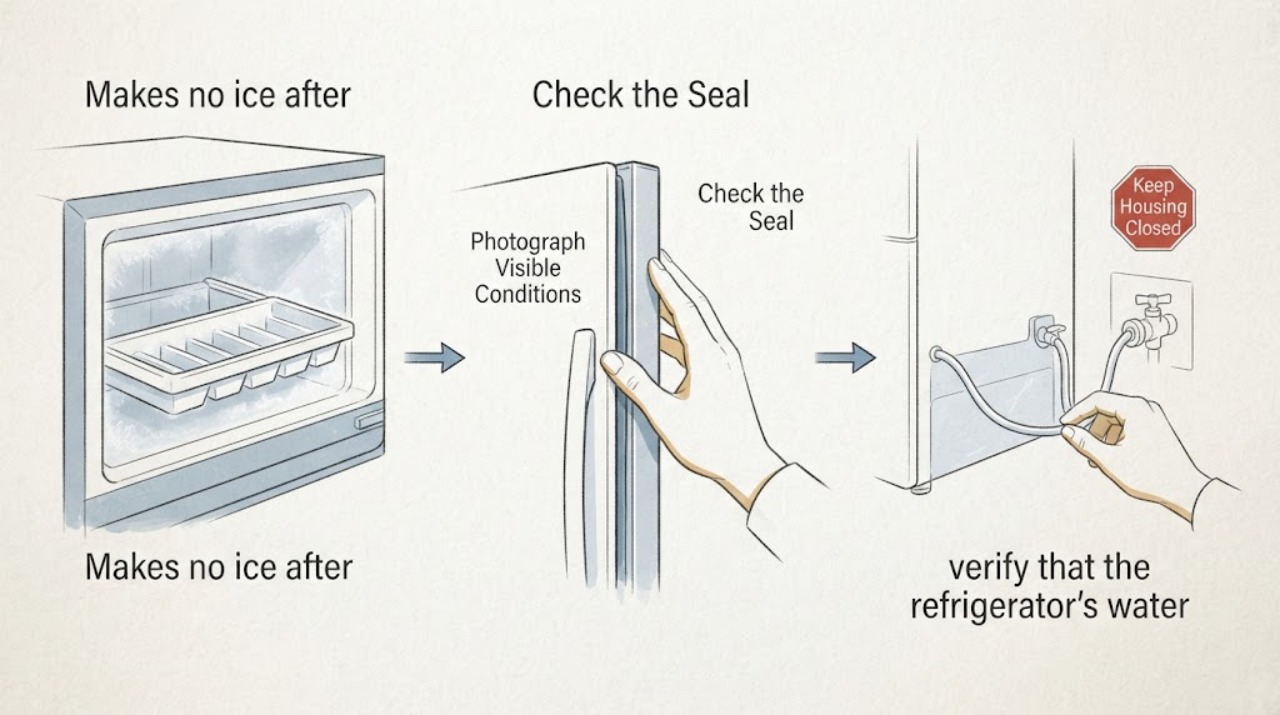
Maytag identifies MFI2568AES as a full-depth French-door, bottom-mount refrigerator. Emptying the ice bin does not by itself prove a failed ice-maker assembly: after the bin is empty, first confirm the ice maker is enabled, the bin is correctly seated, the doors close and seal, and the water supply is open. Maytag's ice-production guidance says to allow 24 hours before judging a cube-count test and notes that a bin can take two to three days to fill depending on usage. Check the freezer temperature against the model manual; Maytag's general guidance uses 0–5°F for ice production. Inspect only visible water-line kinks and filter seating, without disconnecting tubing or reaching into the ejector. If the bin and controls are correct, water flow is normal, the freezer is cold, and no ice returns after the documented wait, arrange qualified Maytag service rather than forcing a harvest, repeatedly resetting the refrigerator, or guessing a valve or ice-maker part.
Work through in order
Diagnostic checks
Use only checks that match the exact appliance or system and its official guide.
-
Check 1
Record the full MFI2568AES model and serial label and photograph the ice bin, control setting, and display from a safe standing position. Confirm through the matching manual whether production uses a switch, control, or shutoff arm; do not reach into the ice-maker mechanism.
Expected result: The exact model is confirmed, the ice maker is visibly off or paused, the bin is removed or mis-seated, the control is unclear, or no setting problem is visible.
Next step: Use only the MFI2568AES manual's normal control and bin-seating instruction once. If the control is unclear, the bin will not seat, or a cover or arm is damaged, stop and arrange service.
Stop if: Do not bypass a sensor, bend or force an arm, insert fingers near the ejector, remove covers, or manually cycle the ice maker.
Why this matters
Why: Maytag identifies MFI2568AES as a French-door bottom-mount refrigerator, but ice-maker types and controls can vary. An off state or mis-seated bin can suppress production without proving an internal assembly failure.
-
Check 2
With the ice maker inactive, reseat the accessible ice bin only as the MFI2568AES manual describes and close the refrigerator and freezer doors normally. Check from outside that food, a shelf, a bin, or a gasket is not preventing full closure; do not move the refrigerator.
Expected result: The bin was not fully seated, a door or gasket is obstructed, the door closes normally, or the bin and doors are correct but no ice appears.
Next step: Correct only the visible bin, food, or door obstruction and then leave the refrigerator closed enough to stabilize. Request service for a damaged bin, gasket, hinge, sensor area, or continued no-ice condition.
Stop if: Do not force the bin, slam the door, hold a door switch closed, pry ice from the mechanism, or operate with a door that cannot seal.
Why this matters
Why: Maytag documents that the refrigerator may stop or limit ice production when the bin is removed, the door is open, or the sensing position is not correct. A correctly seated bin and sealed doors shift attention to temperature, water, filter, or the internal ice-making path.
-
Check 3
From ordinary access, verify that the refrigerator's water shutoff is open and inspect only visible tubing for a kink or crushing. If the water dispenser is present and safe to use, note whether flow is normal or weak; do not disconnect or loosen a pressurized line.
Expected result: The shutoff is closed or unknown, visible tubing is kinked, dispenser flow is weak or absent, or water flow appears normal while the ice maker remains dry.
Next step: Restore only an accessible shutoff or visible line position that matches the manual. Use plumbing or appliance service for a leak, hidden restriction, damaged tubing, or any connection that must be opened.
Stop if: Stop for a leak, water near electrical parts, a stuck shutoff, damaged tubing, or any need to pull the refrigerator or disconnect the water line.
Why this matters
Why: Maytag lists restricted water supply and kinked tubing as common ice-maker causes. Normal dispenser flow does not prove the ice-maker fill path or valve is sound, and weak flow can also result from a filter or household pressure issue.
-
Check 4
Check the water filter indicator and visible filter seating according to the MFI2568AES manual. If the filter was recently changed, confirm it is locked and sealed; do not force the housing or leave an open water connection.
Expected result: The filter is due, recently replaced, visibly mis-seated, associated with weaker dispenser flow, or the filter and flow appear normal.
Next step: Follow only the model-specific filter replacement, flushing, and reset procedure once. If flow remains weak, the housing leaks, or the filter cannot be safely identified, leave ice production off and arrange service.
Stop if: Do not bypass filtration, install an unverified substitute, force the filter, or operate with a leaking or unsealed housing.
Why this matters
Why: Maytag says a clogged or incorrectly installed filter can reduce or stop water flow to the ice maker and dispenser and can cause a filter-housing leak. A normal filter check does not identify an ice-maker or valve fault.
-
Check 5
Read the freezer temperature through the normal control or display and inspect the visible door gasket and air path for an ordinary food obstruction. Use the exact manual for the MFI2568AES setting; Maytag's general ice-maker guide uses 0–5°F as an ice-production range.
Expected result: The freezer is warmer than the applicable setting, the door or gasket cannot seal, food blocks a visible air path, or temperature and closure are normal.
Next step: Correct only a visible food or door obstruction and allow the refrigerator to stabilize. Arrange service for persistent warm temperatures, gasket or hinge damage, or any cooling problem beyond ordinary control adjustment.
Stop if: Do not move or tilt the refrigerator, adjust hidden components, block vents, or continue use with a damaged seal or unstable appliance.
Why this matters
Why: Ice cannot form reliably when the freezer is too warm or the door does not seal. If temperature and closure are normal, water, filter, bin position, recovery time, and internal ice-maker causes remain possible.
-
Check 6
After the bin is correctly seated, the ice maker is enabled, water and filter checks are normal, and the freezer is cold, empty the bin only if needed and observe the normal production period. Maytag's cube-count procedure uses 24 hours without dispensing ice; do not use that wait as a reason to open or manually cycle the mechanism.
Expected result: New ice appears within 24 hours, the bin begins filling slowly, no ice appears after 24 hours, or the refrigerator was repeatedly reset or the bin was repeatedly removed.
Next step: Leave the refrigerator in its normal enabled state and record when the first ice appears. If there is still no ice after the applicable wait, request Maytag diagnosis with the model, temperature, water, filter, bin, and timing observations.
Stop if: Do not force the ejector, chip or heat ice, reach near moving parts, repeatedly unplug the refrigerator, or keep removing and replacing the bin to provoke a harvest.
Why this matters
Why: A delayed first harvest or slow fill can be normal after emptying or a reset. Maytag says some bins can take two to three days to fill, but no ice after the documented observation with normal setup warrants service rather than more resets.
Use your observations
Decision map
Find the observation that best matches what you see, then follow the next safe action.
-
PATH 01Next step
What you see
The bin was empty or mis-seated, the ice maker was off, or a door or visible obstruction was corrected, and new ice appears during the 24-hour observation.
Do this next
Leave production enabled and the bin and doors correctly positioned. Allow the normal two- to three-day fill window before judging low quantity, and request service if production stops again without a new visible cause.
Why this path and its safety boundary
Why it matters: A setting, bin, door, or normal recovery delay is more likely than a failed internal assembly.
-
PATH 02Next step
What you see
The water shutoff is closed or unknown, a visible line is kinked, dispenser flow is weak, or production improves after the exact filter procedure.
Do this next
Restore only the documented accessible supply or filter condition. Use plumbing service for the household connection and appliance service for an internal line, valve, leak, or unresolved restriction.
Why this path and its safety boundary
Why it matters: A supply, filter, pressure, or flow restriction is the stronger first explanation.
-
PATH 03Next step
What you see
The freezer is warmer than the applicable setting, the door or gasket cannot seal, or a visible air path is blocked.
Do this next
Correct only an ordinary control or door obstruction allowed by the manual and allow stabilization. Arrange service for persistent cooling, gasket, hinge, or installation problems.
Why this path and its safety boundary
Why it matters: Cooling, door, or airflow conditions can prevent freezing even when the ice-maker control is enabled.
-
PATH 04Next step
What you see
The bin, control, doors, water, filter, and freezer are normal, but no ice appears after 24 hours or a normal two- to three-day fill window, or the mechanism clicks, leaks, or remains jammed.
Do this next
Keep the ice maker off if it behaves abnormally and arrange qualified Maytag appliance service with the complete model and observations. Do not force a harvest or replace a component by symptom alone.
Why this path and its safety boundary
Why it matters: An internal ice-maker, fill-valve, sensor, wiring, or control fault is possible, but the safe checks cannot identify the failed component.
-
PATH 05Next step
What you see
There is a water leak, damaged filter housing or tubing, water near electrical parts, an unstable refrigerator, exposed wiring, or any need to move the appliance or open the ice-maker cover.
Do this next
From a dry, safe, readily accessible position, stop ice production and isolate water or power only when safe. Arrange qualified appliance or plumbing service and do not restart to locate the cause.
Why this path and its safety boundary
Why it matters: This is a stop-use water or electrical safety condition, not a routine no-ice adjustment.
When checks do not resolve it
Need a professional?
Arrange qualified Maytag appliance service when MFI2568AES produces no ice after the exact control, bin, door, water, filter, temperature, and documented waiting checks; when the ice-maker mechanism remains jammed; or when a cover, valve, sensor, wiring, or internal water path requires access. Provide the full model and serial, bin-emptying time, control state, freezer temperature, dispenser and filter observations, visible tubing condition, and the first or absent harvest. Do not order an ice-maker assembly or water valve from the symptom alone.
Common questions
FAQ
Does emptying the MFI2568AES ice bin reset or damage the ice maker?
Emptying the bin does not by itself prove damage. Reseat it using the model manual, verify that the ice maker remains enabled, and allow Maytag's 24-hour observation before judging production. Do not force the ejector or manually cycle the mechanism.
How long should I wait for ice after emptying the bin?
Maytag's cube-count procedure uses 24 hours without dispensing ice. Depending on refrigerator type and usage, a bin can take two to three days to fill, so distinguish a delayed first harvest from persistent zero production.
Should I replace the water valve or ice-maker assembly first?
No. Maytag's checks move through enablement, bin and door position, freezer temperature, water supply, filter, and the normal wait before service. Those observations do not identify a specific internal part, so do not replace one from the empty-bin symptom alone.
Read the exact guide
Official sources
- Making too Much Ice - Ice Maker in RefrigeratorMaytag · Maytag French-door refrigerator guidance used only for the bin and door sensing principle; the exact MFI2568AES manual controls location and mechanics.
- MFI2568AES | Maytag Owner CenterMaytag · Exact MFI2568AES model page; it identifies the French-door bottom-mount refrigerator and directs users to model-specific documents and service.
- Ice Maker Not Working - TroubleshootingMaytag · Maytag full-size refrigerator symptom guidance used for supply, freezer temperature, enablement, and filter branches; exact MFI2568AES controls remain manual-specific.
- Ice Cube Test - How much ice should my Freestanding Ice Maker make?Maytag · Maytag bottom-freezer cube-count guidance used for timing only; the page warns that location images and production ranges may not match every model.
- Not Making Ice - RefrigeratorMaytag · Maytag French-door bottom-freezer guidance used for enablement, reset timing, door, water line, and filter branches; use the MFI2568AES manual for exact layout and control.
Community feedback
Share a repair observation
Share a plain-text repair observation. Accepted observations are published automatically; this page may take a moment to update.