
On this page
Start here
Quick answer
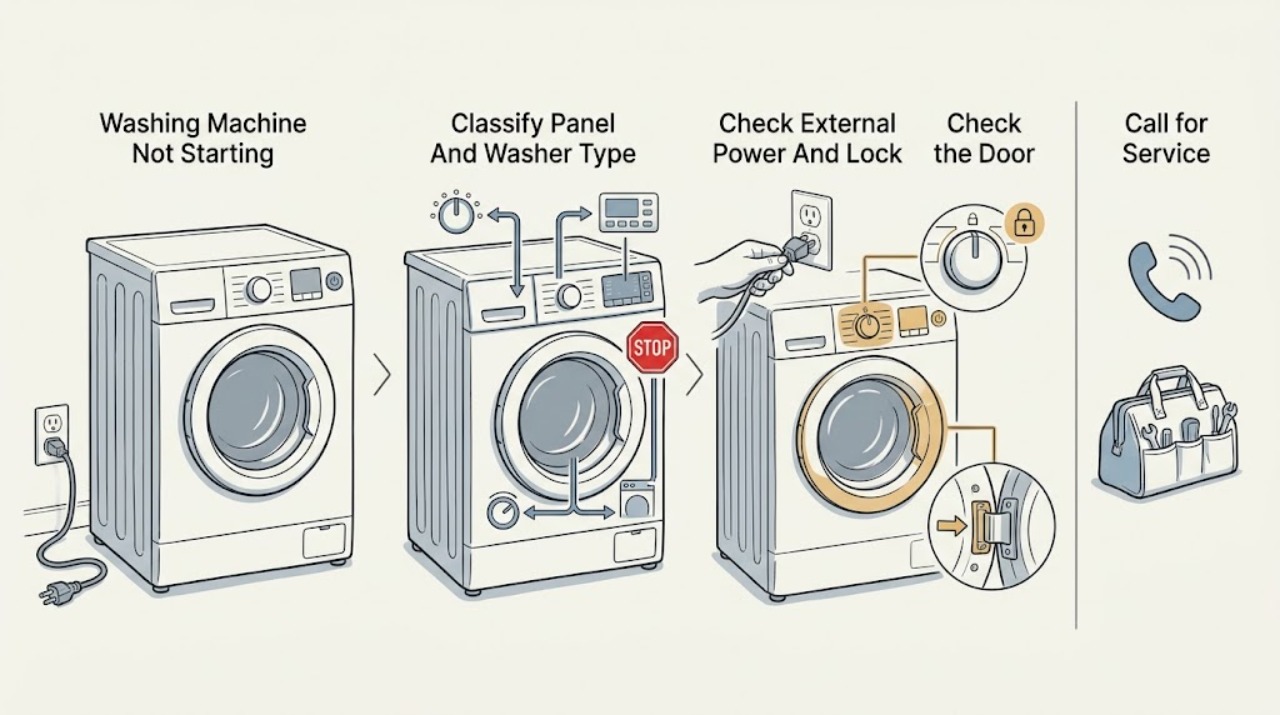
When an Amana washing machine will not start, first separate a blank control panel from a powered panel that will not begin a cycle. Check the grounded outlet and household breaker or GFCI from a safe position, make sure Control Lock is off, set the selector fully on a valid cycle, close and latch the lid or door, and press or hold Start exactly as the model requires. For a front-load model, also confirm both water valves are open and both inlet hoses are connected; a delayed, locked, or unassigned control state can look like a failure. If one model-appropriate five-minute power reset does not restore operation, the lid or door will not latch, an error returns, water leaks, or the circuit trips again, stop and arrange qualified appliance or electrical service. Do not bypass the lock, open the console, or test wiring.
Work through in order
Diagnostic checks
Use only checks that match the exact appliance or system and its official guide.
-
Check 1
From outside the washer, identify whether it is top-load or front-load and record whether the panel is completely dark, lit but unresponsive, showing a lock or delay indicator, or showing an error. Note whether the tub contains water and whether the lid or door is currently closed.
Expected result: The panel is blank; the panel has lights but no command response; a lock, delay, or error is displayed; the lid or door is open; or water is visible in the tub.
Next step: Follow the power, controls, lid or door, water-supply, or error branch below. Keep hands out of the basket and do not open a locked door containing water.
Stop if: Stop immediately for smoke, burning or electrical odor, visible sparking, water near electrical parts, a damaged cord, a leaking cabinet, or a breaker that trips again.
Why this matters
Why: A blank panel starts with external power. A powered panel shifts attention to Control Lock, cycle selection, Start timing, lid or door closure, water supply, or a displayed code. Visible water changes the safe boundary because the lid or door should not be forced.
-
Check 2
Check that the power cord is fully seated in a grounded three-prong outlet and that the normal household breaker or GFCI has not tripped. If a fuse or breaker is open, reset it only once from a dry, safe position; also look for a Control Lock indicator and use the model's documented unlock control.
Expected result: The panel returns after the supply correction; the outlet remains without power; the Control Lock clears; the panel remains unresponsive; or the breaker or GFCI opens again.
Next step: If power and controls return normally, continue to the cycle and lid or door checks. If the supply is absent, the panel stays dead with supply available, or the protection device trips again, leave the washer off and arrange qualified electrical or appliance service.
Stop if: Do not use an extension cord, open the outlet or console, change fuse capacity, test live wiring, or repeatedly reset a tripping circuit.
Why this matters
Why: Amana links no start to a missing or incorrect supply and says Control Lock prevents touch commands. A repeated trip is an electrical fault or overload signal, not a reason to keep resetting the circuit.
-
Check 3
Set the selector fully on a valid cycle, close the top-load lid or front-load door firmly without forcing it, and press or hold Start for the interval stated in the Owner's Manual. Check externally for lint, clothing, or another obvious obstruction at the latch; do not insert tools into the lock.
Expected result: The cycle starts; the selector is between or outside valid cycles; the lid or door will not latch; the lock light remains on; or Start is accepted but the washer still does not begin.
Next step: If correcting the cycle or closure starts the washer, monitor one cycle. If the lock will not engage or the washer remains idle after the documented Start action, stop trying undocumented combinations and arrange service.
Stop if: Do not force the lid or door, bypass the lid or door lock, open a locked front-load door with water visible, or open the console.
Why this matters
Why: Amana says the selector must be on a cycle, the lid or door must be completely closed and latched, and some models require holding Start for up to three seconds. A latch that will not engage or a repeated failure at that transition can indicate an interlock or control fault.
-
Check 4
If the washer is front-load and the cycle reaches a fill step without starting, verify from outside that both hot and cold supply valves are open and both visible inlet hoses are connected and not kinked. Do not loosen a pressurized hose or remove an inlet screen unless the exact manual gives a safe, unpressurized procedure.
Expected result: A valve is closed; an inlet hose is kinked, disconnected, or missing; the washer fills after a safe correction; or the water path looks correct but the washer remains idle or shows an error.
Next step: Open only an obviously closed valve or restore a safe visible hose path, then make one normal start attempt. Arrange service for a leak, persistent no-fill condition, or recurring error.
Stop if: Do not disconnect a pressurized hose, run the washer with a leak, clean internal screens while pressurized, or work near water at the electrical connection.
Why this matters
Why: Amana's front-load guidance says both hot and cold valves and inlet hoses must be connected for correct operation. A correct visible supply does not prove the inlet valve, sensor, wiring, or control is working.
-
Check 5
Read the display and indicator lights for Delay Start, Control Lock, an unassigned cycle position, or a model-specific code such as LoC, LC, Err, dr, or a countdown. Copy the message exactly and use the matching Amana Owner's Manual to clear only the documented state.
Expected result: A delay or lock clears; the cycle selector was not assigned; a door-related message clears after the door is opened and closed as documented; or the same code remains or returns.
Next step: After a documented correction, make one normal start attempt and record the result. If the code returns or the controls remain unresponsive, leave the washer off and arrange qualified service.
Stop if: Do not repeatedly clear codes, enter a service mode, defeat a lock, or continue if the washer leaks or trips power.
Why this matters
Why: Amana documents delay and lock states that intentionally prevent or postpone operation, and front-load models can show different messages depending on the condition. A recurring or unknown code is evidence for model-specific service, not permission to guess at a part.
-
Check 6
After the external checks show no water or electrical hazard, perform one controlled power reset: disconnect the washer from power for five minutes, then reconnect it and make one normal start attempt. If it is hard-wired, use the exact model and household procedure rather than opening the appliance.
Expected result: The washer starts normally; the same no-start condition or code returns; the controls remain dead; water remains or appears; or the circuit trips again.
Next step: If the symptom returns, stop resetting and arrange qualified Amana appliance or electrical service with the model, washer type, exact display state, cycle, water state, and checks performed.
Stop if: Do not repeat the reset, open panels, test live components, tip the washer, force a lock, or reconnect after smoke, sparking, water intrusion, or a breaker trip.
Why this matters
Why: Amana says a five-minute power cycle can clear a temporary control issue, but it does not prove a persistent fault is repaired. Recurrence can involve the lock, control, inlet system, motor, or household supply and needs diagnosis.
Use your observations
Decision map
Find the observation that best matches what you see, then follow the next safe action.
-
PATH 01Next step
What you see
The display and status lights are completely dark.
Do this next
Check only the grounded plug, normal outlet, breaker, GFCI, or fuse once. If supply is present but the panel stays dark, arrange qualified service.
Why this path and its safety boundary
Why it matters: The washer may lack external power or may have an internal power fault.
-
PATH 02Next step
What you see
The panel is lit but touch commands do not respond, a lock indicator is on, or the selector is not on a valid cycle.
Do this next
Use the exact Owner's Manual to clear Control Lock, align the selector with a real cycle, and press or hold Start as documented. Arrange service if the controls remain unresponsive.
Why this path and its safety boundary
Why it matters: Control Lock disables commands, and an unassigned selector position cannot start a cycle.
-
PATH 03Next step
What you see
The lid or door looks closed but does not latch or the washer stops at the locking step.
Do this next
Remove only an obvious external obstruction, close the lid or door without force, and make one start attempt. Do not bypass the lock; arrange service if it will not engage.
Why this path and its safety boundary
Why it matters: The washer will not operate without the required lid or door state, and a recurring lock failure may be an interlock or control fault.
-
PATH 04Next step
What you see
A front-load washer does not progress into the fill step or shows a water-related start condition.
Do this next
Check only the visible valves and hose routing, correct an obvious closed valve or kink, and make one start attempt. Arrange service for leaks, persistent no-fill, or an error with a correct visible supply.
Why this path and its safety boundary
Why it matters: Both hot and cold supply valves and both inlet hoses may be required for correct operation.
-
PATH 05Next step
What you see
Delay Start, a countdown, LoC, LC, Err, dr, or another model-specific display message is visible.
Do this next
Copy the message and follow the exact Owner's Manual once. If it remains or returns, stop clearing it and arrange qualified service.
Why this path and its safety boundary
Why it matters: The washer may be deliberately waiting, locked, in an invalid cycle state, or reporting a condition that differs by model.
-
PATH 06Next step
What you see
The washer still will not start after the model-specific power, control, cycle, lock, and water checks and one five-minute reset.
Do this next
Leave the washer off and arrange qualified appliance or electrical service with the exact symptoms and observations; do not select a replacement part from the no-start symptom alone.
Why this path and its safety boundary
Why it matters: The remaining fault may involve the lock, control, inlet system, motor, sensor, wiring, or household supply.
-
PATH 07Next step
What you see
There is smoke, burning or electrical odor, sparking, a damaged cord, water near electrical parts, a leak, or a repeated breaker or GFCI trip.
Do this next
Stop using the washer and arrange qualified appliance or electrical service. Isolate power only if it can be done without touching water or damaged equipment.
Why this path and its safety boundary
Why it matters: This is a safety condition rather than a start-setting problem.
Helpful context
Understand the symptom
First identify what not starting means
A completely dark panel points to supply or control power. A lit panel with no response can be locked, positioned between cycles, waiting for a Start command, or showing a model-specific delay or error. A front-load washer can also pause at the door or water-supply step. Note whether the washer is top-load or front-load, whether any lights or code are visible, and whether water is already in the tub before changing anything.
Controls and locks vary by model
Amana says some washers require the Start button to be held for up to three seconds, and some models respond differently to the lid or door lock. Control Lock can leave touch commands inactive, while a selector that is not aligned with a real cycle can prevent a start. Use the Owner's Manual for the exact lock, countdown, cycle, and reset procedure rather than copying a sequence from another Amana washer.
Keep water and electrical checks separate
For a front-load washer, both hot and cold valves and both inlet hoses may be required for correct operation. Power checks are different: use only the normal plug, outlet, breaker, GFCI, or fuse access point. If water is near the power connection, the cord is damaged, or the circuit opens again, leave the washer off and use qualified help.
Safety boundary
Stop conditions
- Stop immediately for smoke, burning or electrical odor, visible sparking, water near electrical parts, a leaking cabinet, a damaged or hot cord, or a breaker or GFCI that trips again.
- Do not bypass a lid or door interlock, force a locked door with water visible, open the console or cabinet, test live wiring, or tip the washer.
- Do not disconnect pressurized inlet hoses or work on a wet electrical connection.
- Do not repeatedly reset a breaker, GFCI, fuse, error code, or control state when the same no-start symptom returns.
- Stop if the washer needs internal diagnosis of a lock, valve, sensor, motor, control, wiring, or other component.
Only after diagnosis
Potential parts
- lid or door lock assembly
Consider this only if qualified diagnosis confirms that the lid or door is correctly aligned but the washer does not receive the required lock signal.
Confirm the exact Amana model and manufacturer fit information before ordering; never bypass or substitute an interlock based only on a no-start symptom. - water inlet valve
Consider this only for a front-load or other applicable model after visible valves and hoses are correct and qualified diagnosis confirms an inlet-valve fault.
Confirm the exact model and manufacturer fit information, water configuration, and technician diagnosis before ordering or replacing this internal component. - control interface or main control
Consider this only after qualified diagnosis confirms a control fault when power, lock, cycle, water, and documented reset checks do not restore starting.
Confirm the exact model and manufacturer fit information; an unresponsive panel alone does not identify a compatible control.
When checks do not resolve it
Need a professional?
Arrange qualified Amana appliance or electrical service when the panel remains blank despite external supply, the controls remain unresponsive, the lid or door will not latch, a front-load washer will not fill with correct visible water connections, a code returns, one five-minute reset does not restore starting, or any leak, smoke, odor, sparking, water near electrics, damaged cord, or repeated circuit trip occurs.
Common questions
FAQ
Why is my Amana washer not starting even though the panel is on?
Check Control Lock, a valid cycle-selector position, the required Start-button hold, the lid or door latch, and any Delay Start or model-specific message. On front-load models, also check both visible water valves and inlet hoses. If one documented reset does not restore operation, arrange service.
How long should I hold Start on an Amana washer?
Amana says some models require pressing and holding Start for up to three seconds, and the exact behavior can differ by model. Use the Owner's Manual for the button and countdown sequence; do not keep pressing if the control is locked or unresponsive.
Can Control Lock stop an Amana washer from starting?
Yes. Amana says an active Control Lock prevents touch commands. Look for the lock indicator and use the exact model manual's unlock control. If the lock cannot be cleared or returns, do not bypass it; arrange service.
Why does an Amana front-load washer not start or fill?
Amana's front-load guidance says both hot and cold valves should be fully open and both inlet hoses connected. Check only visible valves and hose routing. A correct visible supply with a persistent no-start or water condition needs service rather than a pressurized-hose or internal-valve repair.
Should I reset an Amana washer that will not start?
Only once and only when there is no water or electrical hazard. Amana describes disconnecting power for five minutes, reconnecting it, and following the model manual for any reset details. A returning no-start condition or code needs service instead of repeated resets.
When should I stop troubleshooting an Amana washer that will not start?
Stop for smoke, burning or electrical odor, sparking, water near electrical parts, a leak, a damaged cord, or a repeated breaker or GFCI trip. Also stop when the lid or door will not latch, water is visible behind a locked door, a code returns, or one documented reset does not restore starting.
Read the exact guide
Official sources
- Owner's ManualAmana · This is a model-specific manual example; use the exact manual for the reader's washer.
- How to Reset a Washer - Product Help | AmanaAmana · Reset guidance is a single controlled user step; it does not replace diagnosis of a returning fault.
- Owners | AmanaAmana · Use the model number to retrieve the correct washer instructions before applying a control, code, or reset procedure.
- Lid Lock Flashing - Washer - Product Help | AmanaAmana · Use only for applicable top-load models and follow the exact model guidance.
- Not Starting - Washer - Product Help | AmanaAmana · Top-load guidance; use the exact Owner's Manual for the specific washer.
- No Power - Washer - Product Help | AmanaAmana · Top-load product-help guidance for external power checks; local electrical access and exact model instructions govern.
- 6 Things You Need to Know if Your Washer Won't StartAmana · Brand-level overview; exact controls and lock behavior remain model-specific.
- Not Starting or Not Operating - Front Load Washer - Product Help | AmanaAmana · Front-load guidance; codes and control sequences vary by model.
Community feedback
Share a repair observation
Share a plain-text repair observation. Accepted observations are published automatically; this page may take a moment to update.