
On this page
Start here
Quick answer
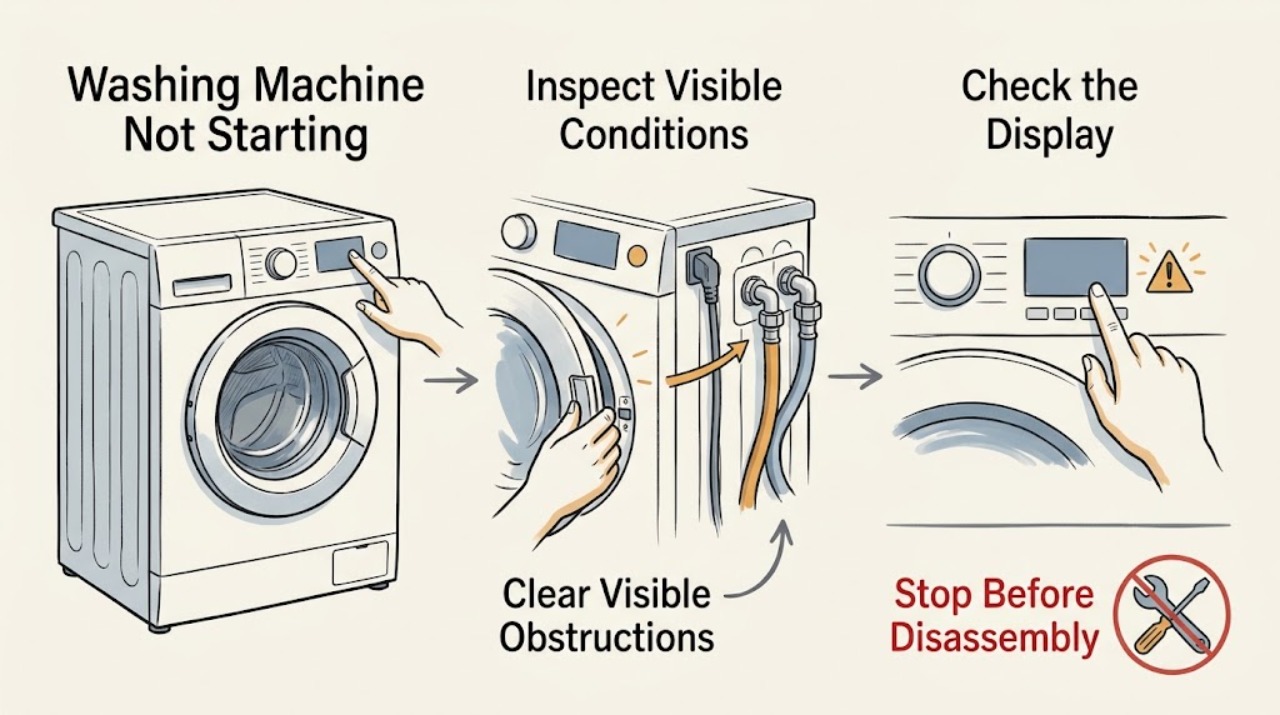
When a Beko washing machine will not start, first separate a dead control panel from a machine that powers on but refuses the programme. For a dead panel, check the mains wall socket and plug connection without using an extension socket. For a powered panel, check that child lock or delay is not active, the door closes without laundry trapped in the seal, and the water inlet is open and unrestricted. A brief Start/Pause/Cancel reset may clear a stopped programme, but a repeated trip, burning smell, damaged cord, persistent lock or fault indication, or a machine that still will not start after these external checks needs qualified service.
Work through in order
Diagnostic checks
Use only checks that match the exact appliance or system and its official guide.
-
Check 1
Press the power control once and observe the panel without opening the cabinet. If there are no lights or sounds, confirm the plug is firmly in a mains wall socket rather than an extension socket, then test that socket with a known-working lamp or similar appliance. Do not use a damaged plug, cord, or wet outlet.
Expected result: The panel remains completely dead, the test lamp also fails, the Beko panel powers up, or the machine powers only intermittently.
Next step: If the outlet is dead, use the household electrical support appropriate for that outlet. If the outlet works but the washer remains dead, stop using it and arrange authorized service. If the panel works, continue to the control and door checks.
Why this matters
Why: A failed test appliance points to the outlet or household supply; a working outlet with a dead Beko panel points toward the machine's plug, fuse where applicable, or an electrical fault. A powered panel means the remaining checks concern programme permission rather than basic supply.
-
Check 2
With the panel powered, check whether a child-lock symbol or delay indicator is shown. Cancel the delay using the exact model instructions; if the machine has stopped unexpectedly, press and hold the Start/Pause/Cancel control for three seconds as Beko describes, then select a programme once.
Expected result: The controls become responsive after child lock is cleared, a delayed start is cancelled, the reset returns the machine to a selectable programme, or the panel still ignores controls.
Next step: If the panel responds, continue to close the door and verify water supply before starting one normal programme. If controls remain unresponsive or the same fault returns, stop repeated attempts and arrange authorized service.
Why this matters
Why: Beko says child lock prevents programme and option changes, delay prevents a cycle from starting, and a three-second Start/Pause/Cancel press can reset a stopped appliance. An unresponsive panel after those model-appropriate checks suggests a control or electrical fault rather than a missing wash setting.
-
Check 3
Inspect the door opening and rubber seal for a sock, garment edge, or other item caught between the door and gasket. Keep the drum still, remove only the visible obstruction, and close the door firmly without slamming until the lock engages; never bypass or force the door lock.
Expected result: The door closes and a locking sound or lock indication appears, laundry was trapped in the seal, the door will not align, or the machine still reports an open door.
Next step: If the door locks, try one normal programme and watch for water entry. If it cannot lock, the lock indication remains absent, or the fault returns, leave the machine unused and arrange service rather than defeating the interlock.
Why this matters
Why: Beko says the washer will not fill when it detects that the door is open and recommends removing items caught in the door before closing it firmly. A door that cannot align or lock after the visible obstruction is removed may have a latch, hinge, seal, or lock problem.
-
Check 4
With the machine idle, confirm the water tap serving it is open and inspect the inlet hose from outside for a twist, kink, crushed section, loose connector, visible leak, or obstruction at the inlet connection. Do not loosen a pressurized connection; if the supply is weak, compare the flow only as the Beko guide and local plumbing practice allow.
Expected result: The tap is closed, the hose is kinked or leaking, the inlet appears restricted, the water flow is weak, or the visible supply is normal but the programme still does not begin filling.
Next step: Correct only an accessible closed tap or visible hose routing issue, then try one normal programme. If there is a leak, weak supply, or no water entry after the external checks, stop and arrange plumbing or authorized appliance service as appropriate.
Why this matters
Why: Beko explains that insufficient water supply can affect operation and that a kinked or twisted inlet hose can reduce water entering the drum. A clear hose and open tap do not rule out an inlet valve or control fault if the machine still does not fill.
-
Check 5
If water remains in the drum, the machine stopped mid-cycle, or the door-lock condition persists, turn the machine off and let it settle. Only if the exact model manual identifies a user-accessible pump-filter or emergency drain, place towels and a container first and inspect that area for visible debris or a kinked drain hose; expect water and do not force a filter or open panels.
Expected result: The drum drains after the approved user check, the pump filter or hose is visibly obstructed, water remains, or the door stays locked because the machine cannot confirm a safe water level.
Next step: Refit the user-accessible filter or hose exactly as the manual directs and run one drain or spin programme if safe. If water cannot drain, the lock remains, a leak appears, or the machine stops again, stop using it and arrange qualified service.
Why this matters
Why: Beko identifies a clogged pump filter or bent drain hose as causes of incomplete drainage and explains that a locked door can be related to water remaining in the drum. Clearing only an accessible obstruction may restore the programme, but standing water or a recurring lock can require service.
-
Check 6
After the safe external checks, make one supervised start attempt and record the model, selected programme, panel response, lock indication, water entry, drain result, and any displayed fault. Do not remove covers, reach into a moving drum, defeat the door interlock, probe wiring, or continue cycling a machine that smells hot or trips power.
Expected result: The programme starts normally, or the machine remains dead, ignores controls, will not lock, does not fill or drain, leaks, repeatedly trips, makes an abnormal sound, or shows the same fault.
Next step: Stop using the washer for persistent or unsafe symptoms and contact an authorized Beko service agent. Provide the model, fault display, cycle stage, water level, and all observations so the technician can work from a useful symptom history.
Why this matters
Why: A successful cycle after a single external correction identifies a likely setting, door, supply, or drain condition, but it does not prove an internal part is healthy. Persistent or unsafe symptoms need diagnosis beyond the user-accessible checks.
Use your observations
Decision map
Find the observation that best matches what you see, then follow the next safe action.
-
PATH 01Safety boundary
What you see
Is the Beko panel completely dark and silent?
Do this next
Test the mains wall socket with a known-working appliance without using an extension socket. If the outlet works but the washer stays dead, stop and arrange electrical or authorized appliance service.
Why this path and its safety boundary
Safety stop: Continue with child-lock, delay, door, water, and drain checks because the machine has power but is refusing or failing to begin a programme.
-
PATH 02Safety boundary
What you see
Does the panel show child lock, delay, or ignore button presses?
Do this next
Use the exact model instructions to clear child lock or delay, then try the documented three-second Start/Pause/Cancel reset once. Persistent unresponsive controls need service.
Why this path and its safety boundary
Safety stop: Continue to the door-closure branch and do not assume that a powered display means the door interlock has accepted the programme.
-
PATH 03Safety boundary
What you see
Does the door close firmly and show the expected lock indication?
Do this next
Continue to water entry and select one normal programme. If the lock indication disappears or the door opens unexpectedly, stop using the machine and request service.
Why this path and its safety boundary
Safety stop: Remove only visible laundry caught in the seal and close the door without force. If it still will not lock, do not bypass it; arrange service.
-
PATH 04Safety boundary
What you see
Does the machine have an open water supply and a clear visible inlet, while the drum is able to drain?
Do this next
Try one normal programme and observe whether water enters. If it still does not start or fill, an internal inlet, control, or door fault may need service.
Why this path and its safety boundary
Safety stop: Correct only a closed tap, visible inlet kink, accessible filter obstruction, or drain-hose routing issue according to the exact manual. Stop for leaks, standing water, or any condition requiring a forced connection.
-
PATH 05Safety boundary
What you see
Does the washer remain dead, refuse to lock or start, repeatedly trip power, leak, or display the same fault after the external checks?
Do this next
Stop using it and arrange authorized Beko service. Do not remove covers, bypass the door lock, probe wiring, or keep restarting the appliance to reproduce the fault.
Why this path and its safety boundary
Safety stop: If one normal programme starts and completes after a safe setting or routing correction, monitor the next load and keep the exact model manual available.
Helpful context
Understand the symptom
Identify what 'not starting' means
A Beko machine with no lights or sounds has a different path from one whose display works but will not begin washing. Record whether the panel responds, whether a lock symbol or delay indicator is visible, whether the door clicks shut, and whether any water enters. These observations narrow the next safe check without proving which internal component has failed.
Keep checks external and model-specific
Beko models use different control layouts and child-lock instructions. Use the manual for the exact model when a button combination or pump-filter location is involved. Do not remove covers, defeat the door lock, handle exposed wiring, or force a locked door to make the machine start.
Safety boundary
Stop conditions
- Stop using the machine for a burning smell, smoke, a hot or damaged plug or cord, repeated power trips, a leak, uncontrolled water, exposed wiring, or a drum or door that cannot be safely controlled.
- Do not remove covers, defeat the door interlock, reach into a moving drum, loosen a pressurized hose, or force a pump filter or locked door.
When checks do not resolve it
Need a professional?
Call an authorized Beko service agent when the washer remains dead with a working outlet, controls stay unresponsive, the door will not lock, water will not enter or drain after the external checks, a fault repeats, or any leak, electrical, or mechanical safety symptom appears.
Common questions
FAQ
Why does my Beko washing machine have power but not start?
Check child lock and delay, close the door firmly with no laundry caught in the seal, and try the model-appropriate three-second Start/Pause/Cancel reset once. If the controls remain unresponsive or the door will not lock, arrange authorized service.
What should I check if my Beko washing machine has no lights?
Use a mains wall socket rather than an extension socket and test that outlet with a known-working lamp or similar appliance. If the outlet works but the washer stays dead, stop using it and arrange electrical or authorized appliance service.
Can a door or water problem stop a Beko washing machine from starting?
Yes. Beko says the machine will not fill when it detects an open door, and a kinked inlet hose, weak water supply, or incomplete drainage can prevent normal programme progress. Correct only visible, user-accessible conditions using the exact model instructions.
When should I stop trying to start my Beko washer?
Stop for a burning smell, smoke, a hot or damaged plug or cord, repeated power trips, a leak, exposed wiring, a forced or faulty door lock, or a recurring fault after the external checks. Do not bypass the door interlock or remove covers; arrange qualified service.
Read the exact guide
Official sources
- How to Solve Problems with Your Beko Washing MachineBeko UK · Beko washing machine reset, water pressure, inlet hose, pump filter, mains power, loading, child lock, and delay checks
- How to check an electrical power fault on your washing machineBeko UK · Beko washing machine mains-socket and basic power-fault checks
- TroubleshootingBeko · Beko washing machine troubleshooting for door lock, drain, low water pressure, and programme progression
- How to fix a washing machine that won’t start a programBeko · Beko washing machine child lock, door closure, programme start, and authorized-service guidance
- My Beko washing machine has stopped working, what should I do?Beko UK · Beko washing machine stopped-programme reset and engineer boundary
- How to fix a washing machine that won’t startBeko · Beko washing machine pump-filter and drain-hose checks related to incomplete cycles
Community feedback
Share a repair observation
Share a plain-text repair observation. Accepted observations are published automatically; this page may take a moment to update.