
On this page
Start here
Quick answer
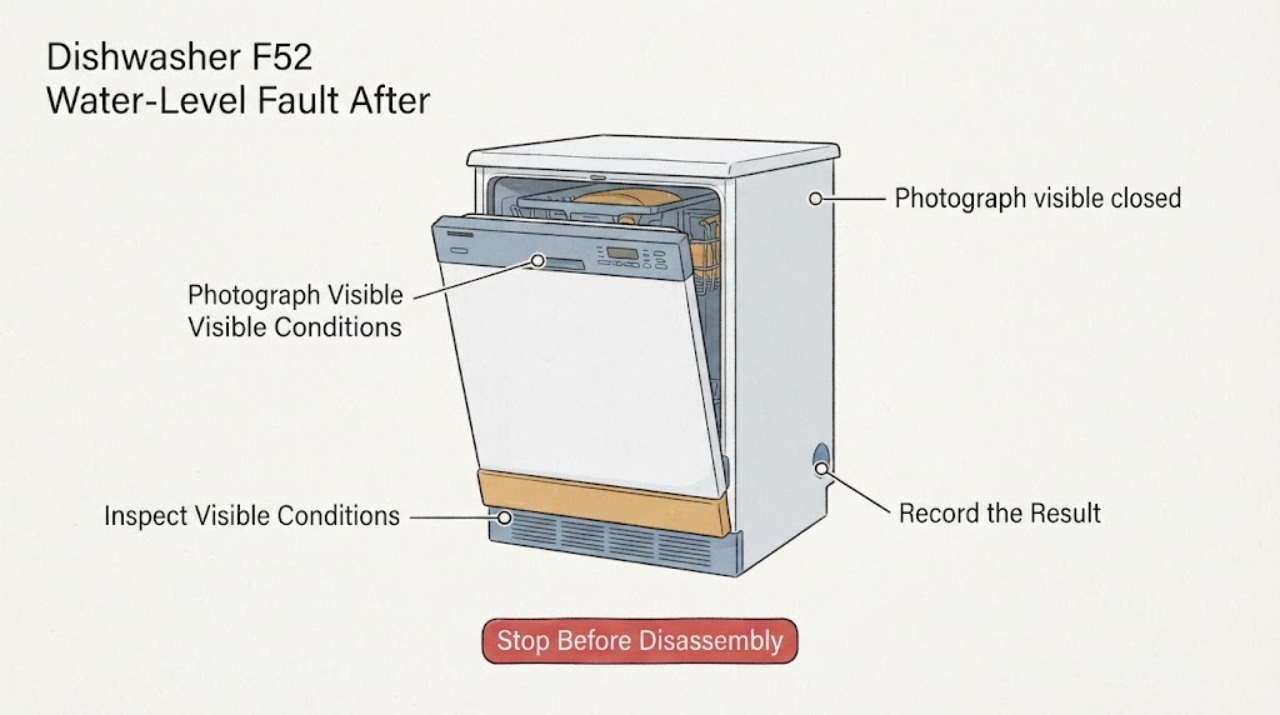
On two opened official ASKO dishwasher manuals for the DFI544H/1 and DFI544D models, F52 is listed as a water-level error and the user instruction is to close the water tap and contact service. Because the exact ASKO model and market are missing here, do not assume that wording applies to every ASKO dishwasher or use it to name a valve, sensor, pump, or control board. Record the exact display, model/serial label, selected program, and the state of the water when F52 appears after about 25 minutes. With the machine stopped, note whether the tub is dry, has a normal small amount of water, is overfilled, foamy, draining, or leaking. Do not open the base, adjust a level sensor, disconnect hoses, run a pressure test, or perform live electrical testing. If water is high, leaking, or the drain pump runs continuously, close the accessible water valve first and arrange qualified ASKO service.
Work through in order
Diagnostic checks
Use only checks that match the exact appliance or system and its official guide.
-
Check 1
Before changing anything, photograph the complete display and write down whether it says F52, F52 with another symbol, or a different sequence. Record the exact model and serial information from the visible rating label or paperwork, the market, selected program, and the elapsed time when the code appeared.
Expected result: The code is clearly F52 and repeatable at about 25 minutes, the display includes another code or symbol, or the model cannot be identified without moving the appliance.
Next step: Keep the photo and timing for ASKO or authorized service. If the model is missing or F52 is not listed in the matching manual, do not invent a reset or component diagnosis; leave the unit stopped and request model-specific guidance.
Why this matters
Why: The opened ASKO manuals identify F52 only within their named DFI544H/1 and DFI544D platforms. A different display sequence, market, or unidentifiable model leaves the code meaning scoped and unproven rather than interchangeable across the ASKO range.
-
Check 2
With the cycle stopped and the door opened only when it is safe, look at the visible tub water without reaching under the filters or removing covers. Record whether the tub is dry or nearly dry, has a small normal-looking amount, is unusually high, contains suds, or is visibly leaking onto the floor.
Expected result: The water is high or rising, water is outside the tub, the tub is empty, there is a normal-looking amount, or thick foam is present.
Next step: For high water, a leak, or a continuously running pump, close the accessible water valve before any power interruption and contact qualified service. For a dry, normal, or foamy tub with no leak, document the result and proceed only with the external observations below; do not reach into the base or adjust a sensor.
Why this matters
Why: Water state separates an apparent overfill or leak hazard from a low/no-fill observation and from a code that occurs with no obvious visible abnormality. It does not identify the level sensor, inlet valve, drain pump, or control board, especially with the model missing.
-
Check 3
From outside the appliance, check that the normally accessible water shutoff is open and look for a visible kink, wet connection, or damaged inlet hose without disconnecting the hose or pulling out an integrated dishwasher. Listen only from a safe standing position for filling, draining, or a pump that continues after the cycle stops.
Expected result: The valve is closed, the hose or connection is wet or damaged, no inlet sound is heard, the machine repeatedly drains, or the external supply looks intact.
Next step: If the dry, intact connection has a closed valve, open only that accessible valve and do not force it. If there is any leak or damage, close the valve and arrange service. If the valve is open but F52 returns, stop cycling the machine and give the technician the sound, timing, and water-state record.
Why this matters
Why: A closed valve or visible installation problem can explain a water-supply symptom, while repeated draining or no fill with an open supply needs model-specific service diagnosis. ASKO's U.S. guide sends pressure verification to a plumber; it does not make a user pressure test or hose disconnection appropriate.
-
Check 4
After the dishwasher is off and any water is cool, inspect only the accessible filter and drain opening for obvious food or glass debris; follow the exact model manual for removal and reinstallation if the model is known. Do not dismantle the pump, remove the bottom panel, or run the appliance with filters or guards missing.
Expected result: The visible filters or drain opening are dirty, the drain area looks clear, standing water remains, or the pump runs continuously.
Next step: Clean and reinstall accessible filters only as the matching manual instructs, then do not repeatedly test F52. If water remains, the pump will not stop, or the exact model manual does not cover the step, close the water valve as needed and call service.
Why this matters
Why: ASKO's cleaning guidance associates visible filter or drain debris with drainage problems, but the F52 manuals do not authorize treating a cleaned filter as a repair for a water-level fault. Persistent water or continuous pumping is a service condition, not a reason to probe the level system.
-
Check 5
Record detergent type and approximate dose, whether unusual suds were present, and whether F52 occurs on one program or several; do not add detergent or run another full cycle merely to reproduce the code.
Expected result: Heavy foam is present, no foam is visible, the code occurs only on one program, or it repeats across programs at a similar stage.
Next step: Stop adding detergent and provide the program, dose, foam, and timing record to ASKO service. Do not pour chemical cleaners into a faulted machine, enter a diagnostic mode, or adjust a sensor to compensate for foam.
Why this matters
Why: Foam and program/timing information can change what the technician checks first, but neither observation proves that detergent caused F52 or that a particular sensor or valve has failed. A repeat at about 25 minutes is useful recurrence evidence.
Use your observations
Decision map
Find the observation that best matches what you see, then follow the next safe action.
-
PATH 01Next step
What you see
The tub is overfilled, water is outside the appliance, or the drain pump runs continuously after F52.
Do this next
Close the accessible water valve first. Keep clear of standing water and electrical connections, then arrange qualified ASKO service; do not unplug before the water supply is shut off when an overflow or active water condition is present.
Why this path and its safety boundary
Why it matters: The immediate priority is overflow and water damage control; the visible pattern does not justify separating a valve, level sensor, pump, or control fault at user level.
-
PATH 02Next step
What you see
The tub is dry or has very little water, the inlet valve is closed or the supply connection is visibly kinked or leaking, and F52 appears after the cycle has been running.
Do this next
If the connection is dry and intact, open only the accessible shutoff; if it is wet or damaged, close the valve. Do not disconnect the hose, measure pressure, or retry a full cycle; contact a plumber or authorized ASKO service as appropriate.
Why this path and its safety boundary
Why it matters: A supply or installation observation is more useful than guessing a component, but the exact F52 platform still needs to be confirmed and water pressure is not a user test.
-
PATH 03Next step
What you see
The water level looks normal, there is no visible leak or foam, and F52 returns at about 25 minutes on a known or repeatable program.
Do this next
Stop testing and request model-specific ASKO service with the display photo, model/market, program, timing, water state, inlet/drain observations, and any prior repair history. Do not order a level sensor, inlet valve, pump, or board from F52 alone.
Why this path and its safety boundary
Why it matters: The code is a repeatable water-level fault indication within the evidence scope, but no visible observation identifies the internal cause; the two opened F52 manuals direct service rather than a user repair.
-
PATH 04Next step
What you see
The exact model cannot be identified safely, the matching manual does not list F52, or the display is not actually F52.
Do this next
Treat the code as unresolved, leave the dishwasher stopped, and give ASKO or authorized service the visible label details, exact display sequence, market, and observations. Do not transfer F52 meanings from another model or appliance.
Why this path and its safety boundary
Why it matters: ASKO uses model-specific manuals and the opened evidence cannot establish the code's meaning on an unidentified platform.
Helpful context
Understand the symptom
The reported delay matters: F52 appears after the dishwasher has been operating for about 25 minutes, not necessarily during the first fill. Treat that timing as evidence to give the technician, not as proof of a particular part. The two official ASKO manuals opened for this research are model-specific Russian-language documents, so confirm the appliance's exact model and market before applying their F52 entry.
Do not keep restarting the cycle to see whether the code clears. ASKO's model-specific F52 instruction is to close the water tap and contact service. Keep hands out of standing hot water, and stop immediately for a leak, overflow, smoke, burning odor, damaged cord, or a pump that will not stop.
The useful first distinction is visible water state: too much water or a leak, too little or no water, a normal-looking level with a repeatable F52, or heavy foam. Those observations narrow the service conversation without exposing the user to the dishwasher's base, level-sensing hardware, plumbing connections, or live electrical circuits.
When checks do not resolve it
Need a professional?
Arrange qualified ASKO service when F52 returns, the exact model manual does not list it, the display sequence is uncertain, or there is no clear external explanation after documenting the water state. Close the water valve immediately for an overfill, leak, or inlet-valve concern; if the pump runs continuously, turn water and power off only after the water supply is secured and it is safe to do so. Seek urgent qualified help for smoke, burning odor, a hot plug, damaged cord, exposed wiring, or repeated breaker trips. Do not open the base, adjust or bypass a level sensor, disconnect plumbing, test live circuits, enter an undocumented diagnostic mode, or keep resetting the fault.
Common questions
FAQ
What does F52 mean on an ASKO dishwasher?
The two official ASKO dishwasher manuals opened here for DFI544H/1 and DFI544D list F52 as a water-level error and direct the user to close the water tap and contact service. ASKO model platforms can differ, so confirm the exact model and market before treating that wording as universal.
Should I replace the water-level sensor or inlet valve for F52?
No part is justified from F52 alone when the model is missing. Record whether the tub is empty, normal, overfilled, foamy, leaking, or continuously draining, then let authorized service match the exact platform and test the relevant path safely.
Why does F52 appear about 25 minutes into the cycle?
The delay identifies when the fault becomes repeatable, but the opened ASKO manuals do not say that 25 minutes maps to one specific component. Give the program and timing to service and do not keep running full cycles to reproduce it.
Read the exact guide
Official sources
- ASKO Search for ManualsASKO · Official manual portal opened to verify that ASKO routes documentation by product code or model; it supports the need for exact identity, not a code meaning.
- ASKO Dishwasher Cleaning GuideASKO · Official U.S. guide used for safe visible observations and escalation boundaries; its F4 reset example is not transferred to F52.
- ASKO DFI544H/1 dishwasher user manualASKO · Exact model-specific ASKO manual opened to verify the F52 entry; it is not evidence that every ASKO dishwasher uses the same code table.
- ASKO Dishwasher Installation InstructionsASKO · Official ASKO installation safety reference for accessible water shutoff, hose condition, leak checks, and qualified electrical/plumbing boundaries; not evidence of F52 meaning on this task's unidentified model.
- ASKO DFI544D dishwasher user manualASKO · Second exact model-specific ASKO manual opened as a platform comparison; it supports the same F52 wording on DFI544D but not a universal ASKO interpretation.
Community feedback
Share a repair observation
Share a plain-text repair observation. Accepted observations are published automatically; this page may take a moment to update.