
On this page
Start here
Quick answer
If a Bauknecht washing machine will not turn on, first separate a completely blank panel from a machine that has lights but will not start a programme. Check the plug, wall outlet, and household fuse or breaker externally, then make sure the door is fully closed, the programme is selected, and any key lock or pause state is cleared using the exact model instructions. If the machine has water or a fault indication, check only the accessible inlet or drain conditions named by the manual; a triggered water-protection system can prevent starting. With power disconnected, a drum that is loose, cannot move, or has an obstruction is a service clue, not permission to open the cabinet. If the outlet is good but the washer remains dead, the breaker trips again, the door will not latch, or there is smoke, burning odor, water near electrical parts, or another hazard, unplug it and arrange qualified Bauknecht service.
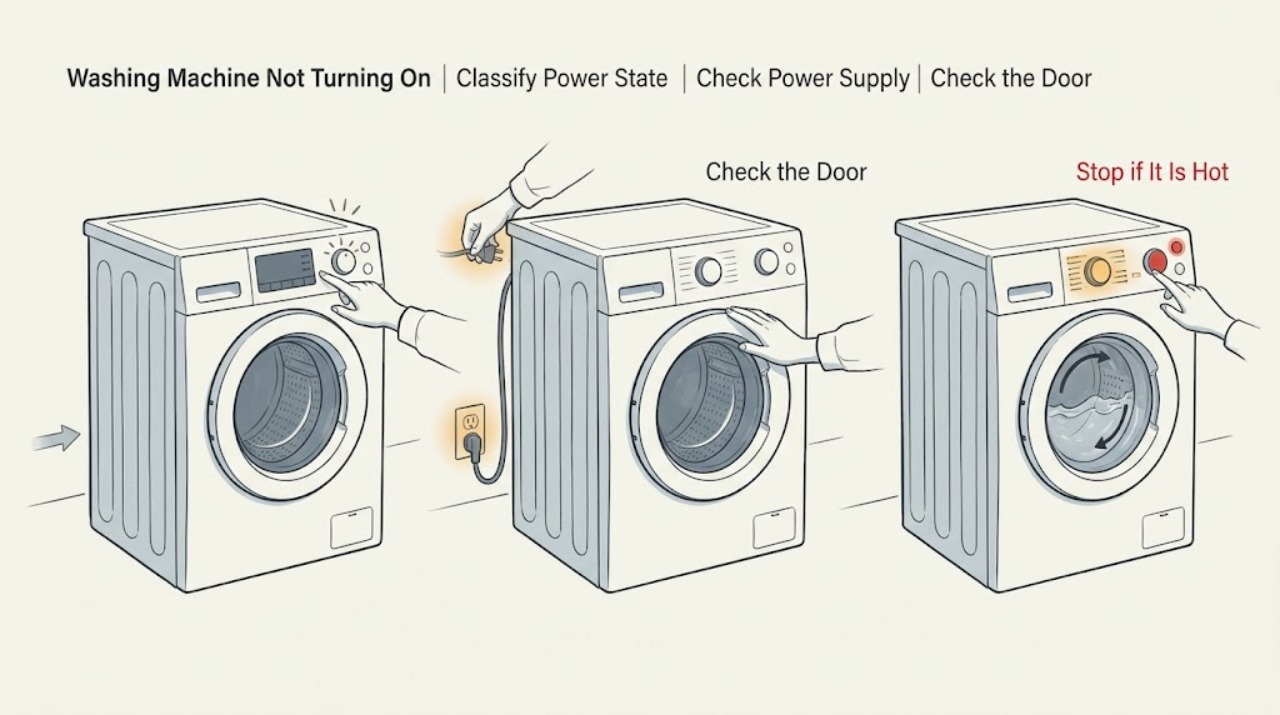
Work through in order
Diagnostic checks
Use only checks that match the exact appliance or system and its official guide.
-
Check 1
Press the normal power control once and observe whether the display is completely blank, briefly flashes, shows a fault/key indication, or lights normally but will not begin a programme.
Expected result: The panel is blank, the panel is active but idle, or a code/lock indication is visible.
Next step: Use the matching power, start-condition, or fault-code branch instead of repeating the same button press.
Stop if: Stop for smoke, burning odor, sparks, heat damage, or a damaged cord or outlet.
Why this matters
Why: A blank panel keeps the supply and internal power path first; an active panel shifts the decision to door, programme, lock, water-protection, or fault handling.
-
Check 2
If the panel is blank, inspect the plug and cord externally and verify the wall outlet with a known-good appliance only when the outlet and floor are dry; check the household fuse or breaker without opening the washer.
Expected result: The outlet works and the breaker stays on, or the outlet is dead, the cord is damaged, or the breaker trips again.
Next step: If the household supply is at fault, have it checked. If the outlet is good but the washer remains blank, leave it unplugged and arrange appliance service.
Stop if: Stop for a hot/discolored outlet, damaged insulation, moisture, sparks, or a breaker that trips again.
Why this matters
Why: Bauknecht identifies the plug, outlet, and fuse as possible reasons a washer will not start. A good outlet with a blank washer points beyond the external supply; a repeated trip indicates a fault.
-
Check 3
If the panel is lit, open and close the door firmly without slamming, remove any fabric caught at the seal, and remove some laundry if the drum is tightly packed.
Expected result: The door latches and the programme starts, or the door will not latch and the washer remains idle.
Next step: If it starts, supervise the first fill. If it will not latch, inspect only visible obstruction and use model-specific service guidance; do not bypass the lock.
Stop if: Stop if the latch, hinge, seal, or door is cracked, loose, scorched, or requires force.
Why this matters
Why: Bauknecht says an incompletely closed door can prevent starting and an overloaded drum can trigger a stop. A door that will not latch keeps the interlock or obstruction in the service path.
-
Check 4
Confirm that a valid programme is selected, the washer is not paused, and any key lock is cleared using the exact model instructions; record a displayed code before attempting a model-approved reset.
Expected result: The washer starts after the setting is corrected or reset, or the lock/code remains and the controls stay unresponsive.
Next step: If it starts, monitor one supervised cycle. If it does not, keep the code record and arrange service; do not factory-reset or erase fault history when a visit is planned unless directed.
Stop if: Do not force buttons, bypass a lock, or remove the control panel.
Why this matters
Why: A lock, pause, or unselected programme can look like a failed power button. A returning code or unresponsive control panel needs model-specific diagnosis rather than repeated resets.
-
Check 5
If the washer shows a water-related indication or never progresses past the start of a programme, check that the water tap is open, the accessible inlet hose is not kinked or damaged, and any visible inlet screen is not obviously blocked, following the model manual.
Expected result: The tap is closed, the hose is kinked/damaged, the inlet path is blocked, or the external water path looks normal but the washer still will not start.
Next step: Correct only an obvious tap or kink and retry once under supervision. If a water-protection indication remains or the inlet component is damaged, close the tap, unplug the washer, and arrange service.
Stop if: Stop for a leaking hose, water in the base, water near electrical parts, or any need to open the cabinet or remove an internal screen.
Why this matters
Why: Bauknecht lists a closed or obstructed inlet and an activated water-protection system as causes of a washer that will not start. A normal external path with a persistent fault can involve the valve, sensor, or control system.
-
Check 6
If the washer has standing water or reaches the drum stage but does not move, switch it off and unplug it; check only the accessible drain hose for a kink and gently turn the empty drum by hand without reaching behind panels.
Expected result: The drain hose is kinked/blocked, the drum turns normally, the drum is loose, or the drum will not move/has an obstruction.
Next step: Correct only an obvious accessible hose position issue. If the drum is loose, jammed, scraping, or the fault returns, leave the washer unplugged and arrange service.
Stop if: Do not open the pump housing with hot water, force the drum, tilt a water-filled washer, or remove panels to inspect the belt.
Why this matters
Why: A blocked drain path can prevent the machine from progressing, while Bauknecht identifies a loose or immovable drum as a possible belt or obstruction issue. These observations do not identify a repair part.
-
Check 7
Before requesting repair, record the model/serial information, blank versus lit display, outlet/breaker result, door-latch result, programme and lock state, any code, water indication, hose result, and drum movement.
Expected result: The washer remains dead with a good outlet, will not latch or start, returns a fault, has a water-protection indication, or the drum is loose/jammed.
Next step: Keep the washer unplugged and the water tap closed when the result is hazardous or persistent, then arrange qualified Bauknecht appliance service with the record.
Stop if: Do not open the cabinet, bypass a lock, live-test wiring, or keep resetting a fault to force a cycle.
Why this matters
Why: The remaining possibilities include the internal power path, control module, door interlock, inlet valve, water-protection sensor, pump, belt, motor, or an obstruction. Those require qualified diagnosis.
Use your observations
Decision map
Find the observation that best matches what you see, then follow the next safe action.
-
PATH 01Safety boundary
What you see
The display remains completely blank.
Do this next
Check the plug, dry wall outlet, and household fuse/breaker externally. If the outlet is good but the washer remains blank, unplug it and arrange service.
Why this path and its safety boundary
Safety stop: Use the powered-but-not-starting path for door, programme, lock, water, and fault indications.
-
PATH 02Safety boundary
What you see
The panel is lit but the door will not latch or the drum is overloaded.
Do this next
Remove visible obstruction and some laundry, close the door without force, and stop for a damaged latch, seal, or hinge.
Why this path and its safety boundary
Safety stop: Continue with programme, lock, water-protection, and fault checks.
-
PATH 03Safety boundary
What you see
A key lock, pause state, or displayed fault prevents the programme from beginning.
Do this next
Follow the exact model instructions, record the code first, and stop if the indication returns after the approved reset.
Why this path and its safety boundary
Safety stop: Check the water path and, if appropriate, the disconnected drum movement.
-
PATH 04Safety boundary
What you see
A water indication is shown, the water-protection system may be active, or the washer does not progress after starting.
Do this next
Check only an obvious closed tap, kinked inlet hose, or accessible drain-hose issue; close the tap and arrange service for a persistent protection indication or leak.
Why this path and its safety boundary
Safety stop: Use the drum and service branch if the washer reaches that stage but does not move.
-
PATH 05Safety boundary
What you see
With power disconnected, the drum is loose, jammed, scraping, or will not move.
Do this next
Leave the washer unplugged and arrange qualified service for the belt, drive, or obstruction; do not open the cabinet.
Why this path and its safety boundary
Safety stop: If the drum moves normally but the washer still will not start, use the control and service path.
-
PATH 06Safety boundary
What you see
There is smoke, burning odor, heat damage, water near electrical parts, a damaged cord, or a repeated breaker trip.
Do this next
Stop, unplug only if safe, close the tap, keep clear, and arrange qualified appliance or electrical service.
Why this path and its safety boundary
Safety stop: Continue only the external checks and stop if the no-start condition persists.
Helpful context
Understand the symptom
Start with what the washer is doing now
A blank display is a power-path symptom. A lit panel that refuses to run is usually a start-condition symptom: door feedback, selected programme, lock, water protection, or a stored fault can stop the cycle. Bauknecht's own guidance treats these as different checks, so do not keep pressing Start without noting which state you have.
Why a reset is not a repair
A model-appropriate reset can clear a temporary control state, but it does not prove that a door lock, inlet valve, control module, wiring, or drum drive is healthy. Record any code or unusual symptom before resetting. If the fault returns, use that recurrence as evidence for service.
Keep the cabinet and live wiring out of the user path
External checks are appropriate when the floor and plug are dry and safe. Do not bypass the door interlock, tilt a water-filled washer, remove panels, probe live terminals, or replace a fuse with a larger rating. A damaged cord, repeated trip, water near electrics, smoke, or burning odor ends the user diagnosis.
Safety boundary
Stop conditions
- Stop and unplug if safe for smoke, sparks, burning odor, heat damage, a damaged cord, or water near electrical connections.
- Stop after a breaker trips again; do not keep resetting it.
- Do not bypass the door lock, remove panels, live-test wiring, or tilt a water-filled washer.
- Stop if the drum is loose, jammed, scraping, or cannot move without force.
- Keep the water tap closed for an active water-protection indication or an internal leak.
When checks do not resolve it
Need a professional?
Arrange qualified Bauknecht service when a good outlet is confirmed but the washer remains blank; when the door will not latch; when a key lock, fault, or water-protection indication returns; when the drum is loose, jammed, or scraping; or when there is a damaged cord, repeated breaker trip, water near electrical parts, smoke, burning odor, or any need to open the cabinet. Keep the water tap closed and washer unplugged for persistent or hazardous faults.
Common questions
FAQ
Why is my Bauknecht washer completely blank?
Check the plug, dry wall outlet, and household fuse or breaker externally. If the outlet works but the washer remains blank, leave it unplugged and arrange qualified service.
Why does my Bauknecht washer have lights but not start?
Check that the door is fully closed, a programme is selected, the washer is not paused, and any key lock is cleared using the model instructions. Record any code before resetting; a recurring fault needs service.
Can an overloaded Bauknecht washer refuse to start?
Yes. Bauknecht lists an overloaded drum as a possible reason for a stop. Remove some items and retry only a supervised programme within the model's stated capacity.
What does a water-related no-start symptom mean?
A closed tap, kinked or damaged inlet hose, blocked inlet path, or activated water-protection system can prevent progress. Correct only an obvious accessible condition and arrange service for a persistent indication or internal water.
When should I stop troubleshooting and call for service?
Call when a good outlet is confirmed but the washer stays dead, the door will not latch, a code or water-protection indication returns, the drum is loose or jammed, or there is smoke, burning odor, heat damage, water near electrics, a damaged cord, or a repeated breaker trip.
Read the exact guide
Official sources
- Warum pumpt die Waschmaschine das Wasser nicht ab?Bauknecht · Bauknecht washing-machine drain-path troubleshooting
- Waschmaschine startet nichtBauknecht · Bauknecht washing-machine no-start troubleshooting
- Waschmaschine anschließen - so einfach geht’sBauknecht · Bauknecht washing-machine inlet, drain, and electrical connection guidance
- Die Waschmaschine schaltet sich ein, beginnt aber nicht zu waschen. Was kann ich tun?Bauknecht · Bauknecht washing-machine powered-but-not-starting FAQ
Community feedback
Share a repair observation
Share a plain-text repair observation. Accepted observations are published automatically; this page may take a moment to update.