
On this page
Start here
Quick answer
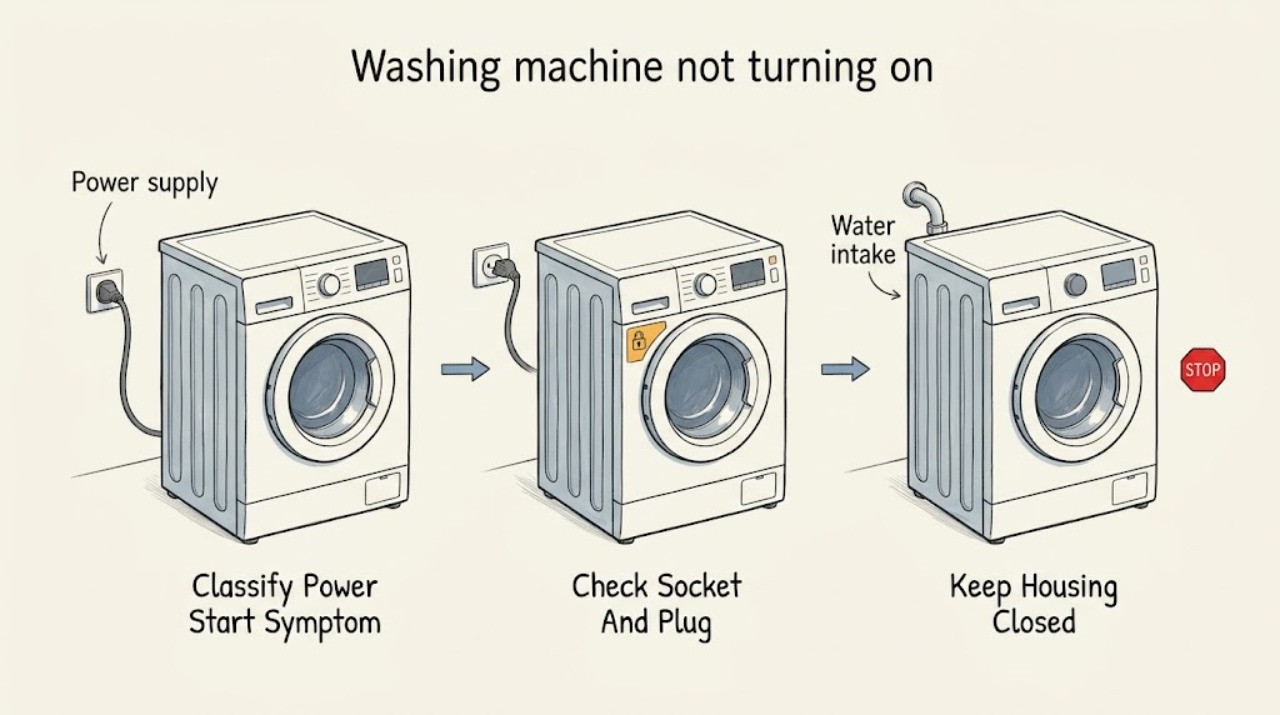
First distinguish a completely dead machine from one that lights up but will not start. Check the wall socket and plug from a safe, dry position, then perform only the single restart described in the AEG guidance. If the display is active, close the door fully, remove enough laundry if the drum is overloaded, check for a padlock or child-lock symbol, and record any error code exactly as shown. Check the water tap and visible inlet hose condition only when the programme has power but will not fill. Do not pull wires, open control or rear panels, bypass the door lock, or repeatedly reset a breaker. If the display stays blank after safe power checks, power trips again, the door will not latch, an error returns, the cord or plug is damaged, or the machine remains unresponsive, stop and arrange qualified AEG appliance or electrical service.
Before you begin
Safety first
- This article covers ordinary-access power, display, programme, door, child-lock, visible water-supply, and code checks only. Internal electrical, electronic, motor, lock, live-circuit, and structural work belongs to a qualified professional.
Work through in order
Diagnostic checks
Use only checks that match the exact appliance or system and its official guide.
-
Check 1
Observe the AEG washer from a dry, safe position and record whether the display is blank, the controls are lit but unresponsive, a programme is selected but does not start, a padlock symbol appears, or an error code or flashing indicator is shown.
Expected result: The machine has no visible power, responds to some controls, has an active display but no programme start, or shows a specific symbol or code.
Next step: Photograph or write down the exact display state, selected programme, and code before changing settings, then follow the matching branch.
Stop if: Stop for smoke, burning or electrical smell, sparking, water around electrical parts, a damaged cord or plug, a hot connection, or repeated power trips.
Why this matters
Why: A blank display directs the next check to the socket and supply. A lit display with no start directs attention to the door, child lock, programme, water, or error path. The exact code can narrow the problem, but it does not authorize internal repair.
-
Check 2
Unplug the washer before inspecting its external plug and cord for visible damage; test the wall socket with a known-safe appliance, without using the washer's wiring or removing any cover.
Expected result: The test appliance works and the AEG washer remains blank, the socket has no power, or the cord or plug shows damage, heat, looseness, or discoloration.
Next step: If the socket is faulty, arrange qualified electrical service; if the socket works but the washer remains blank, continue to one documented restart only when the cord and appliance are safe.
Stop if: Do not use a damaged cord, extension workaround, wet socket, exposed conductor, or appliance that causes a spark or breaker trip.
Why this matters
Why: A working socket with a blank washer points toward the washer's supply or electronics. A dead socket points toward the household electrical supply. Cord or plug damage is an electrical safety fault, not a user repair.
-
Check 3
When there is no smell, damage, water hazard, or active electrical fault, switch the washer off and leave it disconnected for the interval specified in the AEG support article, then reconnect it and try the power control once.
Expected result: The display returns and remains stable, the washer is still blank, or the same error, lock, no-start symptom, or power interruption returns.
Next step: If the restart fails or the symptom returns, leave the machine disconnected and arrange AEG service; do not repeat the cycle of resets.
Stop if: Do not reconnect if the cord, plug, socket, appliance, or surrounding area is damaged, wet, hot, smoking, or sparking.
Why this matters
Why: A recovered display with normal operation supports a temporary electronic interruption. A recurring symptom indicates an unresolved fault or condition; repeated resets can hide evidence and may stress a faulting circuit.
-
Check 4
If the display works but the programme will not start, close the loading door firmly, remove enough laundry if it is preventing closure, and check for a padlock or child-lock symbol; use only the exact model manual's documented lock control.
Expected result: The door latches and the programme starts, the door remains ajar or will not latch, a padlock clears after the documented action, or the symbol and no-start condition remain.
Next step: Run one normal programme only when the door latches securely and the documented lock state clears; arrange service if the door or lock remains abnormal.
Stop if: Do not force the door, defeat the interlock, insert tools into the latch, pull wires, or open the door against a locked or water-filled drum.
Why this matters
Why: AEG says an overloaded drum can prevent secure closure and that child lock prevents accidental operation. A door that will not latch or a lock that will not clear may indicate a mechanical or control fault, not permission to bypass the interlock.
-
Check 5
If the washer powers on and the door latches but the programme does not proceed to fill, confirm the water tap is open and inspect the visible inlet hose for twisting, crushing, or damage; do not disconnect a pressurized hose.
Expected result: The tap is closed, the visible hose is kinked or damaged, water enters normally, or the washer shows a water-related error and still does not start.
Next step: Correct only a clearly closed tap or accessible hose position, then make one normal start attempt; arrange service for a leak, damaged hose, persistent error, or no fill.
Stop if: Do not loosen hose connections, reach into inlet components, run the machine with a leak, or continue if water reaches electrical parts.
Why this matters
Why: AEG identifies restricted water intake as a source of performance issues and error messages. Restoring a closed tap or safe hose position may allow a programme to start, but a persistent error can involve an inlet, sensor, or control fault.
-
Check 6
Read the complete error code or warning exactly as displayed, including letters, digits, beeps, or flashes, and consult the exact AEG model troubleshooting guide without guessing at a replacement part.
Expected result: The code matches a documented temporary or user-check condition, is not listed for the model, disappears once, or returns after the recommended action.
Next step: Follow only the model-specific documented action once, preserve the code and result, and arrange qualified service if it remains or returns.
Stop if: Do not clear or conceal a recurring warning by repeated power cycling, open internal panels, or bypass a safety message.
Why this matters
Why: AEG says error codes provide information about the affected system or component, but some codes indicate temporary conditions and others require service. An unlisted or recurring code is not safely diagnosed by a generic reset.
-
Check 7
After the safe socket, single-restart, door, lock, water, and code checks, document whether the washer is blank, unresponsive, unable to latch, unable to fill, or repeatedly stopping; do not dismantle the machine.
Expected result: The machine starts normally, remains dead, repeats the same no-start condition, trips power, leaks, or develops an electrical, burning, or mechanical warning.
Next step: Leave the washer off or disconnected when unsafe and arrange qualified AEG appliance or electrical service with the model, display state, code, and checks already performed.
Stop if: Stop immediately for smoke, burning or electrical smell, sparking, water near electrical parts, a damaged cord, repeated breaker trips, or an unsafe locked door condition.
Why this matters
Why: A successful start supports a power, lock, programme, or water condition that was corrected. Persistent no-start behavior may involve the supply, door lock, control, motor, sensor, or another internal fault that cannot be identified safely from outside.
Use your observations
Decision map
Find the observation that best matches what you see, then follow the next safe action.
-
PATH 01Safety boundary
What you see
The test appliance works at the socket but the AEG washer remains blank or does not react.
Do this next
Perform one safe restart only as the AEG guidance describes; if the display remains blank, arrange qualified appliance service.
Why this path and its safety boundary
Why it matters: The washer's supply path, control, or electronics may have a fault.
Safety stop: Do not open panels, test internal power, use a damaged cord, or repeat resets.
-
PATH 02Safety boundary
What you see
The test appliance also fails at the socket, or a breaker or residual-current device has tripped.
Do this next
Leave the washer disconnected and arrange qualified electrical assessment of the socket or supply.
Why this path and its safety boundary
Why it matters: The household socket or electrical supply may be the cause rather than the washer alone.
Safety stop: Do not repeatedly reset protection, use an extension workaround, or handle a wet, hot, sparking, or damaged socket.
-
PATH 03Safety boundary
What you see
The display is active but the door does not latch, the drum is overloaded, a padlock symbol is shown, or the child-lock control is active.
Do this next
Reduce the load if it blocks closure and use only the model manual's lock procedure; call service if the latch or lock remains abnormal.
Why this path and its safety boundary
Why it matters: The machine may be correctly preventing a start until the door and control state are safe.
Safety stop: Do not force the door, defeat the interlock, pull latch wires, or open a locked water-filled drum.
-
PATH 04Safety boundary
What you see
The washer powers on and latches but does not proceed because the tap is closed, the visible inlet hose is kinked, or a water-related warning appears.
Do this next
Open the tap or correct an accessible hose position only when safe, then make one start attempt; arrange service for damage, leaks, or a persistent warning.
Why this path and its safety boundary
Why it matters: Restricted water intake may be preventing the programme from progressing.
Safety stop: Do not disconnect pressurized hoses, reach into inlet components, or operate with a leak.
-
PATH 05Safety boundary
What you see
A code or warning returns, the machine stays unresponsive after the safe checks, or it repeatedly stops or trips power.
Do this next
Leave the washer off and arrange qualified AEG appliance service with the exact model, code, display state, and recorded observations.
Why this path and its safety boundary
Why it matters: An internal supply, lock, control, motor, sensor, or other fault is possible, but the failed part cannot be identified safely by ordinary checks.
Safety stop: Do not dismantle internal components, bridge an interlock, test live circuits, or continue operating with an electrical, water, or mechanical warning.
Helpful context
Understand the symptom
A blank display and a programme that will not start are different faults
When an AEG washer has no lights or response, begin with the socket and appliance power path. When the display is active but the wash does not begin, door closure, overloading, child lock, water intake, programme selection, or an error can prevent the start. Record which state you see instead of repeating the same start command.
Use one controlled restart, then preserve the evidence
AEG recommends disconnecting the machine for a limited restart interval when an electronic interruption may be temporary. After reconnecting, check whether the same blank display, lock symbol, code, or no-start behavior returns. A recurring symptom is useful service evidence; it is not a reason to keep cycling power or to remove a panel.
Door and lock checks stay outside the cabinet
An overloaded drum can keep the door from closing, and the child lock can prevent controls from responding. These are ordinary control and closure checks. A door that will not latch, a damaged seal or lock, or a fault that remains after the documented child-lock step needs qualified service rather than a bypass or improvised repair.
Safety boundary
Stop conditions
- Do not open the washer, remove internal covers, pull wires, test live circuits, bridge the door interlock, or replace an internal control, motor, lock, or sensor from the symptom alone.
- Stop immediately for smoke, burning or electrical smell, sparking, a damaged or hot cord or plug, water near electrical parts, repeated breaker or residual-current trips, or visible fire or water damage.
- Do not repeatedly reset the appliance or household electrical protection, use a damaged socket or cord, or reconnect a machine that is wet or unsafe.
- Only adjust a clearly closed tap, accessible hose position, door load, or documented child-lock state as the exact AEG manual permits; do not loosen pressurized connections or force a locked door.
- If the machine remains blank or unresponsive after the safe checks, stop troubleshooting and arrange qualified appliance or electrical service.
Only after diagnosis
Potential parts
- washing-machine door lock assembly
Consider this category only after a qualified technician confirms that the door cannot latch or the interlock has failed after the load and child-lock checks pass.
Confirm the complete AEG model and manufacturer fit information; never bypass or substitute the interlock as a test. - washing-machine power cord or plug assembly
Consider this category only when qualified electrical assessment confirms external cord or plug damage and the exact appliance installation permits that replacement.
Confirm the model, electrical specification, connector, and local installation requirements with a qualified professional; do not repair a damaged cord yourself. - washing-machine electronic control module
Consider this internal category only after a qualified technician diagnoses a control fault following the power, door, lock, water, and error checks.
Confirm the complete model and manufacturer fit information; a blank or no-start symptom alone does not prove a failed control module.
When checks do not resolve it
Need a professional?
Arrange qualified AEG appliance or electrical service when the display remains blank after a safe socket check and one documented restart, the washer powers on but the door will not latch, the child lock or error returns, the machine cannot fill or start after safe water checks, a breaker or residual-current device trips again, or an internal control, lock, motor, sensor, or supply fault is suspected. Stop immediately for smoke, burning or electrical smell, sparking, water near electrical parts, a damaged cord or plug, or any other unsafe condition.
Safety scope: This article covers ordinary-access power, display, programme, door, child-lock, visible water-supply, and code checks only. Internal electrical, electronic, motor, lock, live-circuit, and structural work belongs to a qualified professional.
Common questions
FAQ
What should I check first when my AEG washing machine will not turn on?
Separate a blank display from a powered machine that will not start. Test the wall socket with a safe appliance, inspect the unplugged external cord for visible damage, and perform one restart only when the machine and socket are safe. Persistent blank operation needs service.
How do I reset an AEG washing machine that is not responding?
AEG's support guidance describes switching the machine off, disconnecting it for the stated restart interval, reconnecting it, and checking whether the symptom remains. Use the exact model guidance and do not repeat resets if the symptom returns or power trips.
Why does my AEG washer have power but not start?
Check that the door is fully latched, the load is not preventing closure, the child lock is not active, and no error code or water-intake condition is blocking the programme. If the door or lock remains abnormal, arrange service rather than bypassing it.
Can an overloaded drum stop an AEG washing machine from starting?
Yes. AEG says an overloaded drum can prevent the door from closing properly, and the machine will not start unless the door is secure. Remove enough laundry to allow safe closure, but do not force the latch.
What should I do with an AEG washing-machine error code?
Record the complete code exactly as displayed, consult the troubleshooting guide for the exact model, and follow only the documented corrective action. An unlisted or recurring code requires qualified service rather than repeated resets.
Should I open my AEG washer to find out why it will not turn on?
No. AEG advises disconnecting power before maintenance and not dismantling internal components unless specifically instructed. Leave internal electrical, electronic, motor, and door-lock diagnosis to a qualified technician.
Read the exact guide
Official sources
- Washing Machine Not Working or Not Turning On – Troubleshooting GuideAEG · AEG official support article applying to washing machines and washer dryers; exact model manual controls variations.
- What to check before contacting AEG consumer serviceAEG · AEG general consumer-service guidance; model-specific manual instructions take precedence for a washing machine.
Community feedback
Share a repair observation
Share a plain-text repair observation. Accepted observations are published automatically; this page may take a moment to update.