
On this page
Start here
Quick answer
A Bauknecht washing machine that is not working may have no power, an incompletely closed door or lid, an active child lock or delay, a missing water supply, a drain or filter obstruction, an unbalanced load, or an error that needs service. First identify whether the display is completely dead, the program will not start, the washer stops with water, or it runs but cannot complete a stage. Check only the plug and normal user controls, close the door or lid without force, confirm the visible water connection, and follow the exact model manual for any filter or reset procedure. Stop for leaks, burning odor, smoke, damaged wiring, repeated electrical trips, a locked door with water inside, or any need to open the cabinet; arrange qualified Bauknecht service.
Before you begin
Safety first
- This article covers normal controls, visible plug, door, hose, tap, load, and drain-path observations, plus only the exact manual's documented user-access procedure. A qualified technician must handle appliance movement, internal panels, electrical measurement, door-lock, pump, valve, motor, control, and wiring work.
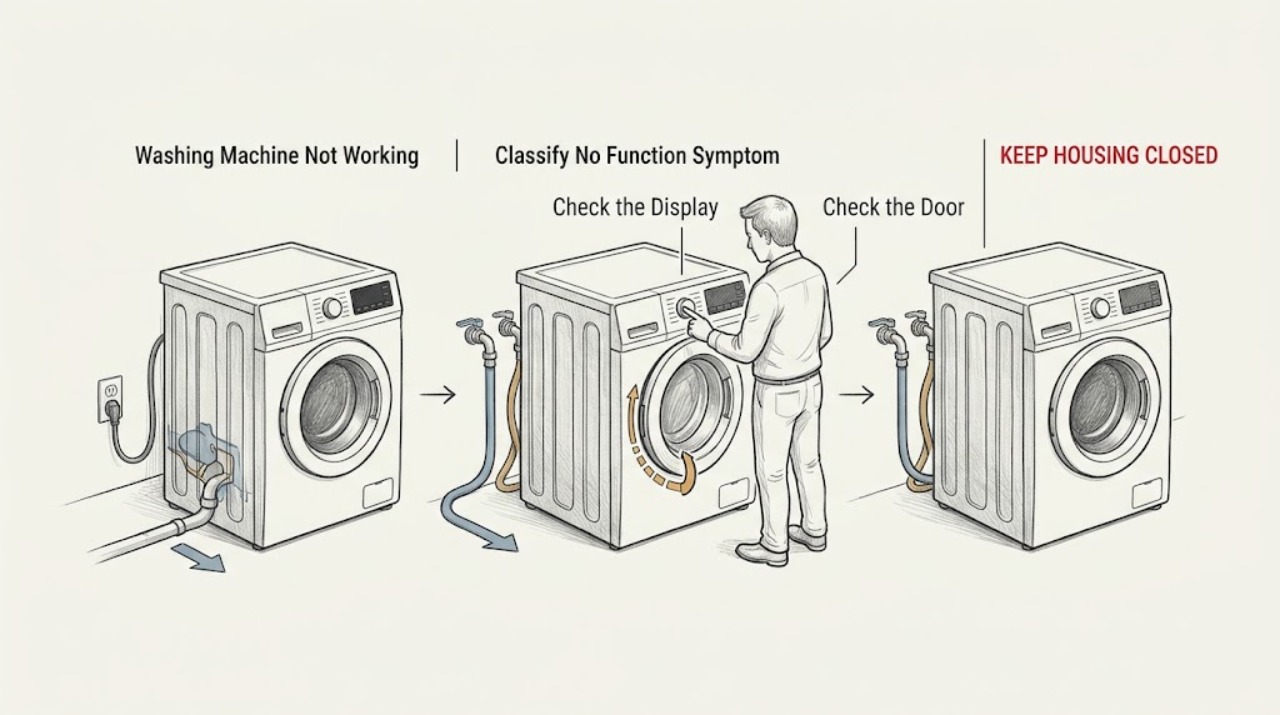
Work through in order
Diagnostic checks
Use only checks that match the exact appliance or system and its official guide.
-
Check 1
Use the normal power and program controls once and record whether the display or indicators respond, whether a program can be selected, and whether the washer stops before filling, during washing, or during draining.
Expected result: Record a completely dark panel, a responsive panel with no start, a running program that stops, an error indication, or water remaining after the cycle.
Next step: If there is no response, continue with the safe power and control-state check. If water remains or the cycle stops with an error, keep the water and fault condition in scope and do not repeatedly restart.
Stop if: Do not keep cycling a washer that leaks, smells of burning, emits smoke, trips electrical protection, or leaves a door locked over standing water.
Why this matters
Why: These observations separate a power or control-state issue from a door, water-supply, drain, or internal fault. A dead panel is not the same problem as a washer that runs but cannot pump out.
-
Check 2
From outside the appliance, confirm that the plug is fully seated, the normal control panel receives power, and no child lock, delay, demo, or test state is shown; use only the exact model manual for changing a control state.
Expected result: Record normal indicators, no panel response, a lock or delay symbol, a demo or test indication, or an outlet or supply that appears unavailable.
Next step: Restore only a clearly enabled user setting according to the manual. If the appliance remains dead or the supply trips, stop and arrange qualified appliance or electrical service rather than opening the washer.
Stop if: Do not remove the plug cover, probe the outlet or appliance wiring, bypass a breaker or safety device, or use an improvised extension arrangement.
Why this matters
Why: Bauknecht lists the plug and powered outlet among the first checks for a washer that does not function, and its support pages explain that a lock, demo state, or delay can prevent a program from starting. This does not prove an internal electronic failure.
-
Check 3
Close the washer door or lid normally and inspect the visible seal and latch area for clothing caught in the opening; do not slam the door or force a locked mechanism.
Expected result: Record a door or lid that closes and latches normally, an obstruction preventing closure, a door that springs back, or a lock indicator that remains active.
Next step: Remove only a loose, visible item from the door opening, close it normally, and try one manual-approved start. If the latch or lock remains abnormal, stop and request service.
Stop if: Do not bypass the door or lid interlock, pry the door open, remove the lock, or reach into a moving drum.
Why this matters
Why: Bauknecht states that a washer will not start when the door is not correctly closed. A latch that will not engage or a door that stays locked with water inside is not a safe user-level adjustment.
-
Check 4
Inspect the visible inlet hose and tap without loosening the connection, and confirm that the tap is open and the hose is attached as shown in the model instructions.
Expected result: Record a normal dry connection and water supply, a closed tap, a kinked or damaged hose, a loose-looking connection, or a no-water indication on the display.
Next step: Open the tap only through its normal handle if it is safely accessible and correct only a visible hose-routing issue. For a leak, damaged hose, blocked inlet, or continuing no-water indication, stop and arrange qualified service.
Stop if: Do not remove the inlet hose, clean an internal inlet screen, open a water-protection device, or continue operation with water escaping.
Why this matters
Why: Bauknecht's water-supply guidance says to check that the tap is fully open and the inlet hose is attached. A washer that cannot fill may appear not to work even when its main control is operating.
-
Check 5
If water remains or the washer reports a drain or filter problem, inspect the visible drain hose for a kink and read the exact manual to determine whether a user-accessible foreign-object filter is provided; do not open an unlisted cover.
Expected result: Record a clear hose and no filter indication, a kinked hose, a filter warning, a pump that only hums, or a filter access point that is absent, stuck, or unsafe to open with residual water present.
Next step: Correct only an accessible external kink. Follow a filter-cleaning procedure only when the exact manual documents it and residual water can be contained safely; otherwise stop and arrange service.
Stop if: Do not tip the appliance, disconnect a full hose, reach toward pump blades, chip an obstruction, use drain chemicals, or open internal panels.
Why this matters
Why: Bauknecht identifies a blocked pump or kinked drain hose as possible reasons water is not pumped out, but a no-drain symptom does not identify whether the pump, filter, hose, or control has failed.
-
Check 6
When the washer is safe to open through its normal control, check whether the load is obviously overfilled or gathered to one side and whether the selected program or spin setting intentionally omits a stage; use the manual's stated load and option limits.
Expected result: Record a reasonable balanced load and suitable program, an overloaded or uneven load, a no-spin or hold option, or a cycle that stops with laundry still very wet.
Next step: Redistribute or reduce an obviously unsuitable load only through ordinary access, then use one manual-approved cycle. If the washer still stops, retains water, or reports an error, arrange service.
Stop if: Do not force the drum, defeat a lid or door lock, or restart repeatedly with a full tub or unstable machine.
Why this matters
Why: Bauknecht explains that some programs or options may omit spinning and that an unbalanced load can interrupt or reduce the final spin. Wet laundry alone does not prove that the washer is completely nonfunctional, but water remaining in the tub keeps the drain branch active.
-
Check 7
If no safety condition is present, use only the reset or restart sequence printed for the exact Bauknecht model, then observe one normal start without changing several settings at once.
Expected result: Record normal operation, the same error, no response, a door that stays locked, water that remains, or a new leak or electrical symptom.
Next step: If one normal cycle completes, monitor for recurrence. If the fault returns or the washer remains inactive, stop user troubleshooting and provide the technician with the model, display state, cycle stage, and observations.
Stop if: Do not repeat resets, enter service or test modes, bypass a safety interlock, or continue after smoke, odor, leakage, or electrical protection trips.
Why this matters
Why: Bauknecht's official support pages describe reset or restart as a model-dependent response to some control or error states, but a reset cannot repair a blocked drain, damaged latch, failed water supply, or internal component.
Use your observations
Decision map
Find the observation that best matches what you see, then follow the next safe action.
-
PATH 01Safety boundary
What you see
The display and indicators remain dark, or the appliance supply appears unavailable after the plug and ordinary controls are checked.
Do this next
Stop and arrange qualified appliance or electrical service, especially if a breaker trips or the plug, cord, or outlet is damaged.
Why this path and its safety boundary
Why it matters: The fault may be at the supply, plug, control state, or internal electronics; an external check cannot identify which one.
Safety stop: Do not open the control panel, probe live parts, bypass protection, or keep resetting the supply.
-
PATH 02Safety boundary
What you see
The door or lid will not close or latch normally, or its lock indication remains abnormal.
Do this next
Remove only a loose visible obstruction and try one normal close. If the latch remains abnormal, stop using the washer and request service.
Why this path and its safety boundary
Why it matters: Bauknecht says the washer will not start when the door is not correctly closed; a failed latch or interlock requires service.
Safety stop: Do not pry the door, bypass the interlock, or reach into a locked or moving drum.
-
PATH 03Safety boundary
What you see
The panel responds but a child lock, delay, demo, test, or other model-specific control state prevents the program from starting.
Do this next
Use the exact manual's documented sequence to clear the state, then try one normal start.
Why this path and its safety boundary
Why it matters: The washer may be operating as configured rather than suffering a confirmed hardware failure.
Safety stop: Do not enter an undocumented service mode or use a reset sequence copied from another model.
-
PATH 04Safety boundary
What you see
The washer powers on but does not fill, the no-water indication appears, or the visible tap or inlet hose is closed, kinked, damaged, or leaking.
Do this next
Correct only a safely accessible tap or external hose-routing issue. Request qualified service for a leak, damaged hose, blocked inlet, or persistent no-water condition.
Why this path and its safety boundary
Why it matters: The washer cannot proceed without the required water supply; a leak or damaged hose is also a property and electrical hazard.
Safety stop: Do not disconnect water fittings, open a water-protection device, or run the appliance during an active leak.
-
PATH 05Safety boundary
What you see
Water remains after the cycle, a drain or filter indication appears, the drain hose is kinked, or the pump does not move water.
Do this next
Correct only a visible external kink. Use a documented filter procedure only for the exact model and safe residual-water arrangement; otherwise request service.
Why this path and its safety boundary
Why it matters: Bauknecht identifies a blocked pump or kinked drain hose as possible causes, but the symptom does not prove which drain component is at fault.
Safety stop: Do not reach into the pump, remove an unlisted cover, disconnect a full hose, use chemicals, or tip a stacked or unstable appliance.
-
PATH 06Safety boundary
What you see
The appliance runs but stops at spin, leaves laundry very wet, or the selected program intentionally has a reduced or absent spin stage.
Do this next
Use the manual to select an appropriate option and redistribute an obviously uneven load once. If the problem recurs with a suitable load, request service.
Why this path and its safety boundary
Why it matters: An option or unbalanced load can affect completion or final spin without proving a complete appliance failure.
Safety stop: Do not force the drum, exceed the manual's load guidance, or repeatedly restart a washer that retains water.
-
PATH 07Safety boundary
What you see
The washer remains inactive or stops with the same error after the model-approved control, door, water, load, and drain checks.
Do this next
Stop troubleshooting and arrange qualified Bauknecht service with the model identification, error display, cycle stage, and prior observations.
Why this path and its safety boundary
Why it matters: An internal control, motor, latch, pump, sensor, or wiring fault remains possible and cannot be selected from the symptom alone.
Safety stop: Do not remove panels, substitute parts, enter test mode, or perform live electrical or motor tests.
-
PATH 08Safety boundary
What you see
Smoke, burning odor, water near electrical parts, damaged cord or wiring, repeated electrical trips, severe leak, or an unstable appliance is present.
Do this next
Stop the cycle and keep clear. Contact qualified appliance or electrical service; leave and contact local emergency services if there is fire or immediate danger.
Why this path and its safety boundary
Why it matters: This is a potential fire, electrical, water, or physical hazard outside ordinary user troubleshooting.
Safety stop: Do not touch wet electrical parts, restart the washer, pull it out alone, or investigate behind covers.
Helpful context
Understand the symptom
Define what "not working" means on this washer
A dead display, a program that will not start, a washer that fills and stops, and a washer that leaves water after the cycle are different decision paths. Bauknecht's support pages cover these as separate checks. Record what the controls show, whether the door or lid is closed, whether water enters, and where the cycle stops before trying a reset or opening anything.
Use the model manual as the access boundary
Bauknecht directs owners to locate a washer manual with the model designation or 12 NC. That matters because control combinations, child-lock behavior, filter access, drain procedures, and error meanings vary by model. Do not copy a reset, filter-cleaning, or hose-removal procedure from a different Bauknecht washer just because the panel looks similar.
Separate a user correction from a service fault
A loose plug, an unclosed door, an enabled delay or child lock, a closed water tap, or a visible hose restriction can prevent an otherwise healthy washer from starting. A persistent error, a locked door with water inside, a pump that only hums, a leak, or a machine that remains dead after safe external checks cannot be diagnosed by guessing at a part. Keep the machine out of service and give a technician the observed sequence and model information.
Safety boundary
Stop conditions
- Stop immediately for smoke, burning odor, water near electrical components, damaged wiring or cord, repeated electrical trips, severe leakage, an unstable appliance, or a locked door with standing water.
- Do not open the cabinet or control panel, probe live parts, enter undocumented test modes, bypass a door or lid interlock, or apply direct power to a component.
- Do not disconnect a full water or drain hose, loosen plumbing fittings, use drain chemicals, tip the appliance, or reach toward pump blades.
- Do not force a locked door, force the drum, repeatedly reset an error, or keep cycling a washer that remains full of water or only hums.
- Do not choose a replacement pump, latch, valve, control, or motor from the symptom alone; use the exact model manual and qualified diagnosis.
Only after diagnosis
Potential parts
- drain pump assembly
Consider this category only after qualified diagnosis finds that the hose, household drain, documented filter path, and load conditions are normal but the pump does not move water.
Confirm the exact Bauknecht model and technician diagnosis before selecting a part; do not access or power the pump as a user test. - door or lid interlock assembly
Consider this category only when the door or lid closes normally but qualified testing finds that the interlock does not confirm a safe start.
Confirm the exact model and professional diagnosis; never bypass the interlock or select a lock by appearance. - water inlet valve or hose assembly
Consider this category only if the visible tap and hose are correct but qualified diagnosis finds an internal inlet or valve fault causing a persistent no-water condition.
Confirm exact model fit and water-system requirements; inlet disconnection and valve replacement are not user troubleshooting. - control or motor assembly
Consider this category only after service diagnosis links a recurring no-start or mid-cycle fault to a control, motor, sensor, or wiring failure.
Confirm the exact model and technician diagnosis; internal electrical testing and replacement require qualified service.
When checks do not resolve it
Need a professional?
Arrange qualified Bauknecht service when the washer stays dead, the door or lid will not latch, a no-water or drain condition persists, the tub remains full, an error returns after the model-specific procedure, or any leak, electrical symptom, damaged component, or internal access is involved.
Safety scope: This article covers normal controls, visible plug, door, hose, tap, load, and drain-path observations, plus only the exact manual's documented user-access procedure. A qualified technician must handle appliance movement, internal panels, electrical measurement, door-lock, pump, valve, motor, control, and wiring work.
Common questions
FAQ
Why is my Bauknecht washing machine completely unresponsive?
Check the visible plug, normal panel response, and whether the outlet appears powered, as Bauknecht recommends. If the panel remains dark, a supply or internal control fault is possible; do not open the washer or test live wiring, and arrange qualified service.
Why does my Bauknecht washer turn on but not start?
Confirm that the door or lid closes and latches normally, and check the exact manual for child-lock, delay, demo, or reset states. Bauknecht says an incorrectly closed door prevents starting; service is needed when the latch or control remains abnormal.
Could a missing water supply make a Bauknecht washer seem not to work?
Yes. Check only that the visible tap is open and the inlet hose is attached and undamaged. A leak, blocked inlet, or continuing no-water indication needs qualified service rather than hose disconnection.
What should I check if my Bauknecht washer stops with water inside?
Inspect the visible drain hose for a kink and consult the exact manual for any user-accessible filter. Bauknecht identifies pump obstruction and hose kinking as possible causes, but a full tub, humming pump, leak, or unlisted access point is a service boundary.
Can I use any Bauknecht reset sequence when the washer is not working?
No. Reset behavior varies by model and may only clear a control state. Use the exact manual, try one normal start, and arrange service if the error or no-operation symptom returns. Never enter undocumented test modes or bypass a safety interlock.
Read the exact guide
Official sources
- Warum pumpt die Waschmaschine das Wasser nicht ab?Bauknecht · Bauknecht official washer FAQ for a washer that does not pump out; the exact model manual determines filter access and residual-water handling.
- Was ist zu tun wen die Wasserzufuhr gestört ist?Bauknecht · Bauknecht official washer FAQ for a disrupted water supply; model-specific hose and protection systems remain controlled by the manual.
- Wo kann ich die Bedienungsanleitung meiner Bauknecht Waschmaschine finden?Bauknecht · Bauknecht official documentation guidance for washing machines; the exact model manual is required for controls, filter access, and safety procedures.
- Was sind mögliche Gründe wenn die Waschmaschine nicht funktioniert?Bauknecht · Bauknecht official washer FAQ; the exact model manual controls the appliance-specific procedure.
- Die Waschmaschine schaltet sich ein, beginnt aber nicht zu waschen. Was kann ich tun?Bauknecht · Bauknecht official washer FAQ for a powered washer that does not begin washing; reset behavior is model-dependent.
Community feedback
Share a repair observation
Share a plain-text repair observation. Accepted observations are published automatically; this page may take a moment to update.