
On this page
Start here
Quick answer
If a Blomberg washing machine suddenly stops working, check the plug, outlet, door latch, selected programme, and any display message before attempting a reset. Keep power disconnected while inspecting the cord, hose, and filter; clear only visible, safe obstructions. A blocked drain can prevent the washer from operating or spinning, while a damaged cord, smoke, burning odor, leak near electrical parts, repeated breaker trip, or a door that will not safely latch requires immediate service. If the basic checks do not restore operation, do not open the cabinet or guess at internal parts.
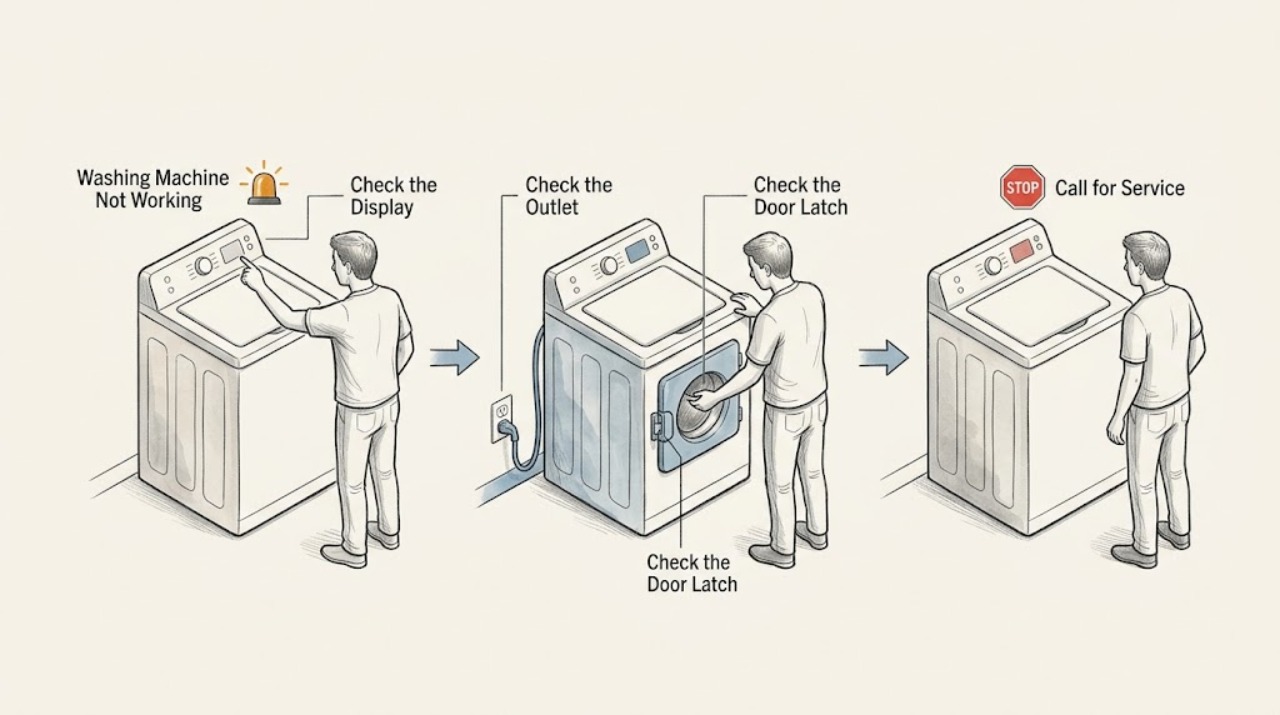
Work through in order
Diagnostic checks
Use only checks that match the exact appliance or system and its official guide.
-
Check 1
Describe the failure before touching controls: note whether the panel is dark, whether the programme starts, whether water remains in the drum, whether the door is locked, and whether an error message, unusual sound, or odor appeared.
Expected result: A dark panel points toward power or control; a door warning points toward the latch; water remaining points toward drainage; an error or abnormal sound narrows the path to the model manual and service boundary.
Next step: Keep the washer disconnected and follow the power, door, programme, or drain branch that matches the observation. Stop immediately for smoke, burning odor, electrical heat, or water near wiring.
Why this matters
Why: The same phrase can describe several different failures, and the stopping point determines which user-level check is safe and useful.
-
Check 2
Check that the plug is seated in the outlet and test the outlet with another small appliance, while inspecting the washer cord only for visible damage with the washer unplugged.
Expected result: If the test appliance also fails, the outlet, breaker, fuse, or household supply is the likely cause. If the outlet works but the Blomberg washer remains dark, or the cord is cut, scorched, or hot, the issue is appliance-level or unsafe to continue.
Next step: Use an electrician for a continuing outlet or circuit issue. For a damaged cord or a washer that remains dark with power available, leave it unplugged and arrange qualified appliance service; do not remove panels.
Why this matters
Why: A supply problem can make every washer function appear to fail, while a working outlet with a dark washer points beyond the wall supply.
-
Check 3
Confirm that the loading door closes fully and latches without force, with no clothing or debris caught around the seal or latch. Check the control panel for a child-lock or door indicator.
Expected result: A normally latched door allows the programme to start. A door that will not latch, springs open, or continues to show a door warning can block operation even when the outlet and controls are working.
Next step: Remove only a visible obstruction and close the door normally. If the latch is damaged or not recognised, stop and request qualified service; never defeat the interlock.
Why this matters
Why: The door safety lock is an operating condition, not an optional setting, and it should not be bypassed.
-
Check 4
Review the selected programme and controls, confirm the washer is not paused or in a lock mode, and try the model's documented reset only once with the drum and door in a safe state.
Expected result: An unselected, paused, or locked programme can look like a dead washer. If the controls respond but the programme still will not start, or a fault message returns after the reset, the problem is not corrected by settings.
Next step: Record the exact display message and consult the model manual. If the washer remains unresponsive or the message returns, leave it out of service and arrange qualified support rather than repeating resets.
Why this matters
Why: Blomberg's guidance treats programme settings, child lock, reset, and error messages as separate checks; a reset is not a repair for a recurring fault.
-
Check 5
If the washer stopped with water inside or will not advance to spin, unplug it and inspect the visible drain hose for a kink, crushing, twist, blockage, or incorrect connection. Then clean the pump filter only after the water has cooled, using a container and towels for the release.
Expected result: A restricted hose or filter, or debris such as coins, buttons, hairpins, or fibres, can explain a stopped cycle and a no-spin condition. A clear hose and filter move suspicion toward the pump, pressure sensing, or controls.
Next step: Drain the water according to the model manual, refit the filter securely, and check for leaks. Do not reach into a powered pump or dismantle the drain system.
Why this matters
Why: Blomberg notes that drainage problems can prevent the machine from operating and that a machine will not spin if water has not drained completely.
-
Check 6
Check the water supply valves and visible inlet hose for a closed tap, kink, or blockage, then verify that the household drain is not backing up before one controlled restart.
Expected result: A closed or restricted supply can prevent a programme from progressing, while a backed-up household drain can leave water in the washer and stop later stages. If both paths are clear, an internal fault becomes more likely.
Next step: Correct only visible hose routing or a normally accessible tap setting. Use a plumber for a blocked standpipe, and use appliance service if the external paths are clear but the washer still does not work.
Why this matters
Why: The washer's start and cycle logic depends on both water entering and water leaving; a failure in either external path can look like a general no-operation fault.
-
Check 7
After the safe checks are complete, run one short model-appropriate programme with no unnecessary load, watching for normal filling, tumbling, draining, and door behavior.
Expected result: A complete short cycle shows that the original issue was likely a supply, setting, latch, hose, or filter condition. Repeated stopping, abnormal noise, a persistent message, a leak, or no response with a known-good outlet confirms that the problem remains.
Next step: Stop the test for smoke, odor, leakage, abnormal noise, or an electrical trip. Keep the washer unplugged and arrange qualified Blomberg service for a persistent failure.
Why this matters
Why: One controlled test verifies a correction without adding a full load or repeatedly stressing a potentially faulty appliance.
Use your observations
Decision map
Find the observation that best matches what you see, then follow the next safe action.
-
PATH 01Next step
What you see
The outlet is dead or the circuit protection has tripped.
Do this next
Use an electrician for a continuing household supply fault and keep the washer disconnected until power is safe.
-
PATH 02Next step
What you see
The outlet works but the washer is dark or the cord is damaged.
Do this next
Stop using the appliance and arrange qualified appliance service; do not open the cabinet or replace internal wiring.
-
PATH 03Next step
What you see
The door will not latch, a lock indicator remains, or the programme will not start.
Do this next
Remove only visible obstructions, confirm the documented programme and lock setting, and request service if the latch or control remains unrecognised.
-
PATH 04Next step
What you see
The washer stopped with water inside or will not spin.
Do this next
Disconnect power, check the drain hose and pump filter safely, and run one controlled test only after the filter is secure and the water path is clear.
-
PATH 05Next step
What you see
External power, door, controls, water, and drain checks are normal but the washer still stops or does not respond.
Do this next
Keep it unplugged and contact qualified Blomberg service for pump, motor, pressure-sensing, door-lock, wiring, or control diagnosis.
-
PATH 06Next step
What you see
Smoke, a burning odor, a hot or damaged cord, a leak near electrical parts, or repeated electrical trips occurs.
Do this next
Stop immediately, disconnect power only when safe, keep the washer out of service, and arrange qualified electrical or appliance help.
Helpful context
Understand the symptom
Define what stopped working
“Not working” can mean a dark panel, a programme that will not start, a cycle that stopped partway through, a washer that fills but will not drain, or a machine that leaves wet laundry. Note the exact stopping point and any display message. A door can remain locked while water is inside, so do not pull it open by force.
Safety before troubleshooting
Switch the washer off and unplug it before examining the cord, hose, filter, or any moving part. Water may be hot and can escape quickly from a filter opening, so allow it to cool and keep towels and a container ready. Do not bypass the door interlock, remove the cabinet, or work on powered wiring. Stop for smoke, a burning smell, a hot or damaged cord, water near electrical connections, or repeated electrical trips.
Common causes
A loose plug, dead outlet, open door, incorrect programme, child lock, or error state can prevent a cycle from starting. A kinked drain hose or blocked pump filter can stop the washer during a cycle and can also prevent spinning. If the external checks are clear, the remaining causes may include the pump, motor, door lock, pressure sensing, wiring, or control board and should be diagnosed by a qualified technician.
When checks do not resolve it
Need a professional?
Use qualified appliance or electrical service when the safe power, door, control, water, drain, and single-test checks do not restore operation, or whenever a safety warning appears.
Common questions
FAQ
What should I check first when a Blomberg washing machine stops working?
Check the plug and outlet, the door latch, the selected programme and lock state, and the display message. If water remains, inspect the drain hose and pump filter with power disconnected.
Can a blocked drain stop the washer from operating?
Yes. Blomberg identifies a blocked or incorrectly positioned drain hose and a blocked pump filter as causes of operational problems; incomplete drainage can also prevent spin.
Why will the door not open after the washer stops?
The door may remain locked while water is present or while the cycle is still finishing. Do not force it; use the model's drain or spin procedure and seek service if the lock remains after the safe checks.
When should I stop trying to fix a Blomberg washer myself?
Stop for smoke, burning odor, electrical heat or trips, a damaged cord, a leak near electrical parts, a failed door lock, or continued failure after the basic checks. Use qualified service instead of opening the cabinet.
Read the exact guide
Official sources
- Why is my Blomberg washing machine not spinning properly? | BlombergBlomberg · Blomberg washing machines; use the exact model manual for capacity and programme details
- My Blomberg washing machine has stopped working, what should I do? | BlombergBlomberg · Blomberg washing machines; exact controls and programmes vary by model
- Washing Machine / User’s ManualBlomberg · Blomberg LBF0502 washing machine manual; use the corresponding manual for another model
- Why is my washing machine not draining properly? | BlombergBlomberg · Blomberg washing machines; follow model-specific filter and installation instructions
Community feedback
Share a repair observation
Share a plain-text repair observation. Accepted observations are published automatically; this page may take a moment to update.