
On this page
Start here
Quick answer
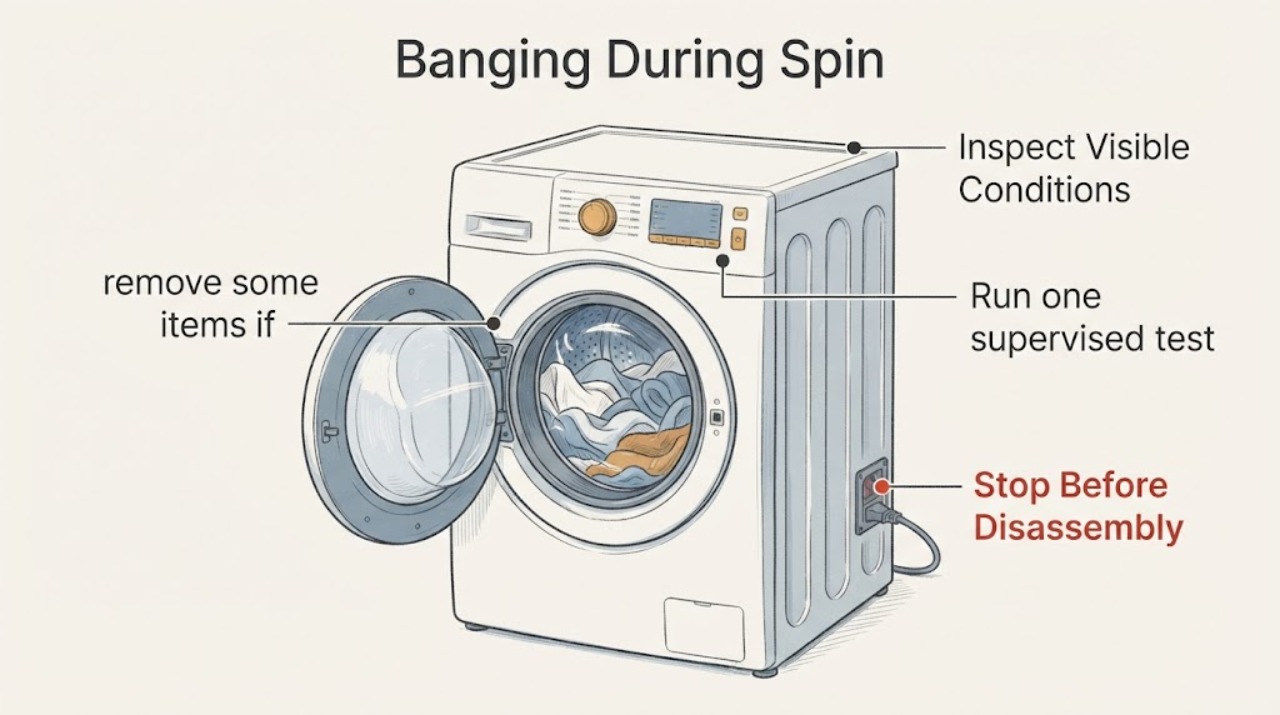
If a Beko WDR7543121W bangs during spin with bed linen and towels, pause the programme safely and first check whether the load has formed one heavy, tangled mass or is packed beyond the programme's capacity. Remove some items, loosen the bedding, and redistribute the towels and sheets before trying a lower or appropriate spin programme. If the washer dryer still bangs with a balanced load, check from outside that it stands firmly and level on the floor. Stop for grinding, a loud high-pitched noise, repeated movement, visible damage, water, or a fault that remains after the load and installation checks; those signs need qualified service.
Work through in order
Diagnostic checks
Use only checks that match the exact appliance or system and its official guide.
-
Check 1
Stop or pause the spin using the normal control and observe the washer dryer from outside. Note whether the banging starts only during acceleration, whether the cabinet moves, and whether the door remains locked or water is visible.
Expected result: The appliance may rebalance and continue, stop with the load at one side, move across the floor, or remain locked with water inside.
Next step: Wait for the normal unlock condition and use the model instructions if water must be managed. Do not force the door or reach into the drum while it is moving.
Why this matters
Why: A noise that tracks acceleration and a visibly one-sided load keeps load balance open. Movement, a locked door with water, or a leak changes the safe sequence and makes forcing access unsafe.
-
Check 2
If the door unlocks normally, remove some items if the load is packed, loosen any sheet-and-towel bundle, and reload the remaining laundry loosely. Keep the selected programme's stated capacity in view.
Expected result: The sheets may be wrapped around towels, the load may be tightly packed, or the items may sit evenly after redistribution.
Next step: Redistribute or reduce the load and use a suitable programme. Do not add random weight to a tightly packed drum or exceed the programme capacity.
Why this matters
Why: A heavy, absorbent or tangled mass can become uneven as it takes up water and may cause noise or movement. The WDR7543121W manual specifically warns that misplaced laundry can cause noise and vibration.
-
Check 3
Run one supervised test with the redistributed load at a suitable spin setting, watching the first acceleration and listening for banging, grinding, rattling, or a high-pitched sound.
Expected result: The washer dryer may accelerate smoothly, repeatedly try to rebalance, bang immediately, or produce a different mechanical noise.
Next step: Stop the test if the cabinet moves severely, the noise is harsh or escalating, or a leak appears. Do not keep increasing the spin speed to force the cycle through.
Why this matters
Why: Smooth operation after redistribution supports a load-balance cause. Repeated banging with a smaller balanced load or grinding/high-pitched noise keeps an installation or mechanical fault open.
-
Check 4
If the load test does not resolve the problem, check from outside that the washer dryer stands firmly on all feet on a firm, level floor and does not rock. Follow the model manual for any permitted foot adjustment.
Expected result: The appliance may rock, a foot may not appear firmly planted, or the cabinet may be stable and level while the banging persists.
Next step: Correct only an obvious, safe installation issue using the model instructions. If the appliance is integrated, cannot be moved safely, or still bangs when stable, arrange service.
Why this matters
Why: Poor levelling or an unstable floor can amplify spin vibration. A stable installation with persistent banging makes a simple footing issue less likely, but does not identify a particular internal part.
-
Check 5
Prepare a service handoff if banging remains. Record the programme, load type and amount, whether sheets were wrapped around towels, when the noise begins, whether the cabinet moves, the footing result, and any grinding, leak, damage, or displayed fault.
Expected result: The pattern may show a load-only problem, repeat banging with balanced laundry, severe movement, or a new mechanical or safety symptom.
Next step: Contact Beko support or a qualified appliance technician. Keep the washer dryer out of use when the noise is severe, persistent, damaging, or accompanied by a leak or other hazard.
Why this matters
Why: These observations help a technician distinguish load distribution and installation conditions from a fault needing internal inspection. They do not prove a bearing, pulley, suspension, or other part.
Use your observations
Decision map
Find the observation that best matches what you see, then follow the next safe action.
-
PATH 01Next step
What you see
The banging happens only with the bed-linen-and-towel load, the sheets are tangled or heavy on one side, and the washer dryer runs smoothly after reducing and redistributing the load.
Do this next
Load bedding loosely, keep within the programme capacity, and use a suitable cycle. Stop if the noise returns or the appliance moves abnormally.
Why this path and its safety boundary
Why it matters: The result supports an unbalanced or overloaded load as the immediate cause. It does not prove that the appliance will tolerate the same arrangement in a larger load.
-
PATH 02Next step
What you see
The washer dryer bangs or rocks with a smaller balanced load, or it is not firmly level on the floor.
Do this next
Follow the model instructions for a safe footing check or adjustment. If it cannot be corrected safely, arrange qualified service.
Why this path and its safety boundary
Why it matters: An installation or stability problem is more likely than a one-off sheet-and-towel imbalance, although the exact mechanical cause remains unconfirmed.
-
PATH 03Next step
What you see
The noise is grinding, high-pitched, rapidly worsening, or accompanied by a leak, cabinet or seal damage, severe movement, smoke, or an electrical warning.
Do this next
Stop the programme and appliance, isolate power only if safe, keep clear of moving or damaged parts, and arrange qualified appliance service. Do not remove panels or continue spin tests.
Why this path and its safety boundary
Why it matters: These signs exceed a normal load-distribution check and may indicate a mechanical, water, or electrical safety problem.
-
PATH 04Next step
What you see
The load is redistributed and the machine is stable, but the same banging returns on the next supervised programme.
Do this next
Stop using the washer dryer and provide the recorded programme, load, sound, movement, and footing observations to Beko support or a qualified technician.
Why this path and its safety boundary
Why it matters: A repeated fault is less consistent with a single tangled load. The external checks have not established which internal component or installation condition is responsible.
Helpful context
Understand the symptom
Why this mixed load can bang
Bed linen can wrap around towels and gather into a dense, wet bundle as the drum accelerates. The resulting load may sit heavily on one side, so the washer dryer may slow or redistribute it and the cabinet may knock or move. Beko also warns that overloading or misplaced laundry can create noise and vibration. Treat the load pattern as the first check rather than assuming that a suspension or bearing part has failed.
Pause and make the load easier to balance
Use the normal pause or cancel control and wait for the door-lock condition to clear; never force the loading door while the drum is moving or water remains. If the door opens safely, take out some of the heaviest or most tightly wrapped items, shake out the sheets, and put the remaining laundry back loosely. Do not exceed the capacity stated for the selected programme. A single towel or a tightly packed bedding bundle can be unbalanced even when the total item count looks small.
Run one supervised test
After redistributing the load, choose a suitable programme or spin setting for the remaining fabric and stay nearby for the first acceleration. A smooth ramp-up and a stable cabinet support a load-distribution explanation. If the drum repeatedly stops to rebalance, bangs as soon as it accelerates, or the noise returns with a smaller balanced load, stop the test instead of adding more speed.
Check the machine's footing from outside
If banging continues with a reasonable load, check that the washer dryer is standing firmly on all feet and that the floor is firm and level. Look for rocking or a gap under a foot without pulling an integrated appliance out unsafely. Follow the WDR7543121W manual for any foot adjustment. Do not open panels or reach into the moving drum.
Separate normal spin noise from a service fault
Some motor and water sounds are normal, but overwhelming banging, grinding, a high-pitched noise, repeated clunks, or severe movement after the load and footing checks should be treated as a service issue. Keep the washer dryer out of use if it leaks, damages the cabinet or door seal, moves across the floor, or shows an electrical or other fault indication.
When checks do not resolve it
Need a professional?
Arrange qualified service if the Beko WDR7543121W continues banging with a reduced, balanced load and a stable footing, or if the noise is grinding, high-pitched, severe, or damaging. Stop immediately for a leak, smoke, sparking, an electrical warning, a hot smell, severe movement, or any need to open panels or inspect moving parts.
Common questions
FAQ
Why does my Beko WDR7543121W bang with bed linen and towels?
Sheets can wrap around absorbent towels and form a heavy, uneven bundle during spin. Pause safely, loosen and reduce the load, then reload it loosely within the programme capacity. Persistent banging with a balanced load needs a footing and service check.
Should I add more laundry to stop the banging?
Do not add items to an already packed drum. First reduce and redistribute the load. Beko advises avoiding overloads and single highly absorbent items; follow the selected programme's capacity and the model manual.
When is banging during spin a repair problem?
Arrange service when the machine bangs with a smaller balanced load, rocks on a firm level floor, or makes grinding or high-pitched noise. Stop immediately for leaks, severe movement, damage, smoke, or electrical warnings.
Read the exact guide
Official sources
- My Beko washer dryer is very vibrating whilst spinning.Beko UK · Official Beko washer dryer guidance used for the level and floor-stability branch.
- How to fix a noisy washing machineBeko UK · Official Beko noise guidance used for load, level, drum, and professional-help decisions; it does not establish a failed part for this model.
- How to load your washing machine correctly for best resultsBeko UK · Official Beko loading guidance used for absorbent items, loose loading, pockets, and overload-related noise and imbalance.
- Why is my washing machine not spinning properly?Beko UK · Official Beko guidance on uneven loads, heavy towels, door conditions, drainage, and spin behavior; used here for the load-related spin branch.
- User's ManualBeko · Exact official manual for the assigned WDR7543121W model family, used for model-specific loading, noise and vibration cautions, and operating safety.
Community feedback
Share a repair observation
Share a plain-text repair observation. Accepted observations are published automatically; this page may take a moment to update.