
On this page
Start here
Quick answer
For a Beko WDR8540141G that leaves laundry damp, first decide whether the machine stopped at its selected sensor dryness level or whether the drying stage never produced a normal result. This model is rated for 8 kg washing but 5 kg drying, and Beko says its sensor programmes stop when the selected moisture level is reached. For frequent small loads, use a programme whose load and fabric match the items: the manual lists Anti Allergy Wash & Dry for up to 2 kg, Wash & Wear for very small quick-drying loads, and larger cotton drying only within its stated limit. Keep the water tap open during drying because this condenser washer-dryer uses water in the drying step. If a correctly sized, label-compatible load remains cold or damp after these checks, stop repeating cycles and arrange service.
Work through in order
Diagnostic checks
Use only checks that match the exact appliance or system and its official guide.
-
Check 1
Run one supervised test with a small, label-compatible load and record whether the cycle completes at the selected dryness level, whether the load is warm or cold, and whether the drum rotates normally.
Expected result: The load is warm and the programme completes but remains slightly damp; the load is cold; the programme ends unusually early; or the drum does not rotate.
Next step: If the load is warm and the cycle completed, continue to the timed-drying and programme-selection check. If it is cold, will not rotate, or repeatedly stops, stop user diagnosis after the safe external checks and arrange service.
Stop if: Stop for smoke, burning smell, damaged cable, repeated breaker trips, leaking water near electrics, a dangerously hot door or drum, or any need to open panels.
Why this matters
Why: Warm, completed laundry points first to a dryness target, fabric mix, load amount, or residual spin issue. Cold laundry, absent rotation, or an interrupted programme keeps a water-supply, motor, heater, sensor, or control fault in consideration.
-
Check 2
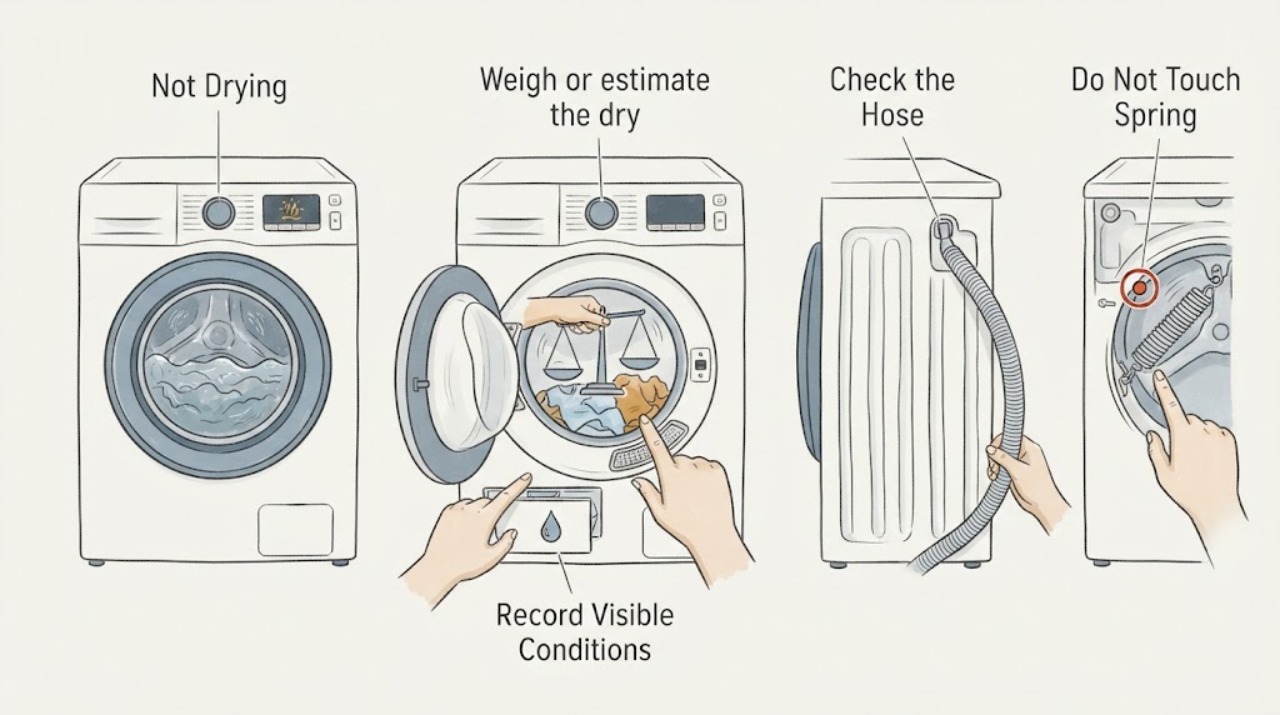
Weigh or estimate the dry load and compare it with the WDR8540141G drying limit and programme type. Split a wash load above the drying limit; for frequent baby-clothing loads, check whether the manual's Anti Allergy Wash & Dry route and its small-load limit fit the labelled fabrics.
Expected result: The load exceeds the drying limit, is within the limit but contains mixed or thick fabrics, or is a small compatible load.
Next step: Run one reduced load on the matching model programme. Use the exact care label and manual for baby items; do not add extra heat or exceed a programme limit to shorten the laundry queue.
Stop if: Do not dry garments that the care label or manual excludes, and do not keep repeating overloaded cycles after a failed reduced-load test.
Why this matters
Why: The model has a lower drying capacity than washing capacity, and Beko says mixed fabrics, amount, and wetness affect sensor dryness. A smaller compatible load is a meaningful test; an overloaded or thick mixed load can remain damp without proving a failed heater.
-
Check 3
Confirm that the cold-water tap supplying the washer-dryer is fully open and that the visible inlet and drain hoses are not kinked. Do this from ordinary access and follow the manual for any filter check; do not disconnect hidden plumbing.
Expected result: The tap was closed or partly closed, a visible hose is kinked, water is unavailable, or the supply and hoses appear normal.
Next step: Correct only a visible tap or hose issue, then run one supervised compatible test. If drying still fails or water leaks, turn off the tap when safe and arrange service.
Stop if: Stop for a leak, water near electrical parts, a damaged hose, or any need to pull out the machine or access internal plumbing.
Why this matters
Why: Beko documents that this drying system uses water during drying, so a water interruption can prevent drying even when the drum turns. A normal supply with a cold, failed drying stage points to a different fault path.
-
Check 4
If the reduced load is warm and the sensor programme completes before the desired result, use the exact manual's permitted timed-drying option for the fabric and load rather than repeatedly selecting a longer sensor target.
Expected result: The load is nearly dry but below the desired level, the load is two or fewer small items, or the load is cold or excessively wet.
Next step: Use the manual's timed-drying selection and monitor one cycle within the care-label limits. If the load remains cold or the same fault returns, stop and arrange service.
Stop if: Do not use timed drying to override a safety symptom, dry prohibited fabrics, or keep cycling an appliance that overheats or trips power.
Why this matters
Why: Beko says timed drying can finish a load that has not reached the desired dryness and that sensor results vary with material and amount. Timed drying does not correct a cold, non-rotating, blocked, or unsafe machine.
-
Check 5
After the reduced-load and supply checks, inspect only the user-accessible filter or lint areas that the exact manual identifies, with the appliance switched off and unplugged. Record any lint, foreign object, or standing water before refitting the cover securely.
Expected result: The accessible area is blocked, the filter is clear, standing water remains, or the cover cannot be refitted securely.
Next step: Clean and refit only as the manual permits, then run one supervised spin or drying test. If water remains, the cover leaks, or drying still fails, arrange authorised Beko service.
Stop if: Do not reach into the pump, remove panels, handle wiring, or clean a hot filter; the manual warns that internal water can be hot.
Why this matters
Why: A restriction can leave laundry wet or interrupt the cycle, but a clear accessible area does not identify a heater, condenser, pump, sensor, motor, or control failure.
Use your observations
Decision map
Find the observation that best matches what you see, then follow the next safe action.
-
PATH 01Next step
What you see
A small, label-compatible load is warm and the sensor programme completes, but the selected dryness level is not reached.
Do this next
Use the exact manual's permitted timed-drying option for the load, then compare one result. Keep baby items within their care labels and the programme's limit.
Why this path and its safety boundary
Why it matters: A programme target, fabric mix, load amount, or residual moisture condition is more likely than an immediate no-heat failure.
-
PATH 02Next step
What you see
A wash load is near the 8 kg wash capacity, the drying load exceeds 5 kg, or a mixed/thick load is being dried together.
Do this next
Split the load and choose the programme matching the fabric; for the frequent small-load context, use the manual's small Anti Allergy Wash & Dry or Wash & Wear limits where the labels permit.
Why this path and its safety boundary
Why it matters: The load is outside the model's drying capacity or is a poor match for a sensor programme, so damp laundry does not by itself establish a failed component.
-
PATH 03Next step
What you see
The tap is closed, water is unavailable, a visible hose is kinked, or the machine stops during drying with no water available.
Do this next
Restore only a safe visible tap or hose condition and run one supervised test. If the supply is normal or the fault returns, arrange service.
Why this path and its safety boundary
Why it matters: Because this condenser drying system uses water during drying, a supply interruption is a plausible external cause.
-
PATH 04Next step
What you see
A correctly sized compatible load remains cold, the drum does not rotate, the programme repeatedly stops, or the fault persists after the permitted filter and supply checks.
Do this next
Stop using the drying function and contact Beko or a qualified washer-dryer technician with the model code, programme, load, water state, and observed result.
Why this path and its safety boundary
Why it matters: An internal heater, sensor, motor, pump, condenser, or control fault is possible, and external observations cannot select the failed part safely.
-
PATH 05Next step
What you see
There is smoke, a burning smell, a damaged cable, repeated breaker trips, water near electrics, uncontrolled heat, or a door that is dangerously hot or will not open normally.
Do this next
Stop the appliance, isolate power only when safe, close the water tap for a leak, and arrange professional service. Do not restart to test.
Why this path and its safety boundary
Why it matters: This is a safety event rather than a drying-performance adjustment.
Helpful context
Understand the symptom
Start with the result, not the heater
A load that is warm but still slightly damp is a different observation from a load that stays cold, the drum does not rotate, or the programme ends early. This Beko model uses sensor drying, so the machine can stop when its selected dryness level is reached; the result also changes with fabric mix, amount, and how wet the load was after spinning. Record the selected programme, load type, whether the load feels warm or cold after the safe cool-down, and whether the cycle completed normally.
Plan frequent loads around the drying limit
The WDR8540141G can wash 8 kg but dry 5 kg. A full wash load may therefore need to be split before drying. The manual lists an Anti Allergy Wash & Dry programme for up to 2 kg, including cotton items such as baby clothes, sheets, and underwear, and a small Wash & Wear route for thin, quickly drying everyday clothes. Follow garment labels and the exact programme limit; the programme name is not a guarantee that every fabric is suitable or that a load is medically sterile.
When checks do not resolve it
Need a professional?
Stop using the appliance and seek Beko or qualified service for repeated failure after a correctly sized test, cold or non-rotating drying, standing water that remains after permitted checks, leaks near electrics, smoke, burning smell, damaged wiring, repeated breaker trips, uncontrolled heat, or a door that cannot be opened normally.
Common questions
FAQ
Why does the WDR8540141G wash a full load but not dry it?
The model's wash capacity is 8 kg while its drying capacity is 5 kg. Split the wash load before drying and match the programme to the fabric. An overloaded or mixed load can remain damp without proving a heater failure.
Which setting is intended for frequent baby-clothing loads?
The manual lists Anti Allergy Wash & Dry for up to 2 kg, including cotton items such as baby clothes, sheets, and underwear. Follow each garment's care label and the manual; this programme description is not a guarantee of medical sterilisation.
Can I use timed drying when the sensor programme ends with damp clothes?
Beko's drying guidance says timed drying can finish a load that has not reached the desired dryness. Use it only for label-compatible items and within the manual's load limits; it is not a remedy for cold drying, no drum rotation, water loss, or a safety fault.
Does the water tap need to stay open during drying?
Yes. The WDR8540141G manual says the machine uses water during drying, so the tap supplying the washer-dryer should be open. If the tap is open and drying still fails, arrange service after the other safe checks.
Read the exact guide
Official sources
- Drying StepsBeko · Opened official Beko drying guidance used for the distinction between a sensor programme's selected dryness level and a remaining damp load; the exact WDR8540141G manual controls model-specific limits.
- My clothes are not drying in the tumble dryer.Beko UK · Opened official Beko not-drying support page used only for general escalation and external obstruction checks; it is not used to claim that this washer-dryer has a tumble-dryer condenser layout.
- Washer Dryer with 8kg / 5kg Capacity WDR8540141Beko UK · Opened official Beko product page for WDR8540141 and model code WDR8540141G; it lists sensor drying and the separate washing and drying capacities.
- User's ManualBeko UK · Opened Beko's official manual PDF; its technical table explicitly includes model name WDR8540141G and the drying instructions are used with the exact model code and regional care-label limits.
Community feedback
Share a repair observation
Share a plain-text repair observation. Accepted observations are published automatically; this page may take a moment to update.