
On this page
Start here
Quick answer
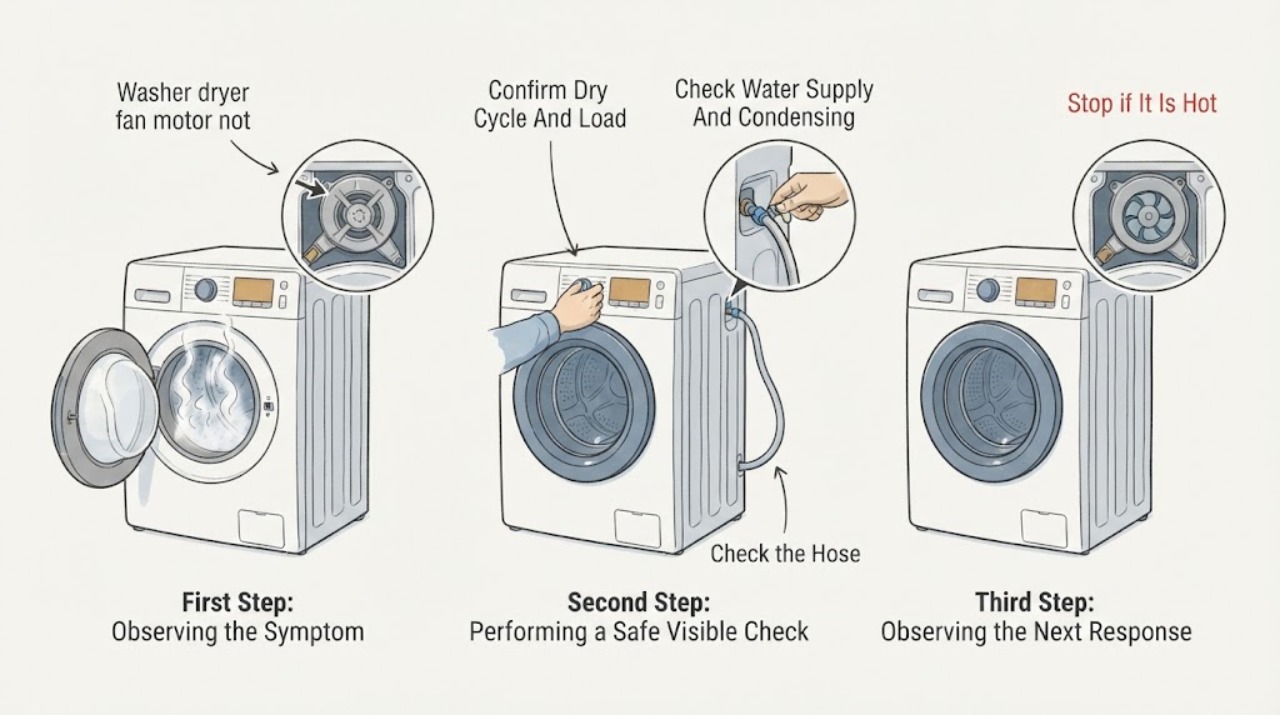
Damp clothes do not prove that the washer-dryer fan motor has failed. In a combo appliance, drying depends on heat circulation, the drain path, and—on many condensing designs—water or air movement through the drying system. First confirm that the selected cycle is actually drying, the load is below the model's drying limit, the water supply required by the model is open, and the drain hose is not kinked, trapped in a U-shape, or holding water. Check the lint filter, heat exchanger, or other user-accessible airflow parts only when the exact manual says they are accessible. If the display shows a fan-related error such as dHE, the fan makes a grinding or repeated-start noise, there is no expected air movement, drying stops with heat, or the unit remains damp after the hose and user checks are correct, stop using the appliance and arrange qualified service. Do not open the cabinet, reach near a hot heater or fan, bypass a thermal device, or test the motor with live power.
Work through in order
Diagnostic checks
Use only checks that match the exact appliance or system and its official guide.
-
Check 1
Read the selected program and display, confirm that a drying phase is selected rather than wash, spin, air-only, or a low-dry setting, and compare the load with the exact model's drying-capacity marking; do not add more laundry to test it.
Expected result: Record a true dry cycle with a small freely tumbling load, a wash-only or spin-only selection, an overloaded drum, folded thick items, or an error/early stop.
Next step: Use the exact cycle and load guidance for one controlled test only. If the load remains damp or an error returns, stop repeated testing and arrange service.
Stop if: Do not run another cycle if there is smoke, burning odor, a hot enclosure, grinding, scraping, water leakage, or a repeated fault.
Why this matters
Why: A wrong cycle, overfilled drum, or dense load can leave clothes damp without a fan fault. A correct small load that stops with a fan-related code or no drying response shifts attention toward the drying system and requires the model-specific branch.
-
Check 2
Without opening the appliance, confirm that the required water supply valve is open and that the inlet hoses are not visibly kinked; follow the model manual for whether the combo uses water during drying and whether hot/cold connections must be identified.
Expected result: Record an open supply with correct visible hose routing, a closed valve, a kinked hose, swapped or uncertain connections, low-flow symptoms, or a model that does not use water during drying.
Next step: Restore only an obvious, model-documented valve position without forcing it. If supply is correct and drying still fails, continue with the drain-hose and airflow checks rather than opening the cabinet.
Stop if: Do not disconnect inlet hoses, remove screens, change hose connections, or continue if a valve, hose, or fitting leaks or will not turn normally.
Why this matters
Why: Many condensing combos need water to remove moisture, so a closed or restricted supply can look like a fan or heater failure. The requirement varies by design; an uncertain connection should not be changed by guesswork.
-
Check 3
With the appliance off and stable, inspect the visible drain hose for kinks, crushing, a U-shaped water pocket, an obstruction, or a route that differs from the model installation guide; do not pull the combo unit or disconnect the hose.
Expected result: Record a smooth supported route, water visibly held in a low loop, a pinched or blocked hose, a hose routed too high, or an inaccessible connection.
Next step: Correct only a clearly accessible external route according to the exact manual, keeping its required gap/support. Run no more than one approved test; if drying remains poor or the hose is damaged, request service.
Stop if: Do not form a sharp bend, seal the hose airtight, remove clamps, tip or drag the unit, or continue if the hose is split, wetting the floor, or under tension.
Why this matters
Why: Water trapped in the hose can reduce drainage and, on applicable designs, prevent humid air from being expelled during drying. A clear route makes a fan, pump, internal hose, control, or another drying-system fault more likely but does not prove the motor.
-
Check 4
Only if the exact manual identifies a user-accessible lint filter, heat exchanger, condenser, or drying-air screen, switch the appliance off and allow it to cool before inspecting and cleaning that part as directed; do not remove a fan cover or heater panel.
Expected result: Record a clear accessible filter/heat exchanger, lint or residue blocking the documented part, an inaccessible or unlisted component, or a clean path with damp clothes still recurring.
Next step: Reinstall only the part the manual says to clean and perform one model-approved dry test. If the fault persists, leave the unit off and arrange qualified appliance service.
Stop if: Do not reach into the drum duct, remove a fixed panel, bend fins, scrape a heater, bypass a thermal protector, or clean while hot or energized.
Why this matters
Why: A blocked user-maintenance part can restrict air movement and extend drying. If the model has no such access, or the path is clean but a fan code/noise persists, the fault is beyond routine maintenance and may involve the fan motor, control, sensor, heater, or airflow assembly.
-
Check 5
From outside the closed appliance during one normal dry attempt, note the display code, whether the drum tumbles, whether the unit starts and stops, and whether there is a new hum, grinding, scraping, repeated clicking, or unusual lack of airflow; do not place hands near vents or moving parts.
Expected result: Record normal tumbling with damp results, a fan-related code, a fan that hums or stops, grinding/scraping, no start, or a hot/odorous enclosure.
Next step: Record the code and timing, then arrange service for a recurring fan symptom. Use the manufacturer-directed restart only when the manual permits it and there are no hazard signs.
Stop if: Stop immediately for smoke, burning odor, hot panels, arcing, grinding that worsens, water leakage, a breaker trip, or a drum/fan that appears to bind.
Why this matters
Why: A normal tumble with damp laundry can still be a load, water, drain, or condensing-path issue. A recurring fan-related code or abnormal fan sound makes a fan motor, control, obstruction, or electrical fault more likely. Heat, odor, or harsh noise is a stop condition, not a reason to listen longer.
-
Check 6
Prepare a service request with the exact washer-dryer model, cycle and load, water-supply status, drain-hose route, accessible filter/heat-exchanger result, display code, sound timing, and any heat, odor, leak, or power symptom.
Expected result: Confirm that the record contains external observations and only model-documented user maintenance, with no cabinet, fan, heater, wiring, pump, or sealed duct disturbed.
Next step: Leave the appliance off when the error repeats or hazards are present and arrange qualified appliance diagnosis. Tell the technician that the assigned concern is a fan-motor-related drying failure, not a confirmed motor replacement.
Stop if: Stop all homeowner work when diagnosis requires opening panels, testing voltage, accessing the fan/heater, removing a sealed duct, or tipping the combo unit.
Why this matters
Why: The handoff helps the technician distinguish a hose/condensing-path problem from a fan motor, pump, heater, sensor, control, or airflow fault and avoids ordering a motor based only on damp clothing.
Use your observations
Decision map
Find the observation that best matches what you see, then follow the next safe action.
-
PATH 01Next step
What you see
The appliance completes a wash or spin but no true dry phase was selected, the load exceeds the model's dry capacity, or thick items are tightly folded.
Do this next
Use a model-approved dry cycle with a smaller, freely tumbling load once. If damp results persist, continue only with the water and drain checks.
-
PATH 02Next step
What you see
The model uses water for condensing, but the supply valve is closed, an inlet hose is restricted, or the water connection is uncertain; drying is poor without a fan code.
Do this next
Restore only an obvious model-documented valve position. Request service if the supply is correct, a fitting leaks, or the model's connections cannot be verified safely.
-
PATH 03Next step
What you see
Water remains in a low U-shaped hose section, the hose is kinked or crushed, or the route prevents smooth drainage during drying.
Do this next
Correct the visible route only according to the model guide and perform one approved test. If the hose is damaged or drying remains poor, arrange appliance service.
-
PATH 04Next step
What you see
A documented user-accessible filter, heat exchanger, condenser, or screen is visibly blocked and the appliance has no heat, smoke, leak, or fan hazard.
Do this next
Clean and reseat only as the manual directs, then run one controlled test. Escalate if damp results, a code, or unusual noise returns.
-
PATH 05Next step
What you see
A fan-related error returns after the permitted restart, or the unit hums, grinds, scrapes, repeatedly starts/stops, or fails to circulate air during drying.
Do this next
Stop using the drying function and arrange qualified appliance service. Do not open the cabinet, bypass protection, or order a motor from the code alone.
-
PATH 06Next step
What you see
There is smoke, burning odor, a hot enclosure, arcing, a breaker trip, active water leakage, a damaged hose, or water near electrical parts.
Do this next
Stop the appliance, keep clear, and arrange qualified appliance/electrical service; use emergency help for smoke, fire, shock, or immediate flooding.
Helpful context
Understand the symptom
A drying symptom is not a fan diagnosis
The fan circulates air in the drying system, but clothes can remain damp when the load is too large, the selected program is not a full dry, water cannot drain, or the combo's condensing path is not operating as designed. Whirlpool explains that a ventless combo loops heated air through a water-cooled condenser and sends the resulting water through the same drain hose used by washing. LG similarly says water left in the drain hose can interfere with drying. Check those conditions before calling the fan motor bad.
The drain hose can affect both washing and drying
A hose that is kinked, trapped high, or holding a pocket of water can restrict drainage and, on some water-free drying designs, prevent humid air from leaving effectively. LG recommends a smooth hose route that lies flat and avoids a U-trap for the applicable system. Whirlpool likewise says incorrect hose installation can cause drainage problems. Use the exact model instructions: one combo's ventless routing may not match a separate vented dryer or another combo.
A fan-related code or harsh fan noise crosses the service boundary
LG's dHE guidance ties the code to the drying fan motor but also allows for a temporary power fluctuation or system glitch; its safe response is a single manufacturer-directed restart and a service request if the code returns. The fan, heater, and nearby parts may be hot or electrically hazardous after use. Do not remove panels to see whether the fan is turning or substitute a motor before the technician confirms the model, wiring, airflow path, and control fault.
Safety boundary
Stop conditions
- Do not open the cabinet, remove a fan/heater panel, test live voltage, bypass a thermal protector, reach into moving parts, or tip/drag the washer-dryer as a homeowner.
- Do not run repeated dry cycles to reproduce a fan error, use chemical cleaners in the drain path, force valves or hoses, or order a fan motor solely because clothes are damp.
- Stop immediately for smoke, burning odor, hot enclosure, arcing, grinding or binding, active water leakage, a split hose, a breaker trip, shock, or water near electrical parts; keep the appliance off and arrange qualified help.
Only after diagnosis
Potential parts
- washer-dryer fan motor
Consider this only after qualified service confirms that the drying fan motor or its electrical circuit is faulty; damp clothes, a blocked hose, or a single transient code is not enough.
Confirm the exact model, fan assembly, connector, mounting, voltage requirements, and manufacturer-approved fit before selection or installation. - drying airflow filter or heat-exchanger component
Consider this only when the exact model includes the component, it is damaged or cannot be restored by the documented cleaning procedure, and qualified diagnosis confirms it is restricting drying.
Verify the exact model, airflow design, access procedure, and manufacturer-approved component before replacement. - drain hose or internal drain-path component
Consider this only when inspection confirms a damaged external hose or qualified diagnosis finds an internal restriction that affects drying drainage or humid-air discharge.
Confirm the exact model, hose routing, connections, support, and manufacturer installation requirements before selecting a part.
When checks do not resolve it
Need a professional?
Arrange qualified appliance service when a fan-related code returns after the model-directed restart, the fan makes a grinding/humming/repeated-start noise, a correct small load remains damp after the water and drain path checks, an accessible airflow part is clean but drying still fails, or diagnosis requires opening the cabinet, accessing the heater/fan, testing voltage, or removing sealed ducts. Stop immediately for smoke, burning odor, hot panels, arcing, water leakage, a damaged hose, a breaker trip, or water near electrical parts.
Have this ready
- Provide the exact model, cycle and load, water-supply status, drain-hose route, user-accessible filter result, display code, timing and character of sounds, drying response, and any leak, heat, smoke, odor, or breaker symptom.
Common questions
FAQ
Does damp clothing prove the washer-dryer fan motor failed?
No. A large load, wrong dry cycle, closed water supply on a condensing model, trapped water in the drain hose, blocked user-maintenance filter, or another drying-system fault can leave clothes damp. A fan motor needs qualified diagnosis, especially when there is no fan code or abnormal sound.
Can a drain hose cause poor drying in a washer-dryer combo?
Yes. On applicable combo designs, water remaining in the hose can restrict drainage or humid-air discharge. Check only the visible route against the exact manual; do not drag the unit or disconnect a water-filled hose.
What does a fan-related drying error mean?
A fan-related code can indicate a fan-motor, electrical, obstruction, control, or temporary detection issue, depending on the model. Follow the exact manufacturer's restart instruction once if permitted; if the code returns, stop using the appliance and request service.
Can I clean the fan motor or open the washer-dryer cabinet?
No. The fan, heater, and surrounding components may be hot or electrically hazardous. Clean only a filter, heat exchanger, or screen that the exact manual identifies as user-accessible, with the appliance off and cool.
When should I call for washer-dryer service?
Call when a fan-related error returns, the fan hums/grinds/stops, a correct small load remains damp after the hose and water checks, or any diagnosis requires opening panels, accessing the fan or heater, testing voltage, or removing a sealed duct. Stop immediately for smoke, odor, heat, arcing, leakage, or a breaker trip.
Read the exact guide
Official sources
- Samsung Bespoke AI Combo is not drying clothesSamsung Support · Samsung combo guidance used only to support the conditional user-accessible filter/heat-exchanger check; exact model instructions govern whether those parts exist and how to access them.
- Dryer Not Drying or Long Dry Times- All-In-One Washer DryerWhirlpool Product Help · Whirlpool all-in-one guidance used for general combo-drying mechanism and performance checks; exact model settings and installation requirements govern.
- Why the dHE error code appears during a dry cycle on your LG washer dryer combo, and how to fix itLG U.A.E. Support · LG washer-dryer-combo guidance used for general fan-motor symptom reasoning; exact model codes and procedures vary.
- Not Draining - All-In-One Washer DryerWhirlpool Product Help · Whirlpool all-in-one drain guidance used for general hose and filter reasoning; exact combo model instructions govern access and dimensions.
- LG Washer Dryer Combo - Troubleshooting Poor Drying PerformanceLG USA Support · LG combo guidance used for general drainage and drying-path checks; exact model installation instructions govern hose geometry and water requirements.
Community feedback
Share a repair observation
Share a plain-text repair observation. Accepted observations are published automatically; this page may take a moment to update.