
On this page
Start here
Quick answer
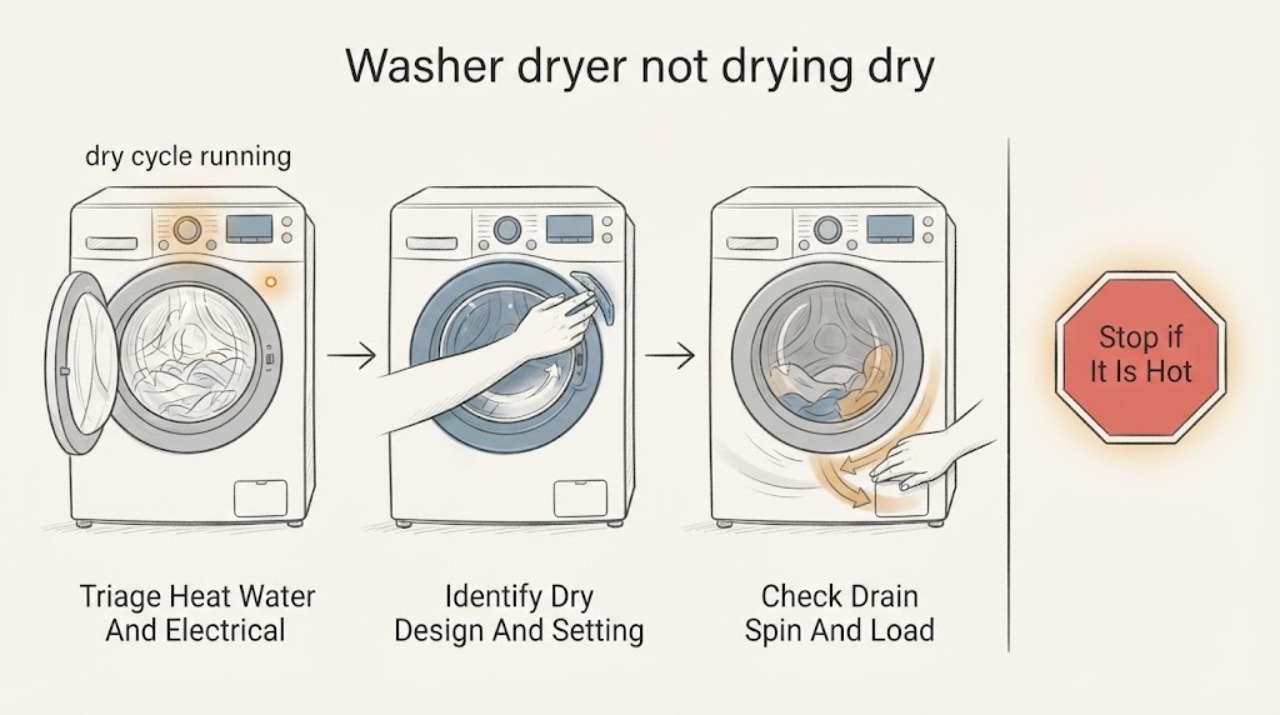
If a washer dryer completes or runs its dry cycle but clothes stay wet, first confirm that the load is draining and spinning, the dry setting and load size match the exact manual, and the appliance has the water supply or airflow that its combo design requires. Some washer-dryer combos use water during drying to condense moisture, so a closed water tap or poor drain path can affect drying. Check the visible drain hose, supply valves, lint or door-seal restrictions, and cycle selections only from a safe position. Stop for smoke, burning odor, unusual heat, water near electrical parts, or a damaged cord, and arrange qualified appliance service when airflow, heating, pump, sensor, or control diagnosis would require opening the cabinet.
Before you begin
Safety first
- Owner checks are limited to safe cycle and load observation, visible supply and drain-hose inspection, and model-approved cleaning of accessible filters, seal holes, condensers, or airflow areas after power is disconnected. A qualified professional must handle cabinet access, heater, fan, pump, sensor, control, wiring, thermal-device, and interlock work.
Work through in order
Diagnostic checks
Use only checks that match the exact appliance or system and its official guide.
-
Check 1
From a safe position, check for smoke, burning odor, sparking, a hot or discolored cabinet, a damaged cord, water near the plug or outlet, or a load that is unusually hot. Do not touch the drum, door glass, water, vent, cord, or cabinet to measure temperature.
Expected result: There is no immediate hazard; or smoke, odor, sparks, abnormal heat, damage, or water near electrical parts is present.
Next step: If smoke, fire, or active sparking is present, leave the area and contact emergency help from a safe location. Otherwise stop the appliance using its normal control if safe, keep clear, disconnect power only if it can be done without approaching water or damage, and arrange qualified service.
Stop if: Stop immediately for smoke, fire, sparks, crackling, burning odor, a hot or melting part, water near energized connections, or any need to touch a hot surface or energized component.
Why this matters
Why: Poor drying can be a load, drainage, airflow, or setting issue, but smoke, overheating, electrical damage, or water near energized parts is an immediate fire, burn, or shock concern.
-
Check 2
Read the exact manual or control display and record whether the appliance is an all-in-one washer dryer, the selected dry mode, temperature or dryness option, estimated time, and any error or water-supply message. Confirm that a dry function—not wash, air-only, cool-down, or an added rinse—is selected.
Expected result: The cycle is air-only or cool-down; a low or damp setting is selected; the dry option is not active; an error or supply message appears; or the intended heated dry mode is selected.
Next step: Use the exact manual to select one appropriate dry mode and load size for a single controlled test only if the appliance is safe. Do not override an error, repeatedly restart an overheating cycle, or assume a similarly named setting has the same behavior on another model.
Stop if: Stop if the display reports overheating, a supply or drain fault, a locked full drum, or a condition that requires opening the cabinet or bypassing a control.
Why this matters
Why: A non-heated, low-temperature, cool-down, or incomplete selection can leave clothes damp without a component failure. An error or missing required supply shifts the diagnosis toward the manual's specific condition; a correct setting makes load, drainage, airflow, or heating checks more useful.
-
Check 3
Before judging the dry system, observe the load after the wash or spin portion: note whether the drum is empty of water, whether clothes are dripping or merely damp, whether the load is tightly packed or balled up, and whether the machine completed a proper spin. Do not open a locked door or reach into a moving drum.
Expected result: Water remains; clothes are dripping wet; the load is dense or unbalanced; spin was skipped or weak; or the load is evenly distributed and only moderately damp.
Next step: If the load is wet or water remains, address the drain and spin branch before running another dry cycle. If it is evenly spun and still will not dry, continue with water-supply, hose, airflow, and model-specific service checks; do not add more heat or extend the cycle blindly.
Stop if: Stop if the door is locked with water inside, the drum is hot, the load is smoking, the machine is shaking severely, or recovery requires forcing the door or reaching into the appliance.
Why this matters
Why: Residual water from poor draining or spin can make a dry cycle appear ineffective even when its heat and airflow are normal. A properly spun, moderately damp load points more toward the combo's water-assisted drying path, airflow, heating, sensor, or control.
-
Check 4
With the appliance off, check that the water supply valves are open when the exact combo manual requires water for drying, the visible drain hose is not kinked or compressed, and the hose is routed as the installation instructions show. Do not disconnect a pressurized hose or move the appliance unsafely.
Expected result: A required supply valve is closed; a hose is kinked, compressed, or holding water; the drain connection backs up; the hose routing differs from the manual; or the visible supply and drain path looks correct.
Next step: Correct only an obvious valve or hose position according to the exact manual and have a plumber inspect a backing-up household drain. If the path is clear and the correct supply is present, do not add fittings or reroute the hose by guesswork; continue to the filter and airflow check.
Stop if: Stop if a hose leaks, the valve or connection is damaged, the household drain overflows, the unit must be pulled out, or correction requires plumbing or electrical disconnection.
Why this matters
Why: Some combo designs use water to condense moisture during drying, and water trapped in a drain hose can interfere with moisture discharge. A backing-up drain or incorrect hose route can also leave the load damp. A clear, correctly supplied path shifts suspicion toward filters, airflow, heating, sensors, or controls.
-
Check 5
If the exact manual provides an accessible pump filter, door-seal drain-hole, lint, condenser, or airflow cleaning procedure, disconnect power and clean only that accessible area as directed. Contain residual water, keep hands away from fans and heaters, and do not remove cabinet panels or internal ducting.
Expected result: Lint or debris blocks an accessible filter, seal hole, condenser, or approved airflow area; residual water is hot or spills unexpectedly; the area is clear; or a cover, filter, or seal will not reseat.
Next step: Clean and reseat the accessible part exactly as the manual shows, then run one model-approved test only if the appliance is safe. If airflow remains poor, the cycle still produces no useful drying, or a fan or heater is suspected, keep the unit off and arrange service.
Stop if: Stop for hot water, uncontrolled water, a damaged filter or seal, an exposed heater or fan, a stuck cover, or any need to remove a panel or reach inside the cabinet.
Why this matters
Why: A blocked filter, seal hole, condenser, or airflow path can restrict moisture removal and increase drying time. Hot water, uncontrolled spills, damaged seals, or a cover that cannot reseat safely requires service rather than further cleaning.
-
Check 6
Record the model and serial information, dry mode and options, load type and size, whether the load was dripping or moderately damp after spin, water-supply state, drain-hose and filter findings, cycle time, error text, and any recent move, cleaning, repair, or installation change. Give the record to qualified appliance service.
Expected result: Drying improves after a setting, load, hose, supply, drain, or accessible-cleaning correction; it remains poor with a properly spun load; the cycle produces no heat or airflow; or the cause remains uncertain.
Next step: Keep the appliance off for persistent, hot, odorous, noisy, or error-producing operation. Have a technician test the drying and drainage systems without guessing at a replacement component or bypassing a safety device.
Stop if: End owner troubleshooting when diagnosis requires energized measurements, cabinet access, heater or fan testing, sensor or control work, pump disassembly, or a replacement part.
Why this matters
Why: An improvement after a safe external correction supports a setup, load, drainage, or airflow cause. Persistent poor drying with correct settings and a properly spun load can involve the heater, fan, condenser, pump, sensor, control, or sealed airflow path and needs model-specific diagnosis.
Use your observations
Decision map
Find the observation that best matches what you see, then follow the next safe action.
-
PATH 01Next step
What you see
The selected function is air-only, low heat, cool-down, a damp setting, or not actually a dry function, and there is no hazard.
Do this next
Use the exact manual to select the intended dry mode and load size, then make one controlled test. If the correct cycle still produces no useful drying, evaluate drainage, airflow, and service branches.
Why this path and its safety boundary
Why it matters: The result is more consistent with cycle selection or normal cool-down than a failed heater or fan.
-
PATH 02Next step
What you see
Clothes are dripping wet or water remains after wash or spin, or the machine did not complete a proper spin.
Do this next
Stop the dry diagnosis and address the drain or spin issue using the model-approved hose and accessible-filter checks. Do not force a locked door or run a long dry cycle with standing water.
Why this path and its safety boundary
Why it matters: A drainage restriction, pump/filter issue, unbalanced or dense load, excessive suds, or a cycle condition is more likely than a dry-heater failure.
-
PATH 03Next step
What you see
The load is properly spun but the model uses water-assisted condensation, the water supply is closed, the drain hose holds water, or the household drain backs up.
Do this next
Restore only an obviously closed required valve or correct hose routing per the exact manual, and have a plumber address household drain backup. If the path is correct, arrange appliance service for the combo's pump, condenser, or control system.
Why this path and its safety boundary
Why it matters: A missing supply or restricted moisture-drain path is more likely; the dry cycle can run without effectively removing moisture.
-
PATH 04Next step
What you see
The load size is within the manual, the drain and supply path are correct, and an accessible filter, seal hole, condenser, or airflow area is visibly blocked.
Do this next
Disconnect power and clean only the model-approved accessible area, then reseat its cover or filter. If drying remains poor or access requires cabinet removal, stop and request service.
Why this path and its safety boundary
Why it matters: A lint or airflow restriction can slow moisture removal and make the cycle run without drying effectively.
-
PATH 05Next step
What you see
The setting, load, spin, supply, drain, and accessible-cleaning checks are correct, but the cycle still produces no useful drying, no airflow, or no heat; or an error recurs.
Do this next
Keep the appliance off if it is hot, odorous, noisy, or repeatedly faulting, and arrange qualified appliance service. Do not remove panels, bypass a thermal device, probe live circuits, or replace a component by symptom alone.
Why this path and its safety boundary
Why it matters: A heater, fan, condenser, pump, sensor, control, wiring, or sealed internal airflow fault is more likely and cannot be safely isolated by external checks.
-
PATH 06Next step
What you see
Smoke, burning odor, sparking, exposed wiring, uncontrolled water, a hot cabinet, a damaged cord, or a locked drum with suspected hot water is present.
Do this next
Stop using the appliance and keep clear. Leave for fire or active arcing and contact emergency help; otherwise disconnect only if safe and arrange prompt qualified service without restarting the cycle.
Why this path and its safety boundary
Why it matters: The immediate priority is fire, electrical, flood, or burn safety, not drying performance.
Helpful context
Understand the symptom
A running dry cycle does not guarantee that moisture is leaving
Washer-dryer combos vary. Some use a water-assisted condensation process during drying, while others use a different airflow and heat arrangement. If water remains in the drum, the load never reaches a proper spin, the water supply is closed on a model that needs it, or the drain hose holds water, the timer can continue while drying performance is poor. Use the model manual to identify the design before assuming that a heater or thermostat has failed.
Check the load and drainage before suspecting a heater
A tightly packed or unbalanced load can retain water after spin, and excessive detergent suds can interfere with rinsing, spinning, and drainage. A blocked pump filter, door-seal drain hole, hose, or household drain can do the same. These are different from a dry cycle that has no heat or airflow, so note the clothes' condition immediately after spin and whether the drum is empty of water.
Keep cabinet and heating work for qualified service
A combo appliance can contain line-voltage heating, fans, pumps, sensors, and control boards in a confined cabinet. Owner checks should be limited to the manual's external settings, visible hoses and filters, and safe cleaning after power is disconnected. Do not remove panels, bypass a thermal device, probe a heater, or test live wiring to make the dry cycle work.
Safety boundary
Stop conditions
- Stop and leave the area for smoke, fire, active sparking, crackling, or a strong burning smell; contact emergency help from a safe location.
- Do not touch the drum, door glass, water, cabinet, vent, cord, or heater to test temperature. Treat an unusually hot cabinet or load as a service and fire-safety concern.
- Do not run a dry cycle with standing water, a locked full drum, a leaking hose, or water near the plug or outlet. Do not force the door or tip and move the appliance.
- Do not remove cabinet panels, probe a heater or live circuit, bypass a thermal device or door interlock, add chemicals to clear a drain, or replace a component based only on a symptom.
- Call qualified appliance service for persistent no-dry performance after safe setting, load, supply, drain, and accessible-cleaning checks, or whenever diagnosis requires internal airflow, heating, pump, sensor, control, or wiring work.
Only after diagnosis
Potential parts
- washer dryer heating element or heater assembly
Consider this only when qualified testing confirms that the selected dry cycle is correct, airflow and drainage are adequate, and the heater is failed or out of specification.
Verify exact model, heater type, electrical rating, mounting, seals, and manufacturer service guidance; do not bypass a thermal safety device or choose a heater by appearance. - washer dryer drying fan or airflow component
Consider this only if a technician confirms that the drying fan or an internal airflow component is not moving air after external restrictions are cleared.
Confirm exact model, fan design, connector, direction, seals, and airflow configuration; internal airflow work should not be attempted with power connected. - washer dryer drain pump or pump filter assembly
Consider this only when a technician confirms that residual water, poor spin, or a drain-path fault is caused by a failed pump or damaged filter assembly after the external path is clear.
Verify exact model, pump design, filter, seal, connector, and drain routing; a pump that looks similar may not be compatible or safe. - washer dryer drying sensor or control component
Consider this only after qualified diagnosis confirms that the appliance has correct load, drainage, airflow, and heat but a sensor or control is ending or regulating drying incorrectly.
Confirm exact model, control revision, sensor type, connector, and manufacturer fit information; do not replace a control to compensate for a blocked drain or airflow path.
When checks do not resolve it
Need a professional?
Call qualified appliance service when a correctly selected dry cycle leaves a properly spun load wet after the external supply, drain, load, and model-approved cleaning checks, or when there is no heat or airflow, a recurring error, a locked full drum, unusual noise, or repeated poor drying. Call a plumber when the household drain backs up. Treat smoke, sparks, burning odor, a hot cabinet, water near electrical parts, and uncontrolled flooding as urgent hazards; do not open panels or bypass safety devices.
Safety scope: Owner checks are limited to safe cycle and load observation, visible supply and drain-hose inspection, and model-approved cleaning of accessible filters, seal holes, condensers, or airflow areas after power is disconnected. A qualified professional must handle cabinet access, heater, fan, pump, sensor, control, wiring, thermal-device, and interlock work.
Common questions
FAQ
Why does my washer dryer run but leave clothes wet?
Common possibilities include a low or non-heated setting, an overpacked or poorly spun load, a drain or water-supply problem, restricted airflow, or a heater, fan, pump, sensor, or control fault. Start with safe cycle, load, drain, and model-approved cleaning checks.
Does a washer dryer combo need water to dry clothes?
Some combo designs use water to condense moisture during drying, while others differ. Check the exact manual; if that model requires water, a closed supply valve can reduce drying performance. Do not assume every model works the same way.
Can poor spinning make the dry cycle ineffective?
Yes. If clothes are dripping wet or water remains after spin, the dry cycle has much more moisture to remove. Investigate draining, filter, hose, load balance, and suds before blaming the heater.
Why does the dry cycle take a long time but not dry?
A dense load, restricted airflow, water-filled drain hose, poor drainage, missing water supply on a condensation design, or a drying-system fault can all extend time. Record the load and water condition and use the model's troubleshooting path.
Can an overfilled washer dryer prevent drying?
Yes. A packed drum limits tumbling and airflow, and manufacturers recommend load sizes that allow clothes to move freely. Use the exact manual's capacity and drying-load guidance; do not keep extending a cycle on an overloaded drum.
What should I check on the drain hose when drying is poor?
Look for a visible kink, compression, incorrect routing, or household-drain backup. Some combo guidance notes that water trapped in the hose can interfere with moisture discharge. Correct routing only as the installation manual shows.
Can a clogged pump filter cause clothes to stay wet after drying?
It can leave water behind or prevent a proper spin, which makes drying appear ineffective. Disconnect power and follow the exact model's residual-water and filter procedure only if water can be contained and is not dangerously hot.
How can I tell whether the heater is bad?
External observation cannot reliably prove a heater fault. First confirm the mode, load, spin, supply, drain, and accessible airflow checks. A technician should test the heater, fan, sensors, control, and safety devices without live owner probing.
Should I keep running the dryer if the clothes are still damp?
Do not keep extending cycles if the cabinet or load is unusually hot, there is an odor, smoke, a water leak, an error, or no airflow. Stop and arrange service; otherwise make only one model-approved controlled test after safe external checks.
When should I call a technician for a washer dryer that will not dry?
Call when a correctly selected cycle leaves a properly spun load wet after hose, supply, drain, load, and accessible-cleaning checks, or when there is no heat or airflow, a recurring error, unusual noise, overheating, or a locked full drum.
Read the exact guide
Official sources
- Whirlpool Janus Combo Use and Care GuideWhirlpool · Official combo manual example supporting power disconnection, contained residual water, filter seating, load and noise checks, and service escalation; exact model manual controls applicability.
- [LG Washer] Dryer Performance TroubleshootingLG USA Support · Manufacturer guidance that combos may use water during drying and that a straight, properly positioned drain hose supports moisture discharge; images and exact details vary by model.
- [LG Washer] Why Isn't My Washer DrainingLG USA Support · Manufacturer warning that residual water can spill and may be hot before pump-filter access; exact access location and procedure vary by model.
- LG Washer - Troubleshooting Washer Does Not Drain or Spin (Clothes Too Wet)LG USA Support · Manufacturer troubleshooting flow for washer and washer dryer combo models; the exact model manual controls test-cycle availability and access.
- Not Draining - All-In-One Washer Dryer - Product HelpWhirlpool Product Help · Manufacturer guidance for an all-in-one washer dryer drain path; installation limits and access steps must be confirmed for the exact appliance.
- Long Dry Time - Washer / Dryer Combo UnitLG USA Support · Manufacturer guidance that combo drying can use cold water for condensation, that taps should be open, and that pump condition and load size affect drying; verify against exact model.
- LG Washer Dryer Combo - Troubleshooting Poor Drying PerformanceLG USA Support · Manufacturer guidance that some recent washer dryer combos use water-free drying with steam discharge through the drain hose, and that accumulated water or a U-shaped hose can impair drying; exact model design controls applicability.
Community feedback
Share a repair observation
Share a plain-text repair observation. Accepted observations are published automatically; this page may take a moment to update.