
On this page
Start here
Quick answer
For a Beko washer-dryer that leaves clothes damp, first confirm the appropriate drying programme and care label, use no more than the model's drying capacity, and make sure the load has been spun. A blockage in the appliance can also affect the result, so inspect the drain-pump filter only as your model manual permits. If the appliance will not start, never heats, stops with a fault, smells hot, trips power, or still fails after these checks, stop using it and arrange authorised service rather than opening the cabinet.
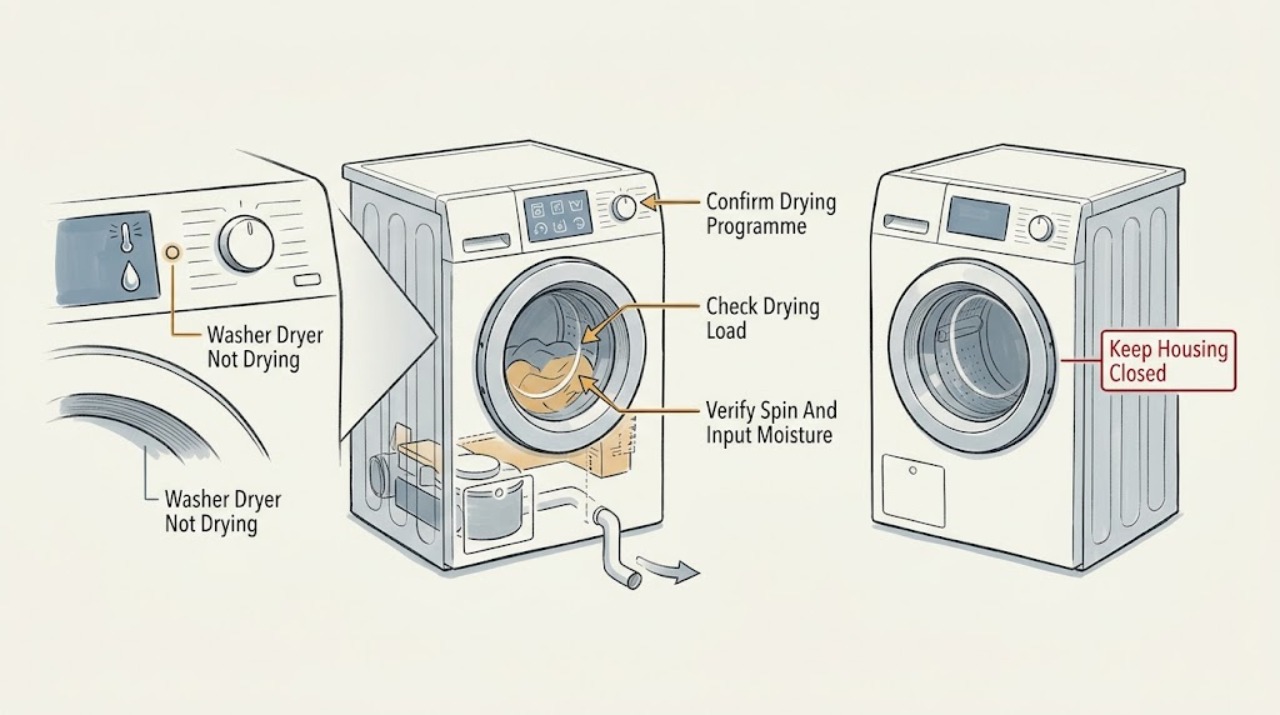
Work through in order
Diagnostic checks
Use only checks that match the exact appliance or system and its official guide.
-
Check 1
With the machine stopped, read the garment care labels and compare them with the drying programme you selected. Confirm that the drying function or a dry-only programme is enabled after the wash programme, using the model manual if the controls are unclear.
Expected result: The selected cycle includes a drying step suitable for the fabric, or the machine has only run a wash or spin step.
Next step: Select a suitable drying programme and retry with a small, compatible load. If a drying step was definitely selected, continue to the load and spin checks.
Stop if: Stop if the controls show a fault, the door or drum is unusually hot, or the cycle cannot start normally; do not force the door or dismantle the control panel.
Why this matters
Why: If no drying step was enabled, the appliance may be operating normally rather than failing to heat. An unsuitable fabric setting can also leave the result unsatisfactory or damage the load.
-
Check 2
Remove some items and untangle the remainder, then compare the amount left in the drum with the drying capacity stated for your exact model. Leave room for the items to move during drying rather than using the larger wash capacity as the limit.
Expected result: The drum was tightly packed, or the remaining load is now smaller and can tumble freely.
Next step: Run the same suitable drying programme with the reduced load. If it dries normally, divide future wash loads before drying; if it remains damp, continue without assuming a failed heater.
Stop if: Stop if the drum will not turn, the machine makes scraping or electrical noises, or the cabinet becomes abnormally hot.
Why this matters
Why: A washer-dryer needs more space during drying than during washing. An overloaded load restricts movement and air circulation, so a smaller load is a meaningful diagnostic change.
-
Check 3
Before the next dry test, feel the load after the wash or spin stage and check whether it is dripping wet. If the garments are very wet, use the highest spin option that the care labels and the model manual allow, then dry a reduced load.
Expected result: The load enters drying merely damp after spinning, or it remains unusually wet because the spin was ineffective or did not run.
Next step: Retry after a permitted spin and compare the result with the same reduced load. If the machine cannot spin or leaves standing water, follow the drain and professional-service branch instead of repeating dry cycles.
Stop if: Stop if water remains in the drum, the machine repeatedly aborts the spin, or the load is hot enough to be unsafe to handle.
Why this matters
Why: Drying begins with the moisture left by washing. Insufficient spinning can make a normal drying system appear ineffective; a failed or interrupted spin points to a separate wash or drain issue.
-
Check 4
If the manual for your exact Beko model provides a user-accessible drain-pump filter, switch the appliance off and unplug it before checking. Place a shallow container and towels below the filter area, open it slowly as the manual describes, and remove only accessible lint or foreign objects; refit the filter securely.
Expected result: The filter contains coins, buttons, lint, or retained water, or it is clean and drains freely.
Next step: If debris was found, run the model-approved drain or spin test and then retry a reduced drying load. If the filter is clean but the machine still will not drain or dry, stop user troubleshooting and arrange service.
Stop if: Stop if the filter will not move, water gushes out, the housing is cracked, the appliance cannot be unplugged safely, or the manual does not authorize this access.
Why this matters
Why: Debris can obstruct the drain path and retained water can explain a wet load or an interrupted cycle. A clean filter does not prove that the heater, pump, sensor, or control system is healthy.
-
Check 5
After the programme, record whether the drum rotated, whether the cycle completed, and whether the load was merely damp or the drying stage never produced warmth. Do not open a hot door to test temperature; use only the display, normal cycle behavior, and safe external observations.
Expected result: A reduced, correctly spun load still stays damp; the drum does not rotate; the drying stage stops; a fault code appears; or there is a burning smell, smoke, repeated breaker trip, or abnormal heat.
Next step: Stop using the appliance, unplug it when safe, preserve the displayed fault code and model details, and contact Beko or an authorised appliance technician for diagnosis.
Stop if: Immediately stop and isolate the appliance for professional help if there is smoke, a burning smell, damaged wiring, a water leak near electrics, or repeated power-tripping.
Why this matters
Why: Persistence after programme, load, spin, and permitted filter checks makes an internal fault more plausible, but these observations cannot identify a heater, sensor, motor, pump, or board safely from outside.
Use your observations
Decision map
Find the observation that best matches what you see, then follow the next safe action.
-
PATH 01Next step
What you see
The cycle ran wash or spin only, or the drying option was not enabled.
Do this next
Select the correct dry function for the fabric and model, then retest with a reduced load.
-
PATH 02Next step
What you see
The load exceeds the exact model's drying capacity or cannot tumble freely.
Do this next
Remove items and dry in smaller batches. A normal result after reducing the load points to loading, not an established component failure.
-
PATH 03Next step
What you see
The load is dripping wet or the spin did not complete normally.
Do this next
Use an allowed spin setting and check draining before another dry test; do not keep repeating drying cycles with standing water.
-
PATH 04Next step
What you see
An exact-model manual permits filter access and debris or retained water is found.
Do this next
Clean and refit the filter according to that manual, then test draining or spinning. Escalate if the filter cannot be secured or draining remains poor.
-
PATH 05Next step
What you see
The correct programme, reduced load, permitted spin, and permitted filter check do not change the result.
Do this next
Treat the remaining problem as requiring technical diagnosis; do not infer a particular replacement part from damp clothes alone.
-
PATH 06Next step
What you see
There is smoke, a burning smell, damaged wiring, a nearby water leak, repeated power tripping, abnormal heat, or a fault that prevents safe operation.
Do this next
Stop the cycle, unplug only if it is safe to do so, keep clear of hot water or steam, and arrange authorised professional service.
Helpful context
Understand the symptom
A washer-dryer has separate washing and drying limits, and the drying limit may be lower. Clothes can therefore come out damp even though the wash completed normally. The programme must also match the fabric and the dry function must actually be enabled; use the care label and the manual for the exact controls on your model.
Use the checks below to separate a load or setting problem from a machine fault. They are limited to user-level observations and cleaning steps described by Beko. Do not remove covers or test heaters, motors, sensors, or the control board yourself.
When checks do not resolve it
Need a professional?
Request authorised appliance service for persistent no-drying symptoms or any internal, electrical, heating, motor, pump, sensor, or control fault. Have the exact model, programme used, load size, displayed code, and the result of the safe checks ready; do not prescribe a replacement part from this symptom alone.
Common questions
FAQ
Why does my Beko washer-dryer wash but not dry?
Check that a drying function was selected, that the programme suits the fabric, and that the load is within the model's lower drying capacity. Also check whether the load was spun sufficiently and whether an exact-model manual permits a drain-pump filter check. If those checks do not help, professional diagnosis is safer than opening the cabinet.
Can I run only the dryer function on a Beko washer-dryer?
Beko says a dryer-only cycle can be run, but model-specific programmes and controls vary. Use the manual, select the appropriate dry programme, and remember that a load that has not been pre-spun may take longer or use more energy.
Should I replace the heater when my Beko washer-dryer leaves clothes damp?
Not from this symptom alone. First separate programme, load, spin, and permitted filter issues. A heater or another internal component requires testing by authorised service; Beko's manual warns users not to repair a nonfunctional appliance themselves.
Read the exact guide
Official sources
- Washer-DryerBeko · Model-specific washer-dryer drying safety, troubleshooting, spin/load guidance, and professional repair boundary; verify that the user's manual matches before applying details
- Why is my washer dryer not drying?Beko UK · Beko washer-dryer programme selection, care labels, load capacity, and manufacturer escalation guidance
- How often does my Beko washer dryer drain pump filter need to be cleaned?Beko UK · Beko washer-dryer drain-pump filter maintenance and blockage prevention
- Can I just use the dryer function only?Beko UK · Beko washer-dryer dryer-only operation and model-manual caveat
Community feedback
Share a repair observation
Share a plain-text repair observation. Accepted observations are published automatically; this page may take a moment to update.