
On this page
Start here
Quick answer
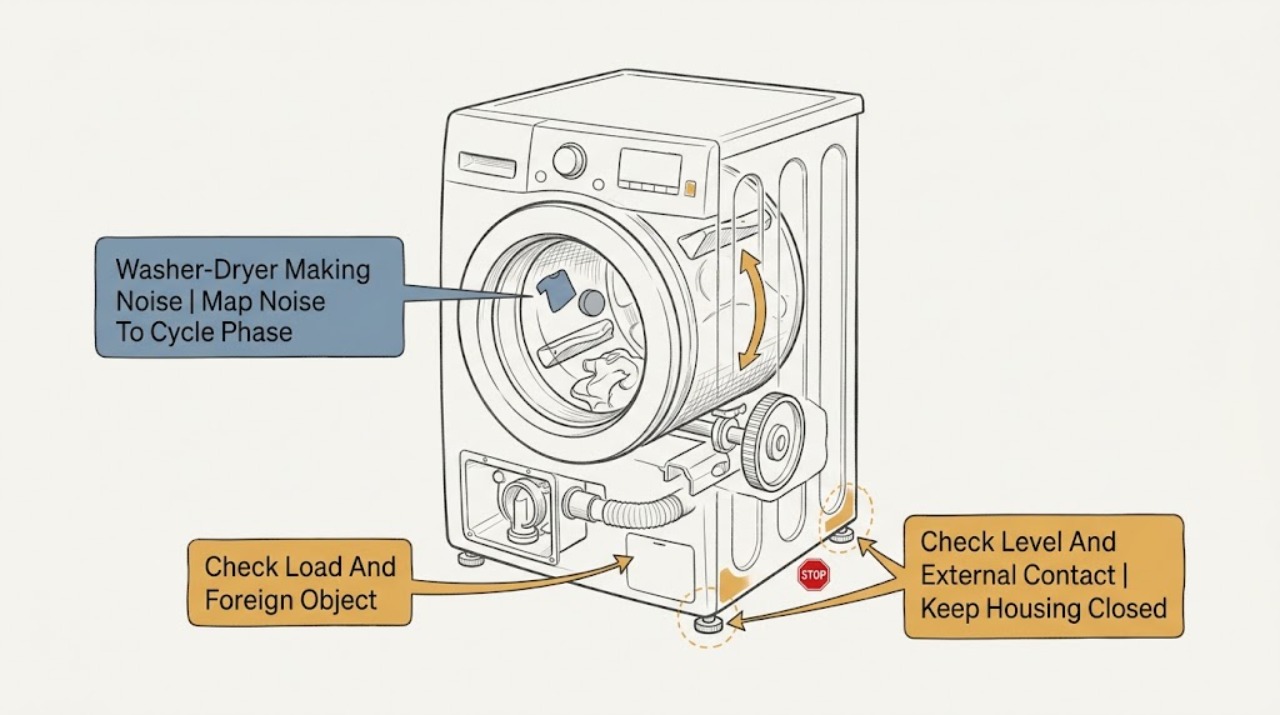
A noisy Beko washer-dryer should be diagnosed by when and how the sound occurs. Rhythmic banging during spin commonly follows an unbalanced load, a foreign object or an appliance that is not level; a hose, wall or cabinet can also be struck. Stop the programme before checking the load, keep hands out of a moving drum, confirm the machine is stable and inspect only accessible hoses and filters as the manual allows. If the noise is grinding or unusually loud, persists with an empty balanced drum, appears with a leak or electrical smell, or the drum is loose or the appliance moves dangerously, stop using it and contact an authorised service agent.
Work through in order
Diagnostic checks
Use only checks that match the exact appliance or system and its official guide.
-
Check 1
Note whether the sound occurs during filling, tumble movement, draining, spin acceleration or drying, and describe it as rhythmic banging, rattling, humming, scraping, grinding or a single clunk.
Expected result: A rhythmic sound during spin differs from a hum limited to drainage, and a one-time clunk between stages differs from continuous metal-on-metal noise. Record whether the machine still completes the programme and whether it moves.
Next step: Use the spin/load branch for rhythmic movement, the hose/filter branch for drainage-only sounds, and the service branch for persistent grinding, scraping or abnormal operation.
Stop if: Stop the cycle immediately for smoke, burning smell, sparking, a water leak, a severe impact or movement that could damage the appliance or surroundings.
Why this matters
Why: Timing and character narrow the next safe check without assuming that every sound is a failed part.
-
Check 2
After the drum has stopped and the door can be opened normally, remove loose objects from pockets and check whether laundry is bunched, overloaded or reduced to one heavy item; redistribute the load without exceeding the documented capacity.
Expected result: A rhythmic bang or repeated knock that occurs with an uneven or single heavy load may lessen when the load is redistributed. Coins, clips or other hard objects may rattle independently of load balance.
Next step: Run one suitable cycle only after the object is removed and the load is balanced. If the same noise returns with a normal load, continue to the stability check and then arrange service if it persists.
Stop if: Do not reach behind the drum seal, use tools inside the drum, or force the door open while water or a running programme may still be present.
Why this matters
Why: Load distribution and foreign objects can create impact noise during spin, but a corrected load should not be used to explain away grinding or a loose drum.
-
Check 3
With the appliance stopped, gently check whether the cabinet rocks and inspect accessible rear hoses and nearby walls or cabinets for contact; verify that all feet rest firmly on a suitable, stable floor.
Expected result: A wobbling cabinet, a hose tapping the back, or a cabinet that has shifted from its original position can explain vibration and knocking. A stable cabinet with an unchanged internal grinding sound points elsewhere.
Next step: If the manual permits user adjustment, level the feet with the machine stable and then retest with a balanced load. If it is integrated, very heavy, still rocks, or cannot be leveled without moving connections, use a professional.
Stop if: Do not tip or drag the washer-dryer alone, alter water or electrical connections, or operate it if it can strike a wall, cabinet or pipe.
Why this matters
Why: Level and clearance affect the mechanical forces transmitted during spin, while external contact can sound like an internal failure.
-
Check 4
If the noise began after first installation or relocation, compare the rear installation with the Beko instructions and confirm that transport restraints and packing were removed as directed; do not dismantle the cabinet.
Expected result: Noise and strong vibration from the first cycles after installation can be consistent with transit hardware or packing still restraining the drum, while a machine that was quiet for months has a different history.
Next step: Use the model instructions or the installer to correct any confirmed installation issue. If the hardware cannot be identified safely, stop using the appliance and arrange authorised service.
Stop if: Do not lean or lift the appliance alone, remove unknown rear parts, or run repeated high-speed cycles to see whether the noise improves.
Why this matters
Why: Installation history changes the likely cause, but identifying or removing restraints on a heavy appliance requires the exact manual and safe access.
-
Check 5
For a sound heard only during draining, inspect the accessible drain hose for a bend or external obstruction and clean the pump filter only if the manual identifies it as user-accessible and the appliance is safely unplugged and drained.
Expected result: A drainage-only hum or whir with a bent hose can change when the hose is correctly routed; a hard object in an accessible filter can cause clicking. Persistent grinding, poor drainage, leaks or an inaccessible filter require service.
Next step: Restore only an obvious accessible hose route or clean the documented filter, then perform one monitored cycle. If the noise remains, is present in other phases, or the appliance is not operating normally, contact an authorised service agent.
Stop if: Stop if water cannot be controlled, the filter is stuck, there is a leak, the pump area is hot, or the appliance shows an electrical or burning symptom.
Why this matters
Why: The drain path can create its own noise, but the check does not diagnose a pump, motor, bearing or wiring fault.
Use your observations
Decision map
Find the observation that best matches what you see, then follow the next safe action.
-
PATH 01Next step
What you see
The noise is rhythmic and appears mainly during spin with an uneven, overloaded or single heavy load.
Do this next
Stop, redistribute the load within the documented capacity and retest once; service is needed if the sound returns with a normal load.
Why this path and its safety boundary
Why it matters: Load imbalance is a plausible cause.
-
PATH 02Next step
What you see
The cabinet rocks, has moved, or a hose, wall or cabinet is being struck.
Do this next
Restore safe clearance and level the feet only as the manual permits; use a professional if the appliance is integrated or cannot be moved safely.
Why this path and its safety boundary
Why it matters: Level, stability or external contact is contributing to the sound.
-
PATH 03Next step
What you see
The sound occurs only during drainage and changes with an accessible hose route or filter check.
Do this next
Complete the manual-directed external cleaning once, then arrange service if noise, poor drainage or leaks remain.
Why this path and its safety boundary
Why it matters: The drain path or a foreign object in the documented user-accessible filter may be involved.
-
PATH 04Next step
What you see
The noise began immediately after installation or relocation and transit restraints may remain.
Do this next
Have the installer or an authorised agent verify the exact installation; do not remove unknown parts or continue high-speed cycles.
Why this path and its safety boundary
Why it matters: Installation hardware or packing may be preventing normal drum movement.
-
PATH 05Next step
What you see
The sound is grinding, scraping, high-pitched, unusually loud, persistent with a balanced load, or accompanied by a loose drum, leak, odor or abnormal operation.
Do this next
Stop using the washer-dryer and contact an authorised service agent with the phase, sound description and any observed movement or leak.
Why this path and its safety boundary
Why it matters: An internal drive, support, pump, suspension or electrical fault remains possible.
Helpful context
Understand the symptom
The cycle phase is the first clue
A washer-dryer can make different normal operating sounds during filling, tumbling, draining and spinning. A rhythmic bang that rises with spin speed points toward load balance, movement or a foreign object; a sound heard only while draining points toward the drain path. A new grinding, scraping or unusually loud sound deserves a lower threshold for service.
Stop before inspecting
Pause or cancel the programme according to the Beko manual and unplug the appliance before external checks when it is safe to do so. Do not reach into a moving drum, remove fixed panels, work near exposed wiring, force a locked door, or tilt a heavy integrated washer-dryer alone.
A balanced empty drum does not clear an internal fault
If the sound disappears after correcting a load or contact point, the operating condition was likely involved. If an empty drum still grinds, knocks, squeals or feels loose, the cause may involve the drive, drum support, pump or suspension and needs authorised diagnosis rather than repeated test cycles.
Only after diagnosis
Potential parts
- adjustable foot or foot lock nut
A missing or damaged foot can prevent leveling, but noise may instead come from the floor, installation or an internal fault.
Confirm the full model and installation design before sourcing; fitting must leave the appliance stable. - pump filter or drain pump component
Drainage-only noise may involve a foreign object, filter or pump, but the symptom does not establish which component has failed.
Do not replace an internal pump based on sound alone; use the model manual and authorised diagnosis. - drum support, suspension or bearing component
Persistent grinding, scraping or a loose drum can involve internal support parts, but compatibility and repair scope are model-specific.
No fit is asserted. Do not open the cabinet or attempt an internal repair as a first user step.
When checks do not resolve it
Need a professional?
Call an authorised Beko service agent if the washer-dryer remains noisy after one load, stability and accessible drain-path check, or immediately for grinding, scraping, a loose drum, a leak, burning smell, smoke, sparking, repeated abnormal operation or dangerous movement.
Common questions
FAQ
Why is my Beko washer-dryer banging during spin?
Check for an uneven or overloaded load, a single heavy item, a foreign object, an unlevel cabinet or contact with a hose, wall or cabinet. If it still bangs with a balanced stable load, arrange service.
Is some noise normal on a washer-dryer?
Filling, tumbling, draining and spinning can have different normal sounds. A new, grinding, unusually loud or disruptive sound, especially with abnormal operation, should be assessed by an authorised service agent.
Could installation cause the noise?
Yes. Beko says the machine should be level and stable, and transit restraints must be removed before installation. Use the exact installation instructions and get help moving a heavy appliance.
What if the noise happens only while draining?
Check the accessible drain hose for a bend or obstruction and follow the manual for any user-accessible filter cleaning. If the sound, poor drainage or leak remains, stop and arrange service.
Read the exact guide
Official sources
- My washing machine is making a rattling or banging noise. Is that normal?Beko · Beko guidance on rhythmic rattling or banging, unbalanced loads, foreign objects, hoses, level, drain hose sounds and authorised service.
- My Beko washer dryer is very noisy whilst spinningBeko UK · Beko guidance for a washer-dryer that is very noisy while spinning and may not be level.
- How to Fit a Washing MachineBeko UK · Beko installation guidance on transit bolts, stable flooring, leveling, heavy-appliance handling and electrical connection.
Community feedback
Share a repair observation
Share a plain-text repair observation. Accepted observations are published automatically; this page may take a moment to update.