
On this page
Start here
Quick answer
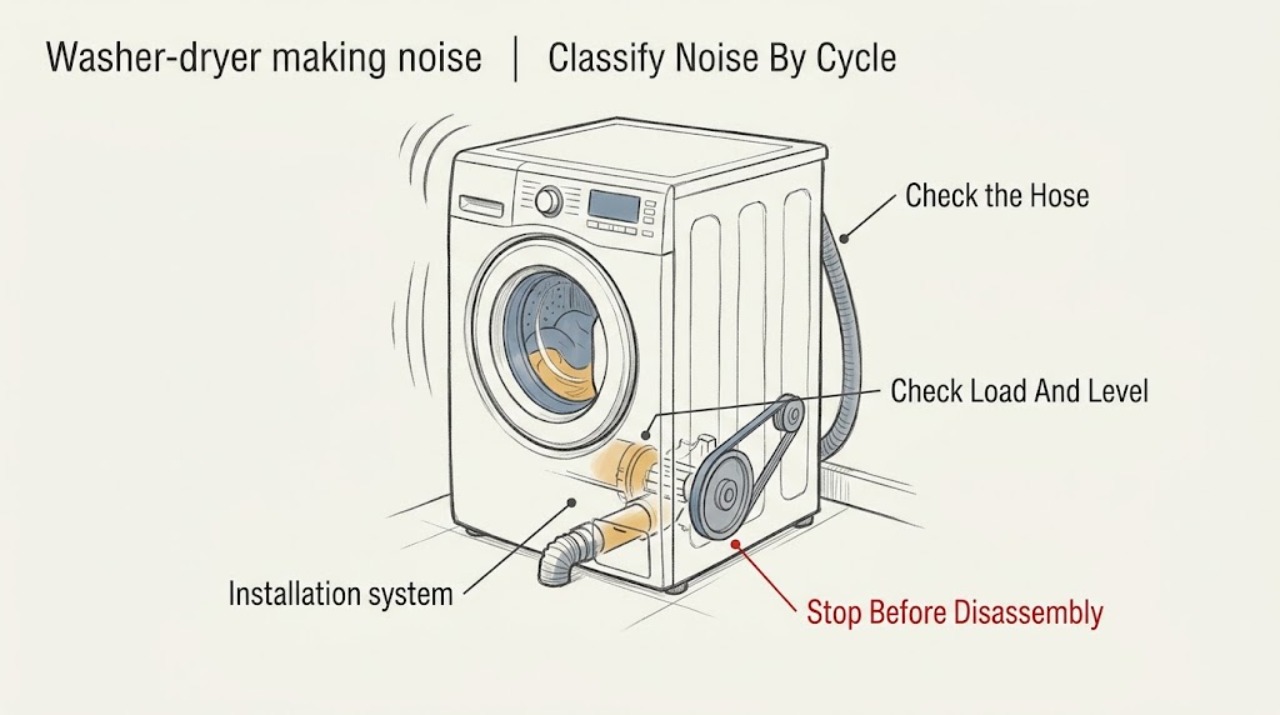
Some AEG washer-dryer sounds are part of normal operation: a motor or drain-pump hum, relay or door-lock clicks, water sloshing, load-balancing movement, and a higher-pitched spin sound can all occur. A new, unusually loud, worsening, or persistent noise should be separated by cycle phase and checked for an unbalanced load, a trapped object, or a visibly kinked, crushed, rubbing, or poorly routed hose. Do not move the appliance or open panels to chase the noise. Stop using it and arrange qualified service for a leak, burning smell, sparking, an error code with poor draining or spinning, severe shaking, or a mechanical noise that persists.
Work through in order
Diagnostic checks
Use only checks that match the exact appliance or system and its official guide.
-
Check 1
From a safe standing position, listen during one supervised cycle segment and record whether the noise occurs while filling, washing, draining, spinning, drying, or when the appliance is idle. Describe it as a hum, gurgle, click, knock, rattle, scrape, or high-pitched sound, and note any error code, leak, or change in performance.
Expected result: The sound is tied to one phase, or it is present across phases; draining and spinning either complete normally or do not.
Next step: If performance is normal and the sound matches a normal operating phase, continue with the visible installation and load checks. If performance is abnormal or the sound is sudden, loud, or worsening, stop the cycle and use the service boundary.
Stop if: Stop immediately for sparking, a burning smell, a water leak, severe movement, smoke, or a sudden harsh mechanical noise.
Why this matters
Why: Phase-limited hums, clicks, sloshing, balancing sounds, and spin sounds can be normal operating sounds. A new or worsening mechanical sound, or a sound paired with poor draining, poor spinning, an error, or a leak, needs escalation.
-
Check 2
With the appliance stopped and viewed from normal access, inspect the visible drain and inlet hoses without moving the washer-dryer. Look for a kink, sharp bend, crushing, twisting, a hose trapped behind the cabinet, contact with a rigid surface, or a drain hose inserted unusually deeply.
Expected result: The drain hose is free to drain and follows the model instructions, or it is restricted, rubbing, unsupported, or visibly contacting the cabinet or a hard surface.
Next step: If a loose, accessible hose position can be corrected without pulling the appliance or disconnecting plumbing, follow the AEG model instructions and retest once. If rear access, disconnection, or force is needed, leave it in place and arrange qualified service.
Stop if: Stop if there is a leak, a damaged hose, water near electrical parts, or any need to pull the appliance out or open a panel.
Why this matters
Why: A restricted drain path can increase pump humming or vibration, while a hose touching the cabinet can transmit vibration. Deep drain insertion can create suction, bubbling, gurgling, or vacuum sounds.
-
Check 3
After pausing and waiting for the drum to stop, check whether the load is gathered on one side and whether the appliance is visibly rocking, walking, or striking the cabinet or nearby surfaces. For a recently installed or stacked unit, compare the visible setup with the AEG instructions rather than adjusting hardware by guesswork.
Expected result: The load is badly bunched, or the cabinet moves severely; alternatively the load is distributed and the appliance remains stable on the floor.
Next step: If the load is the only visible issue and the appliance is stable, redistribute it using the owner's instructions and make one cautious retest. If it walks, bangs hard, remains unstable, or is newly installed with uncertain installation hardware, stop and have installation or service checked.
Stop if: Stop for severe shaking, a cabinet that walks, a stack that shifts, a damaged foot or bracket, or any adjustment that would require lifting or opening the appliance.
Why this matters
Why: An uneven load, uneven floor, installation problem, or missing shipping-bolt step can cause spin vibration. Severe movement is a safety and installation problem, not a reason to keep increasing the spin or repeat the cycle.
-
Check 4
Only when the appliance is unplugged or otherwise made safe according to the owner's instructions and the drum has fully stopped, inspect the accessible door-seal fold and drum opening for a loose coin, zip, button, or other object. Do not remove covers, reach into a pump, or dismantle the drum.
Expected result: A loose object is visibly accessible and can be removed without tools, or the accessible area is clear while the rattle or scrape remains.
Next step: Remove only an obviously loose, reachable object and make one supervised retest. If the noise remains, is metallic or grinding, or water does not drain, stop and arrange qualified service.
Stop if: Stop if the object is lodged, hot, sharp, electrically exposed, or requires a tool, filter/pump access, or panel removal.
Why this matters
Why: A loose object can explain a light rattle, but a clear accessible area does not rule out a trapped object deeper in the drain path or an internal component fault.
-
Check 5
Before another cycle, decide whether the noise persists after the safe visible checks or is accompanied by poor draining or spinning, an error code, a leak, a burning smell, sparking, or severe vibration. Do not keep resetting, repeatedly restarting, or opening the cabinet to locate an internal fault.
Expected result: The sound is gone or unchanged and harmless after one controlled retest, versus persistent/worsening noise or any warning symptom.
Next step: For a persistent noise or warning symptom, stop using the washer-dryer, isolate water and power only when it can be done safely, and arrange qualified appliance service. Provide the model, cycle phase, sound description, error code, and any leak or drainage symptom.
Stop if: Stop now for burning smell, smoke, sparking, a leak, an exposed wire, a sudden harsh mechanical sound, or movement severe enough to strike or walk.
Why this matters
Why: A persistent or worsening noise is not resolved by repeatedly running the machine; combined water, electrical, or movement symptoms raise the urgency and can indicate a component or installation fault.
Use your observations
Decision map
Find the observation that best matches what you see, then follow the next safe action.
-
PATH 01Next step
What you see
The sound is a familiar hum, click, slosh, balancing movement, or spin sound; the cycle drains and spins normally; and there is no error, leak, or worsening trend.
Do this next
Treat it as a possible normal operating sound and continue observing rather than replacing a part based on sound alone.
-
PATH 02Next step
What you see
The noise is a gurgle, bubbling, vacuum-like sound, pump hum, or knock and a visible drain or inlet hose is kinked, crushed, rubbing, unsupported, or inserted too deeply.
Do this next
Treat the hose routing or drain path as the first distinct check, using only the model instructions and normal-access adjustments.
-
PATH 03Next step
What you see
The noise occurs mainly during spin and the load is bunched, the appliance rocks or walks, or the unit is newly installed/stacked with uncertain leveling or shipping-bolt setup.
Do this next
Stop the cycle, wait for the drum to stop, and address only load redistribution or installation checks allowed by the owner's instructions.
-
PATH 04Safety boundary
What you see
The accessible seal and drum opening are clear but a rattle, scrape, grinding sound, or repeated metallic knock remains, or draining/spinning is impaired.
Do this next
Do not dismantle the washer-dryer or reach the pump, motor, bearings, or wiring as a DIY next step.
Why this path and its safety boundary
Safety stop: True
-
PATH 05Safety boundary
What you see
There is a burning smell, smoke, sparking, water leakage, an exposed electrical part, severe shaking, or a sudden harsh mechanical noise.
Do this next
Stop the appliance immediately, keep clear, and do not run another test or open the cabinet.
Why this path and its safety boundary
Safety stop: True
Helpful context
Understand the symptom
First identify when the noise occurs
A noise that occurs only while filling, draining, spinning, or drying points to a different area than a noise present with the appliance idle. Listen from a safe standing position and note whether the sound is a hum, gurgle, knock, rattle, scrape, or high-pitched whine. Also note whether the drum completes the cycle, drains normally, shows an error, leaks, or makes the sound louder on every attempt. A sound with normal performance may be an operating sound; a change in both sound and performance is a stronger reason to stop and request diagnosis.
Check the installation path without disassembly
From the front or another normal-access position, inspect the visible drain and inlet hoses. A drain hose pushed too deeply into the standpipe can make suction, gurgling, bubbling, or vacuum sounds. Kinks, sharp bends, crushing, twisting, or a hose trapped behind the cabinet can restrict drainage and make the pump hum or vibrate. An inlet hose or cabinet contact can transmit vibration or make the hose knock against a rigid surface. Do not pull the appliance out or reach behind it; use the model's instructions or a qualified technician when a rear-access correction is needed.
Separate load and floor vibration from a machine fault
A single heavy item or a load gathered to one side can make a washer-dryer shake or knock during spin. Pause only using the appliance controls and wait until all movement has stopped before opening the door. If the load is visibly bunched, redistribute it according to the owner's instructions; do not put hands into a moving drum. Observe the cabinet and floor during a cautious, supervised retest: walking, striking, or severe movement is not a noise to work through. For a new installation, the floor, feet, stacking arrangement, and shipping-bolt status need to be checked against the AEG instructions; do not remove installation hardware without the correct model procedure.
Know when a sound is beyond user maintenance
A rattling sound can come from a loose item in an accessible pocket or seal area, but a scrape, grinding sound, repeated metallic knock, or noise that remains after the load and visible hoses are normal may involve a pump, motor, bearings, suspension, or another internal component. These parts and any wiring or electrical diagnosis require a qualified technician. Keep the model and serial information from its normal-access label and record the cycle phase, sound description, error code, and whether water remains in the drum so service can begin with useful evidence.
Safety boundary
Stop conditions
- Do not move the washer-dryer, pull it from the wall, disconnect hoses, or open panels merely to locate a noise.
- Do not reach into a moving drum or access a pump, motor, bearings, suspension, controls, or wiring without qualified service.
- Stop immediately for burning smell, smoke, sparking, water near electrical parts, a leak, severe shaking, walking, or sudden harsh mechanical noise.
When checks do not resolve it
Need a professional?
The noise persists, gets louder, or returns after the safe visible checks., The washer-dryer drains or spins poorly, displays an error, leaks, or makes a repeated grinding or metallic noise., A hose correction would require pulling the appliance, disconnecting plumbing, opening a panel, or reaching a pump, motor, bearing, suspension, or wiring., The appliance walks, shakes severely, or is a newly installed or stacked unit with uncertain leveling or shipping-bolt setup.
Common questions
FAQ
Is a humming sound from an AEG washer-dryer always a fault?
No. AEG lists motor and drain-pump humming among sounds that can occur during normal operation. It becomes more concerning when the hum is new or unusually loud, the machine drains poorly, an error appears, a leak occurs, or the sound persists with other mechanical symptoms.
Why does my AEG washer-dryer gurgle or make a vacuum sound while draining?
AEG notes that a drain hose inserted too deeply can create suction, gurgling, bubbling, or vacuum sounds. A kinked, crushed, twisted, or poorly routed hose can also restrict drainage and make the pump hum or vibrate. Check only visible routing against the model instructions; obtain service if correction needs rear access or the machine drains poorly.
What should I do if the washer-dryer bangs during spin?
Pause and wait for the drum to stop, then check whether the load is bunched and whether the appliance is rocking or walking. Redistribute a visibly uneven load only when the appliance is stable and the owner's instructions permit it. Severe or repeated movement, a newly installed unit with uncertain leveling, or a shifting stack needs service rather than repeated spin tests.
Can I remove the back panel to find the noise?
No. A pump, motor, bearing, suspension, control, or wiring diagnosis requires internal access and a qualified technician. Do not move the appliance, disconnect hoses, or open panels as a noise-finding exercise; record the sound and cycle phase for service instead.
When should I stop using the AEG washer-dryer immediately?
Stop for sparking, a burning smell, smoke, a leak, exposed wiring, severe shaking or walking, a sudden harsh mechanical sound, or poor draining/spinning with an error. Keep clear and isolate power or water only through normal accessible controls when safe; otherwise arrange qualified service without another test cycle.
Read the exact guide
Official sources
- Laundry Washers Noises GuideElectrolux · Supplementary laundry-washer guidance only; AEG model instructions take precedence for an AEG washer-dryer.
- AEG Washing Machine Making Unusual Noises During Draining or Spinning – Causes and SolutionsAEG · AEG washing machines and AEG washer dryers; model-specific hose routing and installation instructions take precedence.
- What are the most common washing machine faults and how do I fix them?AEG · General AEG washing machine fault guidance; model-specific owner's instructions apply to any installation or maintenance step.
- Washing Machine Care & Repair Advice from AEG ExpertsAEG · AEG washing machines and related washer-dryer care and repair guidance; exact model instructions apply.
Community feedback
Share a repair observation
Share a plain-text repair observation. Accepted observations are published automatically; this page may take a moment to update.