
On this page
Start here
Quick answer
First determine whether the sound comes from the washer or dryer and whether it occurs during filling, draining, spinning, or drum movement. Frigidaire lists clicks from a lid lock or water valve, gurgling during draining, water rushing during filling, and some dryer air or roller sounds as normal operating sounds. Rattling or clanking calls for stopping the appliance and checking pockets, fasteners, and loose objects; an empty cycle can show whether the item or the appliance is the source. For vibration or walking, check level, stable flooring, shipping materials, and stacking hardware without opening the cabinet. Stop and arrange service for noise that remains during an empty cycle, a new grinding or scraping sound, smoke, a burning smell, a loose cabinet, repeated violent movement, or a recently installed unit that is still unstable.
Before you begin
Safety first
- This article covers listening, stopping, load and pocket checks, visible setup inspection, and one safe comparison cycle only. Cabinet removal, moving or unstacking the unit, internal drum or drive work, electrical testing, and replacement of hidden parts require qualified service.
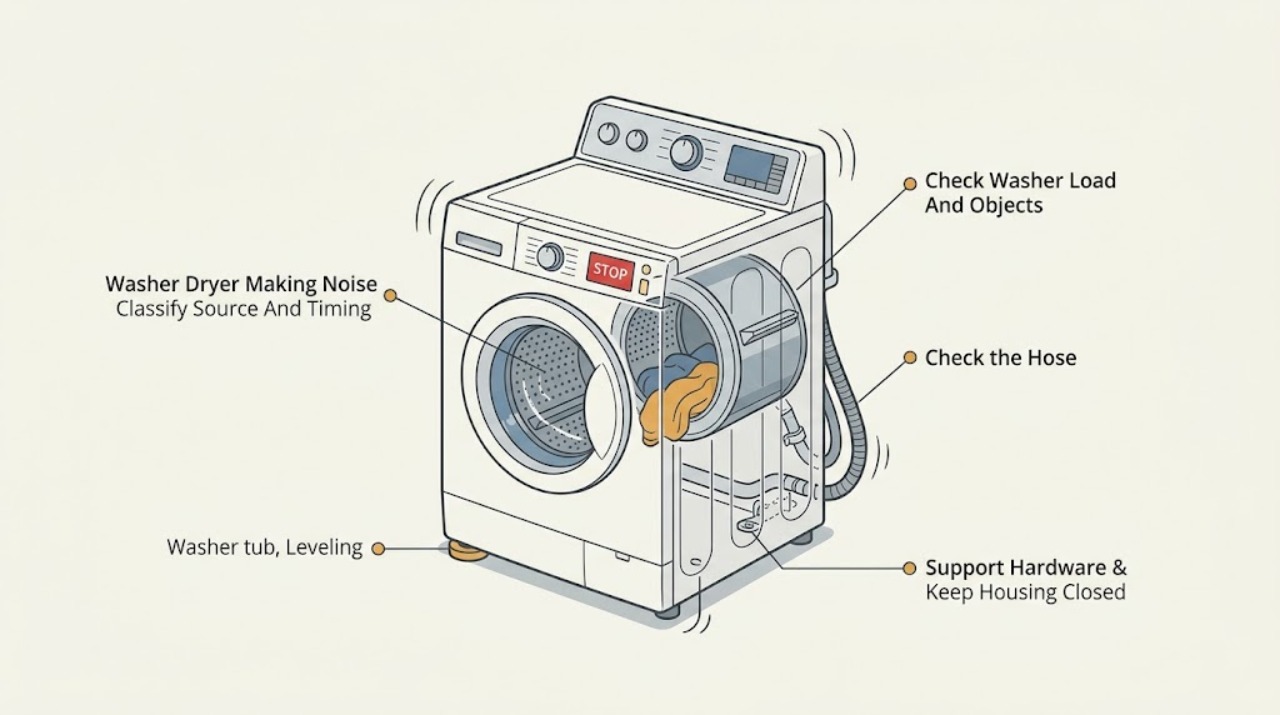
Work through in order
Diagnostic checks
Use only checks that match the exact appliance or system and its official guide.
-
Check 1
Stand clear of the moving appliance and record whether the noise comes from the washer section, dryer section, or both, and at which stage it begins: door or lid lock, filling, draining, spin, or dryer drum movement.
Expected result: The sound is a click, hum, gurgle, rushing water, rattle, clank, thump, squeak, scrape, or severe vibration, and it is tied to one section or cycle stage.
Next step: Use the washer-load, dryer-load, or installation branch that matches the observation. Stop immediately if the sound is accompanied by smoke, a burning smell, visible damage, or uncontrolled movement.
Stop if: Do not put hands into a moving tub or drum, hold a panel, or lean behind the unit while it runs.
Why this matters
Why: Frigidaire associates clicks with locks or water valves, gurgling with draining, water rushing with filling, and some spin or dryer movement sounds with normal operation. A cycle-specific description narrows the next check but does not prove a mechanical part is safe.
-
Check 2
For a washer-side rattle, clank, or thump, stop the cycle, wait for the lid or door to unlock, remove or redistribute the load, and check pockets and the visible tub for coins, fasteners, or other loose objects.
Expected result: The sound disappears after a fastener or object is removed, changes with load size, remains with the load removed, or was a thump only at the beginning of spin.
Next step: Secure fasteners and balance the load before one supervised restart. If the sound returns with an empty cycle, stop using the washer section and arrange service.
Stop if: Do not reach into a moving tub, pull an object from a locked drum, or keep running the washer with a sharp scrape, loud impact, or visible damage.
Why this matters
Why: Frigidaire says heavy loads can occasionally thump at the start of spin and that fasteners or foreign objects can rattle or clank. A sound that remains without laundry is more likely to involve the appliance or setup.
-
Check 3
For washer vibration, shaking, walking, or a knocking hose, inspect from the front and sides with the unit stopped: check that it rests firmly on a solid floor, is level, has no visible shipping material, and has a drain hose secured as directed by the installation guide.
Expected result: The unit rocks, one foot is not firmly down, the floor flexes, shipping material remains, a stack is loose, or the drain hose can strike the cabinet.
Next step: Pause use and correct only visible setup issues according to the model installation guide. If the unit still walks or shakes, or if the stack or floor cannot be made stable, arrange installer or qualified service.
Stop if: Do not tip, lift, unstack, or reach behind the appliance alone; do not adjust hidden supports while the unit is connected or moving.
Why this matters
Why: Frigidaire links vibration with an unbalanced load or an unlevel unit, and links knocking with an unsecured drain hose. Shipping material, stacked hardware, or an unstable floor can also transmit movement.
-
Check 4
For a dryer-side rattle or clank, stop the dryer, check pockets and the visible drum for coins or other objects, and secure buckles or metal fasteners on garments before any supervised empty-cycle comparison.
Expected result: The noise is present only with a particular garment, disappears when the drum is empty, continues empty, or is a brief thump or rolling sound at startup.
Next step: Remove the load-related cause and monitor one normal cycle. If the empty drum still rattles, clanks, squeaks, or scrapes, stop the dryer and request service.
Stop if: Do not operate the dryer with smoke, a burning smell, a hot electrical smell, a drum that rubs, or an object that cannot be safely removed while stopped.
Why this matters
Why: Frigidaire attributes rattling or clanking to objects and fasteners, while some brief startup roller or air-handling sounds may be normal. Noise that continues empty is not explained by the load.
-
Check 5
If no hazard is present and the owner guide permits it, run one empty comparison cycle for the affected section while staying nearby. Record whether the sound is absent, unchanged, or getting worse, and note the cycle stage and any display message.
Expected result: The sound stops when empty, remains at the same stage, becomes louder, or is accompanied by walking, a leak, an error, smoke, or an odor.
Next step: Stop the affected section when the comparison is complete. Arrange service for persistent or worsening noise and provide the recording, timing, load state, and installation history.
Stop if: End the cycle at once for violent movement, scraping, smoke, burning smell, leak, exposed wiring, or any condition that could damage the appliance or home.
Why this matters
Why: An empty-cycle result distinguishes load noise from appliance or installation noise. A persistent or worsening sound, or a sound paired with another fault, needs more than a load adjustment.
-
Check 6
Prepare the exact model, washer or dryer section, sound description, cycle stage, empty-cycle result, load details, recent installation or moving history, and any visible damage for the installer or qualified technician.
Expected result: The unit is within its recent installation period, is stacked, has persistent noise when empty, or has a sound that cannot be explained by objects, load balance, or visible setup.
Next step: Keep the affected section off until assessed and share the observation record with the installer or qualified appliance service. Do not select a component solely from the sound.
Stop if: Do not remove cabinets, belts, drum supports, motors, stacking brackets, or electrical covers as a user repair.
Why this matters
Why: Frigidaire directs unresolved noise to the installer for recently installed units and to service for older units. A record of when the sound occurs is more useful than guessing at a motor, belt, bearing, or support part.
Use your observations
Decision map
Find the observation that best matches what you see, then follow the next safe action.
-
PATH 01Safety boundary
What you see
The sound is a click at a lock or valve, water movement, draining gurgle, low pump hum, or a brief dryer startup or air-flow sound.
Do this next
Continue only under normal supervision and compare with the model owner guide. Escalate if the sound becomes new, harsh, persistent, or is paired with an error or damage.
Why this path and its safety boundary
Why it matters: Frigidaire lists these as possible normal operating sounds when they match the cycle and do not bring another fault.
Safety stop: Do not dismiss smoke, a burning smell, severe vibration, scraping, or a leak as a normal sound.
-
PATH 02Safety boundary
What you see
The washer rattles, clanks, or thumps with laundry and the sound changes after checking the load.
Do this next
Stop before checking, secure fasteners, remove visible objects, redistribute the load, and make one supervised comparison. Use an empty cycle only if safe and allowed by the guide.
Why this path and its safety boundary
Why it matters: Fasteners, coins, other loose objects, heavy loads, or an unbalanced load can create the reported sound.
Safety stop: Stop if the sound remains empty, becomes a scrape or repeated impact, or the tub or cabinet is visibly damaged.
-
PATH 03Safety boundary
What you see
The dryer rattles or clanks only with certain garments or objects in the drum.
Do this next
Stop the dryer, remove the object if it is safely accessible, secure fasteners, and compare with an empty drum once. If the sound continues empty, request service.
Why this path and its safety boundary
Why it matters: Frigidaire identifies pockets, coins, buckles, and other metal fasteners as common load-related sources.
Safety stop: Do not run the dryer with smoke, burning odor, drum rubbing, or an object trapped behind a panel.
-
PATH 04Safety boundary
What you see
The washer-dryer walks, shakes, or knocks the wall or cabinet, especially after installation or moving.
Do this next
Stop the unit and inspect only visible setup. Follow the installation guide for leveling or hose restraint; send a recent installation back to the installer if stability remains poor.
Why this path and its safety boundary
Why it matters: Leveling, a solid floor, shipping materials, stack hardware, feet, or an unsecured drain hose can be involved.
Safety stop: Do not unstack or tilt the appliance without proper support, and do not operate it while the stack or cabinet is loose.
-
PATH 05Safety boundary
What you see
The sound remains during an empty comparison, gets louder, or cannot be linked to the load or visible installation.
Do this next
Stop the affected washer or dryer section and arrange qualified Frigidaire appliance service. Provide the exact timing and an audio or video record taken from a safe position if available.
Why this path and its safety boundary
Why it matters: The noise is no longer explained by clothing or setup and may involve an internal support, drive, drum, motor, or another fault that requires diagnosis.
Safety stop: Do not open the cabinet, replace internal parts, or keep testing a loud or worsening sound.
Helpful context
Understand the symptom
A sound is useful only when tied to timing
Listen from a safe position and note which section is active, whether the sound starts with a load or an empty drum, and whether it occurs during fill, drain, spin, or dry. A click at a lock or valve, a low pump hum, gurgling during drain, or water movement can be expected. A new scrape, repeated knock, or sound that becomes louder changes the decision toward stopping and service.
Separate load noise from appliance noise
Metal fasteners, coins, and other loose objects can rattle in either the washer tub or dryer drum. Stop the affected section before checking pockets and the visible drum area. If the owner guide permits an empty cycle, use it only while supervised and only when there is no hazard; continued noise with no laundry points back to the appliance or its installation.
Installation changes the path for vibration
A newly installed or stacked unit can shake because shipping materials remain, the floor is unstable, the appliance is not level, or stacking hardware is loose. Inspect only the visible setup and follow the model installation guide. Do not remove panels or reach behind a moving unit to test a support, belt, motor, or drum.
Safety boundary
Stop conditions
- Stop the affected section for smoke, a burning smell, hot electrical odor, visible arcing, or a leak and arrange prompt qualified assessment.
- Do not put hands into a moving tub or drum, reach behind the appliance while it runs, or remove an object through a panel.
- Do not operate through severe walking, repeated impacts, a scraping drum, a loose cabinet, or unstable stacking hardware.
- Do not remove cabinets, belts, drum supports, motors, stacking brackets, or electrical covers as a user repair.
- Treat a persistent empty-cycle noise, a worsening sound, or a recently installed unit that remains unstable as a service or installer issue.
When checks do not resolve it
Need a professional?
Arrange service when rattling, clanking, squeaking, grinding, scraping, or vibration persists with an empty comparison; when load and visible setup checks do not explain it; or when the unit is newly installed and still unstable. Stop promptly for smoke, burning odor, visible arcing, leaks, severe movement, or a loose structure. Internal drum, motor, belt, support, and electrical work require qualified service.
Safety scope: This article covers listening, stopping, load and pocket checks, visible setup inspection, and one safe comparison cycle only. Cabinet removal, moving or unstacking the unit, internal drum or drive work, electrical testing, and replacement of hidden parts require qualified service.
Common questions
FAQ
Which Frigidaire washer-dryer sounds can be normal?
Clicks from a lid lock or water valve, gurgling while draining, water rushing while filling, and some dryer startup or air-flow sounds can be normal when they match the cycle. A new, harsh, worsening, or persistent sound still needs assessment.
Why is my Frigidaire washer rattling or clanking?
Stop the washer and check pockets, coins, fasteners, and other loose objects. Redistribute the load, then use one safe empty-cycle comparison if the owner guide permits it. If the noise remains empty, arrange service.
Why is my Frigidaire dryer rattling?
Coins, pockets, buckles, and other metal fasteners can rattle or clank. Stop the dryer and check the visible drum and load. If the sound continues with an empty drum, keep the dryer off and request service.
What should I check if my Frigidaire washer-dryer is shaking or walking?
With the unit stopped, check visible leveling, solid flooring, shipping materials, stacking hardware, feet, and drain-hose restraint according to the installation guide. If it remains unstable, contact the installer for a recent installation or arrange qualified service.
When should I stop using a noisy Frigidaire washer-dryer?
Stop for smoke, a burning smell, visible arcing, a leak, severe movement, scraping, a loose cabinet, or noise that persists during an empty comparison. Do not remove panels or internal parts; keep the affected section off and arrange qualified service.
Read the exact guide
Official sources
- Is it normal for my washer to make sounds or noises?Frigidaire · Official Frigidaire washer support page; it supports the washer load, pocket, object, and empty-cycle checks without implying an internal diagnosis.
- Laundry Washers Noises GuideFrigidaire · Official Frigidaire guide applying to all laundry washers; it supports the washer-side checks in a washer-dryer or laundry-center article, while the exact model installation guide controls.
- Is it normal for my Frigidaire Laundry Center to make sounds or noises?Frigidaire · Official Frigidaire laundry-center page, directly relevant to a combined washer-dryer form factor; it supports normal sound and load-object distinctions for both sections.
- Laundry Dryer NoisesFrigidaire · Official Frigidaire dryer support page; it supports the dryer-side load and visible installation checks in a washer-dryer article.
Community feedback
Share a repair observation
Share a plain-text repair observation. Accepted observations are published automatically; this page may take a moment to update.