
On this page
Start here
Quick answer
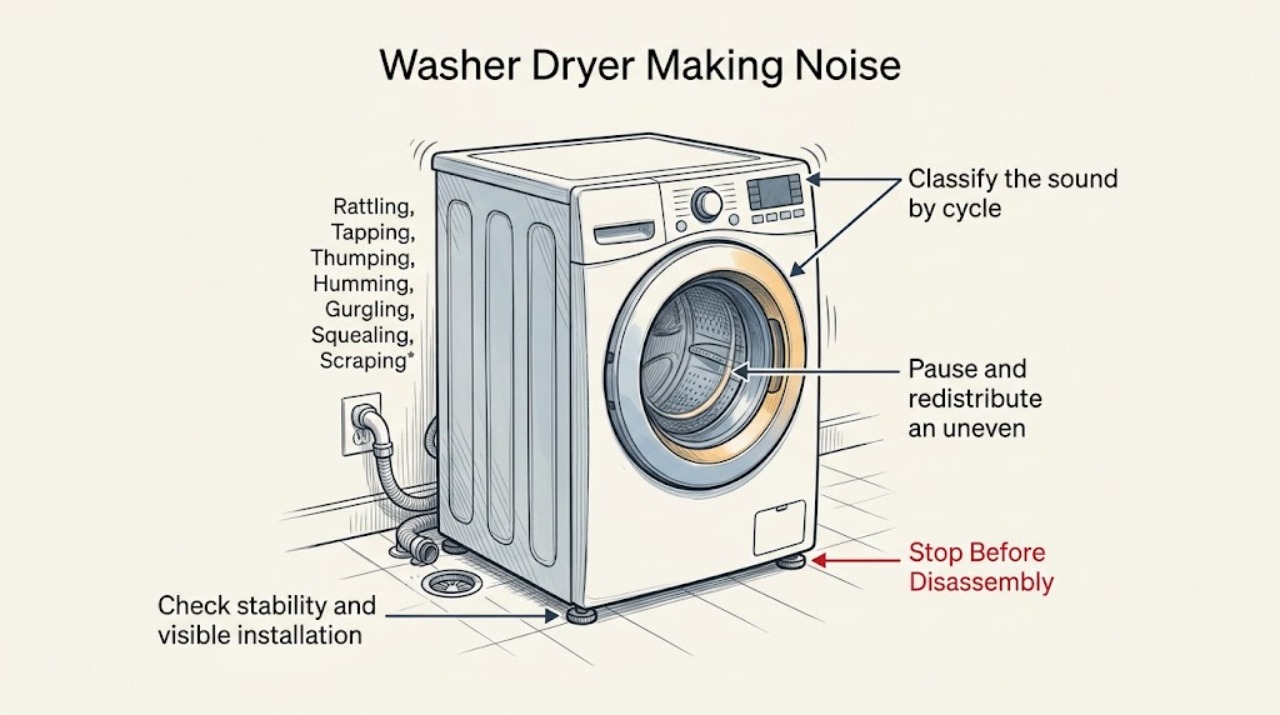
Start by identifying when the sound occurs. A thump or rattle during spin commonly follows an uneven load, an unleveled machine, shipping hardware left after installation, or contact with a nearby cabinet; a clack can be a coin or other object. A low drain-pump hum or dryer hum/gurgle can be normal, but a sharp metallic scrape, severe movement, a burning smell, a damaged cord, a leak near electrics, or a noise that continues with an empty drum is a stop condition. Pause the cycle, keep hands away from the moving drum, redistribute laundry only after it stops, check level and visible surroundings, and use the exact model guide for filters or shipping hardware. If the noise persists, arrange qualified LG service. [Source: lg-washer-noise; lg-spin-noise; lg-vibration; lg-dryer-noise]
Work through in order
Diagnostic checks
Use only checks that match the exact appliance or system and its official guide.
-
Classify the sound by cycle phase
From a safe position, note whether the sound occurs during wash agitation, water draining, high-speed spin, or the drying portion. Describe it as tapping, clacking, rattling, thumping, humming, gurgling, squealing, or metallic scraping, and note whether the cabinet or door is visibly shaking.
Expected result: The sound is only during spin, only during draining, follows the dryer drum, occurs throughout every phase, or is accompanied by severe movement, smoke, burning odor, leak, or electrical damage.
Next step: Follow the matching load, installation, foreign-object, drain, dryer, or stop branch. Do not continue a cycle that is moving violently or producing a safety symptom.
Why this matters
Why: Spin points toward load balance, level, shipping hardware, or surrounding contact; drain noise can be pump or filter related; dryer noise can be laundry or rollers; a sharp persistent scrape or safety symptom needs service rather than more testing.
-
Pause and redistribute an uneven load
When the washer has stopped moving, pause the cycle, open the door only when the lock releases, and spread the laundry evenly. Remove a single bulky or waterproof item if it has pulled the load to one side; do not place hands into a moving drum or force the door open.
Expected result: The noise stops after the load is spread, returns only with a blanket or single heavy item, or remains with a balanced ordinary load.
Next step: Run one supervised model-appropriate spin or rinse-and-spin check with a balanced load. If the sound returns with an ordinary balanced load, continue to the level and service checks.
Why this matters
Why: LG identifies laundry clumped on one side, bulky items, and unsuitable loads as causes of pounding, rattling, and extended balancing movements. Persistence with a balanced load makes load imbalance less likely.
-
Check stability and visible installation hardware
With the appliance empty and stationary, gently press opposite corners to see whether it rocks, and check that it stands on a firm level floor with all visible feet in contact. If it was recently installed, use the exact LG manual to confirm that shipping bolts or packing supports were removed; do not tilt a stacked or heavy unit alone.
Expected result: The machine rocks, a foot is not firmly contacting the floor, the floor flexes, nearby walls or cabinets are being struck, or shipping hardware may still be installed.
Next step: Adjust the leveling feet only as described by the model instructions and secure any specified lock nuts. If the machine is stacked, cannot be leveled safely, or still vibrates, arrange qualified service.
Why this matters
Why: LG links excessive noise and vibration to an unleveled machine, unstable floor, nearby contact, or shipping hardware left in place after installation. Installation hardware that cannot be safely addressed from the manual should be handled by service.
-
Check for objects, hoses, and a loud drain sound
After pausing and waiting for the drum to stop, remove accessible laundry and look for coins, hair pins, zippers, or other loose objects in the drum and pockets. From outside the unit, check whether the inlet or drain hose is tapping the cabinet and whether the drain filter symptom matches the model guide; do not open an access cover or remove residual water unless that guide supports it and the appliance is safely isolated.
Expected result: A loose object is present, a hose or nearby shelf is being struck, a loud hum occurs only while draining, or the noise remains with the drum empty and surroundings clear.
Next step: Remove only accessible laundry objects, reposition a loose hose or nearby item, and follow the exact model procedure for a drain filter. If the object is trapped, the filter cannot be safely serviced, or the sound persists, stop and request service.
Why this matters
Why: LG identifies objects as clacking or rattling causes, hoses and cabinets as tapping sources, and a drain-pump hum as normal unless unusually loud or obstructed by debris. Noise with an empty clear drum is more likely to need diagnosis.
-
Separate normal dryer sounds from scraping
For noise during drying, stop the cycle when safe and check pockets, zippers, buttons, and loose accessories before the next load. Note whether the sound is a brief startup or reversal tone, a low hum or gurgle, or a sharp squeal or metal-scraping sound that continues through the cycle.
Expected result: The noise follows an object in the load, occurs briefly at startup or drum reversal, is a low hum or gurgle, or is a persistent sharp metallic scrape.
Next step: Remove loose objects and secure fasteners for a supervised next cycle only when no safety symptom exists. For persistent scraping, burning odor, unusual heat, or damaged parts, keep the dryer off and arrange service.
Why this matters
Why: LG describes some dryer hums, gurgles, brief belt-settling sounds, and roller thumps as normal; pockets and fasteners can strike the drum. Persistent sharp scraping can indicate worn or damaged internal parts and is not a load adjustment issue.
-
Stop and arrange qualified diagnosis when noise persists
Record the model, cycle phase, sound description, load type, movement, object or hose checks, level check, shipping-hardware status, and any error message. Keep the washer-dryer out of service if the noise continues after the safe checks or if the drum sounds rough when stationary; do not remove panels or diagnose a belt, bearing, motor, or roller by sound alone.
Expected result: The noise disappears after one safe correction, returns with a normal load, occurs with an empty drum, or is accompanied by scraping, burning odor, smoke, leak, electrical damage, or severe movement.
Next step: Use qualified LG service for a persistent mechanical or electrical noise. For smoke, burning odor, sparking, a damaged cord, a leak near electrics, or violent movement, stop immediately and use the appropriate emergency or electrical service channel.
Why this matters
Why: A corrected load or installation issue can be monitored. Persistent or empty-drum noise, sharp scraping, and safety symptoms require proper diagnosis because internal or electrical damage cannot be identified safely from outside.
Use your observations
Decision map
Find the observation that best matches what you see, then follow the next safe action.
-
PATH 01Safety boundary
What you see
The noise is a brief thump or rattle during spin and the laundry is clumped on one side.
Do this next
Pause safely, redistribute or remove the unbalanced item after the drum stops, then perform one supervised model-appropriate check.
Why this path and its safety boundary
Safety stop: Continue with level, object, hose, drain, or dryer-sound checks.
-
PATH 02Safety boundary
What you see
The appliance rocks, strikes a nearby cabinet or wall, or was recently installed with shipping hardware in question.
Do this next
Stop the cycle, correct accessible leveling or surrounding contact using the exact LG guide, and arrange service if shipping hardware or stacking cannot be safely addressed.
Why this path and its safety boundary
Safety stop: Continue with load and foreign-object checks.
-
PATH 03Safety boundary
What you see
A clack or rattle comes from loose objects, pockets, or a hose or shelf touching the machine.
Do this next
Stop safely, remove accessible objects after the drum stops, reposition the loose hose or nearby item, and monitor one normal cycle.
Why this path and its safety boundary
Safety stop: If the sound is unusually loud or continues with the drum empty, arrange service.
-
PATH 04Safety boundary
What you see
A low drain hum or dryer hum/gurgle occurs only in the relevant operating phase.
Do this next
Compare it with the model guide's normal operating sounds; investigate only if it is unusually loud, obstructed, or changes into scraping.
Why this path and its safety boundary
Safety stop: Continue with load, level, and internal-part service checks.
-
PATH 05Safety boundary
What you see
The noise is sharp metallic scraping, continues with an empty drum, or appears with smoke, burning odor, severe movement, leak, or electrical damage.
Do this next
Stop immediately, keep the appliance out of service, and arrange qualified LG or electrical service; do not run another test.
Why this path and its safety boundary
Safety stop: Use one supervised cycle after the applicable safe load or installation correction, then escalate if the noise returns.
Helpful context
Understand the symptom
Noise in a washer-dryer is most useful when described by phase: washing, draining, spinning, or drying. The same cabinet can transmit several different sounds, so listen for whether the drum is moving, water is draining, or the dryer is operating before deciding what to check.
The safe owner checks are limited to pausing the cycle, handling laundry after the drum stops, checking visible objects and hoses, confirming that the machine is stable, and following the exact model manual. Do not reach into a moving drum, remove panels, tilt a heavy stacked unit alone, or attempt to replace bearings, belts, motors, or electrical parts from a sound alone.
A brief balancing movement, a drain-pump hum or gurgle, and some short dryer startup or reversal sounds can be normal. What changes the decision is persistence, sharp metal-on-metal scraping, severe movement, damage, or a safety symptom alongside the noise.
Safety boundary
Stop conditions
- Stop immediately for smoke, burning or melting odor, sparking, a damaged power cord, a leak near electrical equipment, violent movement, a loose door, or a sharp metallic scraping sound.
- Never reach into a moving drum, force the door lock, tilt a heavy or stacked washer-dryer alone, or place hands near belts, rollers, fans, or other moving parts.
- Do not remove panels, shipping hardware, drain filters, or trapped objects unless the exact model instructions make the step safe and accessible; do not work on wiring, motor, belt, bearing, or electrical parts.
- Do not keep running cycles to reproduce a persistent noise. Arrange qualified service when safe load, level, hose, and surrounding-object checks do not correct it.
When checks do not resolve it
Need a professional?
Request qualified LG service when noise persists with a balanced load and level machine, continues with an empty drum, follows a suspected internal object, cannot be resolved because access is unsafe, or sounds like persistent metal scraping. Use the appropriate emergency or electrical service channel for smoke, burning odor, sparking, a damaged cord, a leak near electrics, or violent movement.
Have this ready
- Exact LG model and serial details
- Whether the sound occurs during wash, drain, spin, or dry
- Sound description, duration, and whether the drum or cabinet moves
- Load type, pocket and fastener check, and whether the sound changes with an empty drum
- Level, floor, shipping-hardware, hose, shelf, and drain-filter observations
- Any error message, leak, smoke, burning odor, sparking, damaged cord, or recent installation
Common questions
FAQ
Why does my LG washer-dryer thump during spin?
Pause safely and redistribute the laundry after the drum stops. A load clumped on one side, bulky items, an unleveled machine, or shipping hardware left after installation can cause spin noise. If the noise remains with a balanced load and level machine, request service.
Is a humming or gurgling sound from an LG washer-dryer normal?
A drain-pump hum or a low dryer hum or gurgle can be normal in its operating phase. If it is unusually loud, changes to scraping, occurs with a blockage, or is accompanied by a safety symptom, stop and arrange service.
When does LG washer-dryer noise require repair?
Request repair when the noise persists after safe load, level, hose, and surrounding-object checks, continues with an empty drum, or sounds like sharp metal scraping. Stop immediately for smoke, burning odor, sparking, a leak near electrics, severe movement, or a damaged cord.
Read the exact guide
Official sources
- LG Washer: Troubleshooting Vibration IssuesLG · LG washing machines and washer-dryer combos; manufacturer guidance for shipping bolts, leveling, load distribution, test cycle, and service
- LG Dryer: Noise From the DryerLG · LG dryers and washer-dryer combos; manufacturer guidance for normal hum/gurgle, laundry objects, rollers, and persistent metallic scraping
- LG Washer - Troubleshooting Noises During the CycleLG · LG washers and washer-dryer combinations; manufacturer guidance for wash and spin noise, shipping bolts, loads, foreign objects, and service
- LG Front Load Washing Machine: Vibrations FloorLG · LG front-load washers and washer-dryer combos; manufacturer guidance for solid, horizontal floors and vibration
- LG Front Loader: Noise During Spin DryLG · LG front-load washers and washer-dryer combos; manufacturer guidance for load balance, level, hoses, cabinets, drain filter, and normal pump noise
Community feedback
Share a repair observation
Share a plain-text repair observation. Accepted observations are published automatically; this page may take a moment to update.