
On this page
Start here
Quick answer
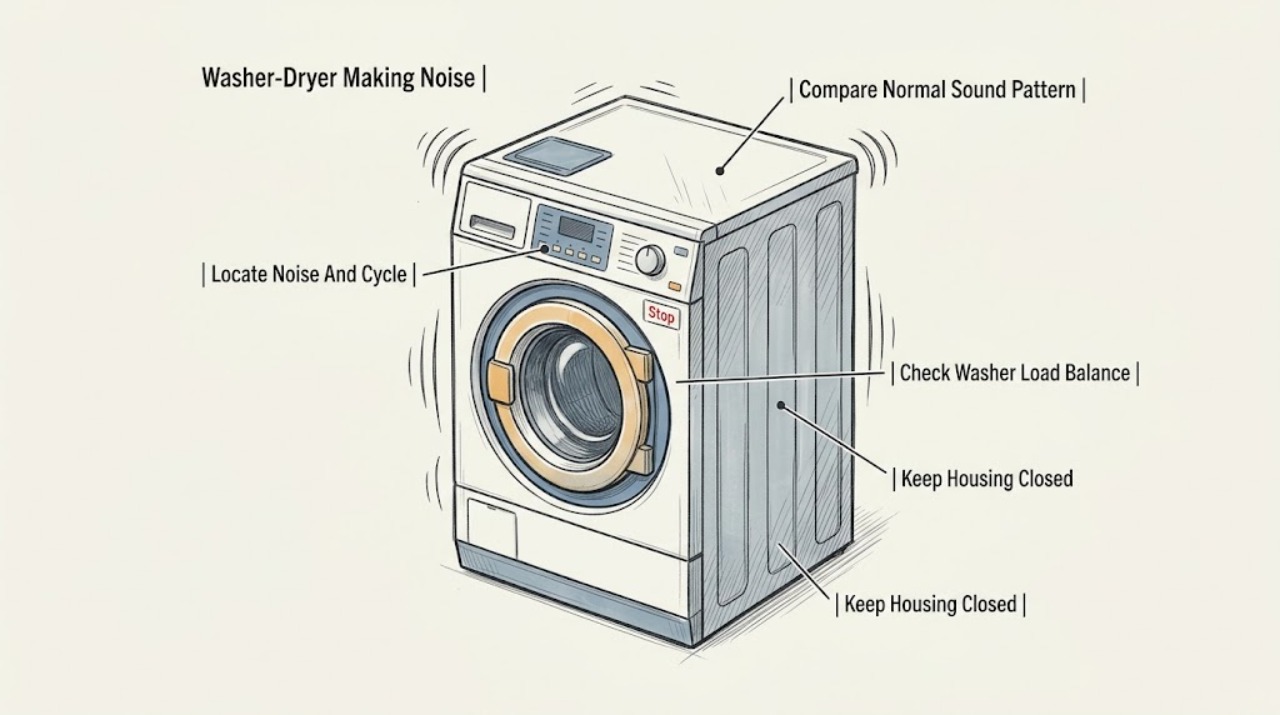
First identify whether the noise comes from the washer or dryer portion and note the cycle, sound, and whether it is brief or continuous. GE documents normal sounds such as water fill, drain gurgle, agitation, spin ramping, a short dryer start squeak, and the drum turning. A thump, persistent squeak, scraping, harsh hum, repeated chirp, walking, or noise that began after installation needs a different check: pause and redistribute a washer load, verify safe leveling and installation from the owner's manual, inspect accessible foreign objects or hoses, and stop using the appliance if the noise remains unusual. Do not open panels or diagnose a belt, motor, pump, bearing, or drive part by sound alone; arrange qualified service when safe checks do not resolve it.
Before you begin
Safety first
- This article supports sound classification and ordinary-access observation only. Do not reach into a moving appliance, open panels, test live wiring, remove the drum or pump, move a stacked or connected unit, or replace an internal part based only on noise.
Work through in order
Diagnostic checks
Use only checks that match the exact appliance or system and its official guide.
-
Check 1
From a safe position, identify whether the sound comes from the washer portion or dryer portion and record the exact cycle phase: fill, agitation, drain, spin, startup, or drying; do not place hands near a moving drum or basket.
Expected result: Describe the sound as a click, water or gurgle, hum, squeak, thump, rattle, scrape, chirp, clunk, or movement, and note whether it is brief, repeats at a regular interval, or continues throughout the phase.
Next step: Use the matching washer or dryer check below and include the cycle phase in any service request. If the sound cannot be safely localized, stop and arrange diagnosis.
Stop if: Stop for smoke, burning odor, sparks, violent movement, water leakage, exposed wiring, or any need to reach into the moving appliance.
Why this matters
Why: Cycle timing separates documented operating sounds from an unusual noise. A drain-only sound follows a hose or pump path; a spin-only sound follows load balance or leveling; a dryer scrape or persistent squeak follows a different service branch.
-
Check 2
Compare the recorded sound and timing with the exact GE owner's manual and with GE's normal-sound guidance, without removing covers or assuming another model's sound table applies.
Expected result: Classify it as a brief startup squeak or drum sound, washer fill/agitation/drain/spin sound, dryer gas-valve or flame sound if the model is gas, or an unlisted thump, persistent squeak, scrape, repeated chirp, or harsh hum.
Next step: Continue only with the low-risk check for the classified sound. Save a short recording from a safe distance and provide the model number if the sound is unlisted or disputed.
Stop if: Stop for a new metal-on-metal scrape, grinding, violent impact, burning smell, or any abnormal sound that continues after the documented normal interval.
Why this matters
Why: A listed, brief, cycle-linked sound may be normal. A sound that is unlisted, persistent, worsening, or paired with poor operation is not cleared by the word normal and needs the relevant inspection or service branch.
-
Check 3
If the noise occurs during washer spin or the unit shakes, pause the cycle and redistribute the load evenly using the normal door or lid access; do not reach into a moving basket.
Expected result: Record whether the load is a single heavy or absorbent item, tightly bunched, very small, or visibly uneven, and whether the noise decreases after safe redistribution or an empty model-approved test cycle.
Next step: Use a balanced load and the manual's cycle guidance. If the washer still bangs, walks, or vibrates with a suitable load or empty test, stop repeated cycles and arrange service.
Stop if: Stop for violent shaking, a machine that moves toward an edge, a loose basket, water leakage, or any need to hold the appliance while it spins.
Why this matters
Why: GE says an unbalanced load can increase washer vibration and that a quiet empty test supports the load as the cause. Noise with an empty basket points away from the laundry and toward leveling, installation, hose contact, or service.
-
Check 4
From outside the appliance, observe whether the washer-dryer rocks, stands unevenly, leans against a wall or cabinet, or was recently installed or moved; consult the exact installation instructions before any leveling or shipping-hardware decision.
Expected result: Record whether all visible feet appear to contact a solid floor, whether the cabinet rocks when idle, whether shipping hardware may still be installed, and whether the sound began after relocation; do not pull a stacked or connected unit out by force.
Next step: Follow only the model manual for accessible leveling or shipping-hardware verification. If moving the unit, disconnecting services, or accessing rear hardware is required, arrange qualified installation or appliance service.
Stop if: Stop for a stacked unit that must be moved, a damaged floor, a rocking cabinet, loose connections, or any need to remove rear hardware without the exact manual.
Why this matters
Why: GE links excessive movement with an unlevel or poorly supported installation and says shipping hardware left in place can cause severe imbalance on applicable combo models. A stable, correctly installed appliance shifts attention to load, hose, foreign-object, or internal service causes.
-
Check 5
When the appliance is stopped and safe, inspect the visible drum, lint-filter opening, cabinet perimeter, and exposed hoses for loose coins, fasteners, buttons, zippers, a hose touching the rear panel, or another object; do not reach into a sharp or concealed opening.
Expected result: Record whether the object or hose is visible, whether the noise changes when the object is removed from ordinary access, and whether a hose bang occurs only during fill or drain.
Next step: Remove only a loose object that is clearly safe to retrieve and secure an exposed hose only as the installation instructions allow. If the object is trapped, the opening is sharp, or the sound persists, stop using the appliance and arrange service.
Stop if: Stop for a sharp edge, trapped object, damaged drum seal, frayed belt, exposed wiring, or any need to disassemble the lint path, drum, cabinet, or hose connection.
Why this matters
Why: GE associates objects in the drum or below the lint filter with rattling or scraping, and associates hoses contacting the rear with fill or drain banging. A noise that remains with no visible cause requires service rather than deeper probing.
-
Check 6
If the noise is a hum, gurgle, bang, or vibration during washer drain or spin, check from outside whether water drains normally and whether the drain hose is kinked or striking the rear; inspect a pump filter only when the model has a user-accessible filter and the manual gives the procedure.
Expected result: Record normal draining, slow or incomplete draining, a hose impact, a pump hum with retained water, or no safe access to a filter on this model.
Next step: Follow the exact manual for a user-accessible filter or hose check. Arrange appliance service for retained water, a persistent hum, inaccessible filter, or noise that continues after the documented check.
Stop if: Stop for leaking water near electrical parts, a full tub that will not drain, a damaged hose, or any need to open the pump or cabinet.
Why this matters
Why: GE describes some drain gurgles as normal and says a drain hose can bang against the rear. A clogged pump filter can contribute to poor draining and spinning issues on applicable models, but inaccessible filters or retained water require service or plumbing assessment.
-
Check 7
After the safe, model-appropriate checks, compare the noise with the original symptom and decide whether it stopped, is normal and cycle-limited, or remains unusual; do not continue running the appliance to force a diagnosis.
Expected result: Record whether the noise is gone, brief and documented as normal, still present with an empty or balanced load, worsening, or accompanied by poor spinning, draining, drying, movement, odor, or visible damage.
Next step: Stop using the appliance when the noise remains unusual and give the technician the model number, phase, sound description, recording, load result, installation history, and checks completed.
Stop if: Stop immediately for scraping, grinding, violent movement, smoke, burning odor, sparks, water leakage, damaged cord, or a drum or basket that rubs.
Why this matters
Why: A persistent or worsening unusual noise is not established as a user-correctable condition. GE advises discontinuing use of an unusually noisy dryer after its checks; comparable unresolved washer or combo noise also needs qualified diagnosis.
Use your observations
Decision map
Find the observation that best matches what you see, then follow the next safe action.
-
PATH 01Safety boundary
What you see
The sound is brief, cycle-linked, and matches the exact manual or GE's documented normal washer or dryer sounds.
Do this next
Continue normal use while monitoring the timing and behavior; keep the model number and sound description for comparison if it changes.
Why this path and its safety boundary
Why it matters: The sound may be normal operation rather than a failed part, provided the appliance otherwise operates normally and the sound does not worsen.
Safety stop: Stop if the sound becomes persistent, harsh, louder, or is joined by movement, odor, leakage, or poor operation.
-
PATH 02Safety boundary
What you see
Noise and shaking occur during washer spin, the load is uneven or unusually small, and an empty or balanced test is quiet.
Do this next
Redistribute or resize the load according to the manual and avoid repeatedly spinning a visibly unstable load.
Why this path and its safety boundary
Why it matters: The laundry load is the leading explanation for that occurrence, not proof of a damaged drive or suspension part.
Safety stop: Stop for violent movement, a machine that walks, leakage, or the same noise with an empty or balanced test.
-
PATH 03Safety boundary
What you see
The combo rocks, leans, vibrates after a move, or may still have shipping hardware, and the model manual identifies an applicable installation check.
Do this next
Follow the exact installation instructions or request qualified service for leveling, rear access, or shipping-hardware verification; do not move a connected or stacked unit by force.
Why this path and its safety boundary
Why it matters: Installation, support, or shipping hardware can change vibration and noise independently of the laundry load.
Safety stop: Stop for an unstable cabinet, damaged floor, loose utility connections, or any rear access that is not safely available.
-
PATH 04Safety boundary
What you see
Banging is isolated to fill or drain and a hose visibly contacts the rear, or draining is slow and the model has a documented accessible filter.
Do this next
Follow the model installation or maintenance instructions for hose position or accessible filter cleaning. Request service if water remains, access is unavailable, or the noise persists.
Why this path and its safety boundary
Why it matters: The hose or drain path is a focused check; a drain sound can also be normal when water is being pumped out.
Safety stop: Stop for a leaking or damaged hose, retained water near electrical parts, or any need to open the pump or cabinet.
-
PATH 05Safety boundary
What you see
Rattling or scraping occurs during drying and a coin, fastener, button, zipper, or other loose object is visible in an ordinary-access area.
Do this next
Remove only the clearly accessible loose object with the appliance stopped; arrange service for trapped objects, a sharp opening, or a damaged seal.
Why this path and its safety boundary
Why it matters: The object can explain the sound, but an object trapped at the drum seal or lint path may require service and can damage the appliance.
Safety stop: Do not reach into a sharp opening, remove the drum or cabinet, or continue drying with metal scraping.
-
PATH 06Safety boundary
What you see
The noise remains unusual with a balanced or empty load, after safe installation and object or hose checks, or it is a persistent thump, scrape, chirp, harsh hum, or worsening squeak.
Do this next
Discontinue use and arrange qualified appliance service with the model number, cycle phase, recording, and all observations.
Why this path and its safety boundary
Why it matters: The cause is not established as a user-accessible condition and may involve an internal drive, suspension, belt, drum support, pump, motor, or another model-specific part.
Safety stop: Keep the unit out of service for smoke, burning odor, sparks, violent movement, water leakage, exposed wiring, or a damaged cord.
Helpful context
Understand the symptom
A washer-dryer noise needs a cycle and location first
A combined laundry appliance can make different sounds during water fill, agitation, drain, spin, and drying. GE lists clicks, water sounds, agitation pulses, drain gurgles, and spin-speed changes as normal on certain unitized washer-dryer models; it separately describes a short dryer start squeak and the sound of the drum turning as normal. Because no model number was supplied, use the owner's manual and do not apply a sound table for one model to another.
Use the sound to choose a low-risk check
A noise tied to a wet load and spin points first to balance, leveling, or installation. A bang during drain can be the hose striking the rear panel. A rattle or scrape during drying can come from a loose object in the drum or below the lint-filter opening, while a persistent squeak, thump, damaged belt symptom, or scraping at the drum seal is a service boundary. Inspect only what the model makes safely accessible.
When to stop
Stop the appliance for smoke, burning odor, sparks, exposed wiring, a damaged cord, a strong metal scrape, a drum that appears to rub, violent movement, water leakage, or a noise that worsens. GE advises discontinuing use when unusual dryer noise remains after its checks; a qualified servicer can distinguish an external obstruction from an internal drive, suspension, pump, or motor problem.
Safety boundary
Stop conditions
- Stop the appliance for smoke, burning odor, sparks, exposed wiring, a damaged cord, water leakage near electrical parts, violent movement, or a drum or basket that rubs.
- Do not reach into a moving basket or drum, open the cabinet, remove the drum, access live wiring, or diagnose an internal belt, bearing, motor, pump, drive, or suspension part by sound alone.
- Do not move a stacked or connected washer-dryer by force, remove shipping hardware without the exact installation instructions, or adjust hidden supports without qualified help.
- Do not continue drying through metal scraping, repeated chirping, a persistent thump, a damaged drum seal, a frayed belt symptom, or any noise that worsens.
- If the sound remains unusual after the balanced-load, installation, hose, and ordinary-access object checks, discontinue use and arrange qualified appliance service.
When checks do not resolve it
Need a professional?
Arrange qualified GE appliance service when an unusual noise persists after the model-appropriate load, leveling, installation, hose, drain, and ordinary-access object checks; when the appliance walks or vibrates with a balanced or empty load; when the drum or basket scrapes; when a belt, pump, motor, drive, suspension, or cabinet fault is suspected; or when service requires moving a stacked or connected unit or opening a panel. Treat smoke, burning odor, sparks, exposed wiring, damaged cord, water leakage, and violent movement as urgent stop conditions.
Safety scope: This article supports sound classification and ordinary-access observation only. Do not reach into a moving appliance, open panels, test live wiring, remove the drum or pump, move a stacked or connected unit, or replace an internal part based only on noise.
Common questions
FAQ
What GE washer-dryer sounds are normal?
It depends on the model and cycle. GE lists water fill, drain gurgle, agitation pulses, transition clicks, spin-speed changes, a brief dryer startup squeak, and the sound of the dryer drum turning as examples of normal sounds on applicable models. A persistent, worsening, scraping, thumping, or harsh sound is not cleared by a generic normal-sound list.
Why does my GE washer-dryer bang during spin?
First pause safely and check whether the washer load is uneven, very small, or a single heavy item. Also consider leveling, installation or shipping hardware after a move, and whether the unit walks. If the sound remains with a balanced or empty test, stop repeated cycles and arrange service.
Why does my GE washer-dryer bang during drain?
Some drain gurgling is normal, but GE says a banging noise can come from the drain hose striking the rear when it is not secured correctly. Check only the exposed hose and the exact installation instructions; retained water, a damaged hose, or an inaccessible pump filter needs service.
What should I do if the dryer portion rattles or scrapes?
Stop the dryer and inspect only ordinary-access areas for loose coins, fasteners, buttons, zippers, or an object below the lint filter. Do not reach into a sharp opening or remove panels. GE associates persistent scraping, a damaged drum seal, and a frayed belt symptom with service.
When should I stop using a noisy GE washer-dryer?
Stop for smoke, burning odor, sparks, exposed wiring, a damaged cord, water leakage, violent movement, drum or basket rubbing, metal scraping, or a noise that persists after safe load, installation, hose, and object checks. Give a qualified technician the model number, cycle phase, sound recording, and observations.
Read the exact guide
Official sources
- Front Load Washer - Walking, Vibrating, Shaking, or MovingGE Appliances · GE official front-load washer guidance used for balance and installation reasoning; exact combo model instructions take precedence.
- GE Profile™ UltraFast Combo Washer/Dryer - Excessive Noise or ShakingGE Appliances · GE official combo guidance for the UltraFast Combo family; it supplies diagnostic branches but does not establish that an unidentified GE model has the same features.
- Washer - Unitized Washer Normal SoundsGE Appliances · GE official normal-sound guidance for listed Unitized Spacemaker washer-dryer models; it must not be generalized to an unidentified model.
- Top Load Washer - Walking or VibratingGE Appliances · GE official top-load washer guidance used for general installation decision boundaries; the exact washer-dryer manual controls.
- Dryer - NoisesGE Appliances · GE official dryer support guidance; the assigned washer-dryer model is unspecified, so exact model instructions control.
- Washer - Normal Noise When DrainingGE Appliances · GE official washer drain-noise guidance; use the exact installation instructions for the assigned model.
- Front Load Washer - TroubleshootingGE Appliances · GE official front-load washer troubleshooting used only for model-conditional drain and balance checks.
Community feedback
Share a repair observation
Share a plain-text repair observation. Accepted observations are published automatically; this page may take a moment to update.