
On this page
Start here
Quick answer
A Blomberg washer-dryer can make more noise during spin when the load is uneven, the appliance is not level, transit bolts remain, or the cabinet is touching a rigid surface. First identify whether the sound occurs while filling, tumbling, spinning, draining, or drying; then stop the cycle, check the load and visible installation conditions, and inspect the pump-filter area only with the appliance safely disconnected and any water managed. A loose object, grinding or scraping, burning smell, water leak, damaged cord, uncontrolled movement, or noise that remains after a balanced load and stable installation requires qualified appliance service. Do not remove panels or run the machine with a suspected damaged drum, motor, bearing, or wiring.
Before you begin
Safety first
- Keep the appliance out of use for harsh noise, violent movement, leaks, burning or electrical signs, or persistent noise with an empty drum. Do not remove panels, bypass the door lock, handle live wiring, or test the motor, bearing, suspension, pump, or dryer components.
Work through in order
Diagnostic checks
Use only checks that match the exact appliance or system and its official guide.
-
Check 1
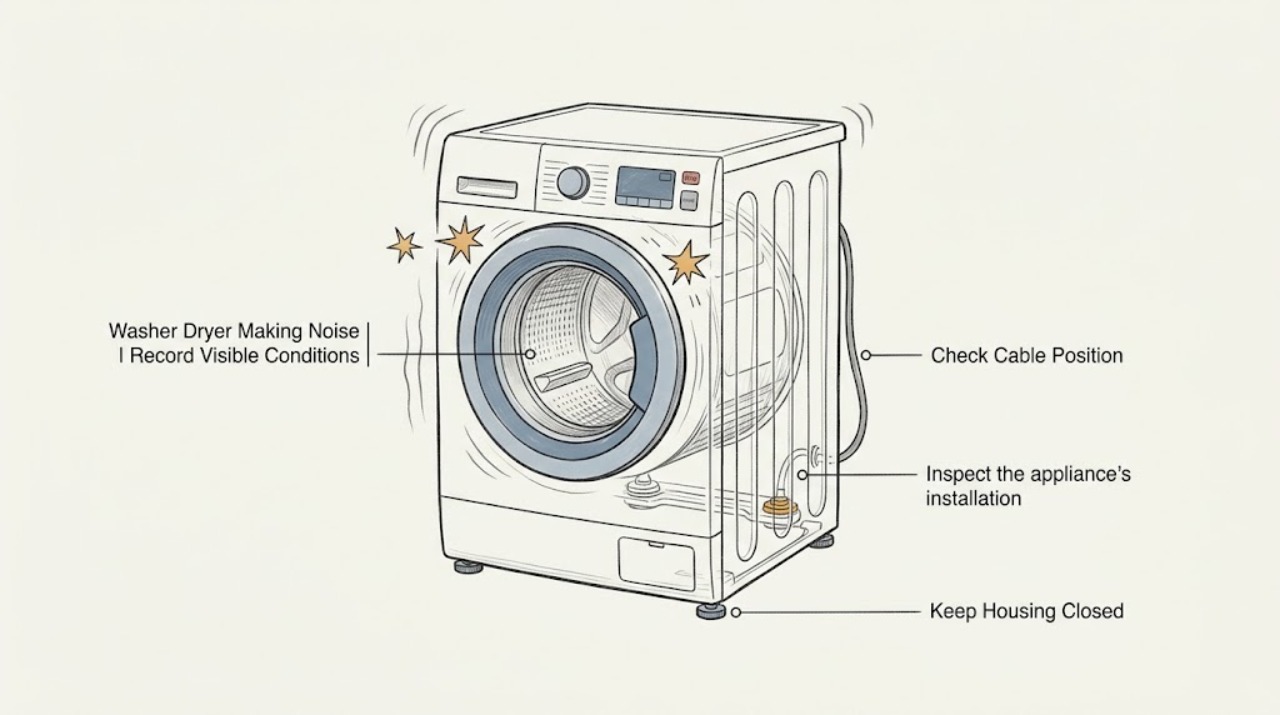
Stop the washer-dryer and record exactly when the sound occurs: filling, washing or tumbling, spin acceleration, steady spin, draining, or drying. Look and listen from outside the cabinet without putting hands into the drum or moving the appliance.
Expected result: The sound may be a brief water or pump hum, a repeated knock that follows drum rotation, a vibration that grows with spin speed, a scrape or grind, or a noise limited to the drying phase. Note whether the cabinet moves, a leak appears, or the sound changes with the load.
Next step: If there is no hazard, continue with the load and drum check. If the machine moves uncontrollably, leaks, smells burned, or makes a harsh metal-on-metal sound, stop using it and arrange qualified service.
Stop if: Do not keep running a washer-dryer that is violently shaking, scraping, leaking, or emitting a burning smell.
Why this matters
Why: A phase-specific sound separates load and installation checks from the drain-pump path and from a possible internal mechanical fault. Violent movement, scraping, grinding, a leak, or a burning smell is not a normal-load adjustment problem.
-
Check 2
With the programme stopped and the drum stationary, remove only obviously loose items from the drum and check the door seal and drum opening for a coin, fastener, wire, or other foreign object that can be safely reached. Redistribute a small or single heavy load evenly; do not overload the wash or drying capacity stated for your model.
Expected result: The load may be bunched to one side, too large for the selected cycle, very small and unable to balance, or accompanied by a loose object. The drum may be clear and the noise may remain with no laundry inside.
Next step: Correct only the load arrangement, remove a safely reachable foreign object, and run one suitable short cycle while observing from outside. If the noise remains or occurs with an empty drum, stop and continue to the installation and service branch.
Stop if: Do not pull on wires, pry the seal, or run another cycle to test a suspected object that is trapped behind the drum.
Why this matters
Why: Blomberg says misplaced, overloaded, or unbalanced laundry can create noise and vibration. A clear, balanced drum that still produces a repeated scrape or knock keeps a mechanical issue open and is not evidence that more laundry or more detergent will fix it.
-
Check 3
Inspect the appliance's installation from outside. Confirm it sits on a firm, level floor, all four feet appear to contact the floor, the cabinet is not touching a wall or other rigid surface, and any transit bolts or packing materials were removed if the noise began after installation. Do not use tools to loosen locking hardware unless the model manual explicitly permits and explains it.
Expected result: The appliance may rock when gently pressed at its upper corners, stand on an uneven floor, touch nearby cabinetry, or still have installation restraints. It may also be stable and correctly installed while the noise continues.
Next step: If the cause is obvious and safe, correct the external clearance or have the feet leveled according to the manual, then run one observation cycle. If the appliance is built in, heavy, difficult to move, or still noisy, arrange professional service.
Stop if: Do not drag a full appliance, lift it alone, loosen unknown hardware, or continue using it if hoses or the cord are strained.
Why this matters
Why: Blomberg's guidance links poor leveling, remaining transit hardware, rigid-surface contact, and an uneven or weak floor to movement, noise, and vibration. A stable installation with persistent noise points away from a simple leveling correction.
-
Check 4
If the noise occurs during draining, safely disconnect the washer-dryer from mains electricity before opening an accessible pump-filter area, following the model manual. Manage any water with a suitable container and cloth, then inspect only the filter and visible pump area for loose debris; do not reach into an energized appliance or dismantle the pump.
Expected result: The filter may contain lint or a small foreign object, the drain hose may be kinked or blocked, or the filter area may be clear. The sound may continue as a loud hum or rattle even after a permitted external blockage is removed.
Next step: Refit the filter securely only if the model instructions allow the check, reconnect power, and run one drain observation without reaching into the machine. If the noise persists, water does not empty, or a leak appears, stop and call qualified appliance service.
Stop if: Do not remove obstructions without disconnecting mains power, run the pump with its cover open, or continue if hot water or uncontrolled water release is possible.
Why this matters
Why: Blomberg treats unusual drain-pump noise and pump-area blockage as a separate drain path. A clear filter with persistent noise, a damaged pump, a hidden blockage, or a leak requires service rather than repeated drain cycles.
-
Check 5
Prepare a service handoff instead of opening the cabinet. Record the programme and phase, load type and amount, whether the drum was empty, whether the noise follows rotation or draining, installation age, leveling and transit-bolt observations, filter or hose findings, leaks, error messages, and whether the appliance moves.
Expected result: The pattern may be load-dependent thumping, installation vibration, drain-pump rattling, or a repeat scrape, grind, or knock independent of the load. It may also occur only during drying or after water remains in the drum.
Next step: Give the model and serial details plus the observations to Blomberg support or a qualified appliance technician. Keep the appliance out of use if the noise is harsh, worsening, associated with movement or leaks, or present with an empty drum.
Stop if: Do not remove panels, test the motor or bearings, bypass door safety, or operate with damaged wiring or a leaking hose.
Why this matters
Why: The pattern helps a technician decide whether to inspect balance and installation, the drain path and pump, or internal drum, motor, suspension, bearing, or dryer components. The sound alone does not identify a part or establish compatibility.
Use your observations
Decision map
Find the observation that best matches what you see, then follow the next safe action.
-
PATH 01Next step
What you see
The noise is a knock or vibration during spin, and it stops after the load is redistributed or reduced within the model's capacity.
Do this next
Use suitable load sizes and distribute laundry evenly; arrange service if the same noise occurs with normal balanced loads.
Why this path and its safety boundary
Why it matters: An unbalanced or overloaded load likely caused the symptom.
-
PATH 02Next step
What you see
The appliance rocks, contacts a rigid surface, or retains documented transit hardware, and the noise stops after a safe installation correction.
Do this next
Keep all feet stable and the cabinet clear of contact, then monitor future cycles.
Why this path and its safety boundary
Why it matters: Leveling, installation restraint, or cabinet contact likely caused the vibration.
-
PATH 03Next step
What you see
The noise occurs mainly while draining and a safely removed visible blockage restores normal draining.
Do this next
Refit the filter correctly, keep the appliance dry and stable, and call service if the noise or drainage problem returns.
Why this path and its safety boundary
Why it matters: A drain filter, pump-area, or hose obstruction may have caused the noise.
-
PATH 04Next step
What you see
The filter and visible drain path are clear but the pump still rattles or hums loudly, or water remains in the drum.
Do this next
Keep the appliance disconnected if safe and arrange qualified appliance service; do not dismantle the pump.
Why this path and its safety boundary
Why it matters: A hidden blockage, pump fault, or drainage problem remains possible.
-
PATH 05Next step
What you see
A scrape, grind, repeated knock, burning smell, leak, damaged cord, or violent movement remains after the external checks.
Do this next
Stop using the washer-dryer and arrange qualified service with the recorded phase and symptom pattern.
Why this path and its safety boundary
Why it matters: An internal mechanical, electrical, suspension, or water-system fault may be present.
-
PATH 06Next step
What you see
The noise occurs only during drying or cannot be located without removing a panel.
Do this next
Stop if the sound is new or harsh, and provide the exact programme and sound timing to a qualified technician.
Why this path and its safety boundary
Why it matters: The available Blomberg user checks do not identify the internal dryer or cabinet component safely.
Helpful context
Understand the symptom
The timing of the noise is the first clue
A low hum while filling or draining, movement and thumping at spin, and a scrape that follows drum rotation do not point to the same check. Run no more tests than needed to identify the phase. Stop immediately for grinding, a burning smell, a leak, a damaged cord, or movement that could pull on hoses or the electrical connection. A normal motor or pump sound can vary by programme, so the change from the machine's usual sound and the phase where it occurs matter more than a sound label alone.
Keep user checks external
The safe user checks are load distribution, visible foreign objects, stable leveling, removed transit hardware after a recent installation, clear external hoses, and the accessible pump filter when the manual permits it. Do not remove the cabinet, reach behind the drum, test a motor or bearing, or continue a cycle that is violently shaking. If a clean, balanced load on a stable appliance still makes a new or harsh noise, stop and arrange service rather than guessing at a part.
Safety boundary
Stop conditions
- Stop immediately for a burning smell, smoke, sparking, damaged cord or wiring, a water leak, violent movement, or grinding or scraping that worsens.
- Do not reach into the drum, pump, or cabinet while the appliance is connected to mains electricity or able to start.
- Do not remove panels, test the motor, bearings, suspension, wiring, or heating and drying components, or bypass the door lock.
- Stop after one safe load, installation, or permitted filter correction if the noise remains or occurs with an empty drum; arrange professional service.
Only after diagnosis
Potential parts
- drain pump or pump filter assembly
Consider only if a technician confirms that persistent drain noise or poor emptying is caused by the pump after the filter and hose path are clear.
Confirm the complete model and pump specification; unusual noise alone does not identify a compatible pump. - suspension or shock absorber assembly
Consider only if professional testing finds an internal suspension fault after load balance, leveling, floor, and transit-hardware checks are excluded.
Verify the exact model and installation configuration before selecting a part; do not open the cabinet as a user check. - drum bearing or drum support
Consider only if a technician confirms a rotation-dependent rumble, grind, or play that is independent of load and installation.
A sound description does not prove bearing failure or fit; use model-specific service diagnosis.
When checks do not resolve it
Need a professional?
The washer-dryer still makes a new or harsh noise after a balanced load and stable, level installation., The appliance moves violently, leaks, has a damaged cord, smells burned, or makes a scrape or grind., A drain-pump noise remains after the permitted filter and visible hose checks, or water does not empty., The noise occurs during drying, requires cabinet removal to investigate, or suggests a motor, bearing, suspension, pump, or electrical fault.
Safety scope: Keep the appliance out of use for harsh noise, violent movement, leaks, burning or electrical signs, or persistent noise with an empty drum. Do not remove panels, bypass the door lock, handle live wiring, or test the motor, bearing, suspension, pump, or dryer components.
Common questions
FAQ
Why is my Blomberg washer-dryer noisy during spin?
Check whether the load is bunched, overloaded, or too small to balance, then inspect leveling, floor stability, cabinet contact, and transit bolts if the appliance is new. If the noise remains with a normal balanced load or the machine moves violently, stop using it and arrange service.
Can an uneven load cause a Blomberg washer-dryer to make noise?
Yes. Blomberg says misplaced or overloaded laundry can cause noise and vibration, especially during spin. Stop the programme, redistribute the load within the model's capacity, and monitor one cycle; recurring noise with balanced loads needs a professional check.
What should I check if the noise comes from the drain pump?
If the machine is not emptying or the noise is tied to draining, disconnect it from mains electricity before opening an accessible filter area, manage the water, and inspect only the filter and visible pump area as the model manual permits. Persistent noise, a clear filter with poor draining, or a leak needs service.
When should I stop using a noisy Blomberg washer-dryer?
Stop for grinding, scraping, violent movement, a burning smell, smoke, sparking, a leak, a damaged cord, or noise that remains after safe load and installation checks. Do not remove panels or test internal parts; arrange qualified appliance service.
Read the exact guide
Official sources
- User’s ManualBlomberg · Blomberg washer-dryer manual guidance on stable installation, load balance, noise, vibration, and troubleshooting
- My new washing machine/washer dryer is shaking, what should I do?Blomberg · Blomberg washer-dryers with shaking, load-balance, installation, or excessive-noise symptoms
- Water from my Blomberg washer dryer is not emptying, what should I do?Blomberg · Blomberg washer-dryers with drain-pump noise, filter or hose blockage, or water remaining in the drum
Community feedback
Share a repair observation
Share a plain-text repair observation. Accepted observations are published automatically; this page may take a moment to update.